
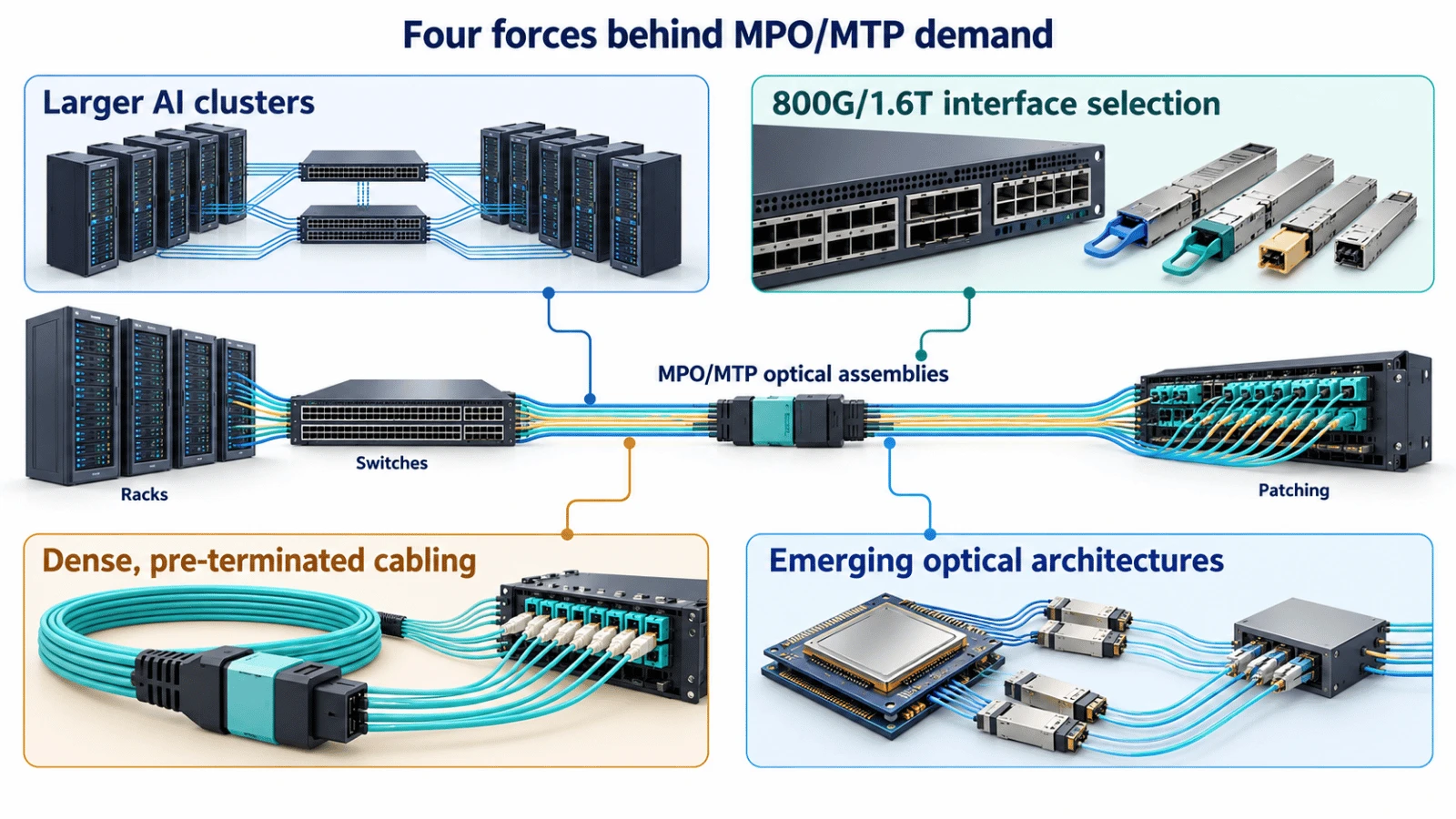
MPO/MTP market demand is being driven by four connected changes: larger AI clusters, upgrades to 800G and 1.6T networking, denser racks that need repeatable installation, and new optical architectures such as co-packaged optics.
The opportunity extends beyond selling more connectors. Buyers need assemblies that match the equipment, arrive with useful test records, and remain manageable after installation.
MPO is a multi-fiber connector family. MTP® is US Conec's branded MPO implementation, as explained in its official MTP connector documentation. For a detailed component comparison, see Glory Optical's MTP vs MPO engineering guide. Here, the focus is demand, deployment constraints, and purchasing decisions.
Why are AI data centers increasing demand for MPO/MTP cabling?
AI clusters require high-bandwidth connections between servers, switches, and storage. When deployments expand, the optical links and their passive cabling must expand with them. MPO/MTP assemblies serve many parallel-optics connections and structured backbones used to organize those links.
The strongest market evidence comes from procurement commitments. In January 2026, Meta and Corning announced a multiyear agreement worth up to $6 billion for optical fiber, cable, and connectivity supporting data center construction. This covers a broad optical infrastructure portfolio; it is not a measurement of the MPO connector market.
A second signal is the NVIDIA–Corning manufacturing partnership announced in May 2026. Its planned expansion connects AI infrastructure demand with manufacturing investment in optical connectivity.
For purchasing teams, these announcements establish direction. An actual cable order still depends on the released switch and transceiver list, rack layout, and construction schedule. Cabling within a data hall should also be distinguished from connections between campuses: the optical architecture and connector requirements can differ.
Glory Optical's data center fiber cabling solution provides a practical route from those project inputs to trunks, patching hardware, labels, and agreed delivery documentation.
Glory product to consider: MPO 12 Fiber Cable
 |
Recommended use: A configured 12-fiber backbone or patching assembly where the approved design calls for this arrangement. The product page describes an OS2 version and project configuration options, making it a useful starting point for a rack-to-rack cable schedule. Confirm before ordering: Fiber mode, connector polish, pin configuration, polarity, route length and jacket designation. The photograph does not establish compatibility with a particular 800G or 1.6T module. |
Do 800G and 1.6T networks always need more MPO fibers?
No. Data rate alone does not determine fiber count or connector format. Higher bandwidth can come from more parallel optical lanes, a faster lane rate, wavelength multiplexing, or a combination. The selected transceiver determines the equipment-side cable interface.
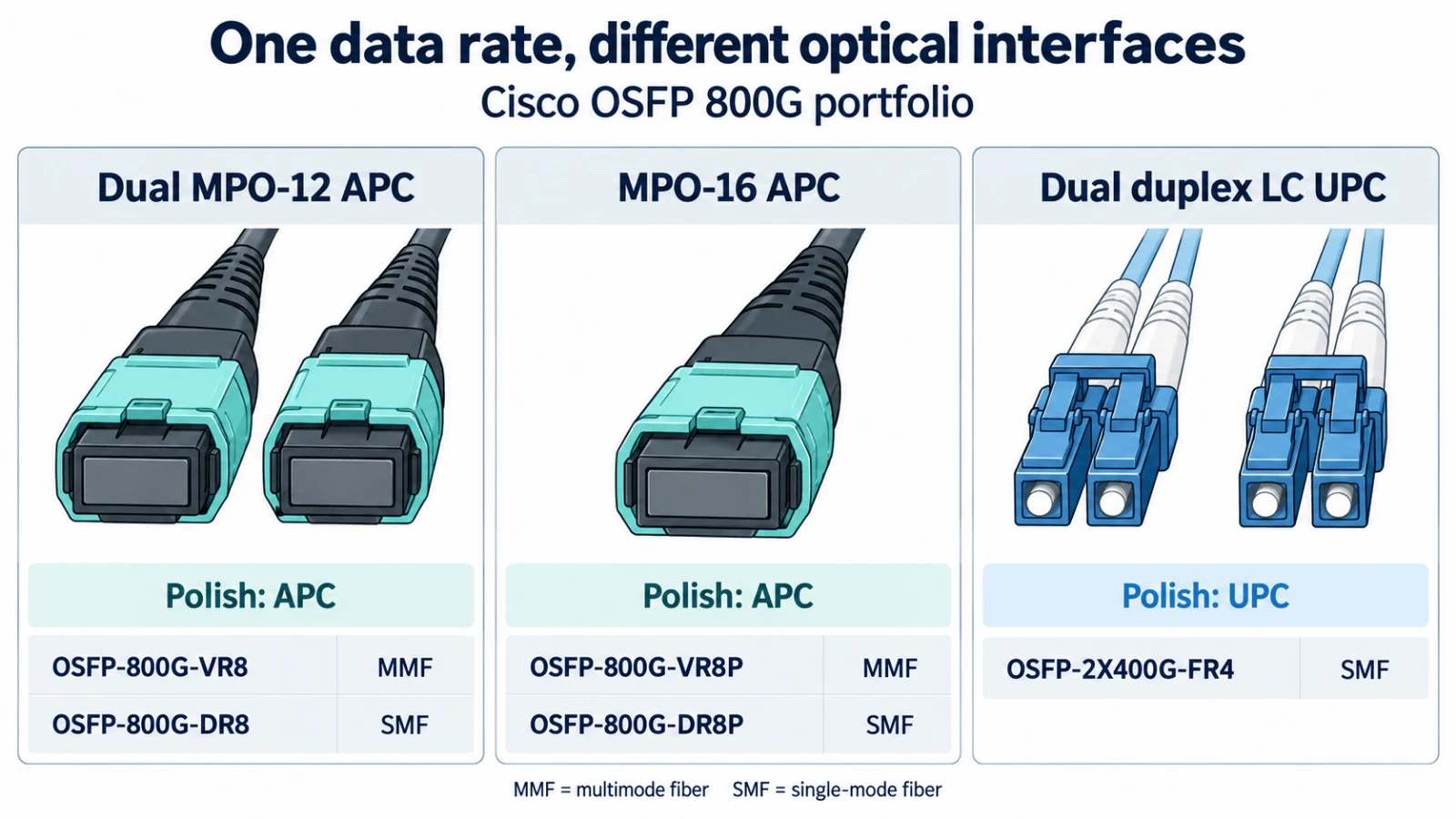
For this article, we reviewed five products in Cisco's OSFP 800G transceiver data sheet, updated January 5, 2026. The comparison reveals three connector arrangements within one 800G-class portfolio:
| Cisco model | Fiber medium | Equipment-side optical interface |
|---|---|---|
| OSFP-800G-VR8 | Multimode | Dual MPO-12 APC |
| OSFP-800G-VR8P | Multimode | MPO-16 APC |
| OSFP-800G-DR8 | Single-mode | Dual MPO-12 APC |
| OSFP-800G-DR8P | Single-mode | MPO-16 APC |
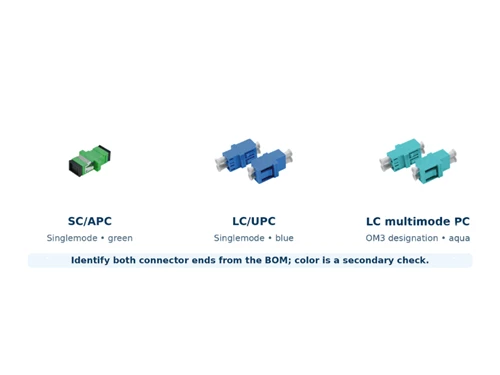
| OSFP-2X400G-FR4 | Single-mode | Dual duplex LC UPC |
Method: manual comparison of the optical-connector column and individual product descriptions. This is a small, purpose-selected documentation sample, not a market-share estimate or a Glory factory test.
The purchasing implication is immediate: specifying an "800G MPO cable" leaves critical decisions unresolved. These multimode MPO examples also require APC, so fiber mode alone cannot be used to infer connector polish. Cisco identifies the listed MPO module ports as pinned and requires unpinned mating cable ends.
NVIDIA's interconnect guidance similarly distinguishes MPO-12/APC for XDR DR4-based optics from duplex LC for FR4. Newer networking therefore creates demand for correctly configured assemblies, without implying that every generation needs a larger MPO ferrule.
For channel design beyond this market overview, use Glory's AI data center fiber cabling guide. Freeze the exact module interface and lane map before releasing the passive cabling BOM.
Glory product to consider: MTP to LC Breakout Cable
 |
Recommended use: An approved multi-fiber-to-LC distribution route where individual fibers must reach specified LC ports. Glory's page presents single-mode harness options with four or six LC duplex branches. Confirm before ordering: Branch count and length, end-to-end lane mapping, connector brand, pin configuration and polish at each end. A passive harness routes fibers; it does not convert a parallel-optics signal into a wavelength-multiplexed FR4 interface. |
How does pre-terminated MPO cabling help dense data centers?
Pre-termination moves connector assembly and specified factory checks ahead of site installation. Multi-fiber connections can also consolidate patching where the architecture supports them. Their value depends on correct configuration, accessible routing, and a workable commissioning process.
Density is only useful when technicians can inspect ports, handle connectors, follow labels, and replace a failed assembly. A tightly packed panel that obstructs access can turn a compact design into a maintenance problem. Panel selection should therefore consider service access alongside front-port count.
Labor availability adds pressure. LinkedIn's February 2026 data center workforce report identifies shortages in physical infrastructure skills, including cabling, racking, and network hardware. That supports planning for repeatable installation and clear documentation, rather than assuming specialist labor will always be available at turn-up.
A useful procurement practice is to divide delivery into rack or installation-zone kits. Each kit can carry its cable schedule, port identifiers, approved mapping, and associated reports. The site crew then receives a defined installation task instead of a box of similar-looking assemblies. This is a workflow recommendation, not a measured labor-saving claim.
Glory's MTP/MPO assembly range is a starting point for product selection. Lengths, connector configuration, labels, and documentation should be agreed for the project. Factory inspection still needs to be followed by appropriate installed-channel verification.
For the purchase-order fields behind that workflow, see Glory's pre-terminated MPO/MTP procurement guide. Use the approved configuration sheet to keep production, packing and site acceptance aligned.
Glory product to consider: GL-07 MPO Fiber Distribution Box
 |
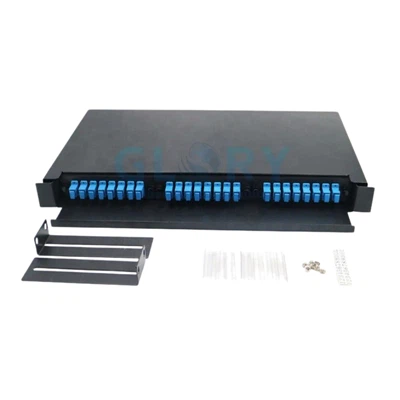
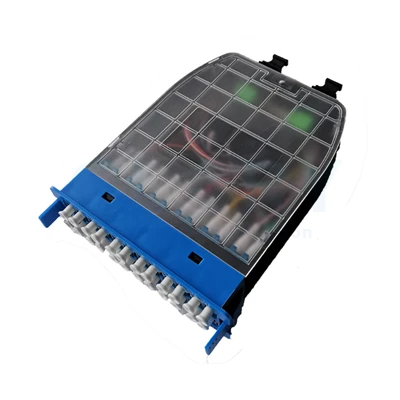
Recommended use: MPO-to-LC distribution at an approved patch-panel or rack position. The published GL-07 layout provides two MTP/MPO adapter positions and twelve LC duplex adapters, with a maximum capacity of 24 fibers. Its translucent cover provides a view of the internal fiber arrangement. Confirm before ordering: Build variant, adapter arrangement, port map and fit in the intended panel. Adapter quantities, LC port count and fiber capacity are separate fields; they do not define an active optical interface or an inspection result. |
Will CPO replace MPO/MTP connectors?
CPO changes where optical engines sit; it does not remove the need to connect and manage fibers. The connector opportunity becomes architecture-specific. Existing MPO/MTP infrastructure, other external connector formats, and precision connections inside equipment can have different roles.
NVIDIA's Spectrum-X Ethernet Photonics description explains the use of co-packaged optical engines and detachable fiber connectivity. Corning's CPO overview describes fiber-array harnesses and fiber-management systems within the deployment architecture.
For a passive cabling supplier, this creates opportunities in routing, connectorized assemblies, and serviceable fiber management. It does not establish that ordinary MPO products can serve every interface inside a CPO switch. Internal optical-engine connections and external patching need their own qualification and specifications.
There are also adoption constraints. TrendForce's June 2026 analysis identifies manufacturing yield, serviceability, connector standardization, and laser supply as challenges. These affect the pace and mix of deployment.
Buyers should ask whether an announced connector belongs at the optical engine, the switch faceplate, or the structured backbone. Before choosing a different external format, consult Glory's MMC vs MPO/MTP comparison. A connector roadmap is most useful when its position in the channel is clear.
What can prevent a factory-tested MPO link from working?
A factory-tested assembly can still enter a channel with the wrong mapping, become contaminated during handling, or be measured with a deteriorating reference cord. Public installer discussions expose these operational gaps, although they cannot establish industry-wide failure rates.
A May 2026 Reddit discussion about data center connector cleaning describes pressure to commission racks quickly while inspection still detects contamination. A commenter also reports increasing loss readings during repeated MPO testing and suspects the test cord. The lesson is to verify the inspection and measurement setup before assigning every rising loss result to the installed cable.
An April 2026 Reddit discussion of MPO-to-LC cassettes raises polarity mistakes and the support burden of introducing unfamiliar cassette configurations. Publicly indexed LinkedIn posts from Geoff Laycock and Shardul Pandya also discuss polarity control and consistent operating records. These are qualitative practitioner signals, not verified outage statistics.
The following procurement controls translate those concerns into deliverables:
| Observed concern | Recommended control |
|---|---|
| Assembly passes optical testing but the channel will not link | Approved end-to-end lane map and independent polarity verification |
| Cleaning repeatedly delays turn-up | Compatible inspection equipment, connector-specific cleaning procedure, and re-inspection |
| Loss readings rise across a testing session | Check reference cords and the reference procedure before repeating channel measurements |
| Technicians cannot identify suitable spares | Configuration-specific part numbers, readable labels, and an agreed spare list |
IEC 61300-3-35:2022 provides the authoritative reference for connector end-face inspection. Its public description explicitly distinguishes visual inspection from attenuation and return-loss measurements. Acceptance needs the agreed evidence for both condition and optical performance.
Fluke Networks' MPO cleaning and inspection guidance calls for checking the end face after cleaning and using an APC-compatible inspection tip for APC connectors. Its MPO test-method white paper also shows why pin configuration and the permanent-link or channel boundary affect the measurement setup. Record the chosen method with the result so the number can be interpreted.
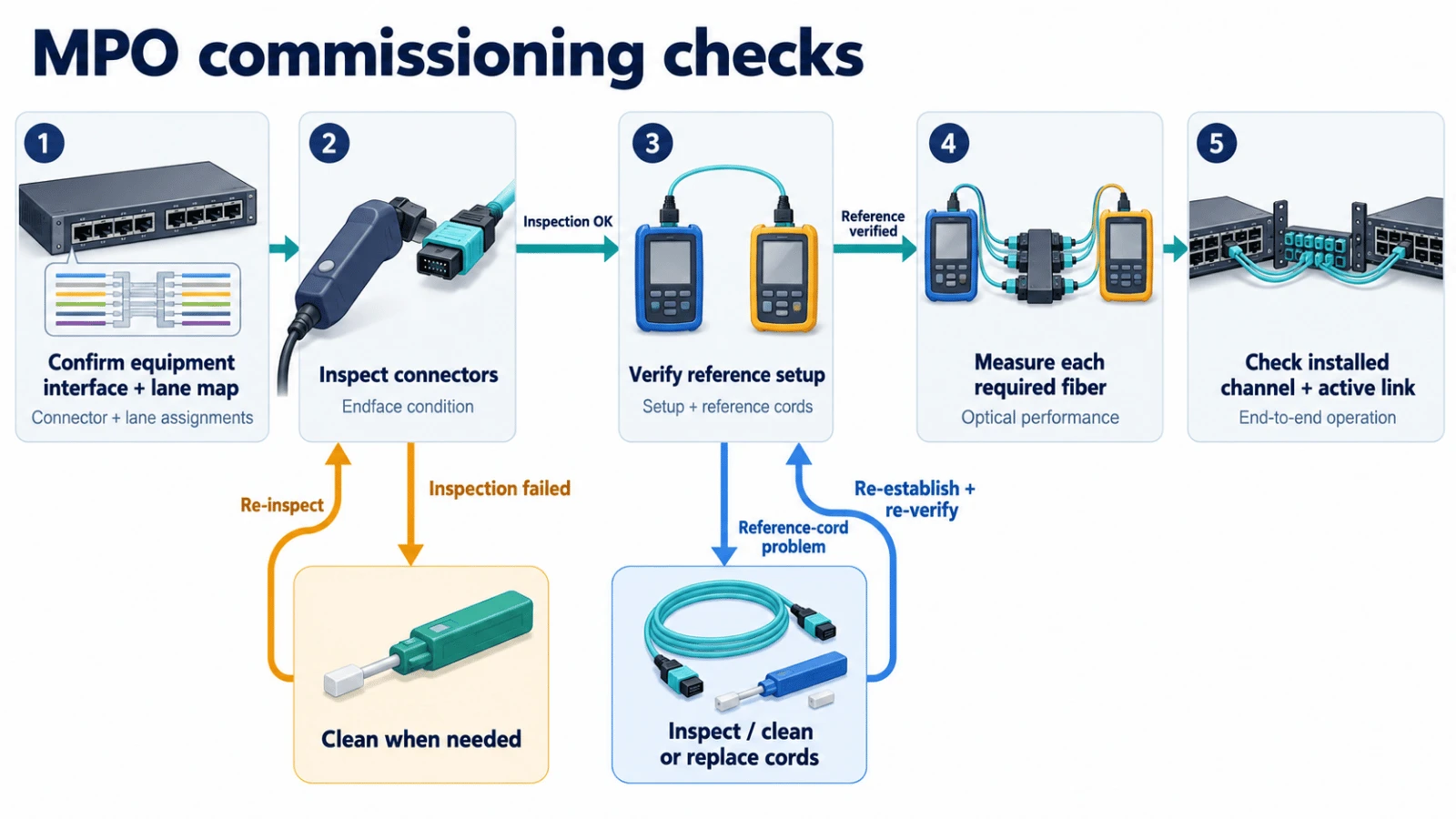
For the corresponding installation practices, use Glory's MPO patch cord and polarity guide and connector cleaning guide when preparing the site procedure.
Glory product to consider: MPO Fiber Patch Cord
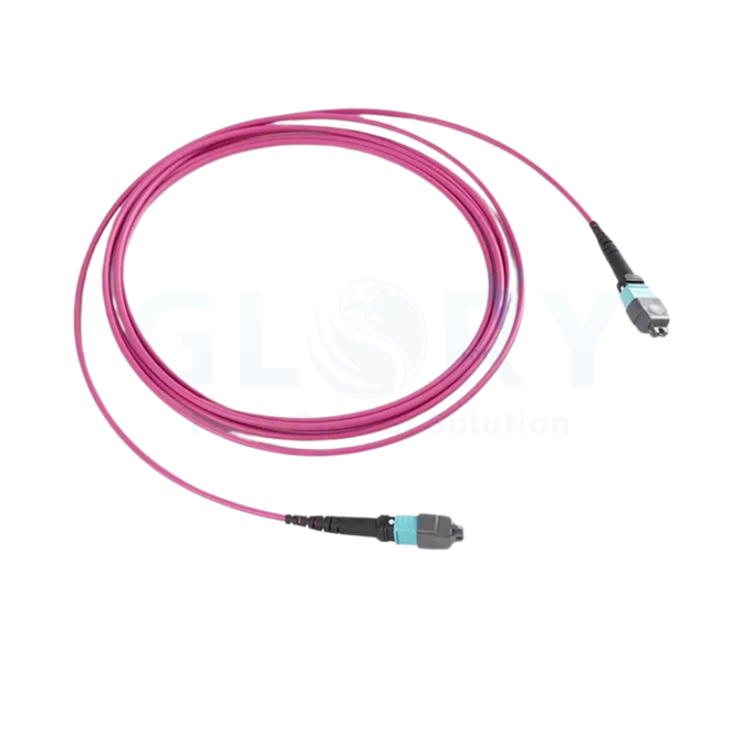 |
Recommended use: A replacement or equipment-patching candidate for an approved 12-fiber OM4 channel. The product page identifies a female-to-female MPO configuration; this gives the spare list a defined starting point rather than the vague description "MPO cable." Confirm before ordering: The approved channel's polish, polarity, pin requirements, length and loss limits. This catalog patch cord should not be assumed to be a test reference cord; that role requires the test-equipment manufacturer's specified cord and reference procedure. |
What is the MPO/MTP market outlook for 2027–2030?
Our base-case outlook is continued demand for high-density optical assemblies, with a changing mix of interfaces and stronger expectations for documentation. This is a qualitative assessment as of October 2026, not a numerical MPO market forecast.
TrendForce's April 2026 optical-transceiver assessment identifies growing demand for 800G-and-above optics and a developing 1.6T supply chain. That is evidence about the wider optics market. It cannot be converted directly into MPO revenue or unit shipments because interface choices and reuse vary.
| Period or scenario | Assessment | Procurement implication |
|---|---|---|
| 2027 base case | Confirmed AI builds and network refreshes sustain demand for qualified parallel-optics and backbone assemblies | Tie orders to approved equipment and construction milestones |
| 2028–2030 base case | Pluggable optics and newer architectures coexist; connector requirements become more varied | Qualify assemblies by interface and channel role |
| Faster deployment | More completed AI fabrics accelerate cabling releases | Secure capacity for the released configuration and test package |
| Slower deployment or greater reuse | Delays, reused trunks, and alternative interfaces moderate new connector purchases | Keep forecasts flexible and inventory configuration-specific |
The useful leading indicators are released optical-module BOMs, accepted cabling samples, and scheduled fabric commissioning. Announced investment provides context; these project milestones are closer to a cable order. Suppliers should also monitor the interface mix and approval requirements, rather than treating every new optical port as the same passive product.
For Glory Optical, the practical opportunity is a repeatable supply offer spanning approved configurations, traceable test results, labels, and replacement assemblies. Its data center cabling portfolio provides the product context; future availability and project-specific qualification should be confirmed before an order is placed.
Reuse is another purchasing variable. Glory's MPO trunk reuse guide for 400G/800G addresses the configuration and channel checks that should precede a reuse decision.
Glory product to consider: MPO Conversion Trunk Cable
 |
Recommended use: A configuration-review candidate where a cabling plan calls for one MPO/MTP-24 connection routed to two MPO/MTP-12 connections, as described on Glory's trunk product page. The fiber map must be approved for the intended channel. Confirm before ordering: Fiber mode, active-fiber assignments, polarity, polish, connector pin configuration and the specified loss limits. A conversion assembly changes fiber routing; it does not increase an optical module's data rate or divide one optical signal like a power splitter. |
What certification and test evidence should MPO/MTP buyers request?
Buyers need evidence at three levels: the supplier's management system, the delivered assembly, and the installed channel. A management-system certificate cannot replace product or channel acceptance.
Glory publishes ISO 9001:2015 quality-management documentation on its company page. The certificate holder, issuing body, scope, and current validity should be checked against the document supplied for procurement. This article does not independently authenticate that certificate.
The ISO/IAF explanation of ISO 9001 certification distinguishes quality-management certification from certification of the product itself. Also check the applicable edition and transition status: ISO's current standard page lists ISO 9001:2026, while Glory's public documentation identifies the 2015 edition.
For the assembly, request an approved configuration sheet, per-fiber insertion-loss results under stated test conditions, polarity verification, return-loss results where applicable, agreed inspection records, and identifiers that connect the cable to its report. When genuine MTP components are specified, confirm component identification in the BOM. A brand name by itself does not define the acceptance limits.
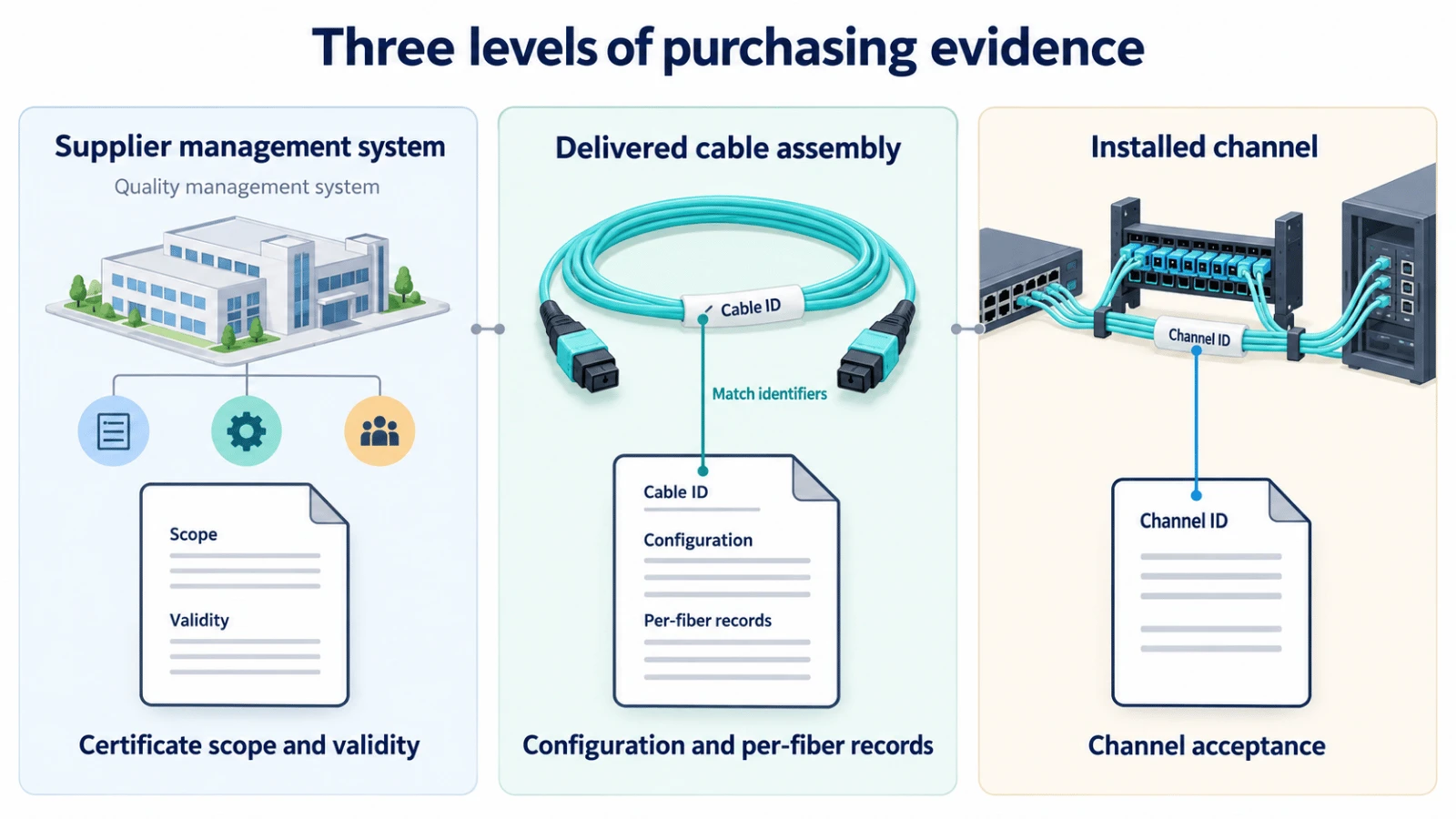
Glory's OEM/ODM documentation and project support and its published data center solution describe configurable testing and traceability options. Agree the required fields before production. After installation, verify the completed channel and the active link with the intended equipment under the project's acceptance plan.
To request a configuration review, send Glory the switch and optical-module list, port schedule, route lengths, rack or panel layout, fiber and interface requirements, desired labels, and required report format. Use the data center project request to turn those inputs into a reviewable quotation.