
Zayo completed its purchase of Crown Castle's fiber solutions business on May 1, 2026, taking on about 90,000 route miles of metro-dense fiber. AT&T's closing announcement for Lumen's mass-markets fiber business, dated February 2, 2026, put the acquired footprint at more than 4 million customer locations and more than 1 million fiber subscribers. The first number describes how far a network reaches. The other two show how many addresses can be served and how many of those already buy service. (Zayo · AT&T)
Two readers will see those headlines on the same morning. A data center network planner wants to know whether the newly acquired routes give a campus a second, independent way in. A regional broadband engineering manager wants to know which neighborhoods are under construction and which homes are about to take service for the first time. The news is the same, and the engineering document each reader needs next is different. On the residential side this analysis concentrates on Fiber-to-the-Home (FTTH), the member of the FTTx family that runs fiber to the residence itself, because that is where the public evidence is strongest. Market information is current to November 18, 2026.
What a Fiber Acquisition Actually Transfers
On the day a deal closes, some assets already exist and some work has only just become possible. The two headline deals show how different the transferred assets can be.
Zayo's purchase covered about 90,000 route miles and 40,000 on-net enterprise locations, which lifted its North American network to 224,000 route miles. Crown Castle's small cells business went to a separate buyer, EQT's Arium Networks, and Zayo agreed to supply fiber to Arium under a long-term commercial agreement. AT&T bought substantially all of Lumen's mass-markets fiber business for $5.75 billion in cash, which brought a residential network and its customers together. One deal moved metro and enterprise routes between operators, and the other moved distribution plant along with a subscriber base. A materials buyer needs to know which layer changed hands before reading anything further into the headline.
Three metrics in these announcements are easy to misread.
| Metric | What it measures | What is still missing for a materials estimate |
|---|---|---|
| Route miles | Length of physical paths. Cables along one route can hold different fiber counts. | Fiber count per segment, spare strands, splice locations, share of aerial and buried plant |
| Locations passed | Addresses the network could serve. | Number of terminals and ports, drop lengths, construction method in each area |
| Subscribers | Customers already buying service. | Gross installs, cancellations, reusable drops, planned first-time installs |
Each metric answers one question and leaves another open. A cable, terminal, or drop-material estimate still needs the items in the right-hand column. Glory's guide to fiber demand across FTTH, DCI and data center cabling compares the purchasing signals at each network layer.
Clearwave's agreement with Ting shows how one announcement can carry several different numbers. On November 17, 2026, Clearwave said it will acquire Ting's owned fiber networks, which it describes as reaching approximately 170,000 homes and businesses, with closing expected in the first quarter of 2027. Ting's open-access partner markets and Ting Mobile stay outside the deal. In its filing with the SEC, Tucows disclosed nominal cash consideration and about $301.5 million of securitized notes, measured at September 30, 2026 balances, that remain with the acquired entity and are non-recourse to Tucows. The 170,000 figure is the buyer's description of footprint, the debt figure describes the seller's balance sheet, and neither release says what the new owner will spend on construction. (Clearwave · Tucows, SEC)
Data Center Interconnect: Which Routes Still Need to Be Built?
Picture two data centers, A and B, that both appear on a carrier's network map after an acquisition. The map shows the routes between them. The engineering team still needs to check what lies in between.
2.1 When existing fiber can carry the new service
A planner starts by checking whether the campus is already connected, whether unused strands remain along the way, and whether the existing transport equipment can meet the capacity requirement. If the route and the strands can carry the new service, the work may amount to lighting spare fibers, adjusting patching, or adding transport equipment. Bandwidth can grow on lines that are already built. Zayo's own announcement describes the acquisition as adding on-net access, route diversity, and capacity in key markets for customers, which is the kind of claim a planner can test against route records. The practical request is a route diagram that shows fiber counts, which strands are free, and what equipment sits at each end.
2.2 When a second route has to be physically separate
Consider a hypothetical case. Carrier X and Carrier Y descend from different historical operators, and each sells a circuit between campus A and campus B. Both circuits enter the campus through the same stretch of conduit, assumed here to be 600 meters long, before they separate. After a merger the route table shows two lines, and a single excavation at the shared section can still interrupt both. A planner would check how long the shared section is, where a second building entrance could go, and which short segment would need new construction. Those answers lead straight to outdoor cable, splice closures, splice trays, and termination hardware.

Hypothetical illustration. "Which operator owns the circuit" and "where the cable physically runs" are two separate attributes, and each needs its own verification.
2.3 What Zayo's expansion plan adds to the evidence
Zayo's two disclosures sit on one timeline. The May 1 closing brought about 90,000 route miles of existing network. On August 20, Zayo announced a supply arrangement with Corning that it said secures a major portion of the fiber optic cable needed for its long-haul expansion through the remainder of the decade, and that supports its plan to add 15,000 new route miles by 2030. The same release cites more than 8,000 miles of new long-haul fiber built with NVIDIA.
The second announcement adds information the first lacked: a construction horizon, a planned mileage, and the fact that supply for much of the cable was arranged early. It gives no contract term and no quantity. The release also speaks about fiber optic cable, and says nothing about closures, splice hardware, or termination equipment. A supplier reading it would ask which parts of the build are still to be awarded, and which materials already sit under a supply agreement.
Zayo's acquisition release also argues that AI workloads are shifting from centralized training toward distributed, latency-sensitive inference, and presents that shift as the reason for the added metro reach. That is the company's own framing of demand. A planner still has to confirm, campus by campus, that the metro routes actually reach the buildings in question. (Zayo acquisition release · Zayo–Corning supply agreement)
From the Campus Entrance to the Rack: Who Specifies the Fiber?
Follow one cable from the street into the machine room and the same project turns out to have three sets of drawings. Outdoor closures and indoor pre-terminated assemblies are approved by different people, checked against different documents, and often ordered by different companies.
| Where | Engineering question | Documents procurement should confirm |
|---|---|---|
| Campus entrance | Where does outside plant enter the campus or building? Are the primary and backup entrances separate? Where does the carrier hand over to the campus owner? | Entrance route drawing, cable type and fiber count, splice locations, construction scope of each party |
| Building termination and distribution | Where does the outside cable terminate, and how does it connect to the building's backbone and patching system? | Termination capacity, rack space, labeling rules, phased delivery schedule |
| Inside the data hall | How do port speed, connection density, link length, and loss budget shape pre-terminated trunks, MPO components, and patch modules? | Port table, connector and polarity scheme, length list, test and acceptance requirements |
The third row is where pre-terminated products come in. A Corning guide to pre-terminated cabling, which is vendor-authored material, notes that trunks and harnesses are mostly made to order, so cable lengths have to be measured correctly, and that changes are harder once fibers are factory-terminated. The same guide lists polarity as a known problem when legacy and new components are mixed, and says a detailed planning phase is needed because the floor plan has to be settled before assemblies are ordered. For a buyer, that moves the length list and polarity scheme to the front of the paperwork. Glory's 400G/800G MTP/MPO cabling guide covers loss budgets and BOM planning. Its MPO trunk cable specifications give the buyer an assembly reference.
Meta and Corning offer a side case on how large data center buyers plan supply. In January 2026 they announced a multiyear agreement worth up to $6 billion, covering optical fiber, cable, and connectivity products for U.S. data center buildout. It shows a large buyer arranging capacity ahead of construction. It is a standalone procurement case, and the ceiling spans several product categories, so no share of it can be assigned to MPO assemblies or patch panels. (Corning and Meta · Corning pre-terminated cabling guide)
FTTH Expansion: What Gets Built Before the First Home Connects?
Start with a street the network has not reached yet. When a regional ISP announces new coverage in several counties, the first orders appear in the distribution layer, well before any household signs up.
4.1 Follow the feeder, distribution, and drop segments

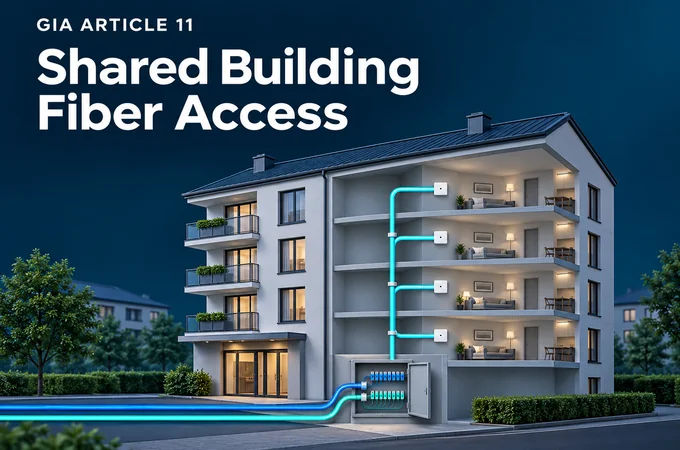
Simplified FTTH path. Splitters may sit in the central office or out in the network, depending on the design.
The FOA's FTTH design guidance describes the same sequence and notes that splitters can be centralized in the central office or distributed in a pedestal, distribution hub, closure, or building. Centralized designs use more fiber and give every subscriber a dedicated strand back to the office, while distributed designs use less fiber and may leave some OLT ports partly filled. What determines quantity differs by segment. Feeder and distribution cable depend on the actual route, fiber count, and topology. Terminals depend on how service addresses are spread out and on port planning. Drops depend on how each home is actually connected.
The loss budget also shapes where splitters go. The FOA points out that each 2:1 split costs about 3 dB plus excess loss, that cascaded ratios cannot multiply beyond 32, and that the total has to fit the PON power budget, which it gives as 13 to 28 dB for GPON with a 32-way split. A design that puts splitters near clusters of subscribers shortens drops, and one that centralizes them keeps passive hardware in the office. Either choice changes the closure and terminal list. (FOA FTTH design)
4.2 Use Omni Fiber to distinguish planned coverage from active construction
Omni Fiber announced its acquisition of Citizens Fiber on June 1, 2026, and said it plans to add nearly 200,000 locations across six counties of western Pennsylvania: Fayette, Indiana, Lawrence, Mercer, Washington, and Westmoreland. The announcement gives no timeline for that total. Omni's service-area page then sorts cities into three states: Now Available, Under Construction & Partially Available, and Under Construction & Coming Soon.
On November 18, 2026, the page listed Greensburg as Under Construction & Coming Soon and New Castle as Under Construction & Partially Available. Greensburg illustrates the distribution build that precedes service. New Castle shows that one city can hold neighborhoods still being built beside others where installations have begun. City-level status does not describe individual streets, and the page can change, so any citation should carry its date. (Omni announcement · Omni service areas)
4.3 Show how the construction method changes the bill of materials
Take two neighborhoods with the same number of service addresses, one served by overhead plant and one by underground plant. The overhead plan has to confirm poles, down-guy or drop attachment points, and fastening methods. The underground plan has to confirm conduit, handholes, splice locations, and whether the buried environment suits the closure. The FOA notes that aerial construction is generally cheaper and easier, that closures and drop hardware can mount on poles or messenger wires, and that underground handholes house splitters and drop closures. Both neighborhoods can serve the same number of homes while needing different closure mounting, different hardware, and different quantities. That is the natural point for product selection, for instance when comparing dome and inline closures or choosing a distribution box for the area.
FTTH Take-Up: What Changes When the Network Already Passes the Home?
The previous chapter explained how fiber reaches a street. This one asks which materials get used when 100 more households on that street order service.
5.1 Why AT&T cares about penetration in the acquired footprint
Return to AT&T. The acquired Lumen network had more than 4 million customer locations and, at closing, penetration of roughly 25%, consistent with more than 1 million subscribers. AT&T said it expects to use its distribution, the strengths of AT&T Fiber, and the AT&T Guarantee to move penetration toward levels closer to its own fiber penetration, and it gave no target figure or timeline. In engineering terms, growth can come from new installations in communities that are already built, or from reactivating homes with a drop already in place. The two cases generate different amounts of field work. (AT&T closing announcement)
5.2 Turn one percentage point into a worked example
A small calculation makes the point concrete. If the footprint stays fixed at 4 million locations, a rise of one percentage point in penetration equals about 40,000 net new subscribers (4,000,000 × 0.01). That is an illustration only, since AT&T has set no such target. The split inside that net number changes the order. If all 40,000 homes needed a new drop, the drop order would be 40,000 kits. If half of them could reuse an existing drop, the first-time drop volume would be about 20,000 even though the net number is unchanged.
The number is easy for a buyer to misuse. Net subscriber growth compares customers at the end of two periods. Installations, moves, and cancellations during the period can add up to more than the net figure, and some addresses already have a drop that can be reused. To estimate materials, ask for three kinds of work orders: first-time drop placement, reactivation of an existing line, and replacement of an old drop.
5.3 Follow one installation from the terminal to the home
Three short scenarios show how the bill of materials changes.
- First-time aerial drop. From the street terminal to the outside wall, check the drop cable length, the fastening hardware, the exterior termination box, and the indoor termination point against the project plan.
- Reactivating an existing drop. First confirm that the old line is usable and that a port is available. The materials may be limited to connections, termination, or a small local replacement.
- A cluster of new customers on one terminal. When free ports run out, an ordinary home installation may first trigger extra capacity at the street terminal. The purchase then grows from a single-home kit to splitter terminals or a small distribution job.
The FOA's installation guidance adds practical detail. Drops usually carry one or two fibers and are often factory-terminated, re-enterable closures allow drops to be added later, and splice-on connectors are commonly used for termination on site. Buried drops are best routed near driveways to reduce later digging damage, and installers should locate underground utilities beforehand. (FOA FTTH installation) Glory's GL-FTB-10E pre-connectorized access terminal is one example of where the subscriber drop connects.
After the Deal, Who Approves the Parts and Who Places the Order?
A merger announcement names a buyer. The person who approves a part and the person who places an order can be entirely different organizations, and one purchase can involve a buyer, a network owner, a specification author, and an ordering party. Two scenarios make that visible.
Data center scenario. A carrier may be responsible for the public route, the campus owner may define the building entrance and handover point, a cabling designer may specify the connection system inside the hall, and a general contractor or integrator may place the order. Track one component through that chain. A fiber distribution frame in the carrier's meet-me area and the same frame in a customer's machine room can have different approvers and different people accepting the work.
FTTH scenario. T-Mobile's fiber joint ventures show a split between brand and network. Announced on April 28, 2026, they are two 50/50 partnerships: one combines Oak Hill Capital's GoNetspeed and Greenlight, and the other acquires i3 Broadband with Wren House. The fiber companies build and operate the networks, while T-Mobile provides its brand, distribution, and customer experience as T-Fiber by T-Mobile. Timing differs. The i3 Broadband venture was completed on October 1, 2026. T-Mobile's quarterly filing expects the GoNetspeed and Greenlight venture to close in the first half of 2027. The announcement expected the Oak Hill platform to pass more than 1.3 million households and i3 Broadband about 500,000 by the end of 2026, figures that describe footprint and say nothing about installations. Even where retail brands look alike, local project schedules and purchasing authority have to be confirmed for each network. (T-Mobile announcement · T-Mobile Q3 2026 10-Q)
A procurement question can close the chapter. Suppose a post-merger operator wanted to standardize closure models across three regions. Who confirms compatibility with the older cable? Who maintains the approved bill of materials? Can existing inventory still be used? These are integration tasks that could arise. They do not mean any operator has begun changing suppliers.
What Buyers Should Verify Before Requesting a Quote
A checklist is more useful than a market summary here. The table below is organized by engineering scenario and ends with the next document to request, so a buyer knows what to do once a market signal appears.
| Scenario | Signal already visible | To confirm before quoting | Related products |
|---|---|---|---|
| Data center site-to-site interconnect | New corridor or alternate route announced | Which segment is new construction, actual route length, fiber count, splice points, scope of supply | Outdoor cable, splice closures, splice trays and accessories |
| Campus and data hall interior | New hall or zone reaches the cabling stage | Handover boundary, port table, lengths, polarity, loss budget, test requirements | Termination and patching, pre-terminated trunks, connector modules |
| FTTH new-build neighborhood | Town listed as under construction | Exact build zone, aerial or underground, splitter location, terminal port count | Distribution cable, closures, distribution boxes, matching hardware |
| FTTH area already passed | Operator pushing installs and penetration | Gross installs, share of first-time drops, reusable existing drops, installation method | Drop cable, termination boxes, wall outlets, aerial fastening hardware |
Here is how the table gets used. If the project gives only "20,000 new addresses to cover," ask first for the zone design and construction phases. If it gives "800 first-time drop orders next month," there is enough to break out cable length, installation method, and kit contents. Both numbers are hypothetical examples, chosen to show which document supports which level of quotation. A request that names the market signal, the segment concerned, and the evidence already in hand gives a supplier something to price, and it lets the buyer compare quotes on the same scope. Record the date of each source as well, because the statuses in this field change: Clearwave's Ting deal and T-Mobile's GoNetspeed and Greenlight venture are both still awaiting closing, and Omni's service-area page is updated as construction moves. For the ODN side of such a quote, Glory's FTTH ODN deployment guide covers standards, component selection, and field practice.
The Next Document to Ask For
Return to the two readers from the opening. After receiving an acquisition map, the data center planner's next document is the physical route drawing, the capacity records, and the campus entrance design. The residential broadband manager, after a coverage announcement, next needs the zone construction drawings, terminal port utilization, and first-time drop work orders.
Both questions share a habit. Read an acquisition announcement for the layer that changed hands, then look for the document that shows what has been built and what has not. A route length, a count of passed addresses, or a subscriber total is a place to start asking, and none of them is a bill of materials. Everything above reflects public information as of November 18, 2026, and pending deals can change before they close.
The closing line can stand on its own:
For a data center, ask to see the route into the building. For a home, ask whether the next installer needs to run a new drop. Those two details tell a buyer more about the next order than the acquisition price does.
Sources
- Zayo, Zayo completes acquisition of Crown Castle's Fiber Solutions business, May 1, 2026.
- Zayo, Long-term fiber supply agreement with Corning, August 20, 2026.
- AT&T, AT&T completes acquisition of Lumen's Mass Markets fiber business, February 2, 2026.
- Clearwave, Clearwave to acquire Ting's owned fiber networks, November 17, 2026.
- Tucows, Press release on the Ting transaction, filed with the SEC, November 17, 2026.
- Corning, Corning and Meta announce multiyear agreement of up to $6 billion, January 2026.
- Corning Optical Communications, Foundational Connectivity Solutions (COR-0464-A4-BEN), vendor guide.
- Omni Fiber, Omni Fiber acquires Citizens Fiber, June 1, 2026; service areas page, viewed November 18, 2026.
- T-Mobile, T-Mobile to add two strategic fiber joint ventures, April 28, 2026; Form 10-Q for the quarter ended September 30, 2026.
- Fiber Optic Association, FTTH network design and FTTH installation.