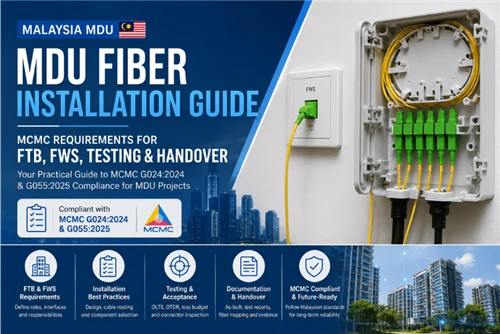

Which MCMC Technical Code Applies to an MDU Fiber Installation?
The first purchasing question should not be "How many ports do we need?" It should be: Is this a new development or an existing-building retrofit?
G024:2024 for New and Greenfield Developments
MTSFB registered G024:2024 in 2024 as the first revision of the fixed-network facilities code for in-building and external infrastructure. It replaces G024:2020 and is the correct starting point when telecommunications rooms, risers, conduits, building distribution points and apartment termination locations can still be coordinated during development.
Official reference: MTSFB Technical Code Register.
G055:2025 for Brownfield and Existing Buildings
For existing properties, MTSFB separately lists MCMC MTSFB TC G055:2025 - Fixed Network Facilities – In-building and External for Brownfield. A brownfield project introduces different design constraints: occupied apartments, limited riser space, existing fire-stopping, old copper or fiber infrastructure and restrictions on disruption.
Official reference: MTSFB G055:2025 Brownfield Code.
Why the Greenfield/Brownfield Decision Must Be Made Before the BOM
Define the MDU Fiber Handover Boundary Before Selecting Products
One of the most expensive apartment-fiber mistakes is allowing the physical installation to move faster than the responsibility map. Before ordering hardware, draw the passive path.
The active ONT does not need to be supplied with the passive infrastructure, but its connector interface and optical requirements affect the passive design. Glory Optical's FTTH ODN Network Solution follows the same passive-path logic by connecting feeder, distribution, access and subscriber termination as one system.
The Passive Path from Network Interface to the Apartment
The route should be defined physically and operationally before the RFQ is released. The permanent building fiber path should identify where the network provider meets the building, where riser fiber changes to floor or apartment distribution, and which part of the link must be included in final acceptance testing.
Four Interfaces That Should Be Frozen Before Procurement
- Where does the network provider's responsibility meet the building fiber?
- Where does the riser transition to floor or apartment distribution?
- Which connector and polish will be used at each termination point?
- Which part of the path must be included in the final acceptance test?
Why FTB and FWS Are More Than Boxes
An FTB and an FWS are physical products, but they are also operational reference points. They define where building fiber begins, where a specific apartment fiber terminates, where a test lead connects and which port ID should appear in the as-built record.
How to Specify the Fiber Termination Box for an MDU
Fiber termination box has strong search demand, but an MDU project needs a more precise purchasing question: what role is this FTB performing in this building?
For general enclosure selection, Glory already provides a Fiber Optic Termination Box selection guide. In a Malaysia MDU project, the next step is to specify the box by network position.
Main FTB vs Floor-Level Distribution Point
Main FTB in TR
- Incoming building fiber
- Splices and pigtails
- Subscriber assignments
- Vertical riser fibers
- Operator patching
Floor-Level FTB
- Riser-to-floor transition
- Smaller branch fiber groups
- Protected splices
- Faster fault isolation
- Shorter restoration routes
Capacity Should Follow the Fiber Map, Not Only Apartment Count
An 80-apartment MDU does not automatically need an "80-port box." The correct capacity depends on fibers per unit, spare fibers, floor distribution, splice/patch architecture, splitter location and expected future activation. A fiber assignment schedule is therefore more useful than unit count alone.
Connector Polish and Adapter Type Must Be Locked in the BOM
For APC-based designs, Glory's SC APC Simplex Adapter is one compatible component option when the approved project interface calls for APC.
What Procurement Should Ask for in an MDU FTB
| Item | Procurement question |
|---|---|
| Network position | Main TR, riser or floor distribution? |
| Working fibers | How many active fibers? |
| Spare capacity | How much future capacity is required? |
| Splices | Number and splice-tray arrangement? |
| Adapter | SC/LC and APC/UPC? |
| Cable entries | Riser cable OD and outgoing cable sizes? |
| Mounting | Wall, cabinet or compact riser installation? |
| Splitter | Required or intentionally excluded? |
| Labeling | How are floor/unit/port IDs represented? |
| Test evidence | What optical data must be supplied? |
Glory Product: 8-Core FTTx Termination Box
Suitable as a candidate for smaller FTTB/MDU access or floor-level nodes after capacity and mounting requirements are confirmed.
Glory Product: 16-Core Distribution Box
A candidate for denser building-distribution positions where more splice and subscriber capacity is required.
FWS and the Final Fiber Connection Inside Each Apartment
The subscriber-side endpoint is physically small but operationally important. It is one of the most frequently accessed components in the whole MDU network.
What a Fiber Wall Socket Must Do
- Protect the fixed indoor fiber.
- Control bend radius.
- Store limited splice or pigtail slack.
- Present a defined adapter interface.
- Protect unused interfaces from dust.
- Create a repeatable ONT connection point.
Glory's 2-Core FTTH Fibre Optic Wall Socket provides a compact subscriber-side termination point for indoor FTTH links.
Bend Control, Dust Protection and ONT Handoff
Poor internal routing can create tight bends, pigtail pressure, crushed splice protectors, dirty adapters and difficulty replacing the final jumper. A link may pass continuity testing before the faceplate is closed and later show excessive loss after installation is completed.
Why a Two-Core Outlet Can Be More Useful Than a One-Port Design
Even when one fiber is activated initially, a second planned fiber can provide service flexibility, restoration options and reduce the need to re-enter the apartment later. Whether two fibers are required should follow the approved project design rather than a generic rule.
Selecting In-Building Fiber for Risers, Corridors and Apartments
An MDU route has tighter routing conditions than most outside-plant fiber, so cable construction and fiber type need to be matched to the section of the building.
Why G.657 Fiber Matters in MDU Routes
The current ITU-T G.657 (08/2024) Recommendation defines bend-loss-insensitive single-mode fibers intended for access networks and installations where improved macrobending performance is required. That makes G.657 particularly relevant around riser exits, corridor turns, distribution boxes, apartment conduits and wall outlets.
Riser Cable and Horizontal Cable Do Different Jobs
Vertical / Riser Section
Often prioritizes fiber count, structured support, tensile performance, flame/smoke requirements and clear floor identification.
Horizontal / Apartment Section
Often prioritizes smaller OD, flexibility, bend performance and easy routing into wall outlets or conduits.
Glory's Indoor Fiber Optic Cable range includes multiple core counts and G.657 options for indoor building routes.
Jacket, Bend Performance and Cable Identification
Every cable item in the RFQ should identify fiber grade, fiber count, jacket material, OD, tensile requirement, bend requirement, reel length, route marking and any fire-performance evidence required by the project.
Fiber Optic Testing Before MDU Acceptance
One of the most useful distinctions in MDU commissioning is: seeing optical power is not the same as proving the installed cable plant meets its acceptance requirement.
OLTS Answers "Does the Link Pass?"
An optical loss test set, or an appropriate light-source and power-meter procedure, measures end-to-end insertion loss. The Fiber Optic Association's Fiber Optic Loss Budget Reference explains how expected fiber, connection and splice losses are combined during design and compared against installed-link testing.
OTDR Answers "Where Is the Loss?"
OTDR testing provides event and distance information that can help identify a high-loss splice, abnormal connector event, bend-related loss, break or unexpected route length. OLTS and OTDR should therefore be treated as complementary rather than competing tools.
A Practical MDU Loss-Budget Example
Consider an illustrative 150 m single-mode FTB-to-FWS route containing 150 m of fiber, four mated connector pairs and three fusion splices. Using common planning values of about 0.4 dB/km at 1310 nm, 0.3 dB per mated connection and 0.15 dB per fusion splice:
Connections: 4 × 0.3 dB = 1.20 dB
Splices: 3 × 0.15 dB = 0.45 dB
Illustrative expected link loss = 1.71 dB
Connector Inspection Is a Separate Acceptance Step
IEC 61300-3-35:2022 addresses visual inspection of fiber-optic connector end faces. End-face inspection complements attenuation and return-loss measurement rather than replacing it.
Glory's Fiber Optic Tool Kit range can support installation and field verification workflows with power meters, VFLs, cleaning equipment, cleavers and stripping tools.
Build a Handover Evidence Chain, Not a Folder of Test PDFs
A test result without a reliable fiber identity has limited operational value. The measurement can be correct while the handover package is still difficult to use.
One Fiber ID Should Connect the Physical Route to the Test Result
The MDU Evidence Lock
| Evidence field | Example |
|---|---|
| Building | Tower A |
| Main FTB | TR-FTB-01 |
| FTB port | P037 |
| Fiber ID | A-037-1 |
| Floor | L07 |
| Unit | 07-03 |
| FWS | FWS-07-03 |
| Connector interface | SC/APC |
| OLTS result | Linked to A-037-1 |
| OTDR trace | Linked to A-037-1 |
| Status | Pass / corrective action |
| As-built revision | Rev. C |
As-Built Records, Calibration and Cabling Provider Evidence
Malaysia maintains the MCMC ReCPro Register for certified proficient persons and cabling-provider information. For procurement teams, the handover package should define in advance which drawings, fiber assignments, test results, calibration records, product data sheets and certification evidence are required.
MDU Fiber Procurement Checklist for Malaysia Projects
The RFQ is the point where most future installation problems can still be prevented cheaply.
What to Put Into the RFQ
FTB and Floor Box Requirements
- Exact network location
- Fiber and splice capacity
- Adapter quantity and polish
- Splitter requirement
- Cable-entry dimensions
- Mounting arrangement
- Port-label format
- Spare-port treatment
Cable and FWS Requirements
- Riser and apartment fiber count
- G.657 grade where required
- Jacket/fire-performance requirement
- OD, bend and tensile requirements
- Wall-socket capacity
- Adapter and patch-cord interface
- ONT handoff condition
Testing and Documentation Requirements
- Test wavelength
- OLTS / light-source and power-meter method
- OTDR requirement
- Pass/fail threshold
- Connector inspection
- Test-file naming
- Fiber-ID convention
- Calibration evidence
- As-built format
Recommended Glory Optical Product Families
Common MDU Fiber Installation Mistakes That Create Handover Problems
Buying by Port Count Alone
A 16-port enclosure and another 16-port enclosure may have completely different splice capacity, cable entry, routing space, splitter compatibility and mounting footprint. Port count is an output of the architecture, not the architecture itself.
Mixing APC and UPC Interfaces
If the RFQ says only "SC adapter," one supplier may quote UPC while another assumes APC. Specify connector type and polish throughout the entire passive path.
Testing Only Selected Apartments
Sampling can be useful for factory QA, but installed-building acceptance is a different problem. A single crushed cable, incorrect splice or mislabeled fiber may affect one apartment while neighboring sampled links pass.
Losing the Relationship Between Port ID and Unit ID
If FTB P16 cannot be confidently connected to Tower B / Floor 8 / Unit 08-02 / FWS-1, the next fault becomes a tracing exercise. Label design therefore belongs in the network design, not the final week of installation.
Final Engineering Rule: Design the MDU Backward from Handover
The strongest way to design a Malaysia MDU fiber installation is to imagine the final acceptance meeting before choosing the first box.
↓ defines
Test method
↓ defines
Test access points
↓ defines
FTB and FWS interfaces
↓ defines
Cable and connector architecture
↓ defines
The product BOM
The MTSFB register confirms that Malaysia now separates greenfield G024:2024 and brownfield G055:2025 fixed-network facilities. Project teams should therefore verify the current registered code and the operator/local acceptance specification at the design stage rather than copy requirements from an older MDU project.
Frequently Asked Questions
Q: What does MDU mean in telecom?
A: MDU means Multi-Dwelling Unit, such as an apartment, condominium or residential building containing multiple subscriber premises. An MDU fiber network normally includes a building-entry or telecommunications-room interface, vertical distribution, optional floor distribution and individual subscriber links.
Q: What is the difference between an FTB and an FWS?
A: The fiber termination box (FTB) is a managed building or floor termination/distribution point for fibers, splices, adapters and cable routing. The fiber wall socket (FWS) is the subscriber-side termination point where permanent building fiber transitions to the final patch connection toward the ONT.
Q: Should MDU fiber be tested with OTDR or OLTS?
A: Use them for different purposes. OLTS or a light-source/power-meter method measures end-to-end insertion loss for pass/fail acceptance, while OTDR identifies distance and individual events such as splices, connectors and abnormal loss.
Q: Which MCMC technical code applies to an existing apartment building?
A: MTSFB lists MCMC MTSFB TC G055:2025 specifically for brownfield fixed-network facilities. New or greenfield projects should start from G024:2024, while project-specific requirements should still be confirmed with the relevant parties.
Q: What information should be included in an MDU fiber RFQ?
A: At minimum, provide building type, greenfield/brownfield status, unit quantity, TR/riser plan, fiber counts, FTB/FWS locations, connector/polish, cable type, fire/jacket requirement, test method and thresholds, labeling convention and required handover documents.