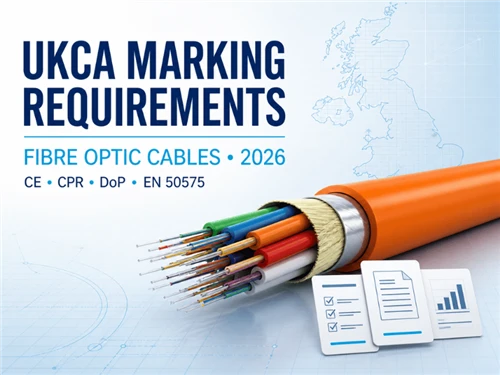




UKCA Marking Requirements in 2026: The 30-Second Answer
The first UKCA marking requirement is to identify the actual destination. Writing only "UK" in a specification is not precise enough because Great Britain and Northern Ireland follow different market-access routes.
According to the current Great Britain construction products guidance, CE marking continues to be accepted in England, Scotland and Wales. UKCA may also be used. The separate Northern Ireland guidance accepts CE or CE+UKNI, but not UKCA alone.
| Destination | Accepted route | Body used when third-party assessment is required | Core evidence |
|---|---|---|---|
| Great Britain | CE | EU-recognised notified body | EU DoP, certificate or report where applicable, and product marking |
| Great Britain | UKCA | UK approved body | UK DoP, certificate or report where applicable, and product marking |
| Great Britain | CE+UKNI | Relevant NI route | Supporting CE+UKNI documentation |
| Northern Ireland | CE | EU notified body | EU DoP and supporting evidence |
| Northern Ireland | CE+UKNI | UK approved body | DoP and CE+UKNI marking |
| Northern Ireland | UKCA alone | Not accepted | - |
The 2025 amendment effective from 8 January 2026 preserves recognition in Great Britain for relevant CE-marked construction products assessed under the updated EU regime. Procurement teams should therefore avoid relying on an old universal UKCA switchover date.
If a project needs a special fibre count, jacket, cable print or private label, use Glory's OEM fibre optic cable service only after the destination and document owner have been defined.
Decide by destination before selecting the mark
A cable supplied to both the EU and Great Britain may use a documented CE route for both markets. A GB-only project may select UKCA. A Northern Ireland order needs its own CE or CE+UKNI decision.
The procurement rule
Never request only "UK compliant cable". State the delivery territory, permanent-installation status, full reaction-to-fire class, selected marking route, legal manufacturer and exact documents required before shipment.
Do UK Construction Products Regulations Cover Your Fibre Optic Cable?
Not every product containing optical fibre automatically falls within the construction products regime. Scope depends on intended use. BS EN 50575 covers power, control and communication cables-including fibre optic cables-when intended for permanent incorporation in construction works and subject to reaction-to-fire requirements. The standard appears in the UK's designated standards list for construction products.
Glory's guide to fibre optic cable structural classifications can identify the physical construction. The regulatory test must then be performed separately.
The three-part scope test
- Is the item placed on the market as a construction product?
- Is it intended to remain permanently incorporated in a building or civil engineering work?
- Is that intended use covered by BS EN 50575 or another applicable designated or harmonised standard?
If all three answers are yes, the CPR, DoP and marking workflow is likely relevant. Confirm the final interpretation against the project specification and current official guidance.
Patch cords, outdoor cables and enclosures
A removable equipment patch cord may follow a different assessment from permanently installed building cable. An outside-plant cable may still face entry-point and fire-stopping requirements where it enters a building. Outdoor location alone does not determine CPR scope: a cable permanently incorporated in a tunnel, transport route or another civil engineering work may still fall within the construction-products regime. Conversely, an outdoor cable may fall outside that regime where it is not intended for permanent incorporation in a building or civil engineering work and is not subject to the applicable reaction-to-fire requirements. A fibre enclosure requires its own product analysis rather than inheriting a connected cable's classification.
CE Marking UK vs UKCA: Which Route Should You Use?
CE and UKCA provide alternative market-access routes rather than different quality grades. CE uses the applicable EU framework and, where required, an EU-recognised notified body. UKCA uses the Great Britain framework and, where required, a UK approved body. CE+UKNI applies when a UK body carries out mandatory assessment for a product placed on the Northern Ireland market.
CE route
Relevant to EU supply and currently accepted for qualifying construction products in Great Britain. The EU DoP, product identity and notified-body evidence must align.
UKCA route
Relevant to Great Britain. Mandatory third-party work must use the appropriate UK approved body, and UKCA evidence cannot be created by merely relabelling an EU certificate.
Dual marking and private labels
When CE and UKCA are both applied, each mark must be supported by the appropriate declaration and assessment framework. BASEC notes that a distributor selling cable under its own name or product reference needs the appropriate evidence before issuing its own DoP. Glory's OEM service should therefore connect each private-label reference to a defined document owner and tested or certified family.
Avoid the relabelling trap
Changing only a cable legend, reel label or commercial model number can break traceability if the new identifier cannot be linked to the DoP and certificate or classification report.
EN 50575, Euroclass and AVCP Explained
EN 50575 is the central reaction-to-fire product standard for relevant power, control and communication cables permanently installed in construction works. BSI's cable testing and certification guidance expressly includes fibre optic cables.
A full classification such as communicates more than the base class alone. The additional components describe smoke production, flaming droplets or particles, and acidity or corrosivity of gases. There is no single Euroclass that is automatically correct for every UK project.B2ca-s1a,d0,a1
| Declared class | Typical AVCP system | Main implication |
|---|---|---|
| Aca, B1ca, B2ca, Cca | 1+ | Product certification, factory production control assessment and continuing surveillance by the appropriate body |
| Dca, Eca | 3 | Testing or classification by the appropriate laboratory; manufacturer controls production and issues the DoP |
| Fca | 4 | Manufacturer route, subject to the applicable legal requirements |
The assessment route should be checked against the current standard and the official AVCP decision for relevant cables.
Reaction to fire is not fire resistance
Reaction to fire describes how a cable contributes to fire growth, smoke, droplets and acidity. Fire resistance or circuit integrity concerns continued operation during a fire. They are different performance questions.
LSZH is not a Euroclass
LSZH describes jacket-related smoke and halogen characteristics. It does not by itself prove CPR conformity, a particular Euroclass, plenum suitability, outdoor performance or circuit integrity. Glory's plenum versus non-plenum guide provides additional context where North American terms appear in the same project.
How to Audit a Declaration of Performance
A Declaration of Performance applies to a defined product type and intended use, connecting that product to declared performance under a stated standard and assessment route. It does not certify an entire supplier or every cable in its catalogue. BASEC's CPR testing guide explains how testing, factory production control and continuing surveillance vary by class.
Glory's fibre product certification explainer covers broader terminology. For construction cable, apply this eight-field procurement audit.
| Field | What must be verified | Hold or reject signal |
|---|---|---|
| 1. Destination | GB, NI or EU | Document route does not match destination |
| 2. Legal manufacturer | Name and address | Supplier cannot be connected to the declaration |
| 3. Product identity | SKU, family or unique product type | DoP covers a similar but different construction |
| 4. Intended use | Permanent construction installation or other stated use | Use is absent or incompatible |
| 5. Standard | Correct BS EN or EN 50575 reference | Standard is missing, obsolete or unrelated |
| 6. Fire class | Full class and applicable suffixes | Only "LSZH" or an incomplete class is shown |
| 7. AVCP and body | System, body number and certificate/report reference | Body cannot be verified or route conflicts |
| 8. Traceability | DoP reference, label, cable print and batch | Identifiers do not match across documents |
Use a three-way consistency test
The manufacturer, product reference, standard, class and assessment-body details should form one uninterrupted chain. A logo, report cover or website badge is not a substitute for this match.
Pass, hold or reject
- Pass: all eight fields align and cover the exact quoted construction.
- Hold: the product may be suitable, but a current DoP, report, label sample or body record is missing.
- Reject: product identity, class, manufacturer or assessment route conflicts across the evidence.
Common UK Fibre Cable Compliance Failures
Public installer and buyer discussions repeatedly treat market-access evidence and installation suitability as the same question. They are not. Glory's guide to cable types, standards and jacket materials can support physical selection; regulatory evidence remains a separate gate.
Gate A: Market access
Check scope, destination, CE/UKCA route, DoP, AVCP evidence, full fire class and product traceability.
Gate B: Route suitability
Check indoor/outdoor exposure, water, UV, rodents, tensile and crush loads, bend radius, pathway and termination method.
A cable can pass Gate A and still fail Gate B. For example, an LSZH indoor cable does not automatically become suitable for a flooded duct. A valid reaction-to-fire class does not prove UV, water or mechanical performance.
Stop conditions
- The supplier sends only a CE or UKCA logo.
- The DoP covers a different product code or construction.
- LSZH is presented as the complete fire classification.
- The assessment body or certificate number cannot be verified.
- The label omits the DoP or unique product reference.
- An old UKCA deadline is used instead of current government guidance.
Glory Fibre Optic Cable Recommendations for UK Projects

Indoor Fibre Optic Cable
A starting point for ducts, trays, risers, telecom rooms and enterprise backbones. The page lists 2–24 fibres, aramid reinforcement and PVC or LSZH project options.
Verify: full Euroclass, DoP, AVCP evidence, exact jacket, pathway and cable print.
Image source: the linked Glory Optical product page.

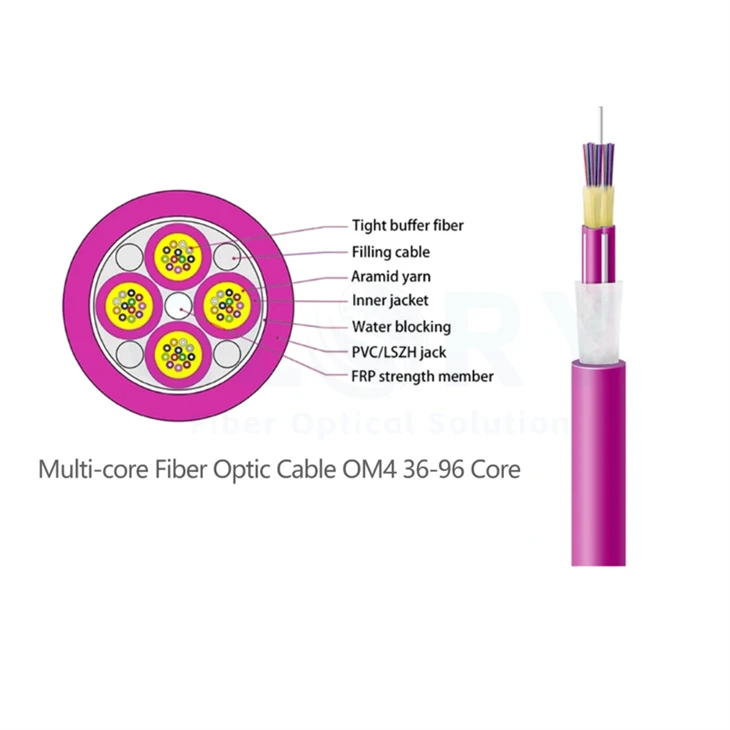
High-Density Sub-Unit Branch Cable
A starting point for high-fibre-count indoor backbone and branch distribution where sub-unit organisation and controlled breakout matter.
Verify: exact family coverage, full class suffixes, System 1+ evidence where applicable, pathway capacity and branch design.
Image source: the linked Glory Optical product page.

FTTx Fibre Optic Cable
A toneable SST flat-drop construction for access and drop applications. Building entry can create a transition between outside-plant and internal fire requirements.
Verify: outdoor exposure, water and UV data, tracer-wire requirements, entry-point controls and the length permitted inside the building.
Image source: the linked Glory Optical product page.

LC–LC Duplex Fibre Patch Cord
A connectorised product for patch panels, switches and optical equipment. Its intended removable use may differ from permanently installed building cable.
Verify: actual installation status, fibre grade, polarity, connector polish, length, jacket and optical acceptance limits.
Image source: the linked Glory Optical product page.
Specify the use case before requesting evidence
A useful RFQ states destination, project type, permanent-installation status, indoor/outdoor transition, fibre count, fibre standard, jacket, complete Euroclass, marking route, OEM ownership and the documents required before shipment.
Evidence must cover the exact SKU
A test on one jacket, diameter or family member does not automatically cover every variation. Ask whether the quoted construction was directly tested, is listed within the certified family or is covered by a valid extended-application assessment.
UKCA Marking Requirements Procurement Checklist
Glory's network solutions and OEM service can be connected to the project after performance and document requirements have been defined.
Before issuing the purchase order
- Record whether the destination is GB, NI or EU.
- Confirm whether the cable is intended for permanent incorporation.
- Identify the applicable standard.
- Record the required full Euroclass.
- Select CE, UKCA or CE+UKNI.
- Confirm the applicable AVCP system.
- Obtain the DoP for the exact product or valid family.
- Verify the notified or approved body where applicable.
- Approve a label and cable-print sample.
- Confirm that the physical construction suits the route.
Repeat the check against the production batch
Match the purchase-order SKU, reel or carton label, cable legend, DoP reference, certificate or classification-report reference, manufacturer, body number and declared class. Store the approved evidence with the batch record instead of retaining only a webpage link.
UKCA Marking Requirements and CE Marking UK FAQ
For wider product terminology, see Glory's complete guide to fibre cables and connectors.
Q: Is UKCA marking mandatory?
A: No universal UKCA-only requirement applies to construction products sold in Great Britain. Current GB guidance accepts CE marking as well as UKCA marking for qualifying construction products. Northern Ireland accepts CE or CE+UKNI; UKCA alone is not accepted.
Q: What items need a UKCA mark?
A: UKCA is relevant to products placed on the Great Britain market under legislation that permits or requires that route. For fibre optic cable, first decide whether the intended permanent construction use brings it within BS EN 50575 and the construction products regime.
Q: Is CE marking still valid in the UK?
A: CE marking remains accepted for relevant construction products in Great Britain under the current arrangements. It is also part of the Northern Ireland route. Always distinguish GB from NI.
Q: What is the difference between CE and UKCA?
A: CE is based on the EU conformity framework. UKCA is the Great Britain framework. Technical requirements may be closely aligned, but the legal declaration, assessment body and market territory must match the selected route.
Q: Can a manufacturer self-certify a fibre optic cable?
A: It depends on the applicable AVCP system and declared fire class. Higher classes such as B2ca or Cca generally require System 1+ third-party certification. Dca and Eca typically use System 3 testing, while Fca uses System 4. The route must be established before anyone describes the product as self-certified.
Q: How much does UKCA marking cost?
A: There is no reliable flat price. Cost depends on fire class, AVCP system, number of constructions, testing, factory production control, surveillance, label changes and whether valid family grouping can be used. Request an itemised quotation tied to the exact cable family.
Q: Does LSZH mean a cable is CPR compliant?
A: No. LSZH is not a Euroclass and does not prove that a DoP exists. It also does not establish plenum, outdoor, water-resistance or circuit-integrity performance.
Q: Is a CE or UKCA logo enough?
A: No. The mark should be supported by a valid DoP, the appropriate certificate or classification report where required, verifiable assessment-body details and product-level traceability.
Build the document chain before the cable order
For a project-specific quotation, send Glory Optical the destination, installation route, required fire class, fibre count, jacket, marking route and evidence list. Begin with the fibre optic cable portfolio or submit a custom construction through the OEM service.
Editorial note: This guide is a procurement and content resource, not legal or fire-engineering advice. Regulations, designated standards and project specifications should be checked at the time of supply. Product images are local copies of images displayed on the linked Glory Optical product pages and are included for accurate product identification.