- Why Fiber Cables and Connectors Are the Foundation of Every Modern Network
- Fiber Optic Cable Types Explained
- Complete Guide to Fiber Optic Connector Types
- How to Select the Right Fiber Cable and Connector
- Insertion Loss, Return Loss, and Quality Certification
- Procurement Execution: Pricing, Inspection, and Trade Terms NEW
- How to Evaluate Any Fiber Supplier: A Buyer's Framework
- Frequently Asked Questions
Fiber cables and connectors are the physical backbone of every high-speed network - from FTTH last-mile subscriber drops to AI hyperscale data center spine architectures. As of 2026, one industry estimate places the global fiber optic connectors market at US $9.6 billion, expanding at a 13.2% CAGR to reach approximately $22.9 billion by 2033.1 Growth is being driven by 5G fronthaul and backhaul buildout, AI-driven data center construction, and government-backed broadband programs including the US BEAD initiative and India's BharatNet. Note: Market figures from single research providers can vary significantly; treat these as directional rather than authoritative.
This guide is written for network planners, procurement managers, and system integrators selecting fiber optic patch cables and connectors for real deployments. It covers cable types, every major connector format, performance specifications, environmental ratings, how to evaluate suppliers objectively, and - in a section that most technical guides omit - how to execute procurement without getting caught out on price, acceptance testing, or trade terms.
Why Fiber Cables and Connectors Are the Foundation of Every Modern Network
Optical fiber transmits data as light pulses, achieving speeds and distances that copper cannot match. A single strand of standard single-mode fiber can carry terabits of data per second over distances exceeding 100 km, with attenuation as low as 0.2 dB/km - roughly 40× less signal loss than Category 6A copper cable over an equivalent run.
Four concurrent trends are driving fiber demand in 2026, and each imposes different requirements on cable and connector specification:
- 5G deployment: According to GSMA Intelligence, more than 2.4 billion 5G subscriptions were active globally as of Q1 2026.8 Every macro cell and small cell requires fiber-based fronthaul, midhaul, and backhaul - typically 4–8 fiber pairs per site - along with ruggedised outdoor connectors rated to IP67 minimum.
- AI data centers: Hyperscale operators are building GPU clusters that require 400G and 800G optical interconnects throughout the fabric. MPO-24 high-density cabling is no longer a premium option; it is the baseline architecture for new builds.
- FTTH expansion: The US BEAD program is funding connections to more than 7 million unserved and underserved locations, with first deployments drawing down as of early 2026.9 China, India, and Southeast Asia are simultaneously executing large-scale access network builds that require low-cost, bend-insensitive drop cable in very high volume.
- Industrial IoT: Smart factories, power substations, and rail networks rely on fiber for its immunity to electromagnetic interference and its ability to bridge long distances inside electrically noisy environments where copper would require shielding and repeaters.
Each of these use cases demands a different combination of cable type, connector format, and environmental protection. Getting it wrong does not always manifest as a total failure - it often shows up as gradual signal degradation that is expensive to trace and even more expensive to reterminate in the field.
Fiber Optic Cable Types Explained
Selecting the correct cable is the first and most consequential decision in any fiber deployment. The wrong choice - using multimode fiber where single-mode is required, for example - results in signal degradation that cannot be corrected without physical recabling. There is no software fix.
Single-mode fiber (SMF)
Single-mode fiber has a core diameter of 8–9 µm - small enough to propagate only one mode of light. This eliminates modal dispersion entirely, enabling long-distance, high-bandwidth transmission. The dominant SMF standards relevant to most buyers are:
- G.652D (OS2) - Standard SMF, ≤0.4 dB/km at 1310 nm, 100+ km reach. The default choice for telecom backbones, metro networks, and enterprise campus backbones.
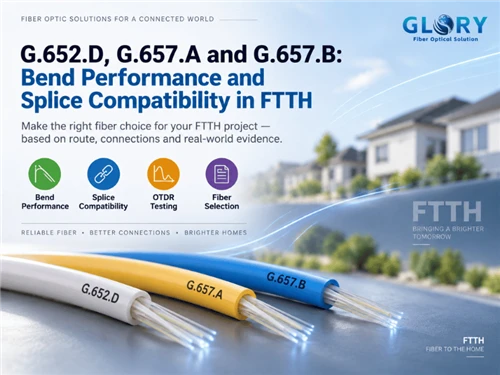
- G.657A1/A2 - Bend-insensitive SMF optimised for FTTH drop cables and tight-radius indoor routing. G.657A2 tolerates a 7.5 mm minimum bending radius versus G.657A1's 10 mm.2 In practice, when routing around door frames or through conduit bends, that 2.5 mm difference matters - see the field note below.
Multimode fiber (MMF)
Multimode fiber uses a larger 50 µm core that allows multiple light modes to propagate simultaneously. This makes it less expensive to terminate (VCSEL-based transceivers cost significantly less than DFB lasers) and suitable for the short distances typical of in-building and data center cabling. Where not to use it: any link that may need to exceed 550 m in the future, or any link that will carry coherent WDM traffic.
| Grade | Core | Bandwidth (850 nm) | Max reach | Best use |
|---|---|---|---|---|
| OM3 | 50 µm | 2,000 MHz·km | 300 m @ 10G | Enterprise LAN, building backbone |
| OM4 | 50 µm | 4,700 MHz·km | 550 m @ 10G / 100 m @ 100G | Data center, high-density campus |
| OM5 | 50 µm | 28,000 MHz·km | 150 m @ 400G (SWDM4) | Hyperscale, short-reach WDM |
FTTH drop cables
Drop cables connect the distribution point (typically a fiber closure or access terminal) to the subscriber premises. They must be lightweight, bend-insensitive, and easy to field-terminate quickly. Glory's FTTH drop cable range complies with ITU-T G.657A2 and is available in flat figure-8 (with messenger wire for aerial span) and round indoor/outdoor variants with LSZH or UV-resistant PE jacket options.
Armored fiber cables
Where mechanical protection is needed - raised access floors, direct burial, or environments with rodent activity - armored cables add a corrugated steel or interlocking aluminum layer inside the jacket. Insertion loss performance is essentially identical to unarmored equivalents; the armor adds weight and approximately 15–25% unit cost in exchange for meaningfully extended physical lifespan in demanding environments. Do not specify armored cable in clean indoor racks: you pay a cost premium for protection you do not need.
ADSS, OPGW, and FTTA specialty cables
All-dielectric self-supporting (ADSS) cables span between utility poles without a separate messenger wire - critical for power utility networks where a conductive messenger would create safety hazards. Optical ground wire (OPGW) integrates fiber inside high-voltage overhead earth wires, providing grid monitoring while protecting the fiber from the environment. For 5G antenna deployments, hybrid FTTA cables combine high-count fiber with power conductors in a single sheath, reducing cable count and installation time at cell sites.
Complete Guide to Fiber Optic Connector Types
A fiber optic connector physically aligns two fiber end-faces to create a low-loss optical junction. Connector choice determines port density, insertion loss, equipment compatibility, and total installation cost. Here are the connectors you will encounter in modern deployments - and one honest assessment of when each is not the right choice.
LC connectors - the high-density standard
LC connectors use a 1.25 mm zirconia ceramic ferrule - half the diameter of SC - and a push-pull latch mechanism that mirrors an RJ45. Originally developed by Lucent Technologies, LC became the dominant connector in data centers, telecom, and FTTH CPE because it enables twice the port density of SC in the same patch panel footprint. Industry estimates suggest LC connectors account for approximately 37% of global connector volume in 2026, though this figure should be treated as indicative rather than precise.1
LC connectors are standardised under IEC 61754-203 and Telcordia GR-326 for reliability. Typical insertion loss: ≤0.2 dB (UPC) or ≤0.3 dB (APC) when factory-terminated to IEC 61300-3-4 test procedures.
When LC is not ideal: In field environments where technicians work wearing gloves - cabinet work in the rain, substation panels - the small LC latch is easy to mis-seat and the pull tab can break under rough handling. In those situations, SC's larger body is genuinely easier to manage.
SC connectors - the telecom workhorse
SC connectors use a 2.5 mm ceramic ferrule with a push-pull snap coupling. SC dominated FTTH OLT ports through the 2010s and remains the connector of choice on PON access terminals and legacy telecom equipment. Its larger form factor is grippy, click-confirmed, and difficult to disconnect accidentally.
LC vs SC - direct comparison
| Feature | LC | SC |
|---|---|---|
| Ferrule diameter | 1.25 mm | 2.5 mm |
| Typical IL (UPC) | ≤0.20 dB | ≤0.25 dB |
| Panel density | High (2× SC) | Standard |
| Glove-friendly field use | Difficult | Good |
| Latch mechanism | Push-pull clip | Push-pull snap |
| Primary use today | Data center, enterprise, FTTH CPE | FTTH OLT, legacy telecom |
| IEC standard | IEC 61754-20 | IEC 61754-4 |
MPO/MTP connectors for high-speed data centers
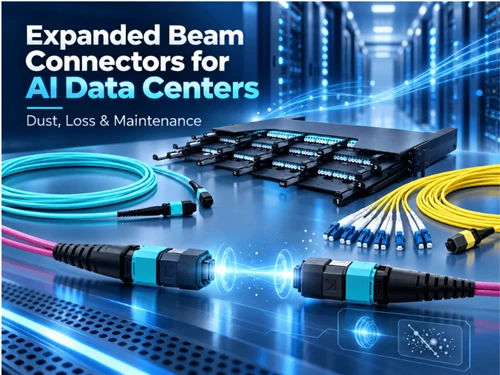
MPO/MTP connectors house 12 or 24 fibers in a single rectangular ferrule, enabling one plug-and-play connection to carry the bandwidth of 12 or 24 individual LC duplex links. They are essential for 40G, 100G, 200G, 400G, and emerging 800G data center backbones.
FC and ST - legacy connectors still in active service
Ferrule Connector (FC) uses a threaded coupling that locks under vibration - still found in optical test equipment, telecom racks in earthquake-prone regions, and aerospace installations. Straight Tip (ST) uses a bayonet twist-lock and was standard in campus multimode networks through the early 2000s. Both are in decline for new installations, but remain active in maintenance and upgrade projects where replacing every connector would require full retermination of existing cables.
APC vs UPC - this is not a preference question
Both LC and SC connectors are available in UPC (Ultra Physical Contact) and APC (Angled Physical Contact) polishes. This is not a quality choice - it is a system compatibility choice determined by your application:
| Feature | UPC (blue body) | APC (green body) |
|---|---|---|
| End-face geometry | Flat polish | 8° angled polish |
| Return loss | ≥ −55 dB | ≥ −65 dB |
| Back-reflection | Moderate | Minimal (deflected out of core) |
| Best for | Digital telecom, data, enterprise LAN | FTTH PON, CATV overlay, coherent systems |
| Matable with | UPC only | APC only - cannot mix with UPC |
Outdoor and IP68-rated connectors
Standard SC and LC connectors are rated for protected indoor environments only. For FTTH drop terminations at the subscriber entrance, street-level distribution cabinets, or 5G FTTA antenna mounts, connectors must meet at minimum IP67 (1 m immersion, 30 min) and ideally IP68 (continuous immersion, per IEC 605294). Glory's outdoor IP68 fiber connector range is tested across −40°C to +75°C and includes the slim 3-in-1 SC/APC format widely used by FTTH operators across Asia, Europe, and Africa for aerial and buried closure applications.
How to Select the Right Fiber Cable and Connector
Use this five-step framework to specify a fiber link correctly before purchasing. Skipping steps - particularly step three - is the most common source of expensive post-installation rework.
Define the application context
Application determines the performance baseline. FTTH subscriber drops require bend-insensitive SMF with robust outdoor connectors. Enterprise LAN backbones typically use OM4 MMF with LC duplex patch cords. Data center spine-leaf architectures increasingly require MPO-24 trunks for 400G uplinks. Industrial environments may require armored cable regardless of fiber type. Establish application before touching component specifications.
Select fiber mode based on distance and future bandwidth requirements
Use multimode for links under 300–550 m (OM4) where transceiver cost is a genuine constraint. Choose single-mode for any link exceeding 550 m, any application requiring DWDM, and any situation where the cable will be in service for more than 10 years and network speeds may increase. Single-mode transceivers have fallen significantly in cost and the risk of hitting multimode distance limits in a future upgrade is real.
Match the connector format to your equipment interface - verify, don't assume
SFP+ and SFP28 transceivers use LC duplex. QSFP28 (100G) uses MPO-12. QSFP-DD (400G) typically uses MPO-16. OLT line cards commonly use SC/APC or LC/APC. Always pull the transceiver spec sheet and confirm connector type before ordering patch cords or pre-terminated assemblies. Assuming "LC is always LC" has caused more expensive rework than any other single error in our experience.
Specify performance requirements in writing
For most installations: insertion loss ≤0.3 dB (UPC/PC) per IEC 617545; return loss ≥−55 dB (UPC) or ≥−65 dB (APC); mating durability ≥500 cycles per TIA-568.3-D6. For critical links - OLT uplinks, amplified spans, coherent DWDM - tighten insertion loss to ≤0.15 dB using factory ultra-low-loss (ULL) connectors. Put these numbers in your purchase order, not just your conversation with the sales team.
Set environmental and safety specifications for the installation environment
Indoor plenum spaces require OFNP (plenum-rated) or LSZH jackets for fire code compliance. Outdoor above-ground routes need UV-stabilised PE or LSZH with weather-resistant jacket. Direct burial adds armoring and gel-filled tubes. Any application involving water immersion or outdoor wash-down requires IP67 minimum; for permanent outdoor termination, specify IP68. Temperature range should be explicitly stated: outdoor environments in continental climates require −40°C to +70°C minimum.
Insertion Loss, Return Loss, and Quality Certification
Signal loss at connector interfaces is the most common - and most avoidable - source of unexplained network performance problems. Understanding the two key metrics enables you to write meaningful purchase specifications and objectively evaluate the test certificates any supplier provides.
Insertion loss (IL)
Insertion loss measures how much optical power is lost when two fiber end-faces are mated, expressed in dB (lower is better). The three primary sources are:
- End-face contamination: A single oil fingerprint or dust particle can add 1 dB or more per connector pair. The Fiber Optic Association's field data suggests contamination accounts for the large majority of connector-related insertion loss failures - clean every end-face with a compliant IEC 61300-3-35 tool before mating, including on brand-new connectors that have been sitting in storage.7
- Core misalignment: Lateral offset between fiber cores, controlled by ferrule bore tolerance. High-quality zirconia ferrules achieve ≤0.5 µm bore tolerance; lower-cost ferrules from unverified suppliers may be significantly worse.
- End-face geometry: Radius of curvature (ROC), apex offset, and fiber height must meet IEC 61300-3-35 for consistent mating across brands and manufacturers.
Return loss (RL)
Return loss measures how much light is reflected back toward the source. Poor return loss degrades laser performance in coherent systems and creates bit errors in analog CATV overlays. APC connectors achieve RL ≥−65 dB by angling the end-face at 8°, sending any reflected light out of the fiber core rather than back to the transmitter. For FTTH PON systems and CATV overlays, APC is not a preference - it is a system requirement.
Certification stack - what to require from any supplier
-
ISO 9001:2015 - third-party registered, not self-declaredRequire the certificate number and registrar (Bureau Veritas, SGS, TÜV, DNV, etc.). Self-declared ISO compliance means nothing - verify the certificate independently on the registrar's public database.
-
IEC 61754 seriesConfirms connector interface dimensions conform to international standards, ensuring cross-manufacturer mating compatibility.
-
Telcordia GR-326Qualification testing for single-fiber optical connectors across temperature cycling, humidity, and mechanical stress - required for telecom-grade procurement.
-
TIA-568.3-DUS structured cabling standard including connector performance tiers and field-test procedures. Required for US enterprise and data center deployments.
-
Per-batch IL/RL test data - actual measurements, not compliance statements"Complies with IEC 61300-3-4" is not a substitute for actual measurement data. Require the test report with measured values, not just pass/fail checkboxes.
Procurement Execution: Pricing, Inspection, and Trade Terms NEW
Most technical guides for fiber connectivity stop at selection and specification. This section addresses the procurement execution layer - the steps between "I know what I need" and "it arrived on time, at spec, and without surprises." These are the areas where procurement teams most commonly get caught out.
Understanding price ranges and total cost of ownership
Fiber connectivity pricing varies widely based on product type, volume, supplier tier, and market conditions. The ranges below are indicative for standard commercial-grade products sourced from established manufacturers as of mid-2026; they will vary by region, volume, and specifications:
| Product | Indicative price range (USD) | Key cost drivers |
|---|---|---|
| LC/UPC duplex patch cord, 1–3 m | $0.80 – $3.50 per pc | Volume, jacket type, ferrule grade |
| SC/APC simplex pigtail, 1 m | $0.60 – $2.20 per pc | Volume, ferrule grade, termination method |
| MPO-12 trunk cable, 10 m | $18 – $55 per pc | Fiber grade, polarity type, connector grade |
| G.657A2 FTTH drop cable (per metre) | $0.08 – $0.22 per m | Volume, jacket, messenger wire |
| IP68 SC/APC outdoor connector | $1.20 – $4.80 per pc | Housing material, IP rating, sealing method |
These ranges are for reference only. Request formal quotations with complete specifications before making purchasing decisions. Price alone is not a quality indicator - very low prices on connectors frequently indicate ungraded ferrules or unverified insertion loss.
Pre-shipment inspection process
For first-time orders from any supplier, and for orders above your standard risk threshold, consider a third-party pre-shipment inspection. Key elements to specify:
- IL and RL tested per IEC 61300-3-4
- Random sample ≥5% of batch (min. 10 pcs)
- End-face inspection per IEC 61300-3-35
- Results compared to purchase order spec
- ISO 9001 certificate current and valid
- Batch-level test report available
- Certificate of Conformance issued
- Shipping marks match PO requirements
- Dust caps present and secure
- Connector body color matches polish type
- No cracking, delamination, or ferrule protrusion
- Quantity and labeling match packing list
- For outdoor/IP-rated: verify IP test certificate
- Temperature range documentation available
- Jacket material matches specification
Identifying substandard and counterfeit products
The fiber connector market has a persistent counterfeit and regrade problem, particularly in lower-cost channels. These are the signs that should trigger rejection or third-party testing before deployment:
- No batch test data available. Any established manufacturer can produce per-batch IL/RL test reports. "We don't keep individual batch records" is a red flag.
- Connector body color does not match stated polish type. Blue body = UPC, green body = APC, per industry convention. Mismatched bodies indicate either mislabeling or reprocessed connectors.
- ISO certificate cannot be verified on the registrar's public database. Every accredited ISO certificate can be looked up by certificate number on the registrar's (SGS, Bureau Veritas, TÜV, etc.) website. If it doesn't appear, it may be self-issued.
- Ferrule end-face shows visible scratches or pitting under 200× inspection. New connectors should have polished, scratch-free end-faces. Anything else indicates a quality control problem.
- Pricing substantially below market range without explanation. Connector manufacturing has real material and testing costs. Prices more than 40% below comparable suppliers usually mean something has been cut - usually testing, ferrule grade, or both.
Trade terms guidance
For buyers purchasing from manufacturers in China or other overseas locations, trade term selection affects your landed cost calculation, risk allocation, and customs clearance responsibility:
- FOB (Free on Board): Seller is responsible until goods are loaded onto the vessel at the origin port. You arrange and pay for ocean freight and insurance. Lower unit cost, but you carry transit risk and handle customs clearance. Suitable for experienced importers with established freight forwarders.
- CIF (Cost, Insurance, Freight): Seller arranges and pays freight and insurance to destination port. You still handle customs clearance and local delivery. Good middle option - predictable landed cost to port, but you retain import responsibility.
- DDP (Delivered Duty Paid): Seller handles everything including customs clearance and delivery to your named location. Highest unit cost, but no hidden import variables. Best for first-time international procurement or smaller orders where logistics complexity is not worth managing internally.
How to Evaluate Any Fiber Supplier: A Buyer's Framework
B2B buyers sourcing fiber connectivity face a fundamental structural choice: buy through a distributor or work directly with a manufacturer. Neither is universally better. The right answer depends on order volume, lead time requirements, customization needs, and your organization's tolerance for supply chain complexity.
| Factor | Factory-direct manufacturer | Distributor |
|---|---|---|
| Unit price at volume | 15–40% lower at sufficient MOQ | Higher margin built in |
| Customization (labels, jacket color, custom lengths) | Full OEM available | Standard SKUs only |
| Minimum order quantity | Typically 50–200 pcs depending on product | 1 pc (stock items) |
| Lead time | 2–6 weeks production + shipping | Next-day on stock items |
| Quality traceability | Batch-level IL/RL data, COC on request | Typically limited |
| Technical support | Direct engineering team access | Limited; escalates to manufacturer |
| Best for | Recurring volume, OEM builds, long-term projects | Urgent small orders, standard items, low commitment |
Five-point supplier evaluation checklist - applicable to any manufacturer
Whether you are evaluating Glory Optical or any other supplier, apply these five criteria consistently:
-
ISO 9001:2015 certificate from a recognised accreditation bodyNot self-declared. Verify the certificate number on the accreditation body's public registry before placing any significant order.
-
Per-batch IL/RL test data available on request for every orderThis is the single most important differentiator between manufacturers who test and manufacturers who claim to test. Ask for the actual measurement report, not just a certificate of conformance.
-
Free sample policy with test data before bulk commitmentAny manufacturer confident in their product quality will provide pre-production samples for testing. Reluctance to provide samples is a quality signal.
-
After-sales response SLA in writingDefine the response time for technical issues before you have a technical issue. Remote response ≤2 hours for technical queries is reasonable for an established manufacturer.
-
Reference customers in your region or application area available for verificationAsk for two or three customer references and actually contact them. A supplier who has successfully delivered to operators in your market is lower risk than one who has not.
About Glory Optical Communication as a factory-direct option
Glory Optical Communication has been manufacturing fiber connectivity components in Ningbo since 2009. Our facility holds ISO 9001:2015 registration (certificate available on request for verification). We perform 100% IL/RL testing on every outgoing batch and issue batch-level test reports with every shipment. We offer free pre-production samples with test data for qualified OEM projects, and our OEM customization capability covers jacket colour, labeling, custom lengths, and connector type across the full product range.
Our OEM customisation service follows a four-stage process: technical consultation and quotation within 24–48 hours; sample production within 7–10 working days; sample approval with no cost or obligation; and full ISO 9001 production with batch test documentation. We support DDP, FOB, and CIF shipping terms. Contact our technical sales team at sales@gloryoptic.com to request a quotation or samples.
We include this information because we believe Glory meets the five-point framework above. We encourage you to apply the same evaluation criteria to all suppliers, including us.
Frequently Asked Questions
Q: What are the different types of fiber optic connectors?
A: The most common types are: LC (1.25 mm ferrule, high density - standard in data centers and modern equipment), SC (2.5 mm ferrule, push-pull snap - common in FTTH OLT ports and legacy telecom), MPO/MTP (12 or 24 fibers, used for 40G/100G/400G backbone), FC (threaded, vibration-resistant, test equipment), and ST (bayonet, legacy campus networks). Both LC and SC are available in UPC (blue body) and APC (green body) polish variants. For outdoor and FTTH deployments, ruggedised IP67/IP68 versions are also widely deployed.
Q: What is the difference between LC and SC connectors?
A: LC connectors use a 1.25 mm ferrule, enabling twice the port density of SC connectors (2.5 mm ferrule) in the same patch panel space. LC is the standard in modern data center equipment, enterprise switches, and FTTH CPE devices. SC remains common at FTTH OLT line cards and in older telecom infrastructure where the larger connector is easier to handle. Both are available in UPC and APC versions. Insertion loss is similar: ≤0.20 dB (LC/UPC) vs ≤0.25 dB (SC/UPC) in factory-grade assemblies.
Q: What is the difference between single-mode and multimode fiber cables?
A: Single-mode fiber (SMF) has an 8–9 µm core that propagates a single light mode, enabling transmission over 100+ km with very low attenuation (≤0.4 dB/km). Multimode fiber (MMF) has a 50 µm core suitable for up to 550 m (OM4) with lower transceiver costs. For any link over 550 m or requiring long-term scalability beyond 100G, choose single-mode. For short runs within buildings and data centers (under 300–550 m), multimode remains cost-effective. Never mix SMF and MMF in the same link - the result is high insertion loss and potential link failure.
Q: What is insertion loss in fiber optic connectors?
A: Insertion loss (IL) is the optical power lost when two fiber end-faces are mated, measured in decibels (dB) - lower is better. Typical specification values: ≤0.20 dB (LC/UPC), ≤0.30 dB (SC/UPC), ≤0.15 dB (ultra-low-loss factory grade). The most common cause of excessive IL in the field is end-face contamination - a single dust particle or fingerprint can add 1 dB or more per connector pair. Cleaning every end-face with an IEC 61300-3-35 compliant tool before mating is the single most effective quality measure an installer can take.
Q: Which fiber connector is best for outdoor installation?
A: For outdoor and FTTH drop terminations, use connectors rated IP67 (tested at 1 m water immersion for 30 min) or preferably IP68 (continuous immersion, per IEC 60529). SC/APC and LC/APC in ruggedised housings are the most widely deployed choices. For aerial closures and weatherproof splice terminals, the slim 3-in-1 IP68 SC/APC format is the FTTH operator standard across Asia, Europe, and Africa. Temperature range specification should be −40°C to +70°C minimum for outdoor environments.
Q: What is an MPO/MTP connector used for?
A: MPO (Multi-fiber Push-On) and its improved variant MTP carry 12 or 24 fibers in a single rectangular ferrule, enabling one cable termination to support 40G, 100G, 200G, or 400G links. MPO is the de facto standard for: high-density data center backbone cabling (spine-leaf architecture); breakout harnesses (e.g. 1× MPO-12 to 6× LC duplex); pre-terminated cable systems that eliminate field splicing and reduce deployment time; and 5G fronthaul where space in street cabinets is limited.
Q: What fiber cable is used for FTTH?
A: FTTH (fiber to the home) drop cables use G.657A1 or G.657A2 single-mode fiber - the A2 grade offers a tighter 7.5 mm minimum bend radius for routing inside buildings and around door frames. Drop cables are typically 2-fiber flat (figure-8 with messenger wire for aerial span) or round indoor/outdoor designs with LSZH indoor jacket or UV-resistant PE outdoor jacket. They are factory-terminated with SC/APC or LC/APC connectors for plug-and-play subscriber connections at distribution boxes or splice closures.
Q: How long do fiber optic connectors last?
A: Quality fiber optic connectors are rated for a minimum of 500–1,000 mating cycles per TIA-568.3-D and Telcordia GR-326. In practice, connectors in well-managed patch panels that are rarely moved - such as ODF interconnection points - routinely remain in service for 20+ years without measurable performance degradation. The key is proper cleaning before mating and keeping protective dust caps in place whenever the connector is unplugged.
Q: What causes signal loss in fiber connectors?
A: The primary causes of excessive insertion loss at fiber connectors are: (1) End-face contamination - dust, oil, or moisture on the ferrule end-face, accounting for more than 85% of field IL failures per FOA field data; (2) Core misalignment - lateral offset between fiber cores caused by poor ferrule bore tolerance or improper connector seating; (3) Defective end-face geometry - ROC, apex offset, or fiber height outside IEC 61300-3-35 limits; (4) APC/UPC mismatch - mating an APC connector to a UPC connector adds ≥0.5 dB loss and risks damaging both end-faces. Buying connectors with factory test certificates and cleaning every end-face before mating prevents the majority of field failures.
Q: How do I choose the right fiber optic cable?
A: Use this five-step process: (1) Define the application - FTTH, enterprise, data center, industrial, or outdoor. (2) Choose fiber mode - single-mode for distances over 550 m or future scalability; multimode for short in-building or data center runs. (3) Match the connector type to your equipment's SFP/QSFP or OLT interface. (4) Specify insertion loss and return loss requirements per IEC 61754 grade. (5) Set environmental specs - IP rating, jacket type (LSZH, PE, plenum-rated OFNP), and temperature range. If uncertain, request a link budget analysis from the manufacturer's technical team before committing to a specification.
References
- Persistence Market Research, Fiber Optic Connectors Market Size, Share, and Growth Forecast, April 2026. persistencemarketresearch.com
- ITU-T G.657, Characteristics of a bending-loss insensitive single-mode optical fibre and cable for the access network. itu.int
- IEC 61754-20, Fibre optic interconnecting devices and passive components - Fibre optic connector interfaces - Part 20: Type LC connector family. iec.ch
- IEC 60529, Degrees of protection provided by enclosures (IP Code). iec.ch
- IEC 61300-3-4, Fibre optic interconnecting devices and passive components - Basic test and measurement procedures - Part 3-4: Examinations and measurements - Insertion loss. iec.ch
- TIA-568.3-D, Optical Fiber Cabling Components Standard. tiaonline.org
- The Fiber Optic Association (FOA), Reference Guide to Fiber Optics. thefoa.org