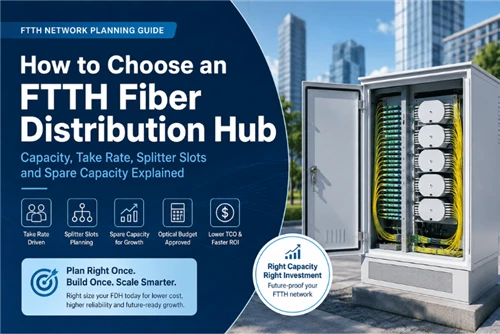

The short answer
The best FDH is not simply the largest cabinet available. It is the smallest configuration that supports the credible growth scenario, leaves a clear expansion path and avoids a second round of civil work.
For a 380-home service area with a 65% design-horizon take rate, the worked example in this guide requires 291 service-ready positions. A 288-port cabinet is therefore too tight under the stated reserve policy, while a 432-port platform provides room for staged growth. Only four 1×32 splitters are needed at launch; ten are planned for full build.
Commercial takeaway: buy the physical pathway once, then add splitter modules and active capacity as paying subscribers arrive.
1. The Commercial Risk Is Usually Not the Cabinet Price
FDH procurement often starts with a port-count comparison. That is understandable, but the cabinet price is only one part of the decision. The more expensive failure is discovering after launch that the splitter area, feeder allocation or service field cannot support the next growth phase.
When the FDH is too small
The operator may need a second cabinet, new feeder work, another foundation or a service-area redesign. The replacement also creates documentation and cutover risk.
When the FDH is overbuilt
Capital is tied up in unused modules, connectors and active ports. A large installed base also increases inventory and maintenance overhead before it produces revenue.
The practical objective is to separate long-life infrastructure from demand-driven components. Cabinet space, feeder access and routing capacity are difficult to change later. PLC splitters, pigtails and OLT resources can usually be added in stages.
Glory Optical's FTTH Network Design Guide provides the wider ODN context. This page focuses on the purchasing decision around the central distribution hub.
2. Use One Simple Capacity Model
The capacity model should be clear enough for engineering, procurement and sales teams to review together. Start with homes passed, apply a design-horizon take rate, and then reserve a defined amount of service capacity.
For the worked example:
| Planning input | Value | Commercial meaning |
|---|---|---|
| Homes passed | 380 | Total long-term sales opportunity in the service area |
| Design-horizon take rate | 65% | Expected connected customers after market ramp-up |
| Expected subscribers | 247 | Likely revenue-generating connections |
| Target maximum utilization | 85% | Example reserve policy for growth and service changes |
| Required service-ready positions | 291 | Minimum planned distribution capacity |
The 85% utilization value is not an industry standard. It is a visible planning assumption. The important point is to name the reserve policy instead of hiding it inside several overlapping growth percentages.
Compare three demand scenarios before ordering
| Take rate | Expected subscribers | Required positions at 85% | Commercial implication |
|---|---|---|---|
| 45% | 171 | 202 | A 288-port tier may be sufficient |
| 65% | 247 | 291 | The design moves above a 288-port limit |
| 80% | 304 | 358 | A 432-port tier still supports the scenario |
This comparison helps management see what it is buying. The step from 288 to 432 ports is not justified by optimism alone; it is justified when the base or high scenario would otherwise force early reconstruction.
3. Choose the Cabinet Tier by the First Capacity Limit
A cabinet can look large on a product page and still have a smaller usable capacity. Distribution ports, splitter positions, feeder access and internal routing must all support the same plan.
| Capacity check | 380-home requirement | 432-port reference platform | Buying decision |
|---|---|---|---|
| Distribution positions | 291 | 432 | Enough capacity for the base and high scenarios |
| 1×32 splitter modules | 10 at full build | 14 splitter positions | Allows staged loading and future flexibility |
| Feeder assignment | 10 working + 2 shared spares | Up to 48 feeder/express positions | No feeder-side bottleneck in the example |
| Splice and routing | Supplier drawing required | Must be checked in the loaded configuration | Do not release the PO from a headline port count alone |
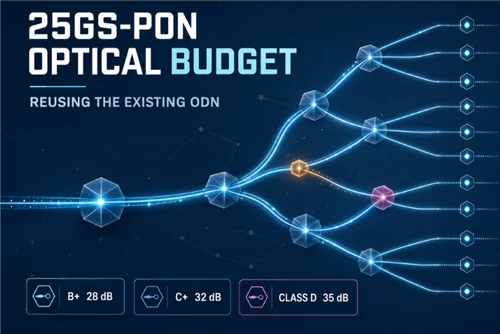
| Optical budget | 24.4 dB with 1×32 | 28 dB Class B+ limit in the example | Split ratio passes with 3.6 dB headroom |
Clearfield's public FDH data sheet illustrates why port density, splitter slots and feeder/express ports are listed separately. The same separation should appear in any supplier quote.
4. Stage Splitter Investment With Subscriber Growth
The cabinet should protect the full-build opportunity, but it does not need to contain every splitter module on day one.
In the 380-home case, 120 launch subscribers need four 1×32 splitters. The long-term plan requires ten. This creates a straightforward deployment strategy:
Day-one purchase
Install the cabinet, feeder path, distribution field and four splitter modules. Activate only the capacity needed for current orders and the agreed operating reserve.
Full-build protection
Reserve module positions, feeder fibers, labels and routing for ten splitters. Add modules when take rate and order volume reach the defined trigger.
This staged approach reduces initial passive and active spending while avoiding the much higher cost of replacing the physical hub. It also makes inventory planning easier: modules can be released in smaller lots against actual demand.
Set expansion triggers in the purchase plan
Do not wait until the last output is sold. A practical trigger may be two remaining equipped splitter positions, a twelve-month order forecast that exceeds the available outputs, or feeder spare capacity falling below the operator's restoration rule. The trigger should reflect supplier lead time and site-access constraints.
5. Confirm the Split Ratio Before It Reaches the Purchase Order
A higher split ratio can reduce splitter modules, feeder fibers and OLT ports, but it also consumes more optical margin. The commercial saving is real only when the longest path still passes.
| Configuration | Full-build modules | Planned path loss | Commercial result |
|---|---|---|---|
| 1×32 | 10 | 24.4 dB | Passes the example Class B+ limit with 3.6 dB headroom |
| 1×64 | 5 | 28.3 dB | Reduces modules but fails the example 28 dB maximum |
The 1×64 option looks cheaper in the cabinet, but the example shows why it cannot be approved by a purchasing team on slot savings alone. The path may need a smaller service area, fewer connector pairs, lower-loss components or a different active optical class.
For a component-level calculation, use Glory's GPON Loss-Budget Planning Guide. Final purchasing values should come from the selected splitter, OLT, ONT, cable and connector data sheets.
6. Build a Quote That Can Be Compared Line by Line
A request for "one 432-port outdoor FDH" leaves too much room for interpretation. Two suppliers may quote different splitter packages, feeder interfaces, cassette counts and accessories while appearing to offer the same cabinet.
A commercial RFQ should state the service-area result first:
Example RFQ opening: Centralized FTTH FDH for 380 design-horizon homes passed, 65% base take rate, 291 required service-ready positions, ten full-build 1×32 splitter modules, four modules installed at launch, twelve assigned feeder fibers including two shared spares, and a verified GPON Class B+ worst-path budget below 28 dB.
Then ask each bidder to confirm the exact cabinet configuration, splitter package, connector interface, pigtail length, feeder and cable-entry count, splice cassettes, parking positions, labels, grounding, locks, mounting accessories, environmental evidence and test documentation.
| RFQ item | Why buyers need it |
|---|---|
| Loaded mechanical drawing | Confirms the quoted layout can actually route and service the required fibers |
| Full day-one and full-build BOM | Separates initial spending from later expansion purchases |
| Maximum optical specifications | Prevents a design based on typical rather than guaranteed losses |
| Environmental test evidence | Reduces the risk of buying a cabinet unsuitable for the pole, pad, pedestal or vault |
| Labelling and port-map format | Supports faster activation, maintenance and future module additions |
Glory's Fiber Distribution Enclosure RFQ Guide can be used to standardize the enclosure and accessory fields.
7. Recommended Glory Optical Components Around the FDH
Glory's public product range is strongest in PLC splitters, adapters and downstream FTTH distribution boxes. These components can be configured around a project-specific centralized hub. Compact FDB products should be used as downstream nodes, not presented as substitutes for a high-density neighborhood FDH.

Core splitter component
1×32 PLC Fiber Splitter
Matches the worked centralized-split design. It can be ordered in staged quantities so the physical FDH is ready for growth without loading all ten modules at launch.
Confirm before ordering: package size, connector polish, pigtail length, fiber type and maximum insertion loss.
View 1×32 splitter

FDH interface component
SC/APC Simplex Adapter
Supports SC/APC PON interfaces in splitter and distribution panels. A consistent adapter and connector specification helps reduce polarity, polish and field-replacement errors.
Published value: insertion loss not more than 0.2 dB.
View SC/APC adapter

24-port downstream distribution
GL-FDB-24D Fiber Distribution Box
Suitable as a local distribution node after the central FDH. It can bring splitter or distribution capacity closer to subscriber clusters while keeping the neighborhood hub focused on feeder and high-density routing.
Published configuration: IP65 housing, 24 SC output positions and support for 1×8 or 1×16 PLC arrangements.
View GL-FDB-24D

16-port sealed access node
GL-ODB-16R FTTH Distribution Box
Designed for sealed downstream NAP/FAT deployment with pre-connectorized subscriber interfaces. It helps create smaller service zones where a single high-density FDH would otherwise require long drop routes.
Use in the network: downstream distribution after the central FDH, not as a replacement for the hub.
View GL-ODB-16RThe images above are the actual images published on the linked Glory Optical product pages. Final connector, pigtail and loaded configurations should be confirmed against the approved project BOM.
Convert the capacity plan into a staged passive BOM
Send Glory the homes-passed forecast, take-rate scenarios, proposed cabinet tier, day-one and full-build splitter quantities, feeder schedule, connector interface and worst-path optical budget. The technical-sales team can review compatible PLC splitters, adapters, pigtails and downstream distribution products as one coordinated package.
Request a project quotationReview FTTH/ODN solutionsContact technical sales
Frequently Asked Questions
Q: Should I buy a 288-port or 432-port FDH?
A: Use the design-horizon subscriber forecast rather than the launch customer count. In the worked 380-home case, 291 service-ready positions are required, so a 288-port cabinet is too small under the stated reserve policy and a 432-port tier is the safer commercial choice.
Q: Do all splitter modules need to be installed at launch?
A: No. The cabinet and feeder plan should support full build, but splitter modules can be added in stages. The example installs four 1×32 modules at launch and protects space for ten at full build.
Q: Why not select 1×64 to reduce hardware?
A: A 1×64 design can reduce splitter and feeder quantities, but it adds optical loss. In the worked Class B+ example, 1×32 passes at 24.4 dB while 1×64 reaches 28.3 dB and fails the 28 dB maximum.
Q: What should be included in an FDH quotation?
A: Request the loaded drawing, day-one and full-build BOM, splitter package, adapter interface, feeder and cable-entry count, splice cassettes, parking method, labels, mounting accessories, environmental evidence and maximum optical specifications.
Q: Can Glory supply the complete high-density FDH?
A: Glory publicly lists the PLC splitters, adapters and downstream distribution products used around an FDH. A high-density project-specific cabinet should be confirmed through the OEM/ODM team using the final drawing, capacity table and environmental requirements.
Sources and Methodology
The 380-home scenario is an illustrative commercial-planning model based on public FDH configuration data and a transparent GPON loss-budget example. Final orders must use the selected cabinet, splitter, OLT, ONT, cable and connector specifications.