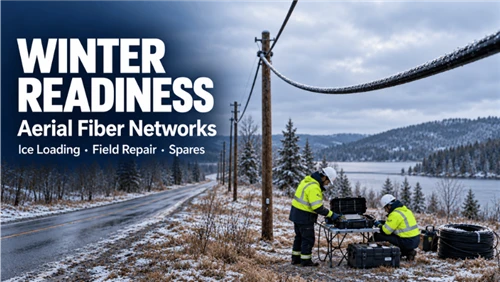

On 21 January 2026, ice and snow on a cable on the Sanchaji Bridge over the Xiang River in Changsha, China, disrupted five base-station network elements. Two crews laid a temporary emergency cable, spliced and tested it, and restored coverage. Elsewhere in the city, inspectors found an aerial cable sagging under ice until its lowest point was close to pedestrian head height; crews climbed the poles, stripped the ice and lifted the cable back to its original pole-line height. The report does not date this second incident (Xinhunan, Rednet, both in Chinese).

Changsha, 21 January 2026: Hunan Mobile crews on the deck of the Sanchaji Bridge over the Xiang River, where ice-laden cable failed and took out five base-station network elements. Emergency cable runs along the bridge parapet, with the city skyline across the water. Photo: Xinhunan / Hunan Mobile Changsha Branch.
Two more January 2026 reports add detail. Tianmen Unicom in Hubei restored an enterprise leased line after ice stretched and broke an aerial cable (Hubei Daily client, 22 January). In Suzhou, Anhui, snow on 19 and 20 January cut five cables, two of them aerial river crossings (Xinhua, 22 January).
These cases show three links in one chain: how much ice a line can carry, how quickly service is restored, and how well the repair is made. This guide is for maintenance and outside-plant staff who prepare aerial fiber lines for winter. It turns each link into something that can be checked, recorded and handed over: a load check on key spans, a repair and splice record, and a spares kit matched to the installed cable.
About the evidence
The field cases come from China, with two European cases added at the end of section 3 for comparison. The load reference data come from US sources: OFS, whose figures follow the NESC loading districts, and Draftech, which works on US wood poles. The cases show what fails and how crews respond; the US data show how a loading check is built. Neither supplies design values for your network, which must come from your national standard and local ice and wind records. Statements in this guide carry one of three labels:
- Reported stated in a cited news report or vendor article.
- Reference published technical data, with its edition given.
- Recommended this guide's own suggestion, not taken from any source.
1. How ice loads an aerial line
Aerial plant carries wind, ice and temperature loads for its whole service life, and the cable and strand expand and contract with them. OFS points out that this differs from buried and duct cable, whose heaviest load usually comes during installation. Optical fiber is also susceptible to static fatigue: under constant stress in the presence of moisture, cracks grow slowly, so fiber strain can reach damaging levels while the cable and its supports look intact, and the problem may surface months or years after installation (Reference: OFS IP-003).
OFS therefore applies two separate checks. The strength check applies the NESC storm loads (Table A in the guideline) and requires that the strand carry them without exceeding 60% of its rated breaking strength. The stiffness check applies the conditions in Table B and limits fiber stress to 12,500 psi (about 86 MPa). In an ice storm the ice rows matter most; the hot rows explain why a span that holds in winter must still be checked for summer.
| Check | District | Radial ice | Wind pressure | Temperature |
|---|---|---|---|---|
| Strength (Table A) | Heavy | 0.5 in (12.7 mm) | 4 lb/ft² (≈190 Pa) | 0°F (−18°C) |
| Strength (Table A) | Medium | 0.25 in (6.4 mm) | 4 lb/ft² | 15°F (−9°C) |
| Strength (Table A) | Light | none | 9 lb/ft² (≈430 Pa) | 30°F (−1°C) |
| Stiffness (Table B) | Heavy | 0.5 in | 4 lb/ft² | 32°F (0°C) |
| Stiffness (Table B) | Medium | 0.25 in | 4 lb/ft² | 32°F (0°C) |
| Stiffness (Table B) | All | none | 9 lb/ft² | 100°F (38°C) |
| Stiffness (Table B) | All | none | none | 170°F (77°C) |
Reference: OFS IP-003, September 2013 edition, US NESC districts; SI values are approximate conversions. OFS also lists April 2018 and March 2021 editions, which were not compared here, so confirm every value against the current edition before reusing it.
Cable and strand are one layer of the problem. The OFS guideline assumes an existing strand and does not cover pole line construction. Draftech's pole loading article treats the whole pole as the unit of analysis: each pole is modelled with every existing and proposed attachment at its real height, loaded under the specified wind, ice and temperature, and compared with the pole's rated capacity to give a utilization figure. Inputs per pole include attachment heights, tensions from real spans and sags, cable weights and diameters, pole class, species, height and setting depth, and guy angles and anchors. The analysis is run one pole at a time with the actual spans on both sides, not a route average (Reported: Draftech is an engineering services firm, and the article is set in the US).
2. Pre-storm checks on key spans
Reference figures transfer only under their own conditions. OFS Table C gives maximum recommended spans for OFS cable families lashed to a strand, assuming 1.5% initial sag and meeting both criteria above. On a 6.6M strand, Fortex loose-tube cable is listed at 400 ft (about 122 m) in the heavy district and 800 ft (about 244 m) in the medium district, while AccuRibbon ribbon cable is listed at 225 ft (about 69 m) and 375 ft (about 114 m). Different cable designs on the same strand have different limits, so a span rule has to come from the data for the cable actually installed. The table covers strand-supported cable only. ADSS and other self-supporting cable needs the manufacturer's tension and sag data, and design ice and wind values must come from your national standard and local records.
| Check | What to record | Basis | Escalate to engineering review when |
|---|---|---|---|
| Spans and sag | Actual span length, current sag, strand size, cable type | Reference: OFS Table C logic | The span exceeds the limit for that cable and strand, or sag is visibly beyond design |
| Existing attachments | Full inventory from a field survey, with photos, including anything unrecorded | Reported: Draftech | The survey finds attachments missing from the records. In Draftech's own case, 15-year-old records showed 78% utilization and the survey showed above 105% |
| New or overlashed cable | Existing cable loading, strand size, span | Reference: OFS Section 5 | Any overlash onto an existing fiber cable: OFS limits the span to 50% of the Table C value, or calls for a strand one size larger |
| Poles and guys | Pole class and condition, guy angles, anchor space | Reported: Draftech | Utilization is marginal. Draftech lists four remedies: rearrange attachments, add guys, replace with a higher-class pole, or reroute. Guys need anchor space, and rearranging needs the other users of the pole |
| Road, bridge and river crossings | Photos, clearance under the cable, vehicle and climbing access, who authorizes access | Cases reported; fields recommended | No safe access, or clearance is already marginal. Changsha had a failed bridge cable and a cable sagging to pedestrian height; two of Suzhou's five cuts were aerial river crossings |
| Closures and splice points | Location, seal condition, any cover | Reported: Suzhou Unicom | Seals are damaged or the closure cannot be reached safely. Before the storm, Suzhou Unicom reinforced vulnerable splice points and fitted insulating covers on exposed closures to prevent cold cracking |
| Remote pole lines after snow | Post-storm survey results | Reported: Suzhou Unicom | The survey finds leaning poles, slack strand or damaged cable. Suzhou Unicom assessed remote pole lines after the snow |
Order of work (Recommended): start with crossings and spans that already sag, then overlashed spans, the longest spans, and any section with undocumented attachments.
3. Field repair: restore service first, then repair properly
The four cases in these January 2026 reports differ in what was broken, where, and how crews got service back.
| Case | Fault | Response | Planning point |
|---|---|---|---|
| Changsha, Sanchaji Bridge | Cable on the bridge failed under accumulated ice and snow; five network elements affected | Two crews laid a temporary emergency cable, spliced and tested it; coverage restored | Special sections may need temporary restoration before any permanent work |
| Changsha, pole line near the south bus station | Aerial cable sagging under ice, lowest point near pedestrian height | Crews climbed the poles, stripped the ice, lifted the cable and re-fixed it at its original height | Sag can create a public-safety risk before anything breaks |
| Tianmen, Hubei | Aerial cable pulled apart by ice; leased line down | Instruments located the break; crews cleared ice and snow from the work area, laid 50 m of new cable, installed two closures, and tested each step repeatedly | A replacement section has a defined scope: length, closures, records |
| Suzhou, Anhui | Five cable cuts from heavy snow, two on aerial river crossings | On the Bianhe Road section, crews cleared snow by hand, melted ice with a heat gun and spliced for four hours at −10°C; all damaged cables were repaired by 18:00 on 19 January | River crossings are likely failure points, and splicing in sub-zero cold takes real time |
The first three columns are Reported; the planning points are Recommended. Across them, fault location decides where crews go and what they carry (Tianmen located the break with instruments first). Working conditions decide who can go and how: a bridge deck, a pole top or an icy road each limits access differently. The restoration approach decides what comes back first. Resources should be planned around break locations and section conditions, not from a fixed template.

Tianmen, Hubei: a Unicom technician works at the roadside during the leased-line repair described above, with the coil of new cable staged beside him and snow still lying along the kerb. The job called for 50 m of cable and two closures. Photo: Hubei Daily client.
Temporary restoration needs a follow-up (Recommended). The Changsha bridge report ends when coverage returns, and none of the cited reports describes later permanent work. For every temporary restoration, log what is temporary, who owns the permanent repair, the target date, and a recheck after the next ice event.
Cold affects crews and equipment. Tianmen's crew worked with stiffened fingers and awkward equipment, and Suzhou's spliced for four hours at −10°C (Reported). Before a winter callout, check (Recommended): the operating temperature range of the splicer and OTDR in their manuals, battery condition in the cold, whether hand protection still allows fine work, and whether the site offers shelter from wind and snow.
Wider weather cases: wind, water and the last mile
Two cases from Europe in the same winter show what happens when access and the weather window, rather than the splice, set the restoration date. In central Portugal, storm-force winds on 4 and 5 February 2026 snapped dozens of aerial fibre lines. Altice Portugal's field bulletin put the densest cluster of simultaneous faults in Leiria, Pombal, Marinha Grande, Ourém and Alcobaça; Meo counted close to 14,000 service tickets in Leiria alone by noon. Repair order was set by customer type - primary schools, health centres and industrial estates first, rural hamlets on overhead cable last - with 250 technicians redeployed from Lisbon and Porto, 60 portable generators for street cabinets where the grid had also failed, and drone inspection along pine corridors (Reported: The Portugal Post, 5 February 2026).
In Cornwall, Storm Goretti on 8 January 2026 took out power, water and broadband at Porthallow on the Lizard Peninsula. Power and water returned within days. The broadband did not, and the village was still offline three weeks later, with digital landlines dead and mobile signal available on one small patch of beach. Openreach said it had replaced multiple telegraph poles and resolved a power fault at its own equipment, but that wind speeds and gusts were restricting the use of hoists - plant that cannot be operated safely in high wind. The company also rejected the idea that the switch to fibre had made the county more vulnerable, attributing the outages largely to trees falling on overhead wires or bringing down poles (Reported: Falmouth Packet, 29 January 2026).
Both cases land on the same three points this guide already makes. First, the failure was in the aerial last mile, not in the core. Second, the binding constraint on restoration was access - a bridge deck, a hoist that cannot be raised, a lane blocked by fallen trees - which is why section 2 asks for access conditions and clearance to be recorded for every crossing before winter. Third, the clock that mattered ran in days and weeks, not hours, which is why a temporary restoration in section 3 needs an owner and a target date rather than a closed ticket.
4. Splice restoration: what to do and what to record
Tianmen Unicom's repair is the most complete path among the cases. Instruments showed that ice had pulled the aerial cable apart; crews cleared the work area, measured, and settled on 50 m of new cable with two closures, which implies one splice point at each end of the replaced section (Reported, with the splice-point reading inferred). That quantity belongs to this fault. A different break position, damaged length or slack on site gives a different number of splice points.
The report names splicing, closure mounting and fixing, fiber color matching, excess-fiber coiling and moisture sealing as the work. The table puts them in working order and adds what to record. The report gives no detail beyond the list, so the checks and records are Recommended unless marked.
| Step | What to check | What to record | Basis |
|---|---|---|---|
| 1. Fiber color matching | Each fiber joins its original counterpart at both ends | Fiber map: color and position, old to new | Step named in report |
| 2. Fusion splicing | Allow working time and wind shelter for cold work | Operator, date, equipment | Step named in report |
| 3. Excess-fiber coiling | Coil within the bend limit of the cable and the closure | Tray layout | Step named in report; limits come from the cable and closure makers |
| 4. Closure mounting and fixing | Secure on the strand or pole | Closure ID, location, height | Step named in report |
| 5. Sealing | Seal by the closure maker's method; check for water ingress | Seal method, inspection date | Step named in report; Suzhou Unicom also fitted covers on exposed closures |
| 6. Testing | OTDR trace of each repaired fiber; splice loss measured in both directions and averaged; compared with the installation baseline trace if one exists; check whether your specification also requires insertion-loss testing | Trace files, method, results | Reference: FOA OTDR guide |
| 7. Handover | Start, end and length of the replaced section; closure positions; fiber map; test files; open items such as temporary work | One repair record | Recommended |
On testing, the Fiber Optic Association explains that an OTDR can show a false gain or an inflated loss at a splice when the two fibers differ in backscatter, and that readings from both directions, averaged, are the way to get an accurate inline splice loss. It also notes that many international standards do not accept an OTDR alone for the loss of an installed cable plant, though for many outside-plant cables an OTDR is considered sufficient, and that a trace taken at installation makes later comparison much easier (Reference). The Tianmen report says every step was tested repeatedly but gives no method or limits. This guide sets no pass or fail values: use your network's acceptance specification or the relevant standard.
5. Spares: matching and readiness
Suzhou Unicom reported 286 crew person-times, 72 vehicle-times and 43 repaired fault points for its whole storm response. Totals like these show the scale of an effort but cannot be turned into a per-repair allowance, because what one repair needs depends on the number of breaks and the site conditions. Spares are better planned by scenario and matched to the installed plant (Recommended, derived from the Tianmen and Changsha cases).
| Scenario | Items | What must match | How to verify before winter |
|---|---|---|---|
| Replace a damaged section (Tianmen type) | Spare cable, aerial closures, splice trays, sealing kits, mounting hardware | Cable construction and outside diameter, fiber type and count, strand or pole mounting method | Test-fit a closure on a sample of the installed cable; confirm tray capacity and cable-entry size from the datasheets |
| Temporary restoration of a special section (Changsha bridge type) | Emergency cable, splicing and sealing materials, temporary fixings | Fiber type and count of the service being restored; length for the crossing; fixings suited to the structure | Stage a complete kit at the depot; record where it is and who holds it |
In this table, 'same type' means the same cable construction and strength or support method, the same fiber type and count, and an outside diameter inside the closure's entry range. OFS shows why such details matter: bend limits and storage-coil sizes are set per cable type and diameter. In its 2013 Table D, Fortex loose-tube cable has a storage coil of 20 × cable OD but not less than 12 in, while LightPack cable has an 18 in coil (Reference). Tray space and fixings in the closure therefore have to suit the cable that will be spliced into it.

Figure 4 from OFS IP-003: a slack storage coil on an aerial span. Coil dimensions are set per cable type and diameter - in the 2013 edition, 20 × cable OD and not less than 12 in for Fortex loose-tube cable, against an 18 in coil for LightPack - which is what decides whether a closure tray and its fixings will accept the cable being spliced into it. Figure: OFS, Aerial Installation Guidelines for Fiber Optic Cable, IP-003 (2013).
A kit is ready when (Recommended):
- its contents are listed against the scenario table above;
- a closure and tray have been test-fitted on a sample of the installed cable;
- its location and owner are recorded;
- it was checked before the first forecast freeze, with items that age, such as sealing materials, checked against their dates;
- it is restocked after every use.
Glory products to review for the winter spares list
The following catalogue examples support the matching checks above (Recommended). Choose the spare cable for the installed support system and match the closure to the cable and splice plan.
ADSS Outdoor Cable - self-supporting cable replacement

For an existing ADSS route, start with an all-dielectric construction matched to the installed cable. Glory's product page shows a loose-tube cable with a non-metallic FRP central member, aramid reinforcement and PE or AT jacket options.
Confirm fiber type and count, outside diameter, the project's ice and wind cases, sag–tension data and compatible dead-end and suspension fittings before adding it to the spares list.
GYTC8S Outdoor Cable - figure-8 aerial routes

For a route built around a metallic messenger, this figure-8 cable is a candidate for replacement stock. The official page shows a stranded-wire support section, corrugated steel tape and a PE sheath.
Match the existing support arrangement, fiber specification, messenger hardware, cable-entry profile and bonding requirements. Have the span and weather loading checked for the supplied construction.
Outdoor Fiber Splice Closure - protect the repaired joints

A replacement section needs a closure suited to each splice point. This Glory product page lists a hinged enclosure for aerial and pole mounting, with space for fiber splicing and storage.
Confirm the exact model, loaded tray capacity, entry seals, cable diameter, strain relief and mounting kit on the order drawing. Test-fit the closure on the installed cable and confirm the sealing procedure and permitted installation temperature.
Product images: Glory Optical's linked product pages, checked 28 October 2026. The cable images are manufacturer construction illustrations; the enclosure image shows the catalogue product.
For a matched replacement kit, send Mia the installed cable specification, measured diameter, fiber count, span schedule, local ice and wind criteria, closure positions and required quantities: sales02@gloryoptic.com
6. A winter readiness checklist
The sections above reduce to three documents, each with an owner and a point at which it counts as done (owners and completion tests are Recommended).
| Document | Contents | Owner | Done when |
|---|---|---|---|
| Priority section list | Road, bridge and river crossings and lines already showing sag; for each, photos, clearance under the cable, access conditions and who authorizes access | Maintenance lead | Every crossing is listed and has been visited this season |
| Line loading check record | Per section: cable type and strand size, spans and sag, pole and guy condition, attachment inventory, the ice and wind design values used and their source | Planning or engineering | A qualified engineer has signed off, and sections flagged for review have an outcome |
| Splicing spares and compatibility list | Items by scenario, what each must match, test-fit result, kit location and owner | Stores or maintenance | Each scenario kit has passed the readiness test in section 5 |
Add one more record: an open-items register for temporary repairs, with the permanent-repair owner, target date and recheck after the next ice event.
Start with one road or bridge crossing and check whether all three documents exist for it. The missing one is the first thing to fill in before winter.
Sources
| Source | Date or edition | Used for | Limits |
|---|---|---|---|
| Xinhunan, Changsha branch of Hunan Mobile and Rednet copy (Chinese) | 27 and 28 January 2026 | Sanchaji Bridge failure and temporary cable; sagging aerial cable near the south bus station | Only the bridge incident is dated (21 January); the sag incident is undated |
| Hubei Daily client, Tianmen Unicom (Chinese) | 22 January 2026 | Leased-line repair: 50 m of cable, two closures, splicing steps | Gives no test method or limits |
| Xinhua, Suzhou Unicom (Chinese) | 22 January 2026 | Five cable cuts, river crossings, sub-zero splicing, pre-storm closure and splice-point measures, citywide totals | Operator's own account; totals cover the whole response |
| Falmouth Packet (The Argus), Porthallow cut off after Storm Goretti | 29 January 2026 | Three weeks without service, telegraph-pole replacement, wind limits on hoist use, operator statement | Single local title; built on resident interviews and one operator statement |
| The Portugal Post, Meo outages in central Portugal | 5 February 2026 | Five councils affected, restoration priority, crew and generator numbers, 72-hour credit rule | Press summary; headcount and ticket figures come from the operator's own bulletin |
| OFS, Aerial Installation Guidelines for Fiber Optic Cable, IP-003 | September 2013 edition, on a distributor's site | Storm-load conditions, fiber stress limit, span and overlash rules, bend diameters | US NESC districts and OFS cable families only; newer editions (2018, 2021) not compared |
| Draftech, Pole Loading Analysis with O-Calc Pro | Published 3 April 2026, updated October 2026 | Whole-pole analysis, inputs, remedies, outdated-records example | Vendor article on US wood poles; case figures are the company's own |
| Fiber Optic Association, OTDR guide | Page copyright 2008 to 2024 | Splice-loss measurement, bidirectional averaging, baseline traces, OTDR versus insertion-loss testing | General guidance, not an acceptance standard |
Image credits: the field photographs and the OFS figure above are reproduced for technical commentary with attribution to the originating outlet or publisher. Copyright remains with Xinhunan / Hunan Mobile Changsha Branch, Hubei Daily client, and OFS. Replace them with your own site photography before any commercial republication.