
Quick Answer
A procurement-ready fiber distribution box FAT should identify the tested configuration, reference the applicable standard and verify cable retention, mechanical integrity, post-stress sealing and optical stability.
Long-duration or potentially destructive tests usually belong to design qualification or representative batch sampling. Configuration, workmanship and optical records can be checked during routine production inspection. Buyers preparing an RFQ can use Glory's fiber distribution box purchasing checklist to define the loaded BOM, cable ranges, splitter configuration and evidence package before a sample is produced.
1. Build the FAT Around Three Evidence Layers
The term FAT is often used for several different activities. Separating them prevents an old type-test report from being presented as proof of the current production batch.
| Evidence layer | Decision it supports | Appropriate scope |
|---|---|---|
| Design qualification | Is the product design suitable for the intended environment? | Mechanical, environmental, sealing and optical performance tests |
| Batch acceptance | Does the shipment remain consistent with the approved design? | Representative samples, document review and selected risk-based tests |
| Routine inspection | Is each supplied unit assembled and configured correctly? | Workmanship, accessories, port map, cable hardware and optical records |
A destructive impact test may be appropriate during qualification without being repeated on every box. Conversely, qualification evidence cannot detect missing blanking plugs or an incorrect splitter installed in the current order. For standard and customized products in Glory's fiber box portfolio, the required evidence level should be agreed at quotation stage.
2. Standards Hierarchy for Purchasing Specifications
The RFQ or purchase order should state the standard edition, product environment and agreed test severity. A broad compliance statement leaves the actual procedure open to interpretation.
| Reference | Procurement use |
|---|---|
| ITU-T L.208 | International performance framework for indoor non-temperature-controlled and outdoor above-ground fiber distribution boxes |
| YD/T 2150-2020 | China communications-industry requirements for fiber distribution boxes |
| TLC standard-change document | Certification-facing comparison of the 2010 and 2020 YD/T 2150 editions |
| IEC 60529 | Basis for interpreting enclosure IP classifications |
| ISO 2859-1:2026 | AQL-indexed sampling schemes for lot-by-lot inspection by attributes |
ITU-T L.208 and YD/T 2150-2020 should not be treated as interchangeable test sheets. Their cable-load methods and vibration conditions differ. The buyer should select one principal acceptance basis and document any additional operator or regional requirements. Glory's OEM/ODM process can translate the selected clauses into a model-specific inspection matrix.
3. Cable Retention Must Represent the Installed Entry System
The retention result depends on the complete load path from the cable jacket and strength member to the clamp, gland and enclosure structure.
The official ITU-T L.208 test program specifies a diameter-based load for multi-fiber distribution cables-cable diameter multiplied by 10 N, with a 500 N maximum-and 25 N for drop cables. The TLC comparison presents YD/T 2150-2020 differently: at least 500 N for the distribution cable and at least 25 N for the user cable.
Before loading
- Record cable type and actual outside diameter.
- Photograph or mark the cable position.
- Identify the gland, insert and clamp revision.
After loading
- Check movement at the entry and internal clamp.
- Inspect the jacket, seal and fiber routing.
- Complete the required sealing and optical checks.
The GL-A2-16C fiber distribution box uses separated routing and clamping for feeder and drop cables. Compact enclosures such as Glory's 16-core FTTx termination box should likewise be approved with the project cable family because cable shape, bend space and entry compression interact inside the housing.
4. Separate Impact, Service Vibration, Transportation and Shock
A single "mechanical test passed" entry conceals important differences between the test methods.
| Test | Main risk represented | Evidence buyers should check |
|---|---|---|
| Impact | A local blow during handling, installation or service | Cover, hinge, latch, entry area, internal structure and sealing |
| Service vibration | Repeated movement while the box is installed | Mounting points, fasteners, cable clamps and transient optical loss |
| Transportation test | Packaged-product stress during logistics | Packaging condition, loose parts and shipment-related damage |
| Shock | A short mechanical pulse | Internal component movement and sudden optical disturbance |
ITU-T L.208 specifies separate impact, vibration and shock evaluations. Its outdoor impact method uses a steel ball dropped from one metre, while the indoor method uses a lower drop height. Service vibration is evaluated across three axes with static and dynamic optical criteria.
The TLC comparison table explicitly labels one retained item as a transportation test and notes that it was called a vibration test in the 2010 edition. The 2020 edition lists a separate new vibration test for operational mechanical performance. A transportation-test report therefore cannot serve as the sole evidence for service vibration.
Pre-connected products should be tested with adapters, splitters, cable entries and mounting hardware installed. The installation assumptions can be aligned with Glory's pre-terminated cable route survey guide before the FAT sample is built.
5. Place the Sealing Check After Mechanical Stress
The IP classification identifies a controlled ingress-protection level. It does not explain whether the ordered cable gland still seals after retention, impact or vibration.
ITU-T L.208 allows the relevant dust and water ingress evaluation to be completed after the related mechanical tests. This sequence can expose reduced gland compression, cover deformation, a loosened entry or a displaced blanking plug that was absent during the initial enclosure test.
Two configuration checks used during Glory project review
- The declared minimum and maximum feeder diameters must fall within the selected gland or insert range.
- Every unused entry shown on the drawing must have a corresponding blanking component in the BOM and physical sample.
These are engineering review checkpoints rather than a published statistical defect rate.
Glory's outdoor FDB sealing acceptance guide explains the relationship between cable diameter, gland compression, entry plugs and cover condition. Its IP-rating selection guide helps buyers separate weather exposure from temporary or continuous immersion requirements.
Recommended footage: cable and blanking-plug configuration, cover closure, water application, test duration indicator and the internal inspection after testing.
6. Loaded Boxes Need Optical Evidence During Mechanical Testing
Mechanical damage is not always visible. Cable movement can tighten a fiber bend, shift a splice sleeve or transfer force to an adapter while the enclosure remains closed.
ITU-T L.208 separates optical evaluation into static change in attenuation and dynamic transient loss. For vibration, shock and intervention tests, the customer and supplier agree the applicable optical criteria.
Measurement record
- Initial insertion-loss baseline
- Test wavelengths and measurement route
- Transient change during vibration or shock
- Residual change after the test
Configuration record
- Splitter, adapters and pigtails
- Connector cleaning and inspection status
- Port population and internal routing
- Any adjustment made during testing
The GL-FSN-0416R pre-connect distribution box and GL-FTB-16C outdoor pre-connected box combine enclosure hardware with optical interfaces and splitter capacity. Their evidence should represent the supplied connector population and loaded BOM.
7. The Wider ITU-T L.208 Qualification Matrix
Cable retention, impact, vibration and sealing translate directly into common RFQ and pre-shipment decisions. ITU-T L.208 defines a wider qualification program that also deserves a project risk review.
| Additional test | When it becomes relevant |
|---|---|
| Cable bending | Cables may be pushed sideways during routing, pole work or maintenance |
| Cable torsion | Installation or rework can rotate the cable near the entry |
| Temperature cycling | The enclosure and optical BOM face large seasonal temperature changes |
| Re-entry | Technicians are expected to reopen the box for activation, repair or expansion |
| Salt mist | Outdoor hardware is installed in coastal or corrosive environments |
| Aggressive media resistance | The box may contact industrial contamination or cleaning chemicals |
| Node intervention | Routine access can disturb fibers, splices and connectors |
Cable bending and torsion represent loads that an axial pull cannot reproduce. Re-entry evaluates whether repeated opening, fiber access and thermal ageing affect sealing. Salt-mist testing is mainly relevant to corrosion-sensitive outdoor parts and may be applied selectively to the components at risk.
The entire matrix does not need to be copied into every batch FAT. The selection should reflect the installation environment, material set, maintenance model and valid qualification evidence for the chosen product in Glory's fiber optic termination box range.
8. Turn the FAT Report into Purchase-Release Evidence
A useful report allows the purchaser to connect the result to the approved product and shipment.
| Report field | Purchasing purpose |
|---|---|
| Product model and drawing revision | Confirms which design was evaluated |
| Sample and production-lot identity | Establishes batch traceability |
| Housing material and seal revision | Prevents unreviewed material substitutions |
| Loaded BOM | Identifies splitters, adapters, pigtails and accessories |
| Cable type and diameter | Connects the result to the specified entry system |
| Test standard and procedure | Defines the actual test severity |
| Equipment and calibration status | Supports measurement credibility |
| Before, during and after results | Shows transient and residual effects |
| Photos and nonconformity record | Supports remote review and dispute handling |
Glory applies a configuration-delta review when the approved sample and production order differ. Changes to the housing material, seal, gland, cable range, splitter, adapter, routing or mounting hardware are compared with the available evidence so that any additional test can focus on the affected risk.
The internal layout should be validated before testing. Glory's fiber box capacity guide helps buyers check tray use, splitter position, splice capacity and routing space before the BOM is frozen.
9. From RFQ to Purchase Release
A repeat order of an unchanged standard product may rely on valid qualification evidence, batch inspection records, configuration photos and remote document review. A new enclosure, custom gland, changed material, first production lot or previous nonconformity justifies a higher level of control.
Information to place in the RFQ
- Installation environment and mounting method
- Distribution and drop-cable specifications
- Required splitter and connector configuration
- Enclosure and entry-sealing requirement
- Principal standard and operator-specific clauses
- Requested sample or inspection plan
- Report format and witness requirement
- Failure, rework and retest responsibilities
Glory can use these inputs to select an existing platform or prepare a custom configuration. The technical schedule can be submitted through the Request a Quote page before final pricing is requested.
10. Glory Product Starting Points for FAT Planning
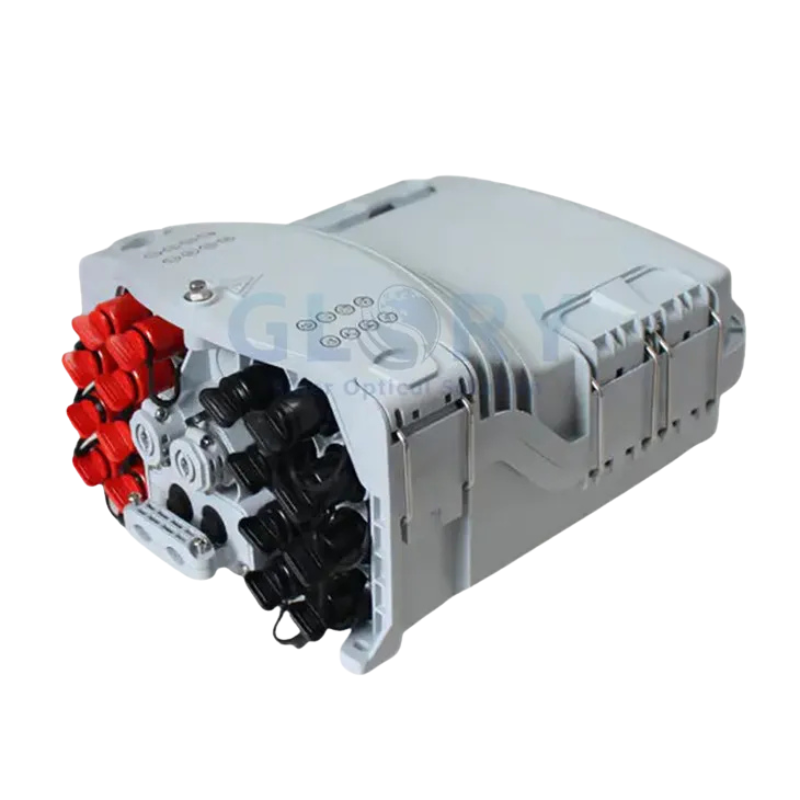
These products represent the enclosure types discussed in the article. Final selection still depends on the cable range, port population, splitter BOM, mounting method and required acceptance evidence.



Procurement FAQ
Q: What is the difference between FAT and SAT for a fiber distribution box?
A: FAT is completed before shipment at the supplier, manufacturer or appointed laboratory. It verifies the approved product configuration and production evidence. SAT takes place after delivery or installation and checks shipment condition, installed cable sealing, mounting, port allocation and end-to-end optical performance under site conditions.
Q: Does the buyer need to witness the FAT at the factory?
A: On-site witnessing is a commercial risk decision. It is more valuable for a new supplier, first article, custom mold, changed sealing system, high-value contract or previous test failure. For an established repeat configuration, a live remote witness, timestamped test video, sample identification and signed report may provide adequate control.
Q: What sampling ratio or AQL should be used?
A: There is no universal FAT sampling percentage for every distribution box order. ISO 2859-1:2026 can support lot-by-lot inspection of attributes, but the buyer must define the lot size, inspection level, defect classification and acceptance rule. Destructive qualification tests require a separate sample plan.
Q: What should happen when a FAT sample fails?
A: The report should open a nonconformity record and identify the affected lot. The supplier then provides containment, root-cause analysis, corrective action and a proposed retest plan. The original failed result should remain in the report history rather than being replaced by a clean retest page.
Q: How long does a fiber distribution box FAT take, and is it charged separately?
A: Routine configuration, workmanship and optical inspection can be completed within the production release process. Mechanical qualification, environmental cycling, third-party laboratory work and buyer witnessing require additional scheduling. Buyers should request separate pricing for standard factory evidence, witnessed FAT and third-party qualification.
Authoritative References
- ITU-T L.208 - Requirements for Passive Optical Nodes: Fibre Distribution Box
- Official YD/T 2150-2020 industry-standard listing
- TLC certification document - Fiber Distribution Box Standard Changes
- IEC 60529 - Degrees of Protection Provided by Enclosures
- ISO 2859-1:2026 - AQL-Indexed Sampling Procedures
Purchase on Evidence That Matches the Shipment
Send the installation environment, cable drawings, connector and splitter BOM, mounting method, standard, sampling plan and witness requirement. Glory can align the product configuration and FAT evidence before production begins.
Request a FAT Quotation Contact the Technical Team