
In telecom projects, many engineers treat the IP rating of splice enclosures as a simple "higher is better" metric. In reality, there is a clear land-water boundary between IP65 and IP68 - and the line between them is defined by physics, not marketing. Choose the wrong rating, and your fiber closure transforms from a protective shell into a mini swimming pool. This article decodes the IEC 60529 standard, dismantles six common IP-rating myths, and provides a field-tested selection framework for every deployment scenario.
Decoding the IP Code: What IEC 60529 Actually Says
The "IP" in IP65, IP67, or IP68 stands for Ingress Protection, a classification system defined by IEC 60529 - the international standard that rates how well electrical enclosures resist the intrusion of solid objects and water. Every IP code follows the format IP + first digit (solid protection, 0–6) + second digit (liquid protection, 0–9), optionally followed by supplementary letters.
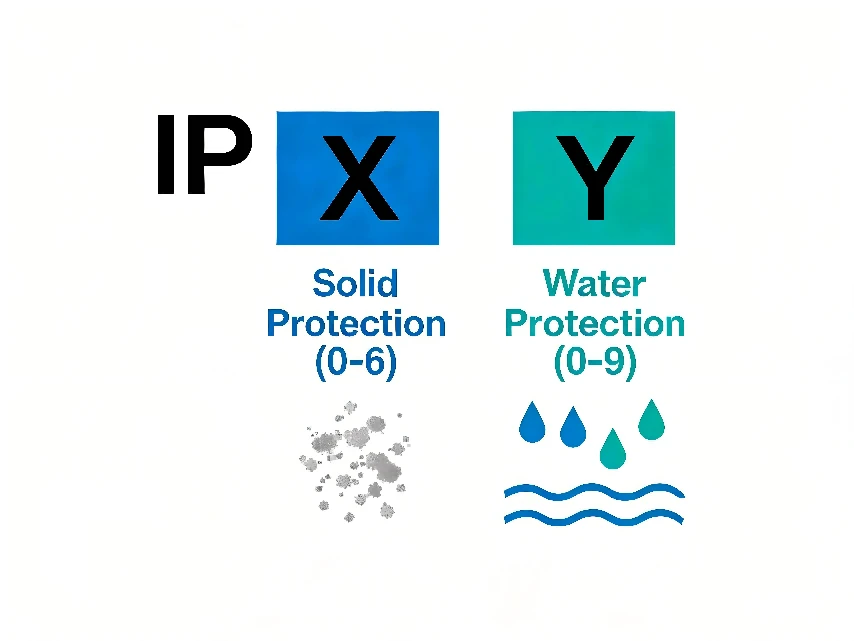
The First Digit: Solids (0–6)
The first digit rates protection against solid foreign objects and access to hazardous parts. Level 6 - the highest - means dust-tight: no ingress of dust whatsoever. For outdoor fiber closures, level 6 is effectively mandatory, as airborne dust and particulate contamination degrade optical splice performance over time. This is why virtually all outdoor-rated fiber closures carry an IP6x rating.
The Second Digit: Liquids (0–9)
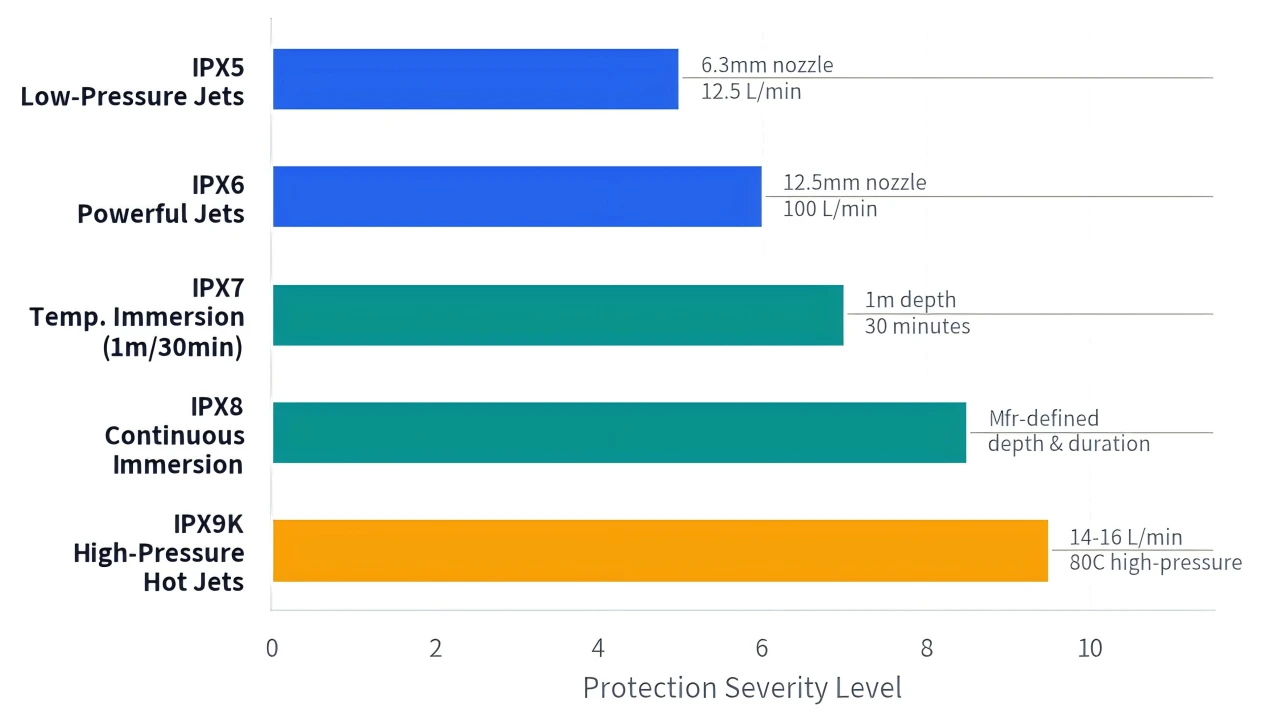
The second digit is where most misconceptions live. It rates protection against water ingress using progressively more severe test conditions - but the progression is not cumulative above level 6. This is the single most misunderstood aspect of the IP code:
•Level 5 - Protected against low-pressure water jets (6.3 mm nozzle) from any direction.
•Level 6 - Protected against powerful high-pressure water jets (12.5 mm nozzle) from any direction.
•Level 7 - Protected against temporary immersion: 1 meter depth for 30 minutes.
•Level 8 - Protected against continuous immersion under manufacturer-specified conditions (depth and duration are NOT fixed by the standard).
•Level 9K - Protected against high-pressure, high-temperature water jets (from ISO 20653, not IEC 60529 itself).
Critical: Water Digits Are Not Cumulative
An enclosure rated IP67 passed a temporary immersion test - but that does not mean it passed the powerful water-jet test required for IP66. If a site needs both jet resistance and immersion resistance, look for a dual rating such as IP66/IP68 rather than assuming one covers the other. This non-cumulative property is why a coastal pole-mounted closure rated IP67 might actually fail under typhoon-driven horizontal rain that an IP66 unit would shrug off.
What IP Ratings Do NOT Cover
Perhaps the most dangerous assumption is that an IP rating is a complete durability specification. It is not. The IP code is a tested ingress figure, not a full environmental performance spec. It explicitly does not cover:
• UV resistance - Prolonged sunlight degrades housing materials and gaskets, but the IP test says nothing about UV durability.
• Corrosion resistance - IP tests use fresh water. Salt spray, solvents, oils, and steam are not covered.
• Impact strength - Mechanical robustness against drops, vibrations, or cable pulling forces is not tested.
• Temperature cycling - Long-term gasket aging under thermal stress is not addressed, yet this is a primary real-world failure mode.
• IP tests use fresh water only - The rating says nothing about saltwater, acidic rain, or chemical-laden groundwater.
This is why two enclosures with the same IP68 rating can perform very differently after five years outdoors. The IP number is an entry ticket - not a guarantee of long-term reliability.
Six Dangerous Misconceptions About IP Ratings
After analyzing field failure data and consulting with installation teams, we have identified six pervasive myths that cause fiber closures to fail prematurely. Each one has a kernel of truth - and a costly blind spot.
|
Myth #1: "IP67 is always better than IP65" Truth: They protect against different things. IP65 resists water jets from any direction. IP67 resists temporary immersion in 1 meter of water for 30 minutes. They are not on the same axis. A wall-mounted FTTH terminal box that will never be submerged needs IP65's jet resistance - not IP67's immersion rating. Conversely, an underground handhole that pools water after rain needs IP67, and IP65 will fail regardless of how "high" the number seems. The right question is not "which is better?" but "which threat am I protecting against?"
|
|
Myth #2: "IP68 means permanently waterproof" Truth: Depth and duration are defined by the manufacturer, not the standard. IP68 means continuous immersion under conditions specified by the manufacturer. The IEC 60529 standard does not set a fixed maximum depth or duration for IP68. One manufacturer's IP68 might mean 1.5 meters for 72 hours; another's might mean 5 meters for 7 days. When specifying IP68 closures, always verify the manufacturer's stated immersion depth and duration, and request third-party test reports. An IP68 label without these specifics is an incomplete specification.
|
|
Myth #3: "All outdoor projects should use IP68" Truth: Over-specifying adds cost without fixing the real failure points. Specifying IP68 for every outdoor project raises material cost without solving the actual risk, because most water-ingress failures are caused by sealing or routing details that went wrong during installation - not by the enclosure body's IP rating being too low. An IP68 closure with a mismatched cable gland will leak just as fast as an IP65 one. The correct approach is to match the rating to the real environment and invest the savings in better installation training and quality cable-sealing kits.
|
|
Myth #4: "IP65 is fine for underground installations" Truth: IP65 handles water jets, not standing water. This is one of the most expensive mistakes in fiber network deployment. IP65 is designed for rain and water jets - it has no immersion capability whatsoever. Underground handholes and manholes routinely accumulate standing water after heavy rain. An IP65 closure placed in a manhole will flood within the first wet season. The practical minimum for underground installations with any water accumulation risk is IP67; for continuously wet or flood-prone sites, IP68 with a defined immersion spec is non-negotiable.
|
|
Myth #5: "Same IP rating means same performance" Truth: Material quality, gasket design, and construction matter as much as the number. Two closures both labeled IP68 can have vastly different real-world lifespans. The difference lies in what the IP code does not test: gasket material (silicone and EPDM age very differently under UV and temperature cycling), housing material (cold-rolled steel vs. polycarbonate vs. glass-filled polypropylene), cable entry seal design, and re-entry durability. A cheap IP68 closure from an unverified supplier may pass the lab test but fail within 18 months in the field, while a premium unit from a reputable manufacturer with the same rating can serve for 20+ years. |
|
Myth #6: "IP rating covers all environmental durability" Truth: IP is an ingress figure, not a durability spec. As explained above, IP ratings do not cover UV resistance, corrosion resistance, impact strength, temperature-cycling performance, or long-term gasket aging. For coastal or industrial sites, a closure rated IP65 or IP67 with a corrosion-resistant build (stainless steel hardware, UV-stabilized housing, EPDM or silicone gaskets) may outperform a generic IP68 unit with standard materials. The IP rating is one input - not the whole decision. |
Why High IP Ratings Still Fail in the Field
The most counterintuitive finding from field failure analysis is that most water-ingress failures are not caused by the IP rating being too low. They are caused by sealing or routing details that went wrong during installation. Understanding these failure modes is essential for translating a correct IP rating selection into actual field reliability.
Cable Entry: The Weakest Point
Cable ports, glands, rubber seals, and unused entry holes are the most common leakage paths. If the cable diameter falls outside the gland's sealing range, the gland never compresses correctly. A seal designed for a 5 mm drop cable will fail on a thicker feeder cable. Unused ports left open let water in even when the closure body is well designed.
Field Case Study
An IP65 wall-mounted box was reused in an underground handhole and flooded within two wet seasons. The housing and gasket were intact. The leak came from a cable gland sized for the original 5 mm drop cable but reused on a thicker feeder cable - the gland never sealed. The fix was not a higher-rated box. It was the correct gland, a closure rated for immersion, and sealing the unused ports.
Gasket Installation Errors
A gasket only protects the closure when it is seated evenly. Uneven cover pressure, a twisted seal, or screws tightened in the wrong order can break the seal on day one. Over months, heat, cold, sunlight, and mechanical stress slowly reduce compression. This is why long-term reliability depends on gasket material (silicone and EPDM age differently) far more than on the initial IP pass mark.
Condensation: The Imposter Leak
Water inside a closure does not always come from outside. Temperature swings cause warm, humid air trapped inside the enclosure to condense on the inner wall - and it can look exactly like a leak. Research has shown that condensation in aerial terminal closures, combined with deposited sea salt, can create ionically conductive pathways that degrade insulation and cause signal failure. Good internal design, sensible cable routing, and breathable venting (where compatible with the required IP level) can reduce this.
Cable Routing Without Drip Loops
If a cable enters from above with no drip loop, water runs down the jacket straight to the entry point and is eventually forced inside. A simple drip loop - routing cables to approach the gland from below or to the side - makes a measurable difference in real installations. This is a zero-cost fix that prevents a significant fraction of field failures.
The Selection Decision Framework
With the IEC 60529 standard decoded and the common myths dismantled, the remaining question is practical: how do you select the right IP rating for each deployment scenario? The following framework maps common installation environments to the recommended IP rating, sealing method, and critical verification points.
Environment-to-IP-Rating Matrix
|
Installation Scenario |
Recommended IP |
Sealing Method |
Key Verification Points |
|
Outdoor wall-mounted FTTH terminal box |
IP65 |
Mechanical (rubber gasket) |
UV-resistant housing, sealed ports, drip loop |
|
Pole-mounted distribution box (inland) |
IP65 - IP66 |
Mechanical |
Cable entry orientation, wind-driven rain |
|
Pole-mounted box (coastal / typhoon zone) |
IP66 |
Mechanical (stainless hardware) |
Salt spray corrosion resistance, powerful jets |
|
Underground handhole (good drainage) |
IP67 |
Gel or mechanical |
Cable diameter match, all unused ports sealed |
|
Underground manhole (periodic flooding) |
IP68 |
Mechanical (compression gaskets) |
Defined immersion depth/duration, re-entry |
|
Direct burial |
IP68 |
Heat-shrink or gel |
Submersion 1-3m for 24-72h, re-entry capability |
|
Flood-prone / high groundwater area |
IP68 |
Gel (TPE or silicone-based) |
Mfr-specified depth & duration, test report |
|
Indoor / building riser |
IP20 - IP44 |
Mechanical (light-duty) |
Fire-retardancy (UL 94 V-0 / IEC 60332) |
Sealing Method Comparison
The sealing method determines both the achievable IP rating and how easily the closure can be re-entered for maintenance. Three primary technologies dominate the market:
|
Sealing Method |
Principle |
Max IP |
Re-Entry |
Best For |
|
Heat-Shrink |
Heat-shrink sleeves with adhesive lining, ~350C |
IP67+ |
Difficult (cutting) |
Direct burial, submarine, permanent installs |
|
Mechanical |
Rubber O-rings / gaskets compressed by screws |
IP65-IP68 |
Easy |
Aerial, wall-mount, vaults needing maintenance |
|
Gel (TPE) |
TPE gel conforms to cable surfaces, fills gaps |
IP68 |
Easy (no residue) |
Distribution points, multi-cable entries |
|
Gel (Silicone) |
Latest evolution - improved elasticity & tolerance |
IP68 |
Easy |
Wide temp range, long-term UV tolerance |
The "Land-Water Boundary" Quick Reference
The original concept that inspired this article - the "land-water boundary" - is a useful mental model for rapid selection:
|
IP65 Rain & Jets Land dweller - wall, pole |
IP66 Powerful Jets Coastal, typhoon zones |
IP67 Temp. Immersion Water dweller - handhole |
IP68 Continuous Submersion Deep manhole, direct burial |
IP65 and IP66 are "land dwellers" - designed for rain and water jets, but incapable of handling standing water. IP67 and IP68 are "water dwellers" - engineered for immersion, with IP67 covering temporary accidents (1 meter, 30 minutes) and IP68 handling continuous submersion under manufacturer-defined conditions. Crossing this boundary - putting an IP65 closure underground or expecting IP67 to handle permanent flooding - is where most costly failures originate.
Conclusion: Pick the IP Rating From the Environment, Not the Data Sheet
The IP rating system is precise but often misapplied. The key takeaways for network architects, installation teams, and procurement decision-makers are:
• IP ratings are not cumulative above level 6. IP67 does not imply IP66. If a site needs both jet and immersion resistance, specify a dual rating.
• IP68 is manufacturer-defined. Always verify the stated immersion depth and duration, and request third-party test reports.
• The IP rating does not cover UV, corrosion, impact, or temperature cycling. These factors determine real-world lifespan as much as the ingress rating.
• Most field failures come from installation, not specification. Cable gland mismatch, unsealed ports, twisted gaskets, and missing drip loops defeat even the highest-rated closures.
• Match the sealing method to the operational model. Heat-shrink for permanent installs, mechanical for frequent access, gel for versatility.
Don't risk challenging the laws of physics to save a few dollars. The cost of repairing water damage once - dispatching a technician, re-splicing fibers, replacing the closure, and accounting for network downtime - could buy hundreds of correctly specified, properly installed fiber closures. Pick the IP rating from the environment, invest in installation quality, and verify everything. Your fiber network's reliability depends on both.