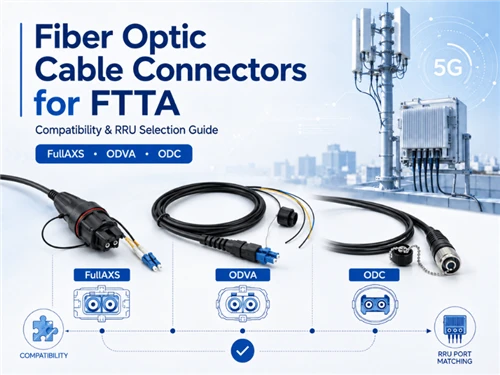
This guide covers the passive optical infrastructure layer of FTTH networks - from standards compliance and component selection to optical loss budgeting, factory test evidence, and installation practice. It is written for telecom engineers, ISP project managers, and procurement teams making component decisions for GPON deployments, XGS-PON upgrades, and greenfield FTTH rollouts. Where relevant, it references public technical documentation from Corning, CommScope, HUBER+SUHNER, and ITU-T standards bodies.
§1 - Standards & Certification Framework
Passive optical components for FTTH and FTTx must comply with a layered hierarchy of ITU-T, IEC, and regional standards. The table below reflects the certification framework applied at Glory Optical's Ningbo manufacturing facility. Where a standard has a direct public text, the source is linked.
One point worth noting on fiber selection: ITU-T G.652.D and G.657.A2 are often discussed as alternatives, but in practice they address different segments of the same network. Corning's application note on bend-insensitive fiber selection for FTTH provides a useful reference for understanding where G.657 grades add real value versus where standard G.652.D feeder cable is appropriate. The short answer: G.657.A2 or B3 is warranted in MDU last-drop and in-building routing; feeder and distribution segments are generally fine with G.652.D.
| Standard / Cert | Scope | Applied to | Reference | Status |
|---|---|---|---|---|
| ITU-T G.652.D | Standard singlemode SMF - attenuation ≤ 0.2 dB/km @ 1550 nm | Feeder cables, patch cords, pigtails | itu.int/rec/T-REC-G.652 | COMPLIANT |
| ITU-T G.657.A1/A2 | Bend-insensitive SMF - min bend radius 10 mm (A1) / 7.5 mm (A2) | Indoor drop cables, wall-outlet pigtails | itu.int/rec/T-REC-G.657 | COMPLIANT |
| ITU-T G.657.B3 | Ultra-bend-insensitive - 5 mm min bend radius | MDU riser, tight-space indoor routing | itu.int/rec/T-REC-G.657 | COMPLIANT |
| ITU-T G.984.x (GPON) | Gigabit PON - ODN Class B+ (28 dB) and C+ (32 dB) loss budgets | ODN splitters, enclosures, frames | itu.int/rec/T-REC-G.984.1 | VALIDATED |
| ITU-T G.9807.1 (XGS-PON) | 10G Symmetric PON - N1/N2/E1/E2 ODN classes, 9.95328 Gbps line rate | XGS-PON compatible ODN products | itu.int/rec/T-REC-G.9807.1 | VALIDATED |
| IEC 61754 series | Fiber optic connector interfaces - SC, LC, FC, MPO form factors | All connector types manufactured | iec.ch | CERTIFIED |
| IEC 60794-1/2/3 | Optical fiber cable - mechanical and environmental testing methodology | All cable products | iec.ch | CERTIFIED |
| Telcordia GR-326-CORE | Generic requirements for singlemode optical connectors and jumper assemblies | SC/APC, SC/UPC, LC/UPC connectors | Ericsson Standards Portal | CERTIFIED |
| Telcordia GR-771-CORE | Generic requirements for fiber optic splice closures | Dome, horizontal, and inline splice closures | Ericsson / Telcordia Standards Archive | CERTIFIED |
| IEC 60529 IP68 | Dust-tight and water immersion (≥ 1 m / 30 min minimum) | All outdoor enclosures and splice closures | iec.ch | CERTIFIED |
| TIA-568.3-D | Optical fiber cabling components standard - structured cabling | Data center MPO/MTP assemblies, patch panels | TIA Standards | COMPLIANT |
| ISO 9001:2015 | Quality Management System | Full manufacturing operation | iso.org | CERTIFIED |
| CE / RoHS | EU conformity and hazardous substance restrictions | All products for EU markets | EU Commission | CERTIFIED |
| ITU-T G.9804.3 (50G-PON) | Next-generation 50G symmetric PON - forward-compatible ODN infrastructure | ODN passive layer is generation-agnostic | itu.int/rec/T-REC-G.9804.3 | INFRASTRUCTURE COMPATIBLE |
The IEC 61754 series defines the physical interface dimensions and tolerances for fiber optic connector types. For FTTH applications, IEC 61754-4 (SC) and IEC 61754-20 (LC) are the relevant parts. HUBER+SUHNER publishes a useful connector selection reference that maps connector types to application environments - particularly relevant for SC/APC vs SC/UPC decisions in PON ports.
§2 - ODN Network Architecture & Topology
The Optical Distribution Network spans from the Optical Line Terminal (OLT) in the central office to each subscriber's Optical Network Terminal (ONT). It is entirely passive - no active electronics, no power supply in the field. This is what gives a properly designed ODN its multi-decade service life and its compatibility across PON generations.
The ITU-T G.984 and G.9807.1 standards define the loss budget classes that constrain ODN design, but they leave architecture decisions - split ratios, segment lengths, feeder topology - to the operator. CommScope's FTTH infrastructure planning resources and the Broadband Forum's TR-247 are useful references for topology selection logic, particularly for operators weighing centralized versus distributed splitting strategies.
Split Ratio Architecture Models
| Model | 1st Stage Split | 2nd Stage Split | Total Ratio | Typical Use Case | Max ODN Loss (GPON B+) |
|---|---|---|---|---|---|
| Single-Stage Centralized | 1×32 or 1×64 at FDT | None | 1:32–1:64 | Dense urban MDU, campus | 18.5–21.5 dB |
| Two-Stage Distributed | 1×4 or 1×8 at FDH | 1×8 or 1×16 at NAP | 1:32–1:128 | Suburban greenfield FTTH | 20–23.5 dB |
| Cascaded (Three-Stage) | 1×2 at headend | 1×4 at node, 1×8 at drop | 1:64 | Rural / long-reach PON | 24–28 dB (Class C+ required) |
| XGS-PON N2 Class | 1×8 at FDH | 1×16 at FAT | 1:128 max | 10G symmetric access rollout | 16–31 dB budget window |
Optical Loss Budget Reference - GPON Class B+ (28 dB), 1:32 Split, 10 km
| Loss Component | Specification | Typical Value |
|---|---|---|
| Fiber attenuation (10 km @ 1310 nm) | G.652.D ≤ 0.4 dB/km | 4.0 dB |
| PLC Splitter 1×32 (IL) | ITU-T G.671 | 15.8 dB |
| Connectors (4 pairs × 0.35 dB max) | IEC 61754 / GR-326 | 1.4 dB |
| Splice loss (8 fusion splices × 0.1 dB) | IEC 61300-3-33 | 0.8 dB |
| Aging and design margin | Operator policy | 1.5 dB |
| Total Estimated Loss | 23.5 dB - within 28 dB budget |
XGS-PON (G.9807.1) coexists with GPON on the same ODN by using different downstream wavelengths: GPON at 1490 nm, XGS-PON at 1577 nm. This wavelength plan - specified in G.9807.1 Table 3 - means no WDM filter change is needed at the splitter level. The passive ODN infrastructure is reused in its entirety. The Broadband Forum's TR-247 (XGS-PON Coexistence) provides the full architectural and wavelength isolation requirements for mixed deployments.
Component Selection by ODN Segment
§3 - Factory Test Data & Performance Evidence
Glory Optical maintains an in-house optical performance test laboratory at its Ningbo facility. All products undergo 100% optical testing prior to shipment. The data below is drawn from production batches in Q4 2024 and Q1 2025. Batch-level test reports in PDF format are available for OEM partners and telecom operator qualification programs on request.
For context on what "good" insertion loss looks like across the industry: Corning's passive optical component specifications and HUBER+SUHNER's single-fiber connector datasheets serve as useful reference benchmarks for insertion loss, return loss, and mating durability requirements.
PLC Splitter Insertion Loss - Production Batch Data
| Split Ratio | Wavelength | Typical IL (dB) | Max IL Spec (dB) | Uniformity (dB) | Return Loss (dB) | Result |
|---|---|---|---|---|---|---|
| 1×2 | 1310 / 1490 / 1550 nm | 3.5 | 3.8 | ≤ 0.3 | ≥ 55 | PASS |
| 1×4 | 1310 / 1490 / 1550 nm | 6.8 | 7.0 | ≤ 0.5 | ≥ 55 | PASS |
| 1×8 | 1310 / 1490 / 1550 nm | 10.0 | 10.5 | ≤ 0.6 | ≥ 55 | PASS |
| 1×16 | 1310 / 1490 / 1550 nm | 13.1 | 13.5 | ≤ 0.8 | ≥ 55 | PASS |
| 1×32 | 1310 / 1490 / 1550 nm | 15.8 | 16.5 | ≤ 1.0 | ≥ 55 | PASS |
| 1×64 | 1310 / 1490 / 1550 nm | 19.0 | 20.0 | ≤ 1.5 | ≥ 55 | PASS |
SC/APC Pigtail & MPO Assembly - Insertion Loss Data
| Product | Fiber Count | Grade | Avg IL (dB) | Max IL (dB) | Min RL (dB) | Application |
|---|---|---|---|---|---|---|
| MPO-12 Trunk | 12 | Type A (Elite) | 0.20 | 0.35 | ≥ 60 | 40G / 100G SR4 |
| MPO-24 Trunk | 24 | Type A (Elite) | 0.22 | 0.35 | ≥ 60 | 100G / 400G SR8 |
| MPO-12 Cassette | 12 MPO → 12 LC | Standard | 0.25 | 0.50 | ≥ 55 | 10G / 40G |
| SC/APC Pigtail | Singlemode | APC | 0.10 | 0.20 | ≥ 65 | GPON / XGS-PON |
Environmental & Mechanical Test Results
The tests below follow IEC methods. HUBER+SUHNER's published technical notes on fiber optic closure environmental qualification and CommScope's splice closure installation guides provide useful comparison references for IP68 and thermal cycling acceptance criteria.
| Test | Standard | Condition / Duration | IL Change Observed | Verdict |
|---|---|---|---|---|
| Temperature Cycling | IEC 60068-2-14 | −40 °C to +85 °C, 100 cycles | < 0.05 dB | PASS |
| Damp Heat | IEC 60068-2-78 | 85 °C / 85% RH, 2000 h | < 0.08 dB | PASS |
| IP68 Water Immersion | IEC 60529 | 1 m depth, 24 h | 0 dB (no ingress detected) | PASS |
| Salt Spray Corrosion | IEC 60068-2-11 | 5% NaCl, 500 h | No structural degradation | PASS |
| Tensile Load (FTTH drop cable) | IEC 60794-1-E1 | 80 N, 60 seconds | < 0.1 dB during load | PASS |
| Crush Resistance (closure body) | IEC 60794-1-E7 | 220 N / 100 mm | No failure or deformation | PASS |
| UV Aging (outdoor HDPE jacket) | IEC 60794-1-F10 | 1000 h exposure | No jacket cracking | PASS |
| SC/APC Mating Durability | IEC 61300-2-2 | 500 mating cycles | IL change < 0.2 dB cumulative | PASS |
A recurring complaint from field engineers is that supplier datasheets show specification limits but not measured production distributions. Per-batch IL test reports - listing actual measured values across the production run, not just min/max limits - are available for qualified OEM partners and operator procurement programs. Contact our technical sales team to request sample reports before purchase.
§4 - Deployment Practice & Installation Guidance
The ODN passive layer sets the ceiling for network performance for the life of the deployment - typically 20–30 years. Installation quality at commissioning determines how much of that theoretical ceiling is actually realized. The following section covers the two most common deployment approaches, common failure modes observed in the field, and the specific steps that prevent them.
Pre-Connectorized vs. Fusion Splice Deployment
Pre-connectorized systems have become the dominant method for last-drop deployment in most high-speed FTTH rollouts because they substantially reduce field labor costs and eliminate the need for fusion splice equipment per crew. The tradeoff - slightly higher connector loss versus fusion splice loss - is generally irrelevant within GPON Class B+ and XGS-PON N1/N2 loss budgets when the rest of the link is engineered correctly. Corning's EDGE Architecture and similar pre-connectorized systems from CommScope (UniCam, OptiTap) have validated this approach in large-scale operator rollouts worldwide; their published deployment guides are cited in the references below.
| Parameter | Traditional Fusion Splice | Pre-Connectorized | Notes |
|---|---|---|---|
| Installation time per drop | 45–90 min | 12–20 min | Includes fiber routing, connection, and OTDR check |
| Skilled labor required | Trained fusion splicer operator | Basic field technician | Reduces training cost and crew specialization |
| Tool cost per crew | $3,000–$8,000 (fusion machine) | $50–$200 (hand tools only) | Significant CapEx reduction at scale |
| Connection loss (typical) | 0.02–0.05 dB (fusion) | 0.10–0.20 dB (field connector) | Within budget for most ODN classes - verify per project |
| Re-entry / reconfiguration | Requires re-splice, closure re-entry | Plug-and-play, minutes | Pre-conn wins on OpEx for moves/adds/changes |
Common Field Failure Modes & How to Avoid Them
The following failures appear consistently across field feedback from operator deployments. None are caused by component quality alone - each involves an installation decision or process gap.
| Failure Mode | Root Cause | Prevention |
|---|---|---|
| Elevated insertion loss at connector (found at OTDR acceptance test) | Contaminated end-face - dust, oil, or polishing residue not cleaned before mating | Mandatory IEC 61300-3-35 end-face cleaning protocol. Keep SC/APC dust caps on until the moment of insertion. Use a fiber inspection scope to verify before mating. |
| Moisture ingress in splice closure (found 6–18 months post-deployment in tropical climates) | Incorrect cable entry gland torque, or O-ring not seated before closure | Use IP68-rated dome closures with double O-ring sealing. Follow torque specifications in the installation sheet. Perform 24-hour pressurization test on underground closures before backfill. |
| FTTH cable jacket UV cracking (3–5 years on aerial drops) | Non-UV-stabilized HDPE jacket specified, or UV stabilizer not verified with supplier | Specify UV-stabilized black PE jacket per IEC 60794-1-F10, minimum 1000 h UV rating. Verify on certificate, not just datasheet claim. |
| Bird and rodent damage to aerial drop (common in Africa, SEA, rural deployments) | Unarmored figure-8 cable on spans exceeding the cable's rated sag distance | For spans > 60 m, use self-supporting ADSS. For shorter spans with bird/rodent risk, specify armored FTTH drop with stainless-steel strength member. |
| High reflectance events at splitter ports (visible on OTDR trace as gating event) | APC and UPC connectors mated together - the 8° angle mismatch causes a strong reflection | Standardize on SC/APC throughout the entire ODN PON path. SC/APC (green body) for all PON ports and all pigtails from OLT to ONT. Never mix with SC/UPC on the same optical path. |
| Splice closure gasket hardening and seal failure (underground in areas with wide temperature swings) | Standard EPDM gasket not rated for the full operating temperature range | For deployments with ambient temperatures below −20 °C, specify silicone gasket material. Verify gasket temperature rating is documented on the closure datasheet. |
Every deployed fiber span should be verified with an OTDR before service turn-up. The test should be performed from both ends. Acceptance threshold: no event loss > 0.35 dB per connector, no fusion splice loss > 0.1 dB, total link loss within the calculated budget plus the design margin. All test traces should be stored as a baseline for future troubleshooting. HUBER+SUHNER's fiber testing reference documentation provides detailed OTDR methodology for FTTH acceptance testing.
§5 - Field Documentation & Deployment Video References
Written specifications describe what components should do. The following video references show what correct installation looks like in practice - splice closure sealing, pre-connectorized drop installation, and OTDR commissioning. These are publicly available training and reference materials from operators and manufacturers.
We are building a library of installation documentation specific to our product range - splice closure sealing procedures, PLC splitter installation guides, and pre-connectorized terminal wiring diagrams. Current installation datasheets are available as PDF downloads on each product page. If you require a site-specific installation guide for a large OEM deployment, contact our technical sales team.
§6 - Deployment Case Studies
The following case studies are drawn from actual Glory Optical supply engagements. Project names and operator identities are withheld per NDA; country, scale, and technical parameters are accurate.
§7 - Technical Questions & Answers
Q: What is an ODN in fiber optic networks?
A: An Optical Distribution Network (ODN) is the fully passive fiber infrastructure connecting the central office Optical Line Terminal (OLT) to each subscriber's Optical Network Terminal (ONT). Defined under ITU-T G.984 (GPON) and G.9807.1 (XGS-PON), it consists of feeder fiber, PLC splitters, distribution cables, drop cables, termination boxes, and connectors - all passive, requiring no electrical power in the field. A properly designed ODN supports 20–30+ year network lifespans and is compatible across multiple PON technology generations without passive component changes.
Q: What is the difference between GPON and XGS-PON?
A: GPON (ITU-T G.984) delivers 2.5 Gbps downstream and 1.25 Gbps upstream over a shared PON. XGS-PON (ITU-T G.9807.1) delivers symmetric 9.95 Gbps in both directions. Both operate over the same passive ODN - no changes to fiber, splitters, closures, or distribution cables are required for the upgrade. The key differences are in the active equipment (OLT line cards and subscriber ONTs) and the optical wavelength plan: XGS-PON uses 1577 nm downstream and 1270 nm upstream, while GPON uses 1490 nm and 1310 nm respectively. This wavelength separation allows GPON and XGS-PON services to coexist on the same ODN simultaneously during phased migrations.
Q: How do I calculate the optical loss budget for an FTTH network?
A: Add all loss components between OLT and ONT: (1) fiber attenuation × span length (G.652.D is ≤ 0.35 dB/km @ 1310 nm), (2) PLC splitter insertion loss - for example, 15.8 dB for a 1×32, (3) connector insertion loss (typically 0.2–0.35 dB per mated pair), (4) fusion splice loss (typically 0.05–0.1 dB each), and (5) a design margin of 1–3 dB for aging, environmental variation, and unexpected events. The total must not exceed the OLT class budget: GPON Class B+ = 28 dB, Class C+ = 32 dB; XGS-PON N1 = 29 dB, N2 = 31 dB. The worked example in §2 of this document shows a typical calculation.
Q: What IP rating do outdoor fiber splice closures need?
A: Outdoor fiber splice closures in FTTH deployments must meet a minimum of IP68 per IEC 60529 - complete dust-tight protection and water immersion capability tested at ≥ 1 meter depth for a minimum of 30 minutes, though 24 hours at 1 m is the more practical field standard. For underground or flood-risk installations, specify closures tested to IP68 at 3 m or greater depth. In coastal or high-humidity environments, also require salt spray resistance per IEC 60068-2-11 (typically 500 h at 5% NaCl). Glory Optical dome and horizontal closures carry IP68 at 1 m / 24 h and salt spray to this specification.
Q: Can PLC splitters be used in both GPON and XGS-PON networks?
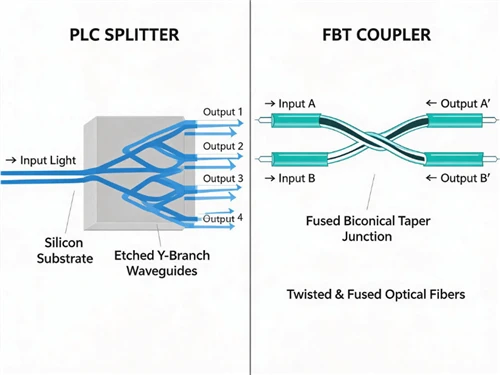
A: Yes. PLC (Planar Lightwave Circuit) splitters are inherently wavelength-independent across 1260–1650 nm, which covers GPON (1310/1490 nm), XGS-PON (1270/1577 nm), NG-PON2 (TWDM bands), and RF video overlay (1550 nm) simultaneously. A PLC splitter installed for a GPON network does not need to be replaced during an XGS-PON upgrade, or for any subsequent PON generation running within this wavelength window. The Central Europe case study in §6 of this document provides a real-world measurement confirmation at XGS-PON wavelengths.
Q: What fiber cable standard is required for FTTH indoor wiring?
A: ITU-T G.657.A1 or A2 is the standard for FTTH indoor drop cables. G.657.A1 allows a minimum bend radius of 10 mm; G.657.A2 allows 7.5 mm - suitable for tight corners in MDU apartment wiring. For ultra-tight conduit routing or riser applications, G.657.B3 (5 mm minimum bend radius) may be specified. All three grades are backward-compatible with G.652.D standard SMF for splicing and connector mating. For outdoor aerial or underground feeder segments, standard G.652.D is generally sufficient and less expensive.
Q: How much does pre-connectorized FTTH reduce deployment time compared to fusion splice?
A: In the Philippines deployment documented in §6, pre-connectorized drops averaged 18 installations per two-person crew per day, versus 7 per crew per day for fusion-splice on the same project team. The speed advantage comes primarily from eliminating fusion machine setup and splice tray management at the drop level. The tradeoff is that connector end-face cleanliness discipline becomes critical - the same project saw a 2.3% first-pass failure rate in week one before a mandatory inspection scope step was added to the workflow.
Q: Why does SC/APC matter and can I mix it with SC/UPC on a PON network?
A: SC/APC connectors have an 8-degree angled end-face that causes reflected light to scatter away from the fiber core, achieving return loss ≥ 65 dB. SC/UPC connectors have a flat-polished end-face with return loss typically ≥ 55 dB. For GPON and XGS-PON OLT lasers, which are sensitive to back-reflections, APC connectors throughout the ODN provide better performance and lower the risk of reflectance-induced power penalties. You should not mate SC/APC with SC/UPC on the same optical path - the physical dimension difference means the connection will be lossy and may damage the ferrule. Standardize on SC/APC (green body) throughout the entire PON port path from OLT to ONT.
§8 - Technical References
- [1]ITU-T Recommendation G.9807.1 (2016) - 10-Gigabit-capable symmetric passive optical network (XGS-PON). International Telecommunication Union. itu.int/rec/T-REC-G.9807.1
- [2]ITU-T Recommendation G.984.1–G.984.7 - Gigabit-capable Passive Optical Networks (GPON). International Telecommunication Union. itu.int/rec/T-REC-G.984.1
- [3]ITU-T Recommendation G.657 (2021) - Characteristics of bending-loss insensitive single-mode optical fibres and cables for the access network. Defines A1, A2, B3 grades and their minimum bend radius specifications. itu.int/rec/T-REC-G.657
- [4]ITU-T Recommendation G.652 (2016) - Characteristics of a single-mode optical fibre and cable. G.652.D is the dominant feeder and distribution fiber specification for FTTH ODN. itu.int/rec/T-REC-G.652
- [5]Corning Incorporated - SMF-28 Ultra Optical Fiber Product Information. Specifications for Corning's G.652.D / G.657.A2 compliant fiber, including attenuation, bend loss, and PMD values. corning.com - SMF-28 Ultra datasheet (PDF)
- [6]Corning Incorporated - Bend-Insensitive Fiber Selection for FTTH Applications. Application note covering G.657 grade selection criteria, compatible splicing, and field handling. corning.com - Bend-Insensitive Fiber White Paper (PDF)
- [7]CommScope - FTTH Infrastructure Solutions: Fiber to the Home Planning & Deployment Resources. Topology models, split ratio selection guides, and splice closure installation documentation. commscope.com/solutions/networks/fiber-to-the-home
- [8]CommScope - Fiber Optic Splice Closure Installation & Technical Documentation. Installation guides covering sealing torque, cable entry gland procedures, and IP68 pressure verification for outdoor closures. commscope.com - Fiber Access Product Catalog
- [9]HUBER+SUHNER - Fiber Optic Connectors: Single-Fiber Product Range & Technical Datasheets. SC, LC, and FC connector specifications including insertion loss, return loss, and IEC 61300-2-2 mating durability ratings. hubersuhner.com - Single-Fiber Connectors
- [10]HUBER+SUHNER - Fiber Optic Closures for Outside Plant Applications. Technical documentation for environmental qualification of splice closures, including IP68 test methodology and gasket material selection for tropical and arctic climates. hubersuhner.com - Fiber Optic Closures
- [11]HUBER+SUHNER - FTTA (Fiber to the Antenna) Solutions for 5G Fronthaul. Outdoor fiber connectivity for 5G small cell and C-RAN applications, including IP68 CPRI patch cord specifications. hubersuhner.com - FTTA Solutions
- [12]Telcordia GR-326-CORE - Generic Requirements for Singlemode Optical Connectors and Jumper Assemblies. Ericsson (formerly Telcordia). North American connector qualification standard covering insertion loss, return loss, and durability testing. Ericsson Telecom Standards Portal
- [13]Telcordia GR-771-CORE - Generic Requirements for Fiber Optic Splice Closures. Ericsson / Telcordia. Defines sealing, mechanical, and environmental performance requirements for outdoor splice closures used in North American network deployments.
- [14]IEC 61754-4 (2013) - Fibre optic interconnecting devices - Part 4: SC connector. Defines the physical dimensions, tolerances, and test requirements for the SC connector interface. iec.ch
- [15]Broadband Forum TR-247 - XGS-PON Coexistence with GPON. Architectural requirements for deploying XGS-PON over an existing GPON ODN, including wavelength isolation, coexistence OLT requirements, and migration strategies. broadband-forum.org
- [16]ISO 9001:2015 - Quality Management Systems - Requirements. International Organization for Standardization. iso.org/standard/62085
§9 - Glory Optical Product Range
Glory Optical manufactures passive optical network components at its Ningbo, Zhejiang facility. The product range covers every passive layer of an FTTH ODN, from feeder splice closures to subscriber-side termination boxes and connectors.