
A listed or heritage building can still receive full-fibre broadband, but the normal exterior-CSP assumption may need to change. This guide turns UK conservation guidance and the Saltaire case into a practical workflow for demarcation, routing, wall entry and fibre-box procurement.
Research and source verification updated: 20 September 2026.
FTTH can be installed in listed and heritage buildings, but the standard residential installation should not be treated as automatic. An external Customer Service Point (CSP), a short cable run across the façade and a new wall penetration may be routine on a modern property, yet the same arrangement can create consent, visual-impact and fabric-conservation problems on a protected building.
The engineering question is therefore broader than choosing an indoor or outdoor fibre box. The project must determine where the passive demarcation point should sit, how the fibre should reach it, which parts of the building can accept fixings or penetrations, and whether future technicians can inspect or repair the connection without causing further damage.
Can Full-Fibre FTTH Be Installed in a Listed Building?
Yes. Listed-building status does not automatically prevent full-fibre broadband, but it can affect which installation methods are acceptable and whether consent is required before equipment is fixed to the building or historic fabric is altered.
Historic England's guidance on installing new services includes communication lines, telephones and IT networks within building services and recommends the principles of mitigation, minimisation and reversibility. Existing routes should be reused where practical, permanent alteration should be limited, and equipment should be positioned discreetly while remaining accessible for maintenance.
Consent requirements remain site-specific. An external fibre box that is acceptable on one listed building cannot automatically be assumed acceptable on another. The relevant local planning authority and conservation requirements should be checked before the installation drawing is finalised.
Why the Saltaire Case Matters
Saltaire shows how a standard FTTP installation detail can conflict with a site-specific conservation requirement. Openreach's normal residential Full Fibre guidance describes fibre arriving from an underground or overhead route, terminating at a small junction box on the outside wall and then continuing indoors to the Optical Network Terminal (ONT). See the Openreach Full Fibre installation checklist.
That arrangement provides a convenient passive transition between outside-plant fibre and the customer premises. In a protected building, however, the location of that transition may need to change.
The Saltaire timeline
June 2023
Internal CSP approach agreed
Bradford Council's Saltaire listed-building advice states that fibre broadband boxes on front elevations require Listed Building Consent and are not recommended. Following liaison with Openreach in June 2023, the stated approach for future requests was to use internal CSPs. The same guidance asks providers to take wiring inside as early as practical and, where a new penetration is necessary, to drill through mortar rather than stone where possible.
January 2024
Agreement recorded again
The Saltaire World Heritage Site Steering Group minutes record the earlier agreement with Openreach and again refer to internal CSPs as the approach for future installations.
July 2026
Remedial work reported
ISPreview reported that Openreach was contacting affected properties where external CSPs had been installed and planned to replace them with smaller, less conspicuous internal units. This report is used as a current case reference; Bradford Council remains the primary source for the local conservation guidance.
Typical residential layout
Outside drop → external CSP → indoor fibre → ONT
A normal operator-accessible passive transition before the fibre enters the customer premises.
Heritage-sensitive alternative
Outside drop → approved low-impact entry → internal passive demarcation → ONT
The optical service remains; the passive handover point moves to reduce impact on protected fabric.

Start With the Building, Not the Fibre Box
A heritage FTTH survey should identify the acceptable route before an enclosure is selected. Choosing a catalogue box first and then searching for somewhere to install it reverses the design sequence.
Historic England recommends investigating existing service routes and openings before creating new ones. It also recognises that the shortest or most direct path may not be appropriate where it would cause unnecessary permanent alteration.
| Survey item | What to establish |
|---|---|
| Existing service routes | Existing telecom entries, conduits, voids, service penetrations or other reusable paths. |
| Sensitive building fabric | Elevations, stonework, mouldings or interiors where new fixings or drilling should be avoided. |
| Acceptable termination zones | Internal service areas, secondary elevations, cupboards or other approved locations. |
| Future access | Whether technicians can inspect, test, re-splice or replace fibre without new building damage. |
A termination point that is visually discreet but inaccessible for maintenance is not necessarily a good design. Glory Optical's FTTP Installation Acceptance Checklist already recommends confirming proposed cable routes, termination positions, building-entry constraints and permissions before installation. On a listed-building project, those items should become formal design controls rather than routine survey notes.
Where Should the FTTH Demarcation Point Sit?
The passive demarcation should be placed where the fibre can be protected and maintained while still meeting the building's conservation and consent requirements. There is no single correct position for every heritage property.
| Arrangement | When it may be suitable | Main trade-off |
|---|---|---|
| External CSP on principal elevation | Only where specifically permitted | Good technician access, highest visual impact |
| External CSP on rear or secondary elevation | Where an external test point remains useful | May require a longer fibre route |
| Internal passive CSP | Where exterior equipment is restricted | Lower façade impact, indoor access required |
| Indoor wall outlet | Small subscriber-side termination with limited passive hardware | Lower splice and slack-storage capacity |
| Shared internal distribution point | Multi-Dwelling Unit (MDU) or larger heritage property | Requires controlled common-area access |
A Network Interface Device (NID) or CSP performs a useful passive role in many conventional FTTH installations by creating a defined transition between the network drop and customer-side fibre. Glory's NID box guide explains that conventional role. A heritage project does not eliminate the need for a clear handover; it may simply require that handover to move indoors or to a less visually sensitive position.
Cable Routing and Wall Entry Often Matter More Than Box Size
A small fibre enclosure does not automatically create a low-impact installation. A tiny box can still require an unacceptable cable route, numerous façade clips or a new penetration through significant historic stonework.
Reuse existing routes first
Existing telecom ducts, former service penetrations and suitable internal routes should be checked before new holes are proposed. Reusing a viable route can reduce new drilling, exposed cable, façade fixings, reinstatement work and future damage when the fibre is upgraded.
Prefer repairable fixing locations
Where fixing or penetration is unavoidable, mortar joints may offer a more repairable location than historic brick or stone, subject to the specific building and conservation advice. Bradford Council applies this point directly in its Saltaire guidance. This does not mean a technician should independently choose any mortar joint on site; the position should follow the approved project design.
The shortest route does not always win
On a standard installation, the shortest path may reduce labour and cable length. On a listed building, a slightly longer route may be preferable if it avoids prominent historic fabric and can still satisfy fibre bend requirements, cable protection, optical performance, installation access and future maintenance.

How to Specify a Fibre Termination Box for a Heritage Project
Port count and ingress protection alone are not enough. Procurement should also consider how the enclosure physically interacts with the building.
| RFQ field | Why it matters |
|---|---|
| Overall dimensions | Controls visual footprint. |
| Projection from mounting surface | Determines how prominent the box appears. |
| Mounting-hole pattern | Determines how much building fabric is disturbed. |
| Mounting method | Affects anchors, brackets and reversibility. |
| Cable-entry position | Helps avoid visible loops and unnecessary penetrations. |
| Supported cable diameter | Reduces field modification. |
| Fibre and splice capacity | Prevents oversizing. |
| Adapter arrangement | Defines the passive handover. |
| Bend-management space | Protects fibre inside a compact enclosure. |
| Environmental protection | Must match the approved indoor or outdoor location. |
| Cover-opening clearance | Determines whether the unit can be serviced in place. |
| Dimensional drawing or sample | Supports approval before procurement. |
Glory's Outdoor vs Indoor Fibre Terminal Boxes guide covers the environmental differences in more detail. In a heritage project, however, the building and route should determine the termination location before the enclosure type is chosen.
Two Enclosure Paths for Heritage FTTH
No enclosure should be described as "heritage approved" merely because it is small, white or customisable. Approval depends on the specific property, installation design and relevant authority; the enclosure is a network component, not a certified heritage solution.

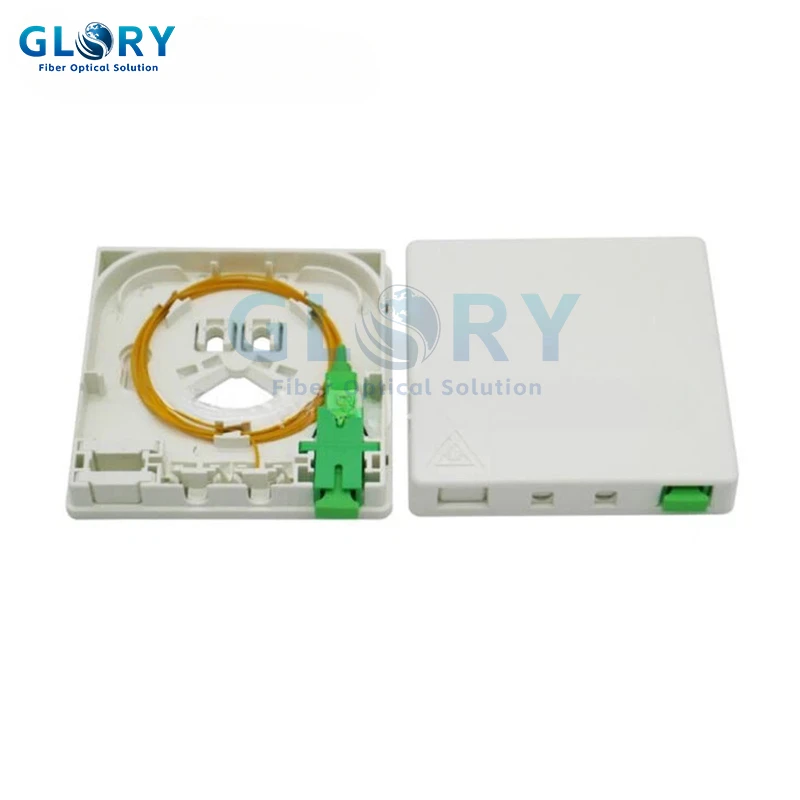
Low-Profile Indoor Subscriber Termination
For an approved internal position where only a small subscriber-side passive interface is required.
- Dimensions: 90 × 90 × 16 mm
- Capacity: 2 fibres
- Adapters: 2 × SC simplex or 2 × LC duplex
- Cable entry: 2 × Φ 3 mm drop/indoor cable
- Installation: indoor wall mount / desktop
Best fit: discreet indoor handoff where the approved design requires a very small footprint and only 1–2 fibres.
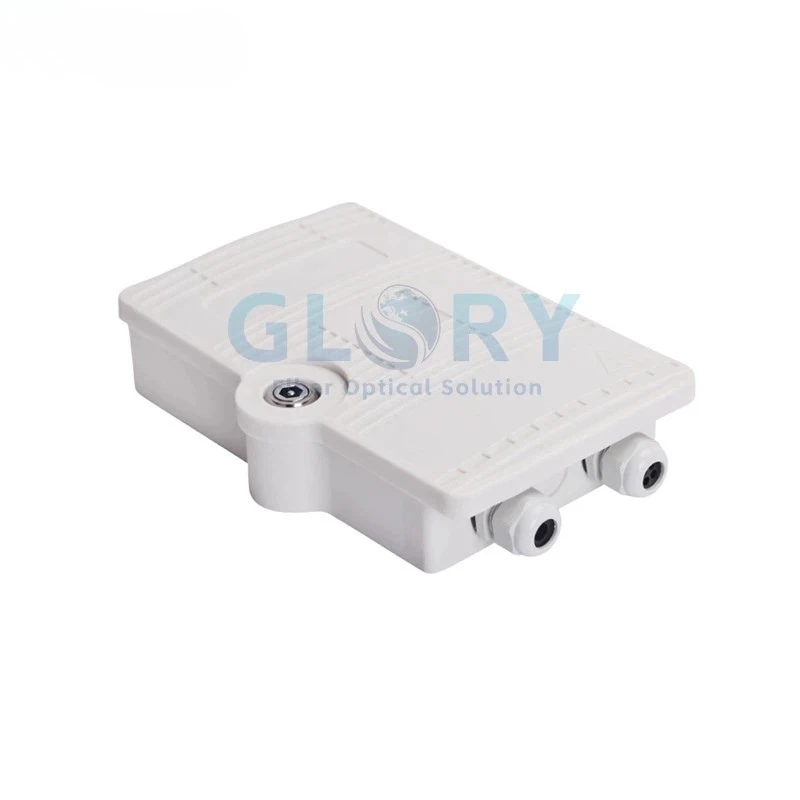
Passive Demarcation With Additional Splice Capacity
For an approved location that needs a more substantial passive handoff, cable-entry range and internal splice/slack management.
- Dimensions: 208 × 153 × 52 mm
- Adapter positions: 2
- Fibre capacity: up to 4 fibres
- Adapter options: SC simplex or LC duplex
- Cable entry: Ø 3–13.5 mm
- Protection: IP65
Best fit: a defined passive demarcation where the approved design needs more splice/storage space than a wall socket. "2-port" describes adapter positions; it does not limit internal fibre capacity to two.
View GL-FTB-4FProject-specific enclosure configuration
Some protected-building projects may require enclosure details to be agreed before procurement. Glory Optical's OEM/ODM service supports project-specific fibre-box configuration. Useful questions include whether the footprint can be reduced, whether cable entry can move to another side, whether the mounting arrangement can reduce unnecessary fixings, and whether an approved colour or finish can be supplied.
For projects still deciding between form factors, the fibre optic wall outlet range and fibre optic termination box range provide more options. The architecture should be fixed before the product family is shortlisted.
What Should a Heritage FTTH RFQ Include?
A supplier cannot select the correct enclosure from the description "listed building" alone. The RFQ should describe the installation context so that the enclosure can be evaluated as part of the complete route.
| RFQ category | Information to provide |
|---|---|
| Building context | Listed/heritage status, approved installation zone, visual or dimensional restrictions. |
| Cable route | Incoming cable type and OD, entry direction, reusable conduit or penetration, indoor route. |
| Termination | Fibre count, splice quantity, connector type, adapter quantity, slack requirement. |
| Enclosure | Maximum dimensions, mounting restrictions, material, environment and colour if relevant. |
| Approval | Dimensional drawing, loaded internal layout and product sample if required. |
| Handover | Installation photographs, as-built route, optical testing and connector-inspection records. |
Better RFQ: "Quote a passive termination assembly that fits this approved route, mounting condition and maintenance requirement."
The Design Rule to Keep
The Saltaire case does not prove that external FTTH boxes are incompatible with all listed or heritage buildings. It shows why the standard external-CSP assumption should be questioned before installation begins on a protected property.
- Understand the building and conservation constraints.
- Confirm consent requirements with the relevant authority.
- Survey existing service routes and reusable penetrations.
- Select the passive demarcation location.
- Design the cable route and wall entry.
- Specify the enclosure for that approved environment.
- Approve drawings or samples where required.
- Install, test and document the final route.
For an ordinary FTTH deployment, exposure conditions often determine whether the terminal should be indoor or outdoor. For a heritage project, the decision begins one level earlier:
Primary sources used in this guide
- Bradford Council - Pre-application Listed Building Advice for Saltaire
- Historic England - Installing New Services
- Openreach - Full Fibre Installation Checklist
- Saltaire WHS Steering Group - January 2024 Minutes
ISPreview is cited separately for the July 2026 remedial-work report; planning and conservation requirements are grounded in the first-party Bradford Council and Historic England sources above.
Need a Fibre Box for a Project-Specific Installation?
For a project where enclosure size, mounting, cable entry or configuration must match an approved route, send the installation context and dimensional limits with the RFQ. Glory Optical can then discuss a suitable wall outlet, termination box or OEM/ODM configuration.
Explore the FTTH ODN Solution