

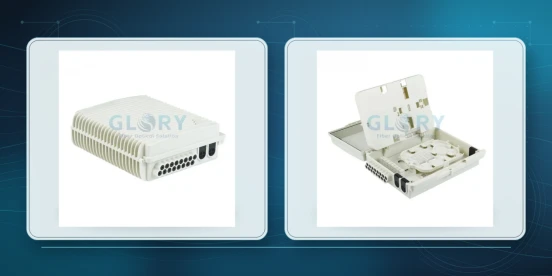
In FTTH network deployments, the opening method of fiber optic distribution boxes may seem insignificant, but it directly impacts on-site installation efficiency and long-term maintenance experience. Traditional screw-fixed distribution boxes, while sturdy, require tools for each opening and closing, which can be very inconvenient with frequent maintenance. Clip-on distribution boxes are easy to open, but after prolonged outdoor use, they may loosen due to material aging or accidental impacts.
Is there a design that balances both "convenience" and "security"? The GL-15N6S Wall Mount Fiber Distribution Box provides the answer: push-pull structure + optional screw fixing.
Two "Personalities", One Solution
Mode 1: Push-Pull Structure – The "Fast Lane" for Daily Maintenance
The push-pull design is designed for extreme ease of field operation. No screwdrivers or multiple clips required-simply push and pull to open or close the cover.
In what situations can a push-pull design save you time and effort?
Routine Inspections-Maintenance personnel need to periodically check patch panels for water ingress, pests, or fiber optic issues. Push-pull opening takes only seconds, significantly reducing single-point inspection time.
Troubleshooting-When users report a fault, technicians need to quickly open the patch panel to test signals. No need to search for tools-simply pull it open, significantly improving response time.
Adding New Users-Activating a new user requires opening the patch panel to access the new port. The push-pull design eliminates the hassle of multiple openings.
Data Comparison: Traditional screw-mounted patch panels take approximately 30-60 seconds to open/close each time (searching for tools, tightening screws, opening, closing, tightening screws again). This push-pull design reduces this time to less than 5 seconds. For maintenance teams managing hundreds of servers, this can add up to hours of time saved daily.
Mode 2: Optional Screw Fixing – A "Safety Lock" for Long-Term Security
While the push-pull design is convenient and practical, additional securing is still required in certain situations. The designers of the GL-15N6S considered this and offer an optional screw-mounting solution.
When should screw-mounting be considered?
Outdoor environments-Boxes mounted on building exterior walls or utility poles are subject to wind, rain, and vibration
.Additional screws prevent strong winds or vibrations from causing the cover to open accidentally.
Child-accessible areas-If the junction box is installed in a low location (e.g., a ground floor hallway), children may open it out of curiosity. Screw-mounting provides an extra layer of safety.
High-value network nodes-For nodes carrying critical business operations or with numerous users, preventing accidental or malicious opening is a reasonable precaution.
It's important to note that screw-mounting is optional, not mandatory. This means you are free to choose whether to use screws based on your actual installation environment and safety requirements. One junction box, two uses.
The Engineering Wisdom Behind the Design
The combination of a push-pull design and optional screw fastening reflects a deep understanding of real-world field needs:
Lowering the maintenance threshold-not everyone who opens a distribution box is a professional engineer. The push-pull design allows ordinary maintenance personnel to operate it easily, thus reducing training costs.
Adapting to various environments-indoor, corridor, outdoor, pole mounting-different environments have different "safety" requirements. Optional screws allow the product to flexibly adapt to various environments.
Balancing efficiency and safety-the push-pull design is suitable for routine inspections, while screw fastening is suitable for high-risk environments-embodying the practical concept of "quick when needed, safe when needed."
Real-World Application Cases
Scenario 1: Multi-story residential corridor
The patch panels are installed in the telecommunications equipment room on each floor, a relatively secure environment. The operator has chosen a push-pull structure, eliminating the need for screws. During routine inspections every six months, each maintenance worker can inspect 40 patch panels per day, three times more efficient than traditional screw-fixed patch panels.
Scenario 2: Outdoor utility pole in a coastal city
The distribution boxes were installed on outdoor utility poles, exposed to sea winds and salt spray corrosion for extended periods. The contractor installed screw-fastening devices on each distribution box. Two years later, a follow-up inspection found no reports of any distribution box covers being accidentally opened or loosened.
Conclusion
The push-pull structure + optional screw fixing design of the GL-15N6S Wall Mount Fiber Distribution Box may seem simple, but it solves a long-standing contradiction in FTTH deployment: How to maximise operational efficiency while ensuring safety and security?
It makes "convenience" and "security" no longer an either-or choice. For daily maintenance, enjoy the smooth operation of push-pull. When extra assurance is needed, a single screw locks in the peace of mind. This "adaptable" design philosophy is precisely why this product deserves attention.