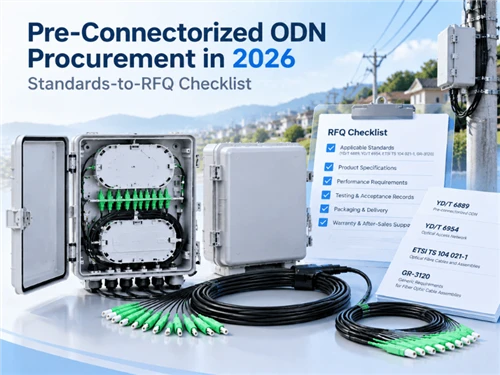

Pre-connectorized ODN standards arrive as four kinds of documents: Chinese industry standards (YD/T), ETSI technical documents, Telcordia and IEC test methods, and the supplier's own datasheet. They use different yardsticks for insertion loss, ingress protection and cable retention. An RFQ that names only a standard number lets every supplier answer a different question. This guide maps each thing you buy (terminal, connector interface, cable assembly, labels and the installed link) to the documents that apply and the evidence you can ask for.
Quick answer
- Three Chinese recommended standards now cover outdoor pre-terminated hardware. YD/T 6889.1-2026 (distribution box) and YD/T 6954-2026 (cable assemblies) took effect on 1 September 2026. YD/T 6889.2-2026 (splitter terminal box) takes effect on 1 November 2026.
- YD/T 7067-2026 took effect on 1 September 2026. Its official record covers the cabling system, including link attenuation, test methods and installation acceptance.
- Select references by project scope. Use the buyer's equipment and network requirements to choose relevant ETSI, YD/T, Telcordia and IEC provisions. Applying selected hardware clauses does not establish compliance with a complete digitalized Quick ODN specification.
- Define the acceptance rule: the measured item, individual limit, any additional sample statistics, mating state, wavelength, test duration and cable profile. A mean or percentage criterion alone does not set an upper limit for every unit.
- Ask for a model-specific report. A standard number on a datasheet is a claim; a clause-level report for the exact configuration is evidence.
Define the hardware and system scope first
This guide focuses on terminals, connector interfaces, cable assemblies and their acceptance records. ODN means optical distribution network; RFQ means request for quotation. Pre-terminated and pre-connectorized describe factory-finished connections here; a digitalized Quick ODN also includes network information and management functions.
- Hardware procurement: identify the box, cable and interface to be supplied, its installation environment and the applicable component tests. The environment is what selects the test severities: IEC 61753-1 defines the operating service environments and the test set, severities and pass/fail criteria behind each, and ETSI TR 103 775 clause 5.3.4 points passive elements - FAT, closures, splitters and connectors - at it. A component report supports only the configuration and requirements it covers.
- Digitalized Quick ODN: ETSI TS 104 021-1, clauses 1 and 6.1, addresses digitalized networks and focuses its component discussion on unequal-ratio QuickConnect networks. Adopting selected physical requirements covers exactly the clauses you list; a full-system claim also calls for evidence on the applicable identification, optical-path information and management functions.
- Installed cabling system: define the complete optical path, loss budget and field acceptance method. Where YD/T 7067-2026 is adopted, obtain its full text and carry its applicable requirements into that plan; its public scope covers link attenuation and testing, and the numerical limits sit in that full text. For the wider build sequence across all four ODN segments, see FTTH ODN Deployment Guide: Standards, Component Selection & Field Practice.
Pre-connectorized ODN standards: where the documents stand
The table lists what a pre-connectorized ODN RFQ can reference as of 13 October 2026. English titles of the Chinese standards are Glory translations; the Chinese titles are included so your supplier's documents can be matched exactly.
| Document | What it covers | Date status | Nature and scope notes |
|---|---|---|---|
| YD/T 6889.1-2026 | Outdoor pre-terminated distribution connection facilities, Part 1: cable distribution box | Published 1 Jun 2026; in force from 1 Sep 2026 | Recommended (推荐性) industry standard. Scope text: design, production and inspection of pre-terminated cable distribution boxes in an ODN. |
| YD/T 6889.2-2026 | Part 2: pre-terminated splitter terminal box | Published 15 Jul 2026; in force from 1 Nov 2026 (not yet in force on 13 Oct) | Recommended industry standard. Same scope wording as Part 1: design, production and inspection. |
| YD/T 6954-2026 | Pre-terminated outdoor cable assemblies for access networks | Published 1 Jun 2026; in force from 1 Sep 2026 | Recommended industry standard. Covers classification and naming, performance, test methods, inspection rules, marking, packaging, storage and transport. Scope text includes acceptance, which the 6889 series scope text does not. |
| YD/T 7067-2026 | Pre-connected optical distribution network cabling system | Published 1 Jun 2026; in force from 1 Sep 2026; filing no. 106722-2026 | Public scope includes system structure, fiber and cable requirements, connecting hardware, link attenuation, test methods and management; applies to design, production, installation and test acceptance. Numerical clauses require the full text. |
| ETSI TR 103 775 V1.1.1 | ODN quick construction and digitalization; includes performance Table 5-1 for pre-connectorized cables | August 2021 | Technical Report. Wording is advisory ("should"), so it supplies a test basis you can adopt in an RFQ. |
| ETSI TS 104 021-1 V1.1.1 | ODN quick construction and digitalization, Part 1: general and guidance | February 2025 | Technical Specification for digitalized Quick ODN, including devices and management functions. Identify selected hardware clauses separately from any full-system compliance claim. |
| ITU-T L.208 (08/2019) | Requirements for passive optical nodes: fibre distribution box | In force | Annex B test program: cable retention, bending, torsion, impact, temperature cycling, re-entries, salt mist, aggressive media, plus optical evaluation. |
| Telcordia GR-3120-CORE, Issue 2 | Hardened fiber optic connectors and adapters | 2013; listed as Current in the Intertek Inform catalogue reviewed on 13 Oct 2026 | Edition and status verified at catalogue level only; full text and any separate amendments were not reviewed. Name Issue 2 and the applicable revisions and clauses in the project schedule; require the report to identify the same basis. |
| IEC 60529 | Degrees of protection provided by enclosures (IP Code) | Edition 2.2 consolidated version, 2013 | Classifies enclosures for electrical equipment up to 72.5 kV. |
| IEC 61753-1 | Fibre optic interconnecting devices and passive components - Performance standard, Part 1: General and guidance | Second edition, 2018 (corrigendum May 2019; AMD1:2020) | Defines the operating service environments and, in Annex A, the normative test set, severities and pass/fail criteria for each. Protective housings use categories A (aerial), G (ground) and S (subterranean); components use C, OP, OP+, I and E, with an HD suffix for housings that also carry active electronics. Conformance is a one-off demonstration of optical performance under those severities; lifetime reliability is a separate programme under the IEC 62005 series. |
YD/T dates and scope statements above come from official public records; they are not a review of the complete Chinese standards. ETSI references identify the editions used in this guide. The GR-3120 entry uses a distributor catalogue for edition metadata, not as evidence of product performance. IEC 61753-1 was read at the level of its scope and category definitions. Record the exact edition and amendments adopted by the project before issuing the RFQ.
What a recommended Chinese standard gives an export buyer
The platform lists YD/T 6889.1, YD/T 6889.2 and YD/T 6954 as recommended industry standards. Their listed drafting organizations include operators, design institutes, test laboratories and manufacturers. For an overseas project, identify whether the buyer adopts specific provisions as purchase requirements or uses them only as design references; do not assume that every project adopts the same documents. They are not global regulation, and a supplier's statement that a model "complies" carries weight only when a report names the document, edition, clause, test condition and the exact configuration tested.
Compare insertion loss, protection and retention on the same basis
The same property appears in several documents with different boundaries. The table sets published requirements beside two Glory product pages to show why an RFQ must say which yardstick applies. Glory figures are the company's published datasheet values, listed for comparison; they are not claims of conformance to the ETSI or YD/T documents. Read the two columns as different measurements, not competing scores: the ETSI connector figures are random-mating statistics, while the Glory adapter-port figure is a single-interface value taken at two fixed wavelengths. For the enclosure-level test programme behind those numbers, see Fiber Distribution Box FAT: Vibration & Optical Tests.
| Property | ETSI TR 103 775 (2021) | ETSI TS 104 021-1 (2025) | Glory published data |
|---|---|---|---|
| Insertion loss | Single-core cable IL ≤0.3 dB with average ≤0.1 dB; multi-core feeder ≤0.35 dB. Random-mated single-core connectors: mean ≤0.12 dB and at least 97% of connections ≤0.25 dB; multi-core: at least 97% ≤0.5 dB. These percentage criteria do not specify an absolute upper limit for every connection. | Distribution cables: average attenuation of random mated single-core hardened connectors ≤0.08 dB. | GL-FTB-10E: ≤0.2 dB at each adapter port, 1310 and 1550 nm, stated as the adapter-port interface only. Sticklok: maximum IL 0.4 dB per cable-profile assembly; branch terminals ≤0.45 dB. |
| Return loss | ≥60 dB (APC), ≥50 dB (UPC) | No figure stated in the clauses reviewed | GL-FTB-10E: APC ≥60 dB, UPC ≥50 dB |
| Ingress and impact | Sealing tests at −15 °C and +45 °C after mechanical tests; 40 kPa tightness test | IPx5 (overhead) or IPx8 (underground) for boxes, adaptors and hardened connectors; IK08 (overhead) or IK09 (underground) for boxes | GL-FTB-10E: IP65 housing with IP67 per-port adapter seals. Sticklok: IP68 and IK08. |
| Connector-to-cable retention | Drop (single-core): 300 N for 2 minutes per cable per test temperature, ΔIL ≤0.2 dB. Multi-core feeder: 800 N, ΔIL ≤0.5 dB, RL ≥60 dB. | Distribution cable connectors ≥800 N; drop cable connectors ≥300 N | Sticklok, by cable profile: 600 to 1200 N for 2 minutes and 200 to 400 N for 10 minutes |
| Temperature and ageing | Operating −40 to +70 °C; cycling −40 to +65 °C, 12 cycles, 4 h dwell; 1000 h at +75 °C and 95% RH, ΔIL ≤0.2 dB | 1000 h at +75 °C and 95% RH | GL-FTB-10E: −40 to +85 °C working. Sticklok: −18 to +75 °C operating, −18 to +40 °C installation. |
For six mated connector pairs, an assumed average loss of 0.12 dB per pair gives a planning estimate of 0.72 dB. The loss of a particular link comes from measuring that link. In ETSI TR 103 775, Table 5-1, the 0.25 dB value applies to at least 97% of random-mated single-core connections; it is not an absolute maximum for every pair.
If the project separately specifies and verifies an individual limit of 0.25 dB for each of the six installed pairs, their combined connector-loss allowance is 1.50 dB. That individual limit is a project requirement, not a consequence of the 97% criterion. Include fiber, splitter and splice losses and the engineering margin separately, and measure the installed path.
The pre-connectorized ODN standards-to-RFQ matrix
Use one row per item on your bill of materials. Select the references that fit the item and project scope; the list is not a requirement to apply every document to every model. Each row identifies the evidence to request and its limits. For a worked comparison of how suppliers quote the same distribution box, see the FTTH Fiber Distribution Box RFQ Guide.
| What you buy | Documents to cite | Evidence to request | Where the evidence stops |
|---|---|---|---|
| Outdoor FAT or distribution box | YD/T 6889.1 for distribution boxes or 6889.2 for splitter terminal boxes when adopted; selected ETSI TS 104 021-1 clause 6.2 requirements; ITU-T L.208; IEC 61753-1 for the service-environment category; IEC 60529 | Type-test report for the exact model and configuration (ports, splitter, cable entry); IP code stated per element and test state; cable-entry sealing method and diameter range; per-port IL | Box tests describe the hardware. The installed link still needs measurement. |
| Hardened connector and adapter interface | GR-3120-CORE Issue 2 (2013), with adopted revisions and clauses recorded; selected ETSI TS 104 021-1 clauses 6.2.4 to 6.2.6; IEC 61753-1 for the service-environment category; relevant IEC 61300 methods | Interface drawing; converter list with measured loss of each mated pair; tensile data by cable profile and test duration | A locked connector confirms mechanical engagement only. Glory's Sticklok page says sealing, end-face cleanliness and loss still need checking. |
| Pre-terminated cable assembly | YD/T 6954-2026; ETSI TR 103 775 Table 5-1; the cable-level standard you specify for the cable itself | Per-assembly IL and RL at stated wavelengths; ordered length and tolerance; labels; pulling-head dimensions; end-face images | The factory report covers the assembly. Route survey and pulling limits decide whether it can be installed; see Pre-Terminated Fiber Pulls: Four Checks Before You Order. |
| Labels and records | ETSI TS 104 021-1 clause 5 and the QuickConnect cable clauses | Unique code per device; identical code on both connector ends of a cable; evidence that the label survives the product's environmental tests | Labels support the port register. They do not replace optical tests. |
| Complete pre-connected ODN | YD/T 7067-2026 where adopted; ETSI TS 104 021-1 for the specified digitalized Quick ODN scope | System drawing; loss budget; clause-by-clause acceptance plan, including applicable digital functions | The acceptance plan shall implement the adopted requirements and project limits. Installed-link and digital-management performance are demonstrated by that plan, with component reports as supporting evidence. |
Choose evidence that covers the requirement
Evaluate evidence against the purchased configuration and the claim being made. The following document types serve different purposes; they are not a universal ranking.
- Design reference: identifies documents considered during development; a measured pass result comes from a test report.
- Supplier test report: can support routine shipment checks or qualification tests. Verify the sample or serial number, method, conditions, results, equipment calibration and the link to the supplied configuration.
- Accredited laboratory report: adds testing within a recognized competence framework. Check that the relevant methods are within the laboratory's accreditation scope and that the report covers the ordered model. Accreditation and independence are separate checks.
- Product certification with surveillance: can add ongoing production oversight within a defined scheme. For example, TÜV SÜD's optical fiber certification scheme includes product testing and recurring factory visits. Verify certificate validity, scheme, model coverage and exclusions; coverage reaches the model range and shipments the certificate names.
For each item, specify the evidence required at qualification, shipment and site acceptance. A buyer might request independent testing for a new interface or an inaccessible installation and use traceable factory records for routine shipment measurements. These are procurement choices to justify for the project, not requirements claimed for most projects. Match the certificate to the configuration being ordered and to the shipment it covers. For port-level sealing evidence on an outdoor box, see Outdoor FDB Waterproof Sealing Acceptance: Cable Gland & Port Checklist.
ODN acceptance checklist: evidence for each stage
ETSI TR 103 775 clause 5.4 lists the pre-connected construction sequence: choose cable lengths from the design drawing and route re-test, check the cables, install distribution cables, coil them, install the closures, build the drops, run a post-installation check, then run the acceptance test against the acceptance criteria. The checklist below attaches evidence to those steps.
- Incoming check. Compare cable and box labels with the packing list and the order. Confirm the label code on both ends of each cable.
- Factory records. Match each serial number to its report: IL, RL, length, connector type and polish.
- Clean and inspect before every first mate. The FOA's guidance on FTTH drop cables notes that dirty connectors cause most network problems, and IEC 61300-3-35:2022 defines end-face visual inspection. Inspection supplements attenuation and return-loss measurement.
- Mount, seat and cap. Seat each hardened connector fully, fit dust caps on unused ports and record the mounting method.
- Measure the installed path. Follow the agreed acceptance plan: measurement endpoints, wavelengths, method, reference setup, instrument calibration, limits and decision rule. Identify which measurement demonstrates total path loss and which locates or characterizes events; a report shall match its assigned acceptance purpose.
- Reconcile the port register. Compare physical ports and labels with the design records and update both.
- Close exceptions. Record failed, untested and reworked items separately. Attach corrective action and retest results, or an authorized deviation with its scope and impact. Keep unresolved items on hold.
- Hand over. Deliver the approved configuration, factory reports, field measurements, photos, port register and closed deviation log. Record who authorizes final acceptance. A stage-by-stage sign-off sheet for this handover is set out in the FTTP Installation Acceptance Checklist.
Set the limits before asking suppliers to quote
The workflow below is a proposed procurement procedure. Numerical limits come from the adopted requirements and the approved design, not from the lowest value in a comparison table.
- Freeze the application. Record the market and operator specification, topology, installation environment, port and interface types, cable profile, PON system and operating wavelengths. List the relevant standard editions and clauses.
- Allocate the loss budget. For each path, start with the permissible loss for the selected optical system, reserve the engineering margin, and allocate allowances to fiber, splitters, splices and connector pairs. Define measurement boundaries so an assembly or port loss is counted once. Check every wavelength and path required by the design.
- Define how a pass is decided. Separate individual limits from sample means and percentage criteria. Specify qualification versus shipment testing, sample selection, test method, uncertainty treatment, retesting and the handling of nonconforming units. Do not use a passing sample mean to excuse a failed individual limit.
- Approve the schedule. The buyer's technical reviewer resolves conflicts between the design, adopted documents and offered values before award. Where a supplier cannot meet a requirement, request a declared deviation with its impact. Record any permitted change in the purchase specification and re-issue the affected clause, so that quotation and shipment both reference the same text.
Pre-terminated fiber terminal RFQ: a clause bank
These clauses are written for the buyer to issue to suppliers; suppliers answer them line by line. Use them after completing the limit schedule above. Fill the bracketed fields, attach the drawings and test plan, and mark optional statistical requirements as applicable or not applicable. Unresolved fields shall be settled before order release.
| Clause | Draft wording | Evidence file |
|---|---|---|
| Standards basis | For each model, identify the adopted document, edition, amendments and clauses. State the report issuer, number, date and tested configuration. Declare deviations and untested requirements separately. For GR-3120-CORE, identify Issue 2 (2013) and the revisions included in the agreed test basis. | Compliance matrix and report index |
| Ingress protection | State IP [__] per IEC 60529 for the terminal as shipped, and name the rated element (housing, adapter seal or mated pair) and its state (capped, mated, with cable). | IP test report with configuration photos |
| Individual insertion loss | Measure every supplied [assembly / port / defined mated connection] at [__] nm using method and reference setup [__]. IL shall not exceed [__] dB for any measured item under decision rule [__]. Record serial numbers, measurement endpoints and results. State whether connector, fiber, splitter and splice losses are included. | Per-serial results and test method |
| Additional statistical qualification, if adopted | For the defined random-mating test, specify sample selection [__], sample size [__], pairing procedure [__] and method [__]. Require sample mean IL ≤[__] dB and at least [__]% of measured connections ≤[__] dB. Submit all results and counts above the threshold. Define retest and disposition rules [__]; this criterion does not waive the separately specified individual shipment limits. | Full test dataset, pairing records and statistical summary |
| Return loss | Report RL at [__] nm; minimum [__] dB for [APC / UPC] polish. | Per-serial test sheet |
| Cable retention | Connector-to-cable retention of at least [__] N for [__] minutes on cable profile [__], with ΔIL not above [__] dB. | Mechanical test report by cable profile |
| Interface compatibility | List every hardened interface family the terminal accepts, the converter model for each, and the measured loss of each converter pair. | Compatibility drawing and sample test |
| Cable profile | State outside dimensions, shape (round, flat, figure-8), fiber type and strength member of each drop and distribution cable. | Cable cross-section drawing |
| Length plan | Supply lengths from the route list with a stated tolerance. Say which end is the pulling end for one-end-terminated assemblies. | Length schedule |
| Identification | Give every box and cable a unique code. The code on both connector ends of a cable shall match, and the label shall survive the product's environmental tests. | Label sample and test evidence |
| Splitter | State the ratio, equal or unequal split, IL per output at the PON wavelengths of the selected system, and uniformity. | Splitter test report |
| Spares | Include [__] spare dust caps and adapters per terminal. | Packing list |
| Test pack | Deliver batch ID, serial numbers, end-face images, measured results, methods, limits and signed dispositions with the shipment. Include qualification reports required by the order. | Shipment documentation |
| Deviations and release | For each RFQ line, state supported, deviation, or not demonstrated, with a report reference. Declare the proposed alternative and its effect on compatibility, environment and loss budget. Shipment or acceptance of a deviation requires written authorization by [role]; otherwise supply a conforming replacement or complete the agreed corrective action and retest. | Deviation log and release record |
Sample RFQ extract: outdoor pre-connectorized terminal on an aerial route
The extract uses published values from the Glory GL-FTB-10E FAT terminal and the Sticklok terminal platform as example inputs. These are candidate inputs, not a verified compatible bill of materials or a complete acceptance specification. The buyer first checks them against the approved design; the supplier then confirms each line for the ordered configuration with a report.
| Field | Example entry |
|---|---|
| Application | Aerial FTTH distribution node on a passive ODN; OLT optics class [__]; wavelengths [__] |
| Terminal | 10 hardened adapter ports on the housing surface, accessible without opening the box; 4F splice cassette; splitter tray for 1×2 plus 1×8 |
| Port loss | ≤0.2 dB per adapter port at 1310 and 1550 nm (GL-FTB-10E published value); loss of splitter and splices reported separately |
| Return loss | APC ≥60 dB |
| Ingress protection | Housing IP65 and adapter seal IP67 as published; supplier states the test state and reports against IEC 60529 |
| Drop assembly | 4 × 7 mm flat drop cable, G.657.A1, hardened-to-SC/APC, maximum IL 0.4 dB, 600 N for 2 minutes (Sticklok published value for this profile); supplier confirms the profile-specific connector code |
| Interface | Hardened interface family [__]; converter for [__] confirmed by drawing and sample before bulk shipment |
| Labels | Unique code per box and per cable, identical on both connector ends |
| Evidence | Traceable factory results for the supplied items; qualification reports covering the exact configuration and required clauses. Specify independent testing or certification where the buyer's qualification plan requires it. |
| Test pack | Per-serial IL and RL sheets, end-face images and batch ID with each shipment |
Review supplier responses: accept, clarify or reject
Use a response register with one line per requirement: item and configuration; document and clause; required limit and method; offered value; report reference; deviation; reviewer; disposition; closure date. The following rules are proposed buyer controls, not a certification scheme. A worked register for a comparable pre-connectorized product is in the MST Box RFQ Checklist: Ports, Connector, Stub Cable & Mounting.
| Supplier response | Decision | What closes the item |
|---|---|---|
| The configuration, test conditions and results match the specified requirement. | Accept that requirement at the relevant review stage. | Record the report reference and reviewer. Qualification acceptance does not replace shipment or installed-link acceptance. |
| The value appears suitable, but the report, edition, sample identity or test condition is missing. | Hold for clarification; conformity is not yet demonstrated. | Obtain the missing evidence or an agreed test result before release. A missing report alone is not proof of a physical failure. |
| The offered model or result differs from the specification. | Assess the declared deviation. | The technical authority checks interfaces, environment and the full loss budget. Approve only an allowable, documented change; otherwise require correction or reject the affected offer. |
| A non-waivable requirement fails, the approved budget is exceeded, or a deviation remains unresolved. | Reject the affected item or withhold release. | Require conforming replacement or approved corrective action and retesting. Record final disposition and shipment or acceptance authorization. |
Illustrative review: if the RFQ requires an individual IL limit of 0.30 dB per defined assembly, a supplier's mean of 0.10 dB does not demonstrate that limit. A result of 0.42 dB for one assembly under the same method fails that individual requirement, even if the sample mean passes. These are hypothetical review values, not a test result or a universal ODN limit.
Declaring the standards basis for China-bound and export projects
Select documents by the purchased item, installation conditions and buyer requirements. The destination sets part of the context; those three inputs together define the technical specification.
- China-bound. "For each model, report against the applicable documents in the approved schedule: YD/T 6889.1-2026 for distribution boxes, YD/T 6889.2-2026 for splitter terminal boxes, and YD/T 6954-2026 for cable assemblies where adopted. Identify any pre-implementation use of YD/T 6889.2-2026. Where the scope includes cabling-system acceptance, identify the adopted YD/T 7067-2026 provisions. Attach evidence and declare deviations per clause."
- Export. "Meet the buyer's scheduled hardware requirements, including the expressly adopted ETSI TS 104 021-1 clauses for [named components and installation conditions]. Declare the evidence for each requirement. Claims cover only those clauses unless full-system compliance is separately required and demonstrated. Identify any YD/T provisions used as purchase requirements or as design references."
The consultation draft on digitized and preconnectorized ODN engineering is background material. This guide does not adopt its route-length, topology or planning-loss figures as acceptance limits. Its final publication status remains undetermined here; use the approved project design and adopted published requirements for procurement.
Frequently asked questions
Q: Are YD/T 6889.1-2026 and YD/T 6954-2026 mandatory outside China?
A: No. The standards platform lists both as recommended industry standards, and neither is global regulation. Export buyers can use them as supplier design references and ask for model-specific reports for any compliance claim.
Q: When do the 2026 pre-terminated standards take effect?
A: YD/T 6889.1-2026, YD/T 6954-2026 and YD/T 7067-2026 took effect on 1 September 2026. YD/T 6889.2-2026 takes effect on 1 November 2026 and is not yet in force on this guide's review date, 13 October 2026.
Q: What is the difference between YD/T 6889.1 and YD/T 6889.2?
A: Part 1 covers pre-terminated outdoor cable distribution boxes (光缆分纤箱). Part 2 covers pre-terminated splitter terminal boxes (分光终端盒). Both state a scope of design, production and inspection in an ODN.
Q: What insertion loss does ETSI TR 103 775 give for pre-connectorized cables?
A: For single-core cables it gives IL ≤0.3 dB with an average of ≤0.1 dB, and for multi-core feeder cables IL ≤0.35 dB. For randomly mated single-core connectors it gives a mean ≤0.12 dB and requires at least 97% of connections to be ≤0.25 dB. The percentage criterion is not an absolute upper limit for every connection. Adopt the relevant test and statistical criteria explicitly, and specify individual shipment limits separately.
Q: Is IP68 on a datasheet enough?
A: It depends on which element carries the rating and in what state. For the components within its scope, ETSI TS 104 021-1 specifies IPx5 for overhead and IPx8 for underground use. Full-system compliance calls for evidence against every adopted requirement, and one ingress rating answers its own clause. Ask the supplier to name the rated element, the test state (capped, mated, with cable) and the report that shows it.
Q: Can one maker's terminal accept another maker's drop cable?
A: Only when the interface family and the converter are confirmed for the exact models. Glory's Sticklok page lists converter options for Sticklok, OptiTAP, Huawei and ZTE interface families and says exact compatibility is model-specific and should be confirmed with drawings and samples before bulk deployment.
Next step: send the project inputs
Send your project market, terminal interface, port count, cable profile and acceptance requirements. Glory returns candidate models and the document list that goes with them.

GL-FTB-10E FAT terminal
10 waterproof adapter ports, 4F splice cassette, splitter tray, IP65 housing.

Sticklok terminal platform
Branch, splitter and TAP versions with cable-profile-specific connector assemblies.
FTTH ODN solution
Feeder, distribution, access and subscriber hardware planned as one BOM with test evidence.
Sources
- YD/T 6889.1-2026 record, National Public Service Platform for Standards Information
- YD/T 6889.2-2026 record, National Public Service Platform for Standards Information
- YD/T 6954-2026 record, National Public Service Platform for Standards Information
- YD/T 7067-2026 official record: dates, scope and filing no. 106722-2026
- ETSI TR 103 775 V1.1.1 (2021-08), ODN Quick Construction and Digitalization
- ETSI TS 104 021-1 V1.1.1 (2025-02), ODN Quick Construction and Digitalization; Part 1: General and Guidance
- ITU-T L.208 (08/2019), Requirements for passive optical nodes: Fibre distribution box
- IEC 60529:1989+AMD1:1999+AMD2:2013 CSV, Degrees of protection provided by enclosures (IP Code)
- IEC 61300-3-35:2022, end-face visual inspection
- IEC 61753-1:2018 (second edition; corrigendum 2019; AMD1:2020), Fibre optic interconnecting devices and passive components - Performance standard - Part 1: General and guidance
- Intertek Inform catalogue: GR-3120-CORE Issue 2 (2013), listed as Current; edition metadata only
- TÜV SÜD, certification mark for optical fibre communication systems
- Fiber Optic Association, drop cables for customer premises FTTH installation
- China Association of Communication Enterprises consultation draft, digitized and preconnectorized ODN engineering
- Glory product pages: GL-FTB-10E, Sticklok terminal platform