
Introduction
Data center backbones are moving fast. Where 10G and 40G once defined a generation, today's networks are being rebuilt around 100G, 400G, and 800G - and AI/GPU clusters are already pointing toward 1.6T. As bandwidth climbs, the parallel-optics cabling that carries it changes shape, and one question keeps landing on the desk of every network architect and procurement engineer: should this link use an 8-fiber MTP/MPO-8 harness, or a 16-fiber MTP/MPO-16 harness?
Both are pre-terminated, factory-tested multi-fiber assemblies that fan a single MTP/MPO connector out to multiple LC or SC duplex connectors. Both are plug-and-play. But they are not interchangeable: the fiber count has to match the optical lane architecture of the transceivers at each end. Choose the wrong one and you either waste fibers today or pay for a re-cabling project tomorrow. This article breaks down the real differences between MTP/MPO-8 and MTP/MPO-16, shows how to pick the right one, and explains how to migrate between them without rebuilding your backbone. If you are still mapping out the overall architecture, it helps to start from a structured high-density MTP/MPO cabling approach.
What Are MTP/MPO-8 and MTP/MPO-16 Harnesses?
MTP/MPO is a multi-fiber connector interface standardized under IEC 61754-7. A single connector houses 8, 12, 16, or 24 fibers inside one rectangular ferrule, aligned by guide pins so every fiber mates simultaneously. A harness - also called a breakout cable or fan-out assembly - places an MTP/MPO connector on one end and fans its fibers out to individual LC or SC duplex connectors on the other. In effect, it is the bridge between a high-count parallel-optics backbone and the duplex ports on servers, switches, and storage. It is worth distinguishing a harness from a trunk cable: a trunk runs point-to-point between two MPO panels with the same connector on both ends, whereas a harness deliberately breaks one high-count connector into individual duplex ports at the equipment. For a fuller taxonomy, see an overview of MTP/MPO cable types.
- MTP/MPO-8 carries eight fibers in a single row. It was purpose-built for Base-8 parallel optics, where four fibers transmit and four receive - the architecture behind 40G SR4, 100G SR4/PSM4, and DR4-class 400G.
- MTP/MPO-16 carries sixteen fibers in two rows of eight. It maps to Base-16 optics with eight transmit and eight receive lanes - the architecture behind 400G SR8 and 800G SR8, and the natural backbone for AI/GPU fabrics.
Because both share the same ferrule form factor, a 16-fiber connector is not "twice as big" in the rack. It simply packs more lanes into the same footprint, which is exactly why fiber count has become a first-order design decision rather than an afterthought. Glory manufactures MTP/MPO trunk and harness cables in all four counts (8/12/16/24) on OS2 single-mode and OM3/OM4/OM5 multimode, with factory-measured insertion loss as low as ≤0.35 dB on Elite assemblies.

- 8/12/16/24 fibers · OS2 or OM3/OM4/OM5
- Type A/B/C polarity · male or female MTP®
- Elite IL ≤0.35 dB · LSZH/OFNR/OFNP jacket
The Key Differences at a Glance
| MTP/MPO-8 | MTP/MPO-16 | |
|---|---|---|
| Fibers | 8 (single row) | 16 (two rows of 8) |
| Optical lanes | 4 TX + 4 RX | 8 TX + 8 RX |
| Typical optics | 40G SR4, 100G SR4/PSM4, 400G DR4-class | 400G SR8, 800G SR8 |
| Fiber utilization | 100% for Base-8 | 100% for Base-16 |
| Best fit | 4-lane links and 8F-to-LC breakout | 8-lane 400G/800G and AI fabrics |
| Port density | Baseline | Up to 2× fibers per port |
| Upgrade headroom | Limited beyond 400G | Built for 800G → 1.6T |
When MTP/MPO-8 Is the Right Choice
MTP/MPO-8 is the correct answer whenever the transceivers at both ends run a four-lane architecture. That covers a large share of today's installed base: 40G SR4, 100G SR4/PSM4, and DR4-class 400G links all use exactly eight active fibers - four transmit, four receive. When the optics need eight fibers, an 8-fiber harness delivers 100% fiber utilization with nothing left dark inside the connector.
The economics reinforce the choice. For 40G/100G links, 8-fiber cabling is both the most practical and the most cost-effective option, because it supports clean four-way branching and reuses the enormous Base-8 ecosystem - panels, cassettes, trunks, and test gear are available everywhere. It is also the natural partner for breakout assemblies: where a single parallel-optics port must reach multiple duplex interfaces, an eight-fiber harness maps neatly onto four LC duplex pairs. For a closer look, see MPO-to-LC breakout versus duplex LC. If your build is dominated by 40G/100G today, an MPO to 4xLC breakout cable is often the most efficient way to terminate the link.

- MPO (female) → 4 × LC duplex
- OS2 / OM3 / OM4 · custom lengths
- Pre-terminated, polarity-managed, plug-and-play
Where MTP/MPO-8 falls short is reach and lifetime. It remains a fine choice for applications up to 400G, but it is not the most future-proof path if you intend to scale to 800G or beyond, where the industry has standardized on 16-fiber lane mapping.
When MTP/MPO-16 Is the Right Choice
MTP/MPO-16 is the answer when the design calls for eight transmit and eight receive lanes in a single connector. That is precisely the architecture behind 400G SR8 and 800G SR8, and it is why hyperscale and AI operators have moved to 16-fiber backbones as GPU clusters scale out.
The decisive advantage is density and headroom. Sixteen fibers in one connector means twice the capacity of an 8-fiber connector in the same rack real estate - and it removes the four "dark" fibers that appear when a 12-fiber connector is used for an eight-lane link. Because the backbone is already 16-fiber capable, operators can deploy 800G links now and step up to 1.6T later by changing optics rather than re-cabling. For teams planning around AI training and high-performance computing, that headroom is not a luxury - it is what keeps a fabric from becoming a bottleneck. In these deployments, 16-fiber harnesses are typically terminated into high-density MPO patch panels and 1U patch panels that keep port counts manageable. If you are weighing smaller-form-factor options instead, see how MMC compares with MPO/MTP.

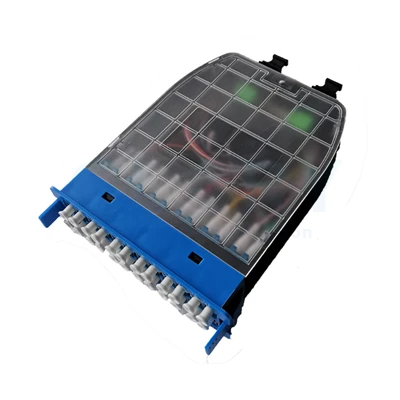
- 192 fibers · OM3/OM4/OM5 or OS2
- LGX modular · sliding tray
- Color-coded ports for fast moves/adds/changes
The trade-off is cost and complexity at the low end. If your network is overwhelmingly 40G/100G, a 16-fiber harness can be over-specified, and its two-row polarity mapping demands more careful planning. The rule of thumb is simple: match the harness to the lane count, and only reach for 16 fibers when the optics - or the near-term roadmap - call for it.
The Density and Cost Math Behind 8 vs 16
The difference becomes concrete when you count fibers in a single rack unit. A typical 1U chassis holds four 12-port MTP panels, giving 48 MPO ports. If every port uses an 8-fiber connector, that is 384 fibers in the rack unit. If the same 48 ports use 16-fiber connectors, you can reach 768 fibers - double the capacity in identical space. Even in a more conservative scenario, where 16-fiber density means only 24 ports are needed, you still reach 768 fibers while freeing half the panel positions for other equipment.
That density compounds into real operational returns. Fewer connectors mean less cable congestion, better front-to-back airflow, and lower cooling load. It also lowers the cost per gigabit: because you provision fewer assemblies and fewer patch positions for the same bandwidth, the material and labor cost of each 100G of capacity falls. Multiply that across a full row of racks and the difference in tray fill, connector count, and maintenance time becomes a recurring operational saving rather than a one-time gain. For operators refreshing a fabric every few years, that density advantage paid once keeps returning value across every subsequent speed generation.
A Practical Decision Framework
- Choose MTP/MPO-8 when the link runs 40G/100G SR4, 100G PSM4, or DR4-class 400G; when you need efficient four-lane breakout; and when the installed base is dominated by Base-8 equipment.
- Choose MTP/MPO-16 when the link runs 400G/800G SR8; when you are building AI/GPU spine-leaf fabrics; and when the roadmap includes 800G or 1.6T within the cable plant's service life.
- When in doubt, decide with your network team, not in isolation. Fiber count is both an infrastructure and a network decision - the optics dictate the lane count, and the physical layer has to match it.
- Think in generations. If a single backbone must serve 40G, 100G, 400G, and 800G over its lifetime, install the higher-count backbone now and step the optics up later.
Migration: Moving from MTP/MPO-8 to MTP/MPO-16 Without Re-cabling
Upgrading from 8-fiber to 16-fiber does not have to mean pulling new cable. There are two established approaches. The first is to increase panel density by moving from LC connectors to smaller-form-factor duplex connectors such as SN or MDC, effectively doubling the fibers per position in the same physical space. The second - and usually the faster path - is to use MTP/MPO conversion harnesses that bridge the two counts directly. A conversion assembly such as an MTP-16 to 2 × MTP-8 cable lets an existing 8-fiber backbone feed a 16-fiber panel, or vice versa, keeping polarity and lane mapping consistent without new horizontal cabling. Before ordering for the next speed step, see what to confirm when ordering MPO/MTP cabling for 800G to 1.6T. Because these are pre-terminated and factory-tested, the field work is a matter of swapping an assembly rather than splicing one. And because the backbone itself is unchanged, the upgrade can be staged rack by rack, so a live fabric keeps running while individual links move to 16 fibers.
Polarity, Gender, and Jacket: Details That Decide Success
Fiber count is the headline, but three details decide whether the link actually lights up. Polarity - defined under the ANSI/TIA-568.3-D optical fiber cabling standard - comes in Type A (straight-through), Type B (flipped), and Type C (pairwise-swapped) methods. For parallel optics, Type B is the dominant convention because QSFP, QSFP-DD, and OSFP transceivers expect it. Get polarity wrong and the link stays dark, which is why standardizing and documenting a single polarity method across a deployment matters more than the choice itself. Gender matters too: MTP/MPO connectors are male (with guide pins) or female (without), and equipment ports are typically male, so cords must be female. Jacket rating must match the space - plenum (OFNP), riser (OFNR), LSZH, or dual-rated - to satisfy local fire codes. Glory's data center assemblies are built to meet these requirements across single-mode and multimode.
How Glory Optical Supports Your MTP/MPO Deployment
Glory Optical Communication has manufactured passive optical products since 2008 from a 20,000 m² facility in Ningbo, China, and ships more than 300 SKUs to customers in over 50 countries. For MTP/MPO builds, the portfolio is designed to cover the whole link:
- MTP/MPO trunk and harness cables in 8, 12, 16, and 24 fibers, with OS2/OM3/OM4/OM5 fiber, Type A/B/C polarity, and LSZH/OFNR/OFNP jackets.
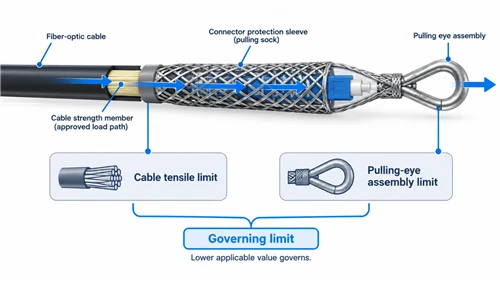
- Pre-terminated breakout assemblies, factory tested with insertion loss as low as ≤0.35 dB (Elite) and available with custom lengths and pulling eyes.
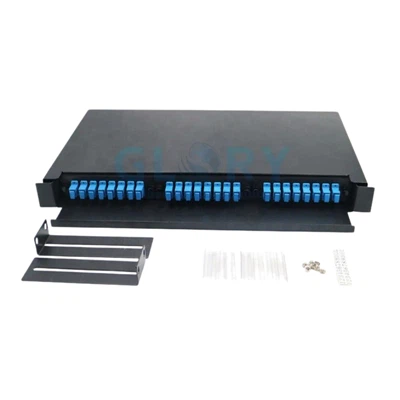
- High-density panels and frames, including fiber panels, a fiber distribution frame, an optical distribution frame, and a rack-mount ODF 19-inch rack scaled from 24 to 576 ports.
Products are engineered to ANSI/TIA-942 and ISO/IEC 24764 and comply with IEC 61754-7 and the IEEE 802.3 Ethernet family, including 802.3bs, 802.3df, and 802.3dj for 400G, 800G, and 1.6T. Multimode options follow the OM1–OM5 classifications described for multi-mode optical fiber, and upcoming data center cabling designs align with the ISO/IEC 11801-5 series for generic cabling in data centres. Manufacturing is backed by ISO 9001:2015 and ISO 14001:2015, CE, and RoHS. For projects that need a specific polarity scheme, panel layout, or branding, OEM/ODM customization is available, and pre-sales engineering can review a link diagram before you commit to a configuration.

- 24–576 ports · 1U/2U/4U
- LC/SC/MPO/FC · drawer or swing-out
- OEM logo and panel layout available
Conclusion: Match the Fiber Count to the Lanes
MTP/MPO-8 and MTP/MPO-16 are not rivals - they are two answers to two different lane architectures. Choose 8 fibers for 40G/100G SR4, PSM4, and DR4-class 400G links, where eight fibers deliver 100% utilization and the Base-8 ecosystem keeps costs low. Choose 16 fibers for 400G/800G SR8 and AI/GPU fabrics, where eight transmit and eight receive lanes need the density and headroom that only a 16-fiber backbone provides. Get that match right - and get polarity, gender, and jacket right with it - and your physical layer will serve multiple speed generations without a single re-cabling project.
Planning an MTP/MPO deployment? Request a free sample, share your link diagram for a pre-sales design review, or contact our technical sales team for pricing and lead times. Glory Optical can help you match the right fiber count, polarity, and panel configuration to your exact architecture.