
Why Outdoor Fiber Enclosures Matter: The Harsh Reality of OSP

Outdoor fiber optic cables and splices are constantly exposed to environmental threats that can compromise network performance and longevity. Unlike indoor environments, the outside plant (OSP) presents four major categories of risk:
• Moisture ingress – Rain, groundwater, condensation, and flooding are the primary enemies. Water in a splice point can cause hydrogen absorption, leading to increased signal attenuation, or in freezing conditions, ice expansion can physically crush fibers.
• Dust and contaminants – Fine particles can scratch connector end-faces or compromise sealing mechanisms over time, leading to intermittent failures.
• Extreme temperature fluctuations – Thermal cycling causes expansion and contraction of materials, which can loosen seals, stress fiber splices, and accelerate material aging.
• Mechanical stress – Wind-induced vibration, ice loading, accidental impacts, and even rodent gnawing all test the structural integrity of outdoor enclosures.
A well-designed outdoor fiber enclosure provides the essential "home" that protects these vulnerable connection points, ensuring network reliability for 20–25 years or more. Industry standards such as IP68 (dust-tight and immersion-proof) and IK10 (impact-resistant) have become baseline requirements for quality outdoor enclosures. Additionally, compliance with GR-771 (for splice closures) and UL 94 (flammability) ensures that enclosures meet rigorous mechanical, optical, and environmental performance standards.
Without proper protection, even the most expensive fiber optic cable and the most carefully executed fusion splice will fail prematurely. This is why selecting the right outdoor enclosure is not just a technical decision-it's a strategic investment in network longevity.
Main Types of Outdoor Fiber Enclosures: Understanding the Differences
Before diving into product specifics, it's essential to understand the functional categories of outdoor fiber enclosures. While the terminology can sometimes overlap, each type serves a distinct purpose in the optical distribution network (ODN).
Fiber Optic Splice Closure (FOSC)
Splice closures are designed primarily for permanent protection of fusion splices. They are deployed where two or more fiber optic cables are joined together-whether for extending a long-haul trunk, branching to a new distribution area, or repairing a damaged cable. Splice closures typically contain splice trays that organize and protect individual fiber splices, along with slack storage for excess fiber.
Splice closures generally fall into two structural categories:
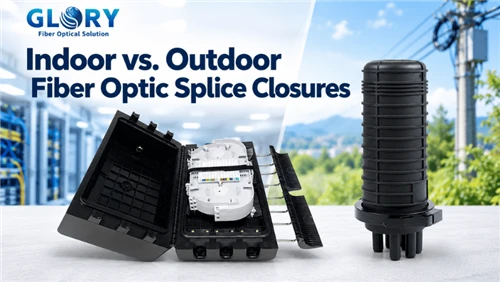
• Horizontal / Inline Closures – Flat or cylindrical in shape, with cables entering from both ends. These are ideal for aerial (pole-mounted), duct, and direct burial applications where cables run in a straight line. Inline closures are space-efficient and well-suited for backbone splicing.
• Vertical / Dome Closures – Domed or bullet-shaped, with all cables entering from the bottom base. Dome closures are the "undisputed king" of manhole and pedestal mounts. Their design allows technicians to pull the tray out, splice in a truck, and easily seal it back up. Dome closures tend to be more popular than inline closures because they are easier to handle during splicing, and it's often safer to store slack with cables entering from only one direction.
Fiber Optic Termination Box (FTB)
Termination boxes are designed to provide a standardized user interface where the network ends and customer equipment connects. They are typically deployed at the network edge-such as a subscriber's home, an office wall, or a small business premise. Termination boxes are smaller in capacity than splice closures or distribution boxes, usually serving one to a handful of users. They feature adapter panels (e.g., SC/APC, LC) for easy plug-and-play connection to ONTs or routers and are often mounted on walls or poles indoors or outdoors.
Fiber Optic Distribution Box (FDB)
Distribution boxes serve as intermediate distribution points in the ODN. They are larger than termination boxes and are designed to serve multiple users-typically 8, 16, 24, or more. A key differentiator of distribution boxes is that they can accommodate PLC splitters (e.g., 1:8, 1:16, 1:32) to divide an optical signal among multiple subscribers. They also include splice trays and adapter panels, and they support both splicing and patching functions. While a fiber optic termination box serves a single user or only a limited number of users (less than five), a Fiber Distribution Box is designed to provide fiber access for multiple users. Distribution boxes are often deployed in street cabinets, building basements, or outdoor pedestals.
Summary Comparison
|
Enclosure Type |
Primary Function |
Typical Capacity |
Splitter Support |
Mounting Locations |
|
Splice Closure (FOSC) |
Protect permanent fusion splices |
24–288+ fibers |
No (splicing only) |
Aerial, manhole, direct burial, pole |
|
Termination Box (FTB) |
End-user interface (1–2 subscribers) |
1–8 ports |
No |
Wall (indoor/outdoor), pole |
|
Distribution Box (FDB) |
Multi-user distribution node |
8–48 ports |
Yes (1:4 to 1:32) |
Pedestal, cabinet, basement, pole |
Key Technical Features to Look for in Outdoor Enclosures
When evaluating outdoor fiber enclosures, several technical specifications are critical to long-term performance. Here's what to look for:
Protection Rating: IP68 vs. IP65
Ingress Protection (IP) ratings define how well an enclosure resists dust and water:
• IP68 – The highest common rating for outdoor enclosures. IP68 means the enclosure is completely dust-tight (the "6" in the rating) and can be continuously submerged in water (the "8") under conditions specified by the manufacturer-typically 1–3 meters for 7 days. IP68 is essential for manhole, handhole, and direct burial applications where standing water is common.
• IP65 – Dust-tight and protected against low-pressure water jets from any direction. IP65 is suitable for wall-mounted outdoor enclosures, street cabinets, and pedestals that are not subject to prolonged flooding, but where rain and hose-down cleaning are a concern.
IK Impact Rating
IK ratings measure mechanical impact resistance:
• IK08 – Withstands impact energy of 5 joules (equivalent to a 1.7 kg mass dropped from 400 mm). This is important for enclosures that may be accidentally struck by tools, debris, or vehicles.
Temperature Range
Outdoor enclosures must survive extreme temperature swings. Quality enclosures typically operate from -40°C to +65°C (or up to +85°C for some models). This range covers everything from Siberian winters to desert summers.
Material Selection
• PP+GF (Polypropylene + Glass Fiber) – Offers excellent rigidity, corrosion resistance, and dimensional stability. The GL-6808 series uses PP+GF for robust mechanical and environmental durability.
• ABS+PC (Acrylonitrile Butadiene Styrene + Polycarbonate) – Combines impact resistance with flame retardancy. The GL-FTB-24E-1 termination box and GL-A5-24R distribution box use ABS+PC for superior environmental protection.
• High-quality engineering plastic – All GLORY enclosures are manufactured from scientifically formulated engineering plastics with anti-aging, anti-corrosion, flame-retardant, waterproof, anti-vibration, and anti-shock properties.
Sealing Technology
Different enclosures use different sealing methods:
• Mechanical nut compression – Cable ports are sealed using tightening nuts and gaskets. This method is reusable and tool-friendly. The GL-6808 series features nut compression sealing that accommodates a wide cable range (Φ10–18 mm).
• Gel sealing – Soft gel compounds flow around cables to create a 360° watertight barrier. Gel seals are self-healing and accept multiple cable diameters in the same port.
• Screw mechanical sealing – The GL-J011 outdoor splice enclosure uses screw mechanical sealing for cable inlets, with cable ports ranging from 13–20 mm.
Additional Quality Indicators
• Flame retardant rating – UL94 standards (e.g., UL94-V0, UL94 HB) ensure the enclosure material self-extinguishes and does not contribute to fire spread.
• UV resistance – UV-stabilized materials prevent cracking, yellowing, and embrittlement after years of direct sunlight exposure.
• Re-enterable design – A quality enclosure should be able to be reopened and reclosed without compromising the seal or structural integrity-essential for maintenance and network upgrades.
GLORY Outdoor Fiber Enclosure Series: Complete Portfolio
GLORY Optical offers a comprehensive range of outdoor fiber enclosures designed to meet the demands of modern fiber optic networks. Below is a detailed overview of each series, organized by functional category.
Fiber Optic Splice Closures (FOSC) – For Permanent Splice Protection

Inline (Horizontal) Splice Closures
|
Model |
Key Features |
Capacity |
Cable Ports |
Protection |
|
GL-H4-C1 |
Patent-protected sealing; supports non-cut cable inlets; eliminates need for additional sealing accessories |
96 fibers (4 trays × 24F) |
2 in + 2 out (Φ10–22mm) |
IP68, -40°C to +65°C |
|
GL-6808 |
Screwless buckle design; nut compression sealing; detachable cap nut allows installation without cutting cable |
72 fibers (3 trays × 24F) |
2 in + 2 out (Φ10–18mm) |
IP68, PP+GF material |
|
GL-J011 |
Compact design; 48-core capacity; ideal for EPON/GPON systems; screw mechanical sealing |
48 cores |
2 in + 8 out (13–20mm) |
IP68, PC/PC+ABS/PP |
Dome (Vertical) Splice Closure
|
Model |
Key Features |
Capacity |
Sealing |
Applications |
|
Outdoor Dome Splice Enclosure |
Dome-to-base design; hinged structure allows access to individual splices without disturbing other trays; ample loose buffer storage basket; lightning protection grounding device |
Up to 8 splice trays |
Fast, reliable sealing mechanism; reusable multiple times |
Overhead, pole/wall-mounted, direct burial |
This dome closure is constructed from injection-molded engineering plastic with anti-aging, anti-corrosion, flame-retardant, waterproof, anti-vibration, and anti-shock properties. It has been tested to withstand voltage strength of 15 kV DC (1 min) with no arcing or breakdown, and temperature cycling from -40°C to +65°C with internal pressure testing.
Outdoor Fiber Termination Boxes – For End-User Access
|
Model |
Key Features |
Capacity |
Splitter Support |
Protection |
|
GL-FTB-24E-1 FTTH Outdoor Terminal Box |
Split-panel design separates fusion and termination areas; independent rubber sealing plug for each drop cable entry; safety lock design; wall or pole mounting |
24 cores |
Supports up to 4 × 1:8 blockless PLC splitters |
IP65, ABS+PC material |
This 24-port termination box is an ideal solution for high-density FTTH distribution points, supporting telecoms, ISPs, and data centers. Its compact design integrates splice trays and splitter modules for efficient cable management, enabling seamless fiber splitting, splicing, and patching.
The split-panel design allows for easy installation and maintenance, with fusion and termination areas completely separated. It is suitable for wall or pole mounting in residential, industrial, or remote areas, and is designed to accommodate mid-span cable access without disrupting existing traffic during network upgrades or expansions.

Outdoor Fiber Distribution Boxes (FDB) – For Multi-User Distribution
|
Model |
Key Features |
Capacity |
Splitter Support |
Protection |
|
GL-A5-24R Outdoor Fiber Distribution Enclosure |
Flip-up distribution panel; separate pathways prevent interference between cables, pigtails, and patch cords; wall, pole, or messenger wire mounting |
24 ports |
Built-in splitter management |
IP65/66, -40°C to +85°C, insertion loss ≤0.15dB, UPC return loss ≥50dB, APC return loss ≥60dB |
|
GL-FDB16 Outdoor Fiber Distribution Box |
Accommodates up to 2 fiber optic cables, splitters, and up to 16 fusion splices; includes 16 SC adapters; connector can be reconnected >200 times |
16 ports |
Up to 1:16 |
IP65, -40°C to +60°C, ABS+PC material |

The GL-A5-24R stands out with its high-performance optical characteristics: insertion loss ≤0.15dB, UPC return loss ≥50dB, and APC return loss ≥60dB, making it suitable for demanding PON applications.
It also features robust electrical protection with insulation resistance ≥2×10⁴ MΩ/500V DC and withstand voltage ≥3000V DC/min. The enclosure integrates clamping mechanisms for feeder and drop cables alongside splicing, fixation, storage, and distribution functions, making it a complete solution for FTTx distribution points.
How to Choose the Right Outdoor Enclosure: Selection Guide by Application
The following decision framework will help you match the right enclosure type to your specific network node:
|
Application / Network Node |
Recommended Product Type |
GLORY Model Examples |
Key Selection Factors |
||
|
Backbone trunk cable splice (high fiber count, permanent) |
High-capacity inline splice closure |
GL-6808-B (288F) |
High splice capacity, durable sealing, direct burial or manhole rated |
||
|
Feeder cable splice to distribution cable (mid-span, underground) |
Dome splice closure |
Outdoor Dome Splice Enclosure |
Bottom cable entry, easy tray access, slack storage basket |
||
|
Aerial (pole-mounted) fiber splice |
Inline splice closure |
GL-H4-C1, GL-6808-A |
Horizontal mounting, wind/vibration resistant, IP68 |
||
|
Street cabinet / pedestal distribution node |
Outdoor distribution box (FDB) |
GL-A5-24R, Outdoor Optical Dist. Box |
Splitter support, multiple drop ports, IP65/66, organized cable management |
||
|
Building entry point (MDU / apartment) |
Outdoor distribution box or termination box |
GL-FTB-24E-1, GL-FDB16 |
Wall-mountable, high-density SC ports, splitter ready |
||
|
Single-family home / user termination |
Termination box (small) |
GL-FTB-24E-1 (can serve 24 users) |
Compact, wall-mountable, SC/APC or FC ports, easy patch cord connection |
||
|
Re-enterable splice closure |
GL-6808 series (screwless design) |
Tool-free re-entry, detachable cap nut, reusable seal |
Conclusion: Why GLORY Outdoor Enclosures Are Your Reliable Partner
As global demand for high-speed broadband, 5G infrastructure, and smart city applications continues to grow, the need for robust, reliable outdoor fiber enclosures has never been greater. GLORY Optical offers a complete range of outdoor enclosures-from high-capacity inline splice closures to compact distribution boxes and user-friendly termination boxes-all engineered to meet the most demanding field conditions.
Key advantages of choosing GLORY outdoor enclosures:
• Proven durability – IP68/IP65 protection, wide temperature range (-40°C to +85°C), UV resistance, and flame-retardant materials
• Flexible configurations – Multiple port counts, cable diameters, splitter options, and mounting methods to suit any network node
• Field-friendly design – Re-enterable sealing, screwless buckles, detachable cap nuts, and clear fiber routing
• Comprehensive portfolio – One trusted supplier for splice closures, termination boxes, and distribution boxes
Whether you are deploying a new FTTH network, upgrading existing infrastructure, or building a 5G fronthaul system, GLORY has the right outdoor enclosure solution for your project.