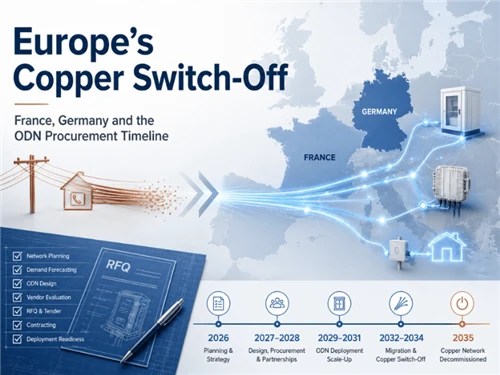
A signal-driven procurement view. It is a planning model, not a forecast of ODN unit sales.
The Short Answer: Europe Is Moving on Different National Timelines
A copper switch-off is the planned withdrawal of services and eventual retirement of a legacy copper access network after customers have a suitable alternative. The process usually moves through several commercial, service and engineering gates.
| Term | Meaning | ODN procurement consequence |
|---|---|---|
| PSTN switch-off | Traditional circuit-switched voice is replaced, often by IP voice. | Voice can leave the PSTN while a copper pair temporarily continues to carry broadband. |
| Stop-sell or commercial closure | New copper-based services can no longer be ordered in the area. | FTTH activation capacity must already support new orders. |
| Technical closure | Active copper services and related network equipment are switched off. | Every affected service needs a tested alternative and a controlled cutover. |
| Physical retirement | Copper cables, cabinets or exchange assets are removed, recovered or left in place. | Reuse depends on condition, space, ownership and local rules. |
EU policy sets the direction; national programmes control execution
The European Commission's Digital Networks Act proposal creates a common direction for the transition to fibre. The EUR-Lex text remains a legislative proposal, so its dates and conditions should be monitored rather than treated as binding obligations.
The likely commercial result is a series of national and regional buying windows. A repeatable base ODN design with controlled local variants is therefore more useful than a single "Europe kit." Glory can configure enclosure ports, materials, mounting, splitter packaging and labels through its OEM/ODM programme, once the operator has fixed the topology and field interfaces.
Policy deadlines sit at the end of the purchasing process
Before an area can release copper, teams must survey premises and civil routes, freeze ODN interfaces and optical budgets, qualify products and second sources, run difficult-site pilots, stage activation material and validate each migrated service. A closure date describes the intended service outcome; it cannot substitute for these upstream gates.
For a component-level map of the passive path, use Glory Optical's FTTH ODN network solution alongside the area-specific migration plan.
Europe, France and Germany: Dates and Decision Gates
| Geography | Position at 27 August 2026 | Procurement signal | Decision caveat |
|---|---|---|---|
| European Union | DNA proposes national plans and a conditional framework extending toward 2035. | Track national plans, CSO areas, coverage thresholds and affordability safeguards. | The proposal is under negotiation. |
| France | Municipality-based commercial and technical closure batches; programme extends to end-2030. | Published lots support qualification and call-off back-planning. | Readiness criteria can postpone individual municipalities. |
| Germany | Regulator proposes regional migration based on fibre readiness, access and notice. | Qualify by operator and ready area. | No nationwide technical-closure date has been fixed. |
European Union
Proposed milestones in the Digital Networks Act
The proposal's transition title would apply in Member States where copper remains in service after 30 June 2029. The draft calls for national regulators to publish copper switch-off areas by 31 May 2028, publish the areas meeting the sustainability conditions by 30 June 2029, and for Member States to notify national transition plans by 31 October 2029.
Before 31 December 2035, Member States would adopt binding acts mandating switch-off in areas where at least 95% of premises are passed by fibre and affordable retail connectivity of comparable quality is available. An exception covers areas where fibre is not economically viable and no adequate replacement exists.
The remaining FTTP gap contains different types of work
The European Commission's Digital Decade 2026 connectivity report gives EU27 FTTP coverage of 74.1%. The complement is 25.9%, indicating that roughly one quarter of premises were outside the reported FTTP footprint. This is a coverage measure rather than an ODN demand forecast: alternative networks, density, installed assets and activation rates all affect the actual component requirement.
France
Commercial and technical closure are separate gates
Arcep's copper-closure guidance distinguishes the end of new copper sales from the later shutdown of active services. Orange Wholesale manages the network-owner programme, while Arcep monitors whether closure conditions have been met.
Commercial closure is an activation-capacity signal: once a new DSL order is unavailable, the fibre access path and drop process must support the new order. Technical closure adds a service-completion requirement covering active voice, broadband and special-use lines.
Lots 3, 4 and 5 create the clearest announced execution wave
| France closure batch | Approximate scope | Commercial status | Technical closure window |
|---|---|---|---|
| Lot 3 | 2,138 municipalities; about 2.5 million premises | 2,097 municipalities closed commercially on 31 January 2026; Orange reported 44 postponements. | 31 January 2027 for the on-time group; 2028 for the postponed municipalities. |
| Lot 4 | 6,894 municipalities; about 8.3 million premises | Part closed in January 2026; the remainder is planned for January 2027. | January, May and October 2028. |
| Lot 5 | 10,470 municipalities; about 11.7 million premises | Part closed in January 2026; the remainder is planned for January 2027. | January, May and October 2029. |
Source: Arcep's current Orange closure-plan page. All forecast closures remain subject to Arcep's readiness criteria.
22.5m
Premises in Lots 3–5
Approximate total from the published lot figures.
20.0m
Premises in Lots 4–5
The two main 2028–2029 windows.
88.9%
Share in Lots 4–5
Glory Research calculation; it is not a unit-sales forecast.
The practical implication is timing: qualification and difficult-site pilots should be complete before the largest announced execution windows. Volume orders can then follow verified area readiness. For pole, wall or aerial distribution, the GL-ODB-16S fibre termination enclosure offers up to 16 SC positions and space for a 1×16 PLC splitter in an IP65/IK10 housing. The operator still needs to confirm splitter loss, connector polish, cable diameters and the site environment.
Germany
An 80% FTTH condition would open the regional migration process
In January 2026, the Bundesnetzagentur regulatory approach proposed that regional migration should begin only when at least about 80% of households and businesses can access FTTH. Actual copper disconnection should take place closer to nationwide coverage, with appropriate wholesale access and consumer safeguards.
Procurement therefore needs a rolling area model. Teams can qualify standard outdoor and in-building designs when a planning area approaches the readiness condition, then release area quantities after address-level availability, building permission and the responsible operator's migration plan have been verified.
Marketing and notice periods create two checkpoints
The regulatory approach proposes ending copper marketing at least 24 months before disconnection and providing at least 12 months' notice. Separately, Section 34 of the German Telecommunications Act requires a company with significant market power to notify the regulator at least one year before decommissioning relevant network parts and to describe the timeline, migration conditions and alternative access products.
- At the early marketing gate, verify that FTTH ports and activation kits can support new orders.
- At the formal notice gate, freeze area quantities, exceptions, spares and cutover teams.
- Before copper release, validate optical performance and every affected service class.
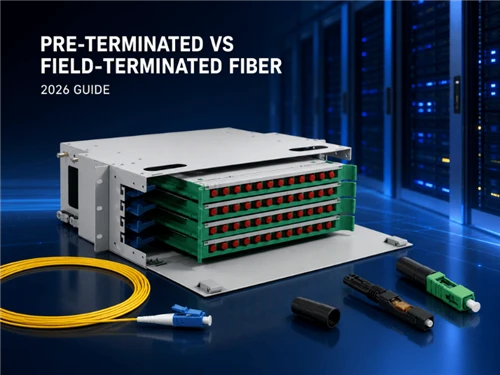
A pre-connectorized FAT terminal can simplify repeat activation where the network has standardized the hardened interface. Connector interoperability, drop length, cleaning, inspection and repair procedures remain part of qualification.
Back-Calculate the ODN Procurement Timeline
The following model starts from T0, the target technical closure for one defined area. It provides a planning framework; individual operators may need longer lead times for new connector systems, custom moulds, third-party approval or complex civil work.
| Time from target closure | Engineering and procurement gate | Evidence required |
|---|---|---|
| T-18 to T-12 months | Survey assets; segment SFU, MDU, rural and business sites; freeze interfaces; qualify suppliers. | Address and route data, preliminary optical budget, enclosure environment, approved connector and cable families. |
| T-12 to T-9 months | Run sample and laboratory qualification; install difficult-site pilots; confirm second source. | Controlled drawings, material declarations, test records, field report and change-control process. |
| T-9 to T-6 months | Place framework or blanket order; approve initial production; train installation teams. | Approved BOM, forecast bands, batch traceability, packaging and labelling plan. |
| T-6 to T-3 months | Release area call-offs; stage activation kits and critical spares. | Confirmed premises, port map, installation schedule, exception register and logistics plan. |
| T-3 to T0 | Install, activate and validate services while retaining a rollback path. | Optical results, voice/data/alarm acceptance, customer sign-off and unresolved exceptions. |
| T0 to T+6 months | Complete long-tail exceptions, reconcile records and release copper assets. | As-built records, closure evidence, spare disposition and defect analysis. |
T-18 to T-12 months: survey and qualification
Record cabinet and pole condition, duct occupancy, chamber flood risk, cable-entry diameters, mounting restrictions, MDU ownership, fire-zone crossings, riser space, access hours and special services. Existing infrastructure should enter the design only after its condition, capacity, ownership and worker access have been verified.
Freeze interfaces before selecting volume supply. Define port count, splice capacity, splitter package, connector type and polish, insertion-loss limits, cable diameter, mounting, IP requirement, temperature, material, labels and batch records. A hardened connector should be qualified as a mated system.
T-12 to T-6 months: include difficult sites in the pilot
A useful pilot mix includes an aerial route, a wet chamber, a compact facade, an MDU common area and a site with an alarm or other special service. Measure each work step, first-pass optical acceptance, rework, contamination, seal damage and unplanned civil work. This process breakdown provides a defensible comparison between field-spliced and pre-connectorized options in the buyer's labour market.
T-6 to T0: release orders against verified readiness
Use the national programme for capacity planning and the verified area plan for purchase release. A call-off file should contain node ID, address cluster, planned homes, expected activation, split ratio, spare-port policy, enclosure model, input cable, drop interface, mounting kit, delivery location and required-on-site date.
T0 to T+6 months: fund the exception tail
No-access premises, landlord disputes, failed power arrangements, alarms, business services, blocked ducts and incorrect records need their own workstream. Reserve compatible enclosures, splitters, adapters and drops for repairs and late activations so that a small exception list does not prolong operational dependence on copper.
Build the BOM Around Field Conditions
A country name is too broad to determine the hardware. Start with ODN function, then select the configuration from exposure, mounting, density, connector system and labour model.
Feeder and Distribution Branch
Candidate: GL-8207-B splice enclosure - 96-fibre splice capacity, eight hardened adapters and an IP68 rating.
Use when: an outdoor branch needs splice protection and hardened drop distribution. Confirm cable OD, mating interface, splitter arrangement and the exact IP test condition.
Pole, Wall or Aerial Distribution
Candidate: GL-ODB-16S - up to 16 SC adapters, up to a 1×16 PLC splitter, IP65 and IK10.
Use when: an above-ground node needs standard SC access. Validate connector polish, splitter loss, temperature and port utilization.
Pre-Connectorized Activation
Candidate: GL-FTB-10E - ten Mini SC positions, factory-routed splitter options and an IP65 enclosure.
Use when: a standardized hardened-drop system needs repeat plug-in activation. Qualify interoperability, cleaning tools, drop lengths and repair stock.
Compact Brownfield or Rural Node
Candidate: B04 gel-sealed distribution box - ten cores, four drop outputs, optional 1×4 splitting and an IP67 rating.
Use when: a small branch needs a compact reopenable node. Confirm cable entries, reopen cycles, splitter configuration and growth capacity.
For centralized or cascaded optical split, specify the 1×N or 2×N ratio, package, connector, wavelength range, maximum insertion loss and uniformity before selecting from the Glory PLC splitter range. Glory can review the node drawings and generate a controlled project BOM through its ODN solution service.
Define the Evidence Package in the RFQ
Quality-system certification and product-performance testing answer different questions. A procurement specification should request both.
Factory system evidence
ISO 9001:2015 specifies requirements for a quality-management system. Verify the certified legal entity, production site, certification body, scope and validity. The certificate supports process consistency and traceability.
Product performance evidence
IEC 61753-1:2018 provides performance-standard guidance for passive fibre products. IEC 60529 defines IP codes. Request evidence for the exact model, configuration and installation environment.
Ask for traceable test evidence
The evidence package should state the report number, laboratory, date, model and configuration, sample quantity, test conditions, acceptance criteria, before/after optical results and requalification triggers. For splitters and connectorized assemblies, define maximum insertion loss, uniformity, return loss or directivity where applicable, wavelength range, connector polish and the batch-record format.
Glory's OEM/ODM quality process lists optical inspection, material traceability and third-party inspection support. Include every required certificate, report and batch record in the purchase specification so that the evidence becomes a contractual deliverable.
Four Field Risks Hidden by Policy Timelines
Regulatory publications establish coverage, access and consumer safeguards. To identify the operational questions people raise during real migrations, Glory Research also coded the primary concern in 14 unique public Reddit discussions. Five focused on MDU or landlord access, four on power or special-service continuity, three on cutover or parallel running and two on timing or terminology.
This convenience sample was used for issue discovery. It does not estimate European prevalence, and it is not used as evidence for regulatory facts or market size.
View the 14-thread social-listening sample- Bell copper POTS migration and power continuity
- First power outage after a fibre upgrade
- UPS requirements for fibre equipment
- Alarm monitoring after copper disconnection
- Property-owner permission during stop-sell
- Flat installation, wayleave and fire rules
- Whole-building fibre installation
- MDU upgrade cost and owner decisions
- Landlord permission for drilling
- Copper removal and premature cutover
- Temporary parallel running
- Indoor fibre route and equipment location
- Active-service versus unused-copper retirement
- PSTN, Digital Voice and access-network terminology
MDU permission and the in-building pathway
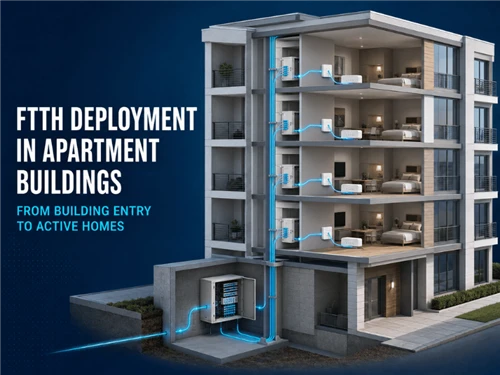
A building may be passed at street level while the individual service path remains unavailable. Add gates for property permission, common-area access, riser capacity, fire stopping, cable classification, terminal location and access to each unit.
ODN planning response: use compact, maintainable common-area distribution with controlled bend radius and clear labels. Keep permission status visible in programme data because an enclosure cannot resolve an ownership dispute.
Power, voice, alarm and telecare continuity
Legacy copper may power a basic telephone from the exchange, whereas FTTH customer equipment normally depends on local electricity. Audit voice, lift phones, alarms, telecare, fax, payment terminals and other special-use circuits. Define backup-power ownership, autonomy, monitoring, replacement and customer instructions.
Service-design response: include ONT/router power and special-service acceptance in the cutover checklist even though active devices sit outside Glory's passive ODN scope.
Premature copper release
Installed fibre alone is insufficient evidence for releasing the copper line. Require the planned optical level, data service, voice, special services, records and customer acceptance to pass, with an agreed rollback or escalation route.
Cutover control: pre-labelled ports, batch records, accessible test points and compatible spare drops reduce troubleshooting time. A GL-FTB-10E pre-connectorized terminal can simplify repeat activations after the interface has been qualified.
Terminology and customer communication
Customers often hear that "the phone network is switching off" without knowing whether the area is at stop-sell, active-service migration, technical shutdown or physical asset removal. Every notice should state the local stage, date, affected services, responsible organisation and required customer action.
Data and labelling response: match identifiers across the GIS, design, enclosure, splitter port, drop assembly and customer work order. Inconsistent labels can turn technically compatible hardware into a cutover failure.
2026–2035 Market Outlook: Volume First, Complexity Later
2026–27
Qualification phase
France Lot 3, German rule development, complex-site pilots and small variant orders.
2028–29
Visible France wave
Lots 4–5 support bulk call-offs, field replenishment and activation kits.
2030–35+
Exception tail
MDU, rural, special-service and maintenance requirements increase the value of controlled variants.
France provides the clearest announced procurement concentration
Lots 4 and 5 place about 20.0 million of the 22.5 million premises in Lots 3–5 into 2028–2029 technical-closure windows. The calculation supports production and logistics readiness ahead of those years, while confirmed area completion and activation should still control order release.
Arcep reported 42.8 million FTTH-connectable premises and 27.7 million fibre subscriptions at the end of March 2026. Dividing the two gives a rough 64.7% subscription-to-connectable-premises proxy. It is not Arcep's official take-up rate because the measures do not form a perfect cohort; it illustrates the operational gap between passing and activating a premise.
Germany will create rolling area-specific demand
The useful leading indicators are regional FTTH availability, wholesale access agreements, formal migration plans, stop-marketing notices and address-level completion. A qualified component library with configurable documentation is more defensible than a single speculative nationwide peak-year forecast.
The post-2030 tail will contain harder sites
As repeatable areas finish, the remaining mix is likely to contain a higher share of MDUs, remote premises, civil constraints and special services. Smaller repeat orders, stronger change control and a longer compatible-spares horizon become increasingly important.
A Procurement-Ready Copper-to-Fibre Checklist
Network and site inputs
- Country, operator and target area
- Stop-sell, migration and technical-closure dates
- SFU, MDU, business, rural and special-service premises
- Aerial, wall, chamber, duct and in-building environments
- Verified reusable assets and node activation assumptions
Component and optical inputs
- PON generation, wavelength plan and optical budget
- Centralized or cascaded split and splitter package
- Cable type, outer diameter and splice capacity
- Connector family, polish, keying and hardened interface
- Port count, labels, material, IP/IK and mounting
Documentation and acceptance
- Approved drawings and BOM revision
- Current ISO 9001 certificate for the correct entity/site
- Product-specific test reports and declarations
- Batch optical records and traceability
- Golden sample, inspection plan and change-control rules
Delivery and operations
- Area call-off schedule and delivery locations
- Packaging, kits, port maps and labels
- Critical spares and replacement horizon
- Installation, cleaning and test instructions
- Service acceptance and rollback process
Turn the closure area into a qualified ODN BOM
Send Glory the topology, optical budget, node count, field environment, connector interface, delivery profile and acceptance requirements. The engineering team can map the requirement to an existing product or a controlled OEM variant before volume ordering.
Primary Sources and Research Boundary
- European Commission - Digital Networks Act proposal
- EUR-Lex - COM(2026) 16
- BEREC - Progress report on managing copper network switch-off
- Arcep - Orange's copper-closure programme
- Arcep - Q1 2026 fixed broadband market
- Bundesnetzagentur - Copper-to-fibre regulatory approach
- German Telecommunications Act §34
- FTTH Council Europe - Copper Switch-Off Tracker
Policy and standards sources establish the regulatory and technical facts. Glory Research calculations are labelled as calculations. The social-listening sample is used only to identify operational questions and does not establish market prevalence.
Frequently Asked Questions
Q: When will copper networks be switched off in Europe?
A: There is no single European date. France is progressing through local batches toward end-2030. Germany has no fixed national date and is developing a regional readiness-based framework. The EU Digital Networks Act contains proposed milestones toward 2035 and was still under the legislative process on 27 August 2026.
Q: Is PSTN switch-off the same as copper network switch-off?
A: No. PSTN switch-off replaces legacy circuit-switched voice, while copper network switch-off retires the access network and requires another suitable access path. A copper pair may temporarily continue to carry broadband after voice has moved to an IP service.
Q: What is the difference between commercial and technical closure?
A: Commercial closure prevents new copper service orders in an area. Technical closure stops the remaining active copper services. FTTH capacity must support new orders by the commercial gate, while active services and exceptions must be resolved before the technical gate.
Q: Does Germany have a fixed copper switch-off date?
A: No nationwide date has been set. The Bundesnetzagentur's 2026 approach proposes regional migration based on FTTH availability, suitable wholesale access, notice and consumer safeguards.
Q: What ODN components are needed for copper-to-fibre migration?
A: The passive path typically includes feeder and distribution cable, splice closures, distribution boxes or hubs, PLC splitters, FAT/NAP terminals, drop cable, wall outlets, adapters and connectors. The final BOM depends on topology, optical budget, density, mounting, environment and the activation process.
Q: Can existing ducts, poles and cabinets be reused?
A: Often, after verification. Survey condition, capacity, ownership, access, water exposure, loading and interface compatibility before design freeze. Record a fallback for blocked ducts or unsuitable cabinets.
Q: How early should ODN procurement begin?
A: For a defined closure area, begin surveys and component qualification roughly 12–18 months before the target technical closure. Release volume against verified area readiness. New connector systems, custom moulds or third-party approval may require additional time.
Q: What should an ODN RFQ include?
A: Include topology, optical budget, node and premises data, split ratio, cable and connector interfaces, enclosure environment, capacity, mounting, standards evidence, batch traceability, labelling, delivery profile, spares and change-control requirements.