
Most procurement failures in fiber infrastructure trace back not to the fiber or the connectors, but to a jacket specified by default rather than by requirement.
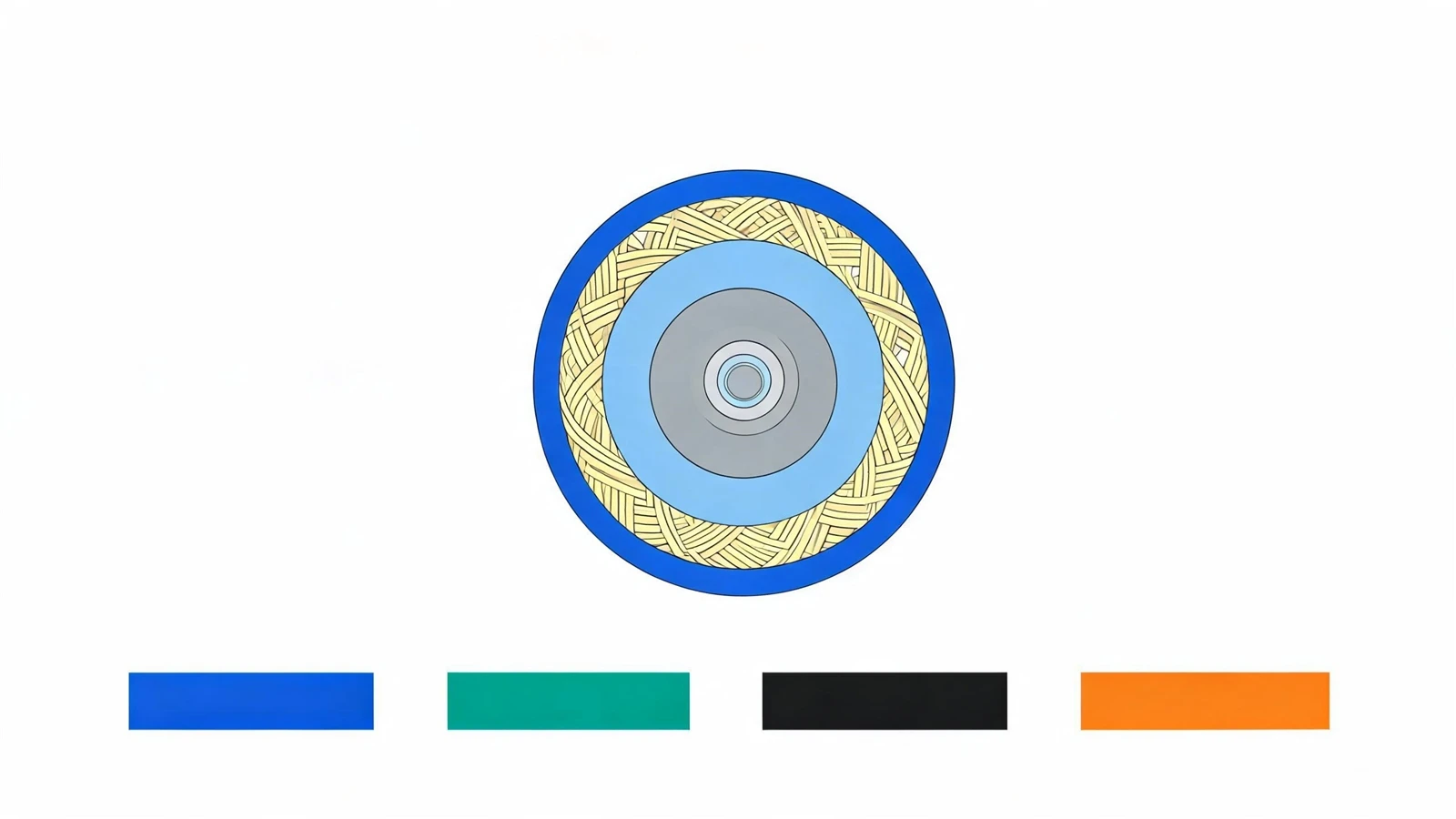
A fiber optic cable jacket is the cable's outer environmental and mechanical protection layer; color alone does not specify its material or fire rating.
The Three Jobs of a Cable Jacket
A fiber optic cable jacket performs three distinct functions that are often treated as one. First, it provides mechanical protection against abrasion, crush, impact, and gnawing. Second, it provides environmental isolation against moisture, UV radiation, chemicals, and temperature extremes. Third, it provides fire behavior control by limiting flame spread, smoke density, and toxic gas emission. No single material optimizes all three simultaneously. Every jacket selection is a trade-off, and understanding which trade-off you are making is the difference between a 25-year installation and a four-day re-pull.
Three Axes of Confusion: Material vs Fire Rating vs Color
The most common procurement error is conflating three separate attributes into a single mental category called "the jacket." This conflation is how jobs fail inspection. The table below separates the three axes that buyers routinely mix up.
| Attribute | What It Tells You | Examples |
|---|---|---|
| Jacket material | What the jacket is chemically made of | PVC, LSZH, PE, TPU, PVDF |
| Fire rating | Where the cable can be legally installed | OFNP, OFNR, OFNG, OFN |
| Jacket color | Which fiber type is inside (OS2 vs OM3/OM4) | Yellow = OS2, Aqua = OM3/OM4 |
A cable can be LSZH material and OFNP fire-rated at the same time. LSZH describes the chemistry of the jacket compound. OFNP describes the fire performance test the cable passed. They are orthogonal. A plenum-rated PVC cable satisfies the fire code but still produces corrosive hydrogen chloride gas when it burns. An LSZH cable without a plenum rating produces clean smoke but cannot legally be installed in a plenum space. The combination "LSZH-OFNP" satisfies both the code and the life safety team.
The NEC Fire Rating Hierarchy: What OFNP, OFNR, and OFNG Actually Mean
The National Electrical Code (NEC) Article 770 defines four fire performance levels for optical fiber cables, arranged in a strict hierarchy. The hierarchy is unidirectional: a higher rating can substitute for a lower one, but never the reverse.
OFNP: Optical Fiber Nonconductive Plenum
OFNP is the most demanding fire rating in the NEC hierarchy. It is required in plenum spaces, which are building areas used for environmental air circulation, typically the open spaces above suspended drop ceilings or below raised floors. Because these spaces serve as HVAC return air paths, a fire starting here can spread smoke throughout the building in seconds. OFNP cables are tested to NFPA 262 (UL 910), the Steiner Tunnel test, which measures both flame spread distance and smoke generation density in a forced-air environment.
The test is brutal. A 25-foot horizontal tunnel furnace forces air through the cable chamber at 240 feet per minute while a 300,000 BTU/hr flame impinges on the cable for 20 minutes. To pass, the cable must limit flame spread to 5.0 feet or less and maintain optical transmittance of at least 95% in the smoke exhaust stream. The OFNP rating is why plenum cables typically use fluoropolymer jackets like FEP (fluorinated ethylene propylene), which has an oxygen index above 95%, meaning it cannot sustain combustion in normal atmospheric oxygen.
OFNR: Optical Fiber Nonconductive Riser
OFNR is rated for vertical riser shafts that connect floors in a building. Its job is to prevent fire from traveling upward between floors through the cable pathway. The test standard is UL 1666, which evaluates flame propagation height when a cable is ignited vertically in a shaft simulation. OFNR does not meet the smoke density requirements of OFNP, so it cannot be installed in plenum spaces. However, OFNP can be installed in riser spaces as a downgrade. Many specifiers standardize on OFNP throughout a building to simplify inventory and ensure maximum fire safety across all pathways.
OFNG: Optical Fiber Nonconductive General Purpose
OFNG is the baseline indoor rating for spaces that are neither plenum nor riser. It is tested to UL 1581, which evaluates resistance to flame propagation in a vertical tray. OFNG is adequate for patch cords inside racks, cable trays in equipment rooms, and general indoor runs where the pathway does not connect floors or pass through air-handling spaces. Most standard PVC patch cords carry this rating.
CPR Euroclasses: The European Framework
Europe uses a completely different fire classification system mandated by the Construction Products Regulation (CPR, Regulation EU 305/2011). Under the harmonized standard EN 50575, all permanently installed power, control, and communication cables must carry a CPR Euroclass rating with CE marking.
The CPR system is more granular than NEC. Each Euroclass rating comprises four sub-indices: a fire spread class (Aca through Fca), smoke production (s1a, s1b, s2, s3), flaming droplets (d0, d1, d2), and acidity (a1, a2, a3). A full rating looks like B2ca-s1a,d1,a1, which means very limited flame spread, very low smoke (transmittance at least 80%), no flaming droplets, and very low acidity (conductivity below 2.5 microsiemens/mm, pH above 4.3).
The AVCP system matters because it determines the level of third-party scrutiny. B2ca and Cca cables fall under System 1+, which requires a notified body to audit the factory, conduct initial type testing, and perform bi-annual surveillance including sample re-testing. Dca and Eca fall under System 3, which only requires initial type testing. Fca is self-declared with no third-party involvement. This means a B2ca rating is not just a test result; it is a continuously verified manufacturing quality claim.
NEC vs CPR: No Direct Equivalence
OFNP and CPR B2ca are often described as equivalent. They are not. The tests measure different things. OFNP uses the Steiner Tunnel (NFPA 262), which focuses on flame travel distance and smoke optical density in a forced-air horizontal tunnel. B2ca uses EN 50399, which measures heat release rate, fire growth rate index (FIGRA), total heat release, and flame spread in a vertical ladder apparatus. A cable tested to one system usually needs additional testing to claim the other. For global projects, specify dual-certified cable with both NEC and CPR documentation.
Material Deep Dive: What Each Jacket Actually Does
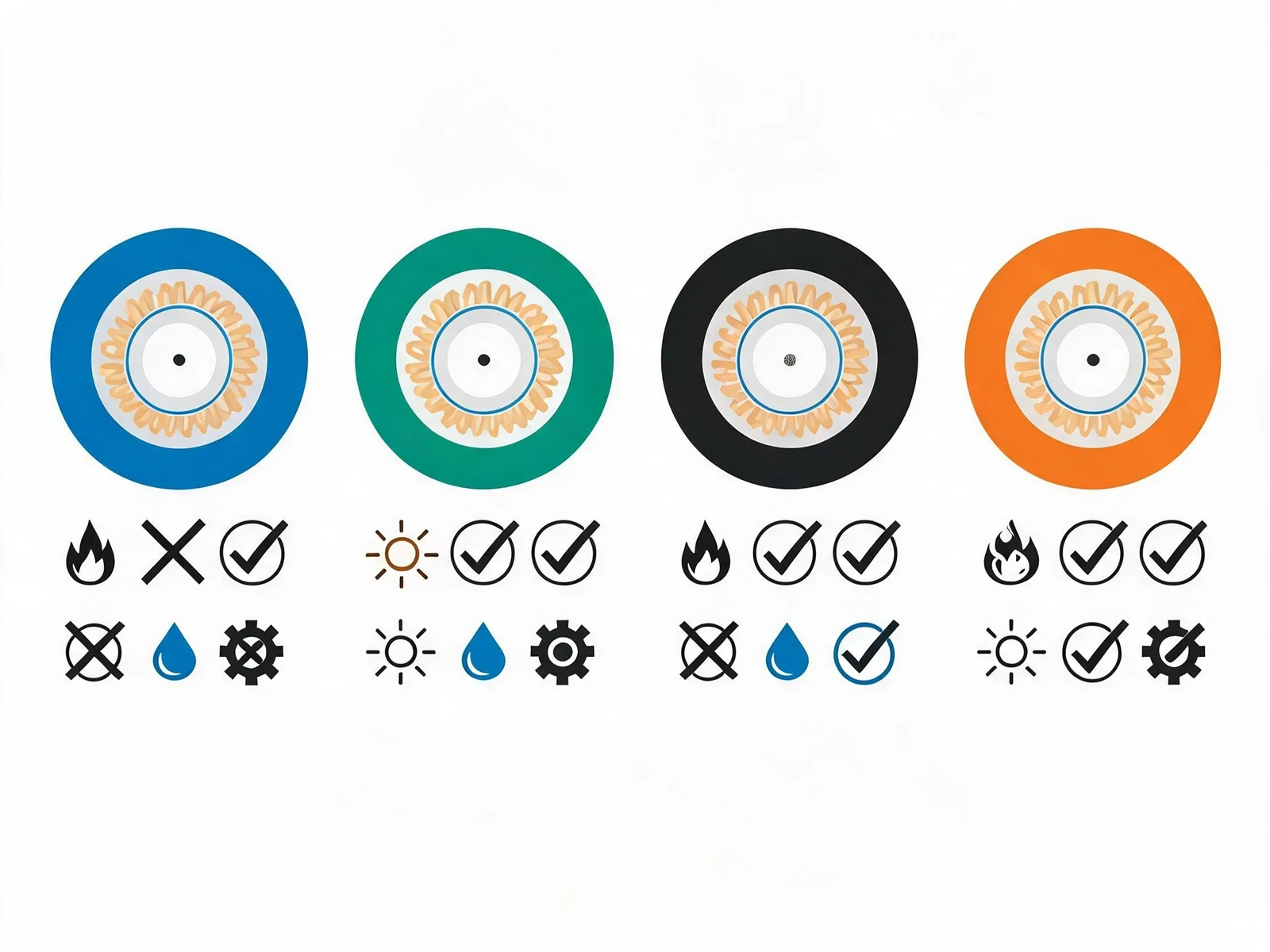
Jacket compounds make different trade-offs across flame behavior, sunlight, moisture and mechanical protection.
PVC: The Cheap Default with Hidden Costs
Polyvinyl chloride is the cheapest jacket material and the most widely used for indoor fiber optic patch cords. It is flexible, easy to extrude, and provides adequate mechanical protection for clean, climate-controlled environments. PVC is inherently flame-retardant due to its chlorine content, which is why it can pass UL 1581 for OFNG rating.
The problem is what happens when PVC burns. The chlorine that makes it flame-retardant also makes it a smoke and toxic gas generator. When PVC combusts, it releases dense black smoke and significant quantities of hydrogen chloride (HCl), a corrosive gas that forms hydrochloric acid on contact with moisture. In enclosed spaces, HCl condensation can destroy electronic contacts, corrode metal structures, and cause respiratory damage at concentrations as low as 35 ppm. PVC also degrades under UV exposure, developing surface crazing within months of outdoor installation.
PVC is the right choice for short patch cords inside climate-controlled telecom rooms where no fire rating is required. It is the wrong choice for plenum ceilings, riser shafts, outdoor locations, or any enclosed space where smoke propagation is a concern. The material cost savings of PVC over LSZH, typically 30 to 50%, evaporate instantly if the cable is installed in a location that requires a higher fire rating.
LSZH: Halogen-Free Chemistry and Its Trade-offs
Low Smoke Zero Halogen (LSZH) is a material specification, not a fire rating. LSZH compounds contain no halogen elements (chlorine, fluorine, bromine) and are formulated to produce minimal smoke when burned. The chemistry relies on hydrated mineral fillers, primarily aluminum trihydrate (ATH) and magnesium hydroxide, which undergo an endothermic decomposition when heated, releasing water vapor that cools the cable and dilutes the combustion gases.
LSZH is tested to two IEC standards: IEC 60754-2 for acidity and conductivity of combustion gases (halogen content verification), and IEC 61034-2 for smoke density (light transmittance in a 3-meter cube chamber). A cable claiming LSZH must demonstrate zero halogen content and smoke transmittance typically above 60% or 80%, depending on the grade.
The trade-off is mechanical. The high mineral filler loading (often 50 to 70% by weight) that gives LSZH its fire performance also makes the jacket stiffer and less flexible than PVC. This is a real problem in high-density rack environments where cables must route through tight bend radii. The solution is not to abandon LSZH but to specify cables engineered for flexibility, such as those using optimized polymer blends or smaller diameter designs that maintain bend performance despite the stiffer compound.
A second trade-off is moisture. LSZH has higher water absorption than PE or PVC, which makes it unsuitable for outdoor or direct-burial applications without additional water-blocking measures. Standard indoor LSZH jackets are not UV-stabilized. For building-to-building transitions, use indoor/outdoor rated cable with water-blocked construction.
PE: The Outdoor Workhorse
Polyethylene is the standard outdoor jacket material for aerial, duct, and direct-burial fiber optic plant. Black PE contains carbon black at a minimum 2% loading, which provides excellent UV stability by absorbing radiation before it can degrade the polymer chain. PE has very low water absorption, excellent chemical resistance, and a service temperature range of -40 to +70 degrees Celsius.
| Property | PE (Black, Carbon-Loaded) |
|---|---|
| UV resistance | Excellent (25+ years outdoor) |
| Moisture resistance | Excellent (water absorption below 0.01%) |
| Temperature range | -40 to +70 degrees C |
| Tensile load (install) | 600 to 2,700 N (varies by design) |
| Crush resistance | 1,000 to 4,000 N/100 mm |
| Typical service life | 25 to 50 years |
| Common standards | IEC 60794, TIA-568, Telcordia GR-20 |
TPU: Industrial Toughness
Thermoplastic polyurethane occupies a specialized niche: applications where the cable moves, rubs, or is exposed to oil and chemicals. TPU appears in factory automation, machine vision, military tactical cables, robotic drag chains, and anywhere the jacket must survive continuous mechanical abuse that would destroy PVC or PE within weeks.
TPU's abrasion resistance is exceptional. On the Taber abrasion test (ASTM D3389), TPU typically loses only 15 to 50 mg per 1,000 cycles, compared to 200 to 500 mg for standard PVC. This means a TPU jacket can be specified at a thinner wall while achieving equal or better wear life, reducing cable diameter and weight. For drag chain applications where the cable flexes millions of cycles, this is the difference between a cable that lasts years and one that fails in months.
Polyester TPU
Offers higher tensile strength, better oil and chemical resistance, and superior abrasion performance. It is preferred for oil-soaked factory floors.
Polyether TPU
Offers better hydrolysis resistance, low-temperature flexibility down to -50 degrees C, and microbial resistance. It is the correct choice for water exposure or humid environments.
What Happens When Each Material Burns
Fire behavior is the attribute that most distinguishes these materials, and it is where the least intuitive trade-offs live. A material can be flame-retardant (self-extinguishing after ignition source removal) while still producing dangerous smoke and gases. The two properties are independent.
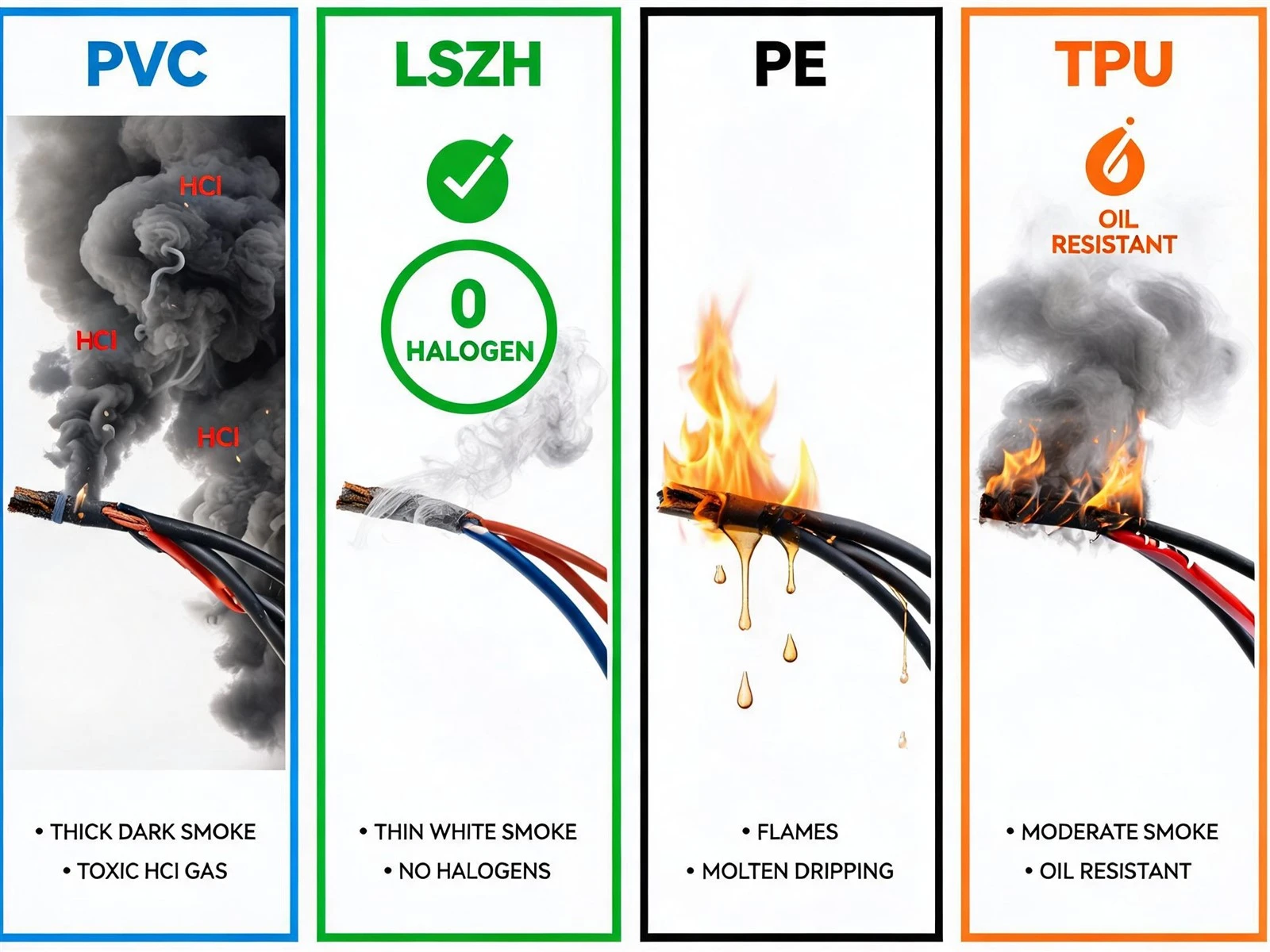
Fire behavior comparison: PVC produces thick, corrosive smoke; LSZH limits smoke and halogens; PE can burn and drip; TPU performance depends on its formulation.
| Material | Smoke Density | Halogen Gases | Flame Dripping | Corrosivity |
|---|---|---|---|---|
| PVC | Very high (dark, dense) | HCl (significant) | Minimal | Highly corrosive |
| LSZH | Very low (light, thin) | None (halogen-free) | Minimal | Non-corrosive |
| PE | Moderate | None | Yes (propagates fire) | Low |
| TPU | Moderate | Depends on formulation | Minimal | Low to moderate |
The smoke density difference is not incremental. PVC combustion can reduce light transmittance in a 3-meter chamber to below 20%, meaning visibility is effectively zero. LSZH typically maintains transmittance above 60% and premium grades exceed 80%. In a building evacuation, this is the difference between finding the exit and not. The halogen difference is equally stark: PVC releases 25 to 30% of its weight as HCl gas, while LSZH releases none.
Armor and Direct Burial: When the Jacket Is Not Enough
No jacket material, however tough, protects against rodent gnawing or backfill compaction in direct-burial applications. For these routes, a metallic armor layer is added between the inner cable core and the outer jacket. The armor provides crush resistance and rodent protection; the outer jacket still provides environmental isolation.
| Cable Type | Armor Construction | Best For | Cost Premium |
|---|---|---|---|
| GYTA53 | APL foil + corrugated steel tape (double armor) | Maximum protection, direct burial, rocky terrain | +20 to 25% |
| GYTY53 | Corrugated steel tape (single armor) | Direct burial, rodent resistance | +15 to 20% |
| GYFTA53 | FRP armor + outer steel tape | Dielectric requirement, anti-EMI zones | +20 to 25% |
| Non-armored PE | No armor layer | Duct installation (duct provides protection) | Baseline |
The decision to armor is route-dependent, not optional for direct burial. On a rural FTTH build where the route crosses farmland or forest, rodent damage to non-armored cable buried at standard depth is a near-certainty. The armor premium of 15 to 25% is trivial compared to the cost of re-trenching and re-pulling a damaged cable. Burial depth also matters: urban installations require a minimum of 0.7 meters, while rural and farmland routes require 0.9 to 1.2 meters. Armor is not a substitute for proper depth.
Data Center Selection: Why LSZH-OFNP Is Becoming the Default
Data centers combine three risk factors that make jacket selection uniquely consequential: high air circulation through plenum and containment systems, expensive equipment with metal contacts vulnerable to acid corrosion, and limited evacuation routes for personnel. The wrong cable in a plenum ceiling can move fire and smoke through an entire facility in minutes.
| Location | Minimum Rating | Recommended Jacket | Why |
|---|---|---|---|
| Return-air ceiling / raised floor | OFNP | LSZH-OFNP | Code + life safety + equipment protection |
| Server cabinets / containment aisles | OFNR or OFNP | LSZH-OFNP | Protection from corrosive gases |
| Vertical riser shafts | OFNR | OFNP (simplify inventory) | Downward compatibility |
| Entrance facility / meet-me room | OFNP or OFNR | LSZH | High-value equipment, limited ventilation |
In AI and GPU clusters, the stakes are higher. A single cabinet may house accelerators worth millions of dollars, connected by high-density MPO trunk assemblies carrying 16 to 32 fibers each. A minor fire in a cable tray that involves PVC-jacketed trunks can release HCl that corrodes the gold contacts on nearby QSFP-DD transceivers within hours. The hardware survives the fire but fails in the days following due to progressive contact corrosion. More hyperscale operators are standardizing on LSZH-OFNP throughout the data hall to eliminate this risk entirely.
The Five Most Common (and Expensive) Mistakes
2.8×
Typical rework cost multiplier
for plenum violations
0.7 m
Minimum burial depth
for urban direct-burial cable
−50°C
TPU low-temperature limit
versus −10°C for PVC
- Using PVC in plenum spaces. PVC is not rated for plenum installation. It fails NFPA 262 smoke density requirements. The cable must be removed and replaced with OFNP-rated cable. This is the single most common code violation in fiber installations.
- Running indoor cable outside. PVC and LSZH jackets are not UV-stabilized. Indoor cable exposed to sunlight will craze, crack, and allow moisture ingress within months. The cable may pass optical tests initially but fail after the first winter.
- Assuming LSZH means plenum-rated. LSZH is a material specification. A cable can be LSZH and still not pass the NFPA 262 Steiner Tunnel test required for OFNP. Specify LSZH-OFNP if you need both halogen-free chemistry and plenum compliance.
- Ignoring the indoor-outdoor transition. Outdoor PE cable is not fire-rated and cannot extend into indoor plenum or riser pathways. The transition must occur at a fire-rated termination point within the code-defined distance from the building entrance.
- Specifying non-armored cable for direct burial. The jacket alone cannot resist rodent gnawing or backfill compaction. Armor is not optional for direct-burial routes in rodent-prone areas. Burial depth and armor work together; neither substitutes for the other.
Conclusion: The Jacket Is the Decision
The fiber inside the cable is remarkably standardized. Whether you specify G.652.D or G.657.A2, the optical performance parameters are defined by ITU-T recommendations and verified by standardized test methods. The connector is similarly standardized. SC/APC and LC/UPC are defined by IEC and TIA specifications that leave little room for ambiguity.
The jacket is where standardization ends and engineering judgment begins. Four materials (PVC, LSZH, PE, TPU), four NEC fire ratings (OFNP, OFNR, OFNG, OFN), seven CPR Euroclasses (Aca through Fca) with three sub-indices each, and the armor decision create a combinatorial space that no single catalog title can fully describe. The framework presented here separates the dimensions, identifies the trade-offs, and establishes the verification points that prevent the most common procurement failures.
Treat it as an engineering decision, not a default.