
An ATB datasheet can say "1 Port" and "2 fibers" on the same page, list a box as pre-terminated and still call for splicing, and quote a capacity for a model that ships with no adapter at all. Each of those lines is accurate. This guide works through real model sheets so you can tell, before quoting, how many fibers a configuration can terminate, how many splices the site will still need, and whether terminating a spare fiber now means ordering a different code.
What Is an Access Terminal Box (ATB)?
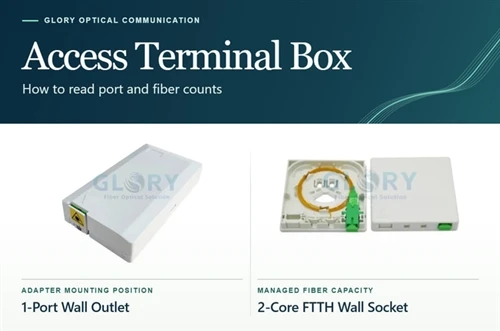
An access terminal box (ATB) is a passive enclosure used at the subscriber end of a fiber-to-the-home connection. It protects and terminates the incoming fiber and provides an optical interface for an optical network terminal (ONT), typically through a short fiber patch cord.
| Quick question | Short answer |
|---|---|
| Can one port serve two fibers? | Yes, depending on the adapter. One LC duplex adapter presents two optical channels. |
| Does "2 Core" mean both fibers are ready to connect? | Check the terminated channel count and the parts list. A 2-core box can hold one terminated fiber and one stored spare. |
| Does pre-terminated mean zero site splices? | Check both cable ends on the model. If the other end is installed by splicing, a splice remains in the work plan. |
Typical subscriber-side path. A separate NID appears only where the project places one at the building entry or outside wall.
Inside, most ATBs hold the same short list of parts: a cable entry with a clamp or strain-relief point, a splice holder, a small tray or routing channel for stored fiber, and an adapter that faces the outside of the box. A pigtail, which has a connector on one end only, links the splice to the back of the adapter. The ONT patch cord then plugs into the front. Every count on a datasheet describes one of these parts, so each count answers a different question.
The name varies by market and vendor. "Access terminal box" is common on Chinese-made indoor FTTH hardware, while the same function may be sold as a fiber wall outlet, fiber socket or optical telecommunications outlet (OTO). Corning, for example, sells its comparable product as a wall outlet. Read the function and the specification lines rather than the product name. For device roles along this path, see the subscriber-side fiber path and where each device sits.
How to Read "1 Port" on an ATB Datasheet
May Telecom's MAY-ATB-101 product page makes a useful practice sheet. The model name says 1 Port. The capacity row says SC: 1 fiber, LC: 2 fibers. The ordering code, MAY-ATB-101-XX-XX, carries two suffix fields: one for the adapter and one for the pigtail.
Those figures stop looking contradictory once you separate two quantities. A port count describes adapter mounting positions; a fiber count describes optical channels presented at the front. One position holding an LC duplex adapter gives two channels, which is the usual way a one-port box reaches two fibers. The sheet, however, does not state simplex or duplex, so that point needs confirming.
Port, adapter format and channel count
The same mounting position can present a different number of channels depending on the adapter body fitted into it. The general rule is below. Whether a particular housing accepts a particular adapter is a model-specific question for the supplier's drawing.
| Adapter fitted in one position | Optical channels at the front | What to confirm |
|---|---|---|
| SC simplex | 1 | Polish (UPC or APC) and whether the adapter is shuttered |
| SC duplex | 2 | That the housing opening accepts a duplex SC body |
| LC simplex | 1 | Polish and the ONT's input connector |
| LC duplex | 2 | That the box has splice and storage room for both fibers |
Huawei's ATB3101 configuration table shows a third quantity. Its ATB3101-1 and ATB3101-2 rows give a core capacity of 1 and 2 but list no adapter, while the lettered variants add SC or LC adapters. So a core capacity tells you how many fibers the box is designed to manage. It does not tell you how many are connectorized when the box arrives.
| Listed on the MAY-ATB-101 sheet | Not listed, so ask the supplier |
|---|---|
| Capacity by connector family (SC 1, LC 2) | Simplex or duplex adapter format |
| Size 116 × 85 × 22 mm, PC/ABS housing | Number of splice positions |
| Suitable for 2 × 3 mm flat drop cable | Fiber and slack the box holds with the cover closed |
| Fusion splice, mechanical splice or field fast connector | Which of these the quoted code is built for |
Lines that decide physical fit
Channel counts get most of the attention, but a configuration also has to accept the installed cable and route fiber without tight bends. The three sheets publish these lines differently:
| Datasheet line | MAY-ATB-101 | Huawei ATB3101 | Corning P10080-016SCAWYN20 |
|---|---|---|---|
| Size | 116 × 85 × 22 mm | 86 × 115 × 23 mm | 100 × 80 × 22 mm |
| Drop cable | 2 × 3 mm flat; inlets left, right and bottom | 2 × 3 mm flat; Φ5–7 mm round | Pre-terminated 1-fiber tail; entry from bottom |
| Fiber or pigtail | Pigtail chosen by ordering suffix | G.657 pigtail, Φ0.9 mm, 0.5 m | ITU-T G.657.A1 |
| Bend radius | Not listed | ≥ 15 mm | Not listed on the catalogue page |
| Port safety | Downward-facing port | Port faces vertically downward | Shuttered SC/APC adapter |
Where a sheet leaves a line blank, treat it as an open question for the supplier rather than an assumption. Bend-insensitive fiber to ITU-T G.657 tolerates tighter bends than standard single-mode fiber, but the box still needs a defined routing path for the stored slack. Before comparing prices, check the interface and usable capacity inside the box against the same four capacity figures for every supplier.
Where Can a Pre-Terminated ATB Still Need a Splice?
Corning's P10080-016SCAWYN20 wall outlet is catalogued as preterminated with a 1-fiber cable, an SC/APC simplex shuttered adapter and a 20 m tail. The same catalogue entry lists Installation Methods: Splicing and heat-shrink splice protectors. The outlet end arrives finished, while the catalogue still expects a splice in the installation.
That pattern is common: the factory finishes the end that is hardest to terminate neatly, which is the adapter inside a small box, and leaves the far end to be joined wherever the network side is. The splice has not disappeared. It has moved to another location, and someone still has to plan it, protect it and test it.
It helps to sort ATB offers by what arrives at each end:
| Supplied state | What arrives | Work left at the ATB | Work left elsewhere |
|---|---|---|---|
| Empty housing | Box only; capacity stated, no adapter (for example, a core-capacity-only row in a configuration table) | Fit adapter, then terminate each fiber | Depends on the drop cable |
| Adapter and pigtail loaded | Adapter with pigtail fitted or supplied | One splice per fiber to the drop | Drop termination at the network end |
| Field-connector build | Box designed to take a field-assembled fast connector | Connector assembly; no fusion splice | Drop termination at the network end |
| Pre-terminated tail | Outlet end finished in the factory with a cable tail attached | None at the outlet end | Splice or connect the tail's far end |
The MAY-ATB-101 ordering code includes a pigtail field, which points to the second row, but the page does not say whether the pigtail ships fitted. Ask. The practical rule: write the supplied condition of each cable end into the order separately, then compare field termination with factory-assembled options on the complete installed arrangement.
Worked Example: One Active Fiber and One Spare
An apartment is served by a 2-core drop cable. The operator requires SC/APC, and only one fiber will carry service on day one. In both options below, each fiber is fusion spliced in the field.
| Check | A · One fiber terminated, spare stored | B · Both fibers terminated |
|---|---|---|
| Optical channels at the faceplate | 1 SC/APC channel | 2 SC/APC channels |
| Day-one splices | 1, using 1 splice position and 1 protector | 2, using 2 splice positions and 2 protectors |
| Held inside with the cover closed | Working-fiber slack plus one protected, labelled, unterminated spare | Slack for both fibers plus two protected splices |
| Bringing the spare into service | Reopen the box, splice and test | Labelled port already in place; enable after verification under the operator's procedure |
| Basis for the quote | 1 optical channel, plus assembly evidence that the spare fits | Full ordering code for a 2-core SC/APC configuration and its assembled drawing |
Option A moves work to a later visit. That visit depends on the box holding a stored spare without pinching it and surviving a second opening, so check closed-cover and reopening behavior on a populated sample.
Option B must be quoted as a 2-core SC/APC configuration with its own ordering code. The MAY-ATB-101 sheet lists SC at one fiber, so Option B needs a different configuration. Huawei's ATB3101 configuration table lists ATB3101-2B as 2SC/APC, quantity 1, capacity 2. That shows a commercial two-channel SC/APC configuration exists. Adapter body count, mounting positions and internal slack for any quoted model still come from its assembly drawing.
Parts list per subscriber
Counting the parts the example implies makes the difference concrete for purchasing, before any price is applied:
| Item | Option A | Option B |
|---|---|---|
| SC/APC optical channels in the ATB | 1 | 2 |
| SC/APC pigtails | 1 | 2 |
| Splice protectors used on day one | 1 | 2 |
| End protection and label for the stored spare | 1 | 0 |
| Dust cap or shutter on an unused port | 0 | 1 |
| SC/APC patch cord to the ONT | 1 | 1 |
Choosing between A and B
Neither option is correct in general. The choice depends on project facts the buyer already holds or can get from the operator:
- How likely the second fiber is to be used. Business units, home offices and buildings where the operator plans a second service favor B. A spare kept purely for repair favors A.
- What a return visit costs. If reaching the unit later means booking access and a splicing crew, the second day-one splice in B may cost less than one extra visit.
- Operator rules on dark ports. Some operators prefer that no unused connector is exposed in the subscriber's space. A shuttered adapter or a downward-facing port, both of which appear on the sheets above, reduces the exposure but does not replace the operator's own policy.
- Room inside the box. A depends on space for an unterminated spare, and B on space for two splices. Only a populated sample settles either.
Zero-splice case. If the project uses an approved field-installable connector, or every interface at this ATB location is plug-in, day-one splices at the ATB can be zero. Joints elsewhere on the link are counted in their own work steps.
Glory Optical Products for the Subscriber Handoff
Match the wall outlet to the intended port loading, then specify the pigtail inside the box and the patch cord to the ONT.

Start with this surface-mount housing for one active SC/APC channel. For Option A, confirm that it has a protected place for the spare fiber and the required slack with the cover closed.

The product page lists a 2-core indoor socket with a two-SC-simplex option. For Option B, specify two populated SC/APC channels and confirm two splice positions and a clamp that fits the actual drop cable.

Select SC/APC for the example. Allow one pigtail for each fiber being fusion spliced. If the outlet ships with pigtails fitted, count those in the assembly.

Use between the wall outlet and the ONT when both interfaces are SC/APC. Specify the length needed for the installed route.
Turn the Datasheet into an Order Line
In MAY-ATB-101-XX-XX, the first suffix identifies the adapter and the second the pigtail. Both use the same codes: SU SC/UPC, SA SC/APC, LU LC/UPC, LA LC/APC. MAY-ATB-101-SA-SA would therefore read as an SC/APC adapter with an SC/APC pigtail. Ask the supplier to confirm the full quotable code and that it matches the capacity you selected.
A copy-ready order line:
State what ships with the box, the drop cable type, dimensions and entry direction, the supplied condition of each cable end, and any remaining field termination.
Common datasheet-to-order slips
- Writing only "2 core". The supplier can meet that with an empty 2-core housing. State the number of terminated channels as well.
- Mixing up cable fiber count and box capacity. A 2-core drop entering a box does not mean the box terminates two fibers.
- Dropping the polish. "SC adapter" without UPC or APC leaves the supplier to choose, and APC and UPC connectors should not be mated.
- Assuming the pigtail is fitted. An ordering field for a pigtail does not by itself mean the pigtail ships installed.
- Leaving out the second cable end. For pre-terminated builds, the far end's condition decides where the remaining splice happens.
Evidence to request from the supplier
- Configuration table with full ordering codes, showing adapter, polish, optical channel count and included accessories.
- Marked-up assembly drawing or physical sample locating the adapter positions, splice positions, end-protection point and cable entry. For Option A, also mark where the unterminated spare is stored.
- Closed-cover routing record listing the cable type and outer dimensions actually fitted and the slack length stored, with confirmation that the cover closes normally. Record 2 × 3 mm under cable dimensions and the fiber count in its own field.
Glory Optical's fiber optic wall outlet range can be reviewed against the same three items. For a project-specific adapter, pigtail or capacity combination, send the connection plan and cable dimensions through the OEM/ODM process and ask for a populated sample. Then carry the approved configuration into the supplier quote so every bidder prices the same assembly.
FAQs
Can a 1-port ATB terminate two fibers?
Yes, when the port holds a duplex adapter, such as LC duplex. One mounting position then presents two optical channels. Confirm that the box also has two splice positions and room for both fibers' slack.
What does "2 Core" mean on an ATB datasheet?
It states fiber capacity. Check how many channels arrive terminated, because one fiber may be connectorized while the other is stored as a spare, and some 2-core configurations ship with no adapter at all.
Does pre-terminated mean no field splicing?
Only if both cable ends arrive finished for your route. Some pre-terminated outlets still list splicing as the installation method, because the far end of the factory tail has to be joined on site.
Does a spare fiber need to be terminated on day one?
No, provided the box can store it protected and labelled with the cover closed. Terminating it later means reopening, splicing and testing.
Is an ATB the same as a fiber wall outlet?
Functionally, yes in most FTTH projects. Both are passive indoor termination points that hand the fiber to an ONT. The names differ by market and vendor, so compare the specification lines rather than the label.
What drop cable does an ATB accept?
That depends on the model. The sheets reviewed here list 2 × 3 mm flat indoor drop, and one also lists round cable from Φ5 to 7 mm. Put your cable's actual outer dimensions on the order and ask the supplier to confirm the entry and clamp fit.