The Importance of Correct Cable Selection

Installing an inappropriate cable can lead to performance degradation, signal failure, or compliance violations. Each cable type is engineered with specific materials and constructions to address distinct challenges, such as mechanical stress, fire safety, or environmental exposure. Using a cable outside its intended application compromises the network's reliability.
For example, deploying an indoor-rated cable in an outdoor setting typically results in premature jacket degradation and moisture ingress, leading to signal loss and necessitating costly replacement.
Industry data underscores the practical impact of these choices. The Fiber Broadband Association has noted that installation errors, including incorrect cable specification, contribute to a significant portion of initial service delays. Furthermore, the International Telecommunication Union (ITU) in its "Measuring digital development" reports consistently highlights reliable infrastructure as a cornerstone of broadband adoption, which begins with correct component selection.
FTTH Drop Cables: The External Building Entry Segment
FTTH drop cables provide the final link from a distribution point on the street to the subscriber's premises. Their design prioritizes flexibility and ease of installation for this short, often complex run. A key characteristic is compliance with the ITU-T G.657 standard for bend-insensitive fiber, which minimizes signal loss when the cable is routed around tight corners or through small entry ports.
These cables typically feature a small diameter, a lightweight design, and are often pre-connectorized to simplify and speed up the installation process. The jacket material is usually designed for limited outdoor exposure but is not equivalent to a full outdoor cable. A common error is extending the use of an FTTH drop cable over long aerial or buried spans.

Since it lacks the robust reinforcement and moisture barriers of a dedicated outdoor cable, such misuse leads to a high risk of failure. Documentation from multiple internet service providers (ISPs) shows that this practice is a frequent cause of preventable network faults in the "last meter" segment.
Indoor Cables: Compliance and Safety for Internal Pathways

Once the signal enters a building, fire safety and electrical code compliance become the primary concerns. Indoor cables are classified by their flammability and smoke production characteristics, as defined by standards like the National Fire Protection Association (NFPA) 70, or National Electrical Code (NEC) in North America.
Two primary ratings are essential:
Riser-rated (OFNR)
Designed for vertical runs between floors in non-plenum shafts. These cables resist the upward propagation of flame.
Plenum-rated (OFNP)
Required for spaces used for environmental air circulation, such as above suspended ceilings or in raised floors. They feature jacketing that produces very low smoke and is less flammable.
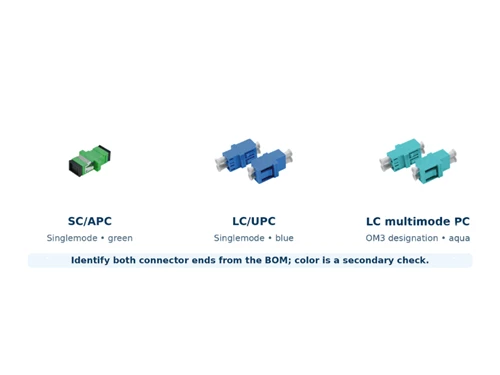
Using a riser-rated cable in a plenum space is a direct violation of building and fire codes. Such violations, if discovered during an inspection, can result in orders to remove and replace all non-compliant cabling. Beyond safety ratings, indoor cables often use a tight-buffered construction for durability, and the choice of connector (LC, SC) and polish (UPC, APC) is determined by the interfacing equipment.
Outdoor Cables: Engineered for Environmental Durability
Outdoor cables are constructed to withstand prolonged exposure to environmental stressors, including ultraviolet radiation, temperature extremes, moisture, and physical damage from rodents or digging. Their construction differs significantly from indoor types. Fibers are typically housed loosely within water-blocked tubes, and the outer jacket is made of high-density, UV-resistant polyethylene.
The required level of mechanical protection depends on the installation method:
Direct Burial
These cables are armored, often with a corrugated steel tape, to resist crushing and rodent penetration.
Aerial
They include an integrated strength member, or messenger, to support the cable's weight over spans between poles.
Duct
Designed with a smooth jacket to facilitate pulling through conduits.

A frequent mistake is bringing an outdoor cable directly into a building interior. The polyethylene jacket of an outdoor cable is not rated for fire safety and is typically prohibited by code for indoor runs. The standard practice is to terminate the outdoor cable in a sealed exterior enclosure and transition to a properly rated indoor cable for the internal pathway.
A Practical Selection Methodology
A systematic approach to selection prevents common errors. The process can be based on three sequential questions about the cable's intended path:
What is the Physical Route?
Determine the complete pathway: external burial, aerial, internal wall, ceiling plenum, or a combination. Segment the route by environment.
What are the Dominant Hazards?
For each segment, identify the main risks. Is it water and crushing (buried), UV and tension (aerial), or fire and smoke propagation (indoor plenum)?
Which Cable Specifications Mitigate These Hazards?
Select the cable whose standard specifications are designed for the identified hazards. This means specifying burial armor for ground segments, a plenum rating for air-handling spaces, and bend-insensitive fiber for tight entry points.
This methodology shifts the focus from product names to performance requirements. It applies universally, whether for a simple home installation or a complex campus network.
Conclusion
FTTH drop, indoor, and outdoor fiber optic cables serve distinct, non-interchangeable functions. The drop cable is optimized for flexibility and simple external entry. Indoor cables are governed by fire safety codes. Outdoor cables are built for environmental and mechanical endurance.
Successful implementation requires respecting the design purpose of each type.
The recurring issues of moisture ingress, fire code violations, and mechanical failure are most often the result of applying a cable outside its intended scope. By first analyzing the installation environment and its associated risks, the appropriate cable specifications become a clear and logical outcome, forming the basis for a reliable and compliant fiber optic installation.