
The Materials Difference: PU vs. PVC
Most standard indoor patch cords use PVC (polyvinyl chloride) jacketing. It's inexpensive, flexible, and adequate for controlled indoor environments like data centers, equipment rooms, and office cabling.
Outdoor patch cords use something else entirely. The OM3 outdoor cord features a flame-retardant, high-toughness polyurethane (PU) elastomer sheath. This isn't a marketing distinction - it's a fundamental material difference with real-world implications.
PU jacketing offers:
• High oxygen index and excellent flame retardancy - it resists ignition and doesn't readily propagate flame
• Oil and chemical resistance - essential for industrial environments where cables may be exposed to hydraulic fluids, solvents, or other corrosive substances
• Tear resistance - it withstands physical abrasion and sharp edges that would quickly compromise PVC
• Low-temperature flexibility - it remains pliable in cold conditions where PVC becomes brittle and cracks
• Stress buffering and pressure-resistant durability - it absorbs mechanical stress that would otherwise transfer to the optical fibers inside
Standard PVC offers none of these properties. It's fine for a controlled indoor environment. Outdoors, it's a liability. Indoor PVC patch cords may age, crack, or harden under long-term sunlight exposure, making them unsuitable for continuous outdoor use.

The Structural Difference: Built to Take a Beating
Standard indoor patch cords have a simple construction: fiber, buffer, strength members (typically aramid yarn), and a jacket. They're designed to be handled carefully in protected environments.
Outdoor patch cords are built differently. The OM3 outdoor cord incorporates several structural features that make it far more robust:
Aramid-reinforced single-strand configurations provide the cable with a wide tensile strain window. In plain English: you can pull on it harder without damaging the fibers inside. This matters during installation through conduits, around corners, and across cable trays - all operations that subject the cable to mechanical stress.
A special coating layer and secondary composite structure absorb mechanical and environmental stress, minimizing additional optical cable loss. Standard patch cords lack this protective layering. When they're bent, pulled, or exposed to temperature changes, the fibers experience micro-bending that increases signal loss.
Small-pitch SZ-stranded optical fibers combined with aramid reinforcement provide a wide tensile strain window. This means the cable can handle repeated bending and flexing without degradation - a critical feature for applications where cables are deployed and retracted repeatedly.
High strength-to-weight ratio and compact round jacket structure make the cable lightweight for its strength and suitable for repeated retractable use.
Tight-buffered color coding complies with the TIA-598-A standard for simplified fiber routing and termination. This attention to standards ensures that even in complex deployments, technicians can quickly identify and manage individual fibers.
Printed product information and length markings on the cable jackets provide easy identification - a small but valuable feature when you're managing dozens or hundreds of cables in a field deployment.
The result is a cable that can survive conditions that would quickly destroy a standard indoor cord. This isn't speculation - it's engineering.
The Environmental Differences: What Outdoor Cables Actually Survive
Standard indoor patch cords are rated for indoor use. That means controlled temperature, no water exposure, no UV radiation, no chemical exposure, and minimal physical stress. The OM3 outdoor patch cord is rated for conditions that are fundamentally different:
Temperature Range: The OM3 outdoor cord operates from -20°C to +70°C. Standard indoor patch cords typically have a narrower operating range (often 0°C to +60°C) and lack the low-temperature flexibility of PU jacketing.
Mechanical Strength: The cable has a minimum bend radius of 248mm during installation and 124mm when laid. Standard patch cords, particularly those with 2mm or 3mm jackets, have much tighter bend radius limits and are more susceptible to damage from over-bending.
Pulling Force: The outdoor cord withstands a maximum pulling force of 150N (15kg). Standard indoor cords typically have much lower pull ratings, and exceeding them causes micro-bending and permanent signal degradation.
The pulling aid (42mm diameter) on both ends allows for easier installation through conduits and raceways. Standard patch cords lack this feature entirely.
Flame and smoke performance: The OM3 outdoor cord's jacket is designed to produce minimal smoke in case of fire and does not emit harmful gas-acid combinations or toxic fumes when exposed to flames. While indoor-rated cables may also have flame ratings (such as OFNR or LSZH), outdoor cables often combine these safety properties with the mechanical robustness required for external environments.
UV Resistance: Indoor PVC jackets degrade under ultraviolet exposure. Outdoor PU jackets are formulated to resist UV damage, maintaining their integrity even after years of sun exposure.
Water and Moisture Protection: Indoor cables lack any meaningful water resistance. Outdoor cables are designed to withstand rain, humidity, and even temporary immersion - a critical requirement for any outdoor deployment.
Tensile Strength Comparison: Outdoor FTTA patch cables typically contain multiple aramid yarn strength members or metal armor, giving them much higher tensile strength than indoor jumpers. This difference becomes immediately apparent when you're pulling cable through a conduit - the outdoor cord takes the strain; the indoor cord takes the damage.

The Application Gap: Where Outdoor Cables Are Non-Negotiable
Standard indoor patch cords are for controlled environments. Outdoor patch cords are for everything else. The OM3 outdoor cord's application list reveals the scope of environments where indoor-rated cables simply cannot perform:
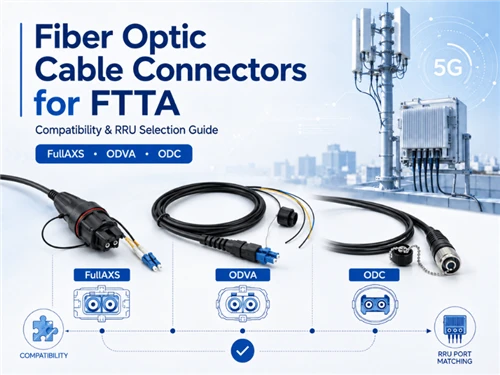
Telecom & 5G (5G & LTE Infrastructure): FTTA antenna feeder cables, 4G LTE and 5G NR base stations, RRH-to-RRU-to-BBU CPRI links, small cell outdoor deployments, and Distributed Antenna Systems (DAS). These are outdoor, exposed environments where cables must withstand UV exposure, temperature swings, and weather. Standard indoor patch cords would degrade rapidly.
Industrial Networks (Smart Factory & Automation): Harsh-environment factory floors, robotics and motion control networks, outdoor industrial Ethernet, oil field and mine communications, chemical plant sensor networks. These environments involve chemical exposure, physical abrasion, and mechanical stress that standard patch cords cannot handle.
Transport & Smart City (Infrastructure & Surveillance): Traffic monitoring systems, tunnel communication networks, roadside ITS units, outdoor PTZ video surveillance, and smart city sensor hubs. These are outdoor, exposed, often remote locations where cable failure means service disruption and expensive truck rolls.
Mission Critical (Defense & Emergency): Military communication systems, marine and offshore platforms, emergency response networks, remote monitoring stations, and fiber optic sensing systems. These are the environments where failure isn't an option - and where the difference between an indoor-rated cord and an outdoor-rated cord can be mission-critical.
Field and temporary wiring: The OM3 outdoor cord is specifically designed for temporary wiring applications where it may be deployed and retracted repeatedly. Standard patch cords would quickly fail under repeated handling.
The consequences of using an indoor cable outdoors can be severe. Indoor patch cords lack proper sealing and UV stabilization; they may fail within weeks when exposed to weather. A cable that fails in a data center can be replaced in minutes. A cable that fails on a tower top, in a manhole, or at a remote industrial site requires a truck roll, a technician, and potentially a tower climb - costs that far outweigh the initial savings of choosing the cheaper cable.
Indoor vs. Outdoor: A Direct Comparison
|
Feature |
Standard Indoor Patch Cord |
OM3 Outdoor Patch Cord |
|
Jacket Material |
PVC |
Flame-retardant, high-toughness PU elastomer |
|
UV Resistance |
None |
Excellent (PU jacket) |
|
Water/Moisture Protection |
None |
Weather-resistant, suitable for outdoor exposure |
|
Tensile Strength |
Low |
High (aramid reinforcement) |
|
Pull Rating |
Limited |
150N (15kg) |
|
Minimum Bend Radius (installed) |
Varies (typically tighter) |
124mm |
|
Temperature Range |
Narrower (typically 0°C to +60°C) |
-20°C to +70°C |
|
Oil/Chemical Resistance |
Poor |
Excellent |
|
Tear Resistance |
Poor |
Excellent |
|
Low-Temperature Flexibility |
Poor (PVC becomes brittle) |
Excellent |
|
Pulling Aid |
None |
42mm diameter pulling aid on both ends |
|
Flame/Smoke Performance |
Varies |
Low smoke, minimal toxic fumes |
|
Repeated Retractable Use |
Not recommended |
Designed for it |
Why This Matters for Network Reliability
Network failures are rarely caused by a single catastrophic event. More often, they're the result of cumulative degradation - a cable that was "good enough" for the environment slowly losing performance until one day, it fails.
Indoor cables used outdoors fail this way. The jacket cracks from UV exposure. Moisture seeps in and causes hydrogen loss. Temperature cycling makes the PVC brittle. A technician pulls a little too hard during maintenance and the fiber breaks.
Outdoor cables are designed to resist this cumulative degradation. The PU jacket doesn't crack. The aramid reinforcement handles the pulling force. The special coating layer absorbs mechanical stress. The result is a cable that maintains its optical performance year after year, even in challenging conditions.
This is especially critical in applications where access is difficult. A cable on a tower top, in a manhole, or at a remote industrial site isn't easy to replace. The cost of a truck roll, a technician, and potentially a tower climb far exceeds the cost difference between an indoor and an outdoor cable. Investing in the right cable from the start is not an expense - it's an insurance policy against future service disruptions.
The Bottom Line: It's Not Just a Thicker Jacket
An outdoor fiber patch cord isn't just an indoor cord with a thicker layer of plastic. It's a fundamentally different product - different materials, different construction, different performance characteristics.
The OM3 outdoor patch cord from GLORY Optical illustrates what that difference looks like in practice: PU jacketing for chemical resistance and low-temperature flexibility, aramid reinforcement for tensile strength, special coatings for stress absorption, and structural design that allows for repeated deployment and retraction. It's built for environments where standard cords simply can't go.
If you're deploying fiber in a controlled indoor environment, standard patch cords are fine. If you're deploying fiber outdoors, in industrial environments, or anywhere that standard cords would be exposed to stress, weather, or chemicals - you need an outdoor cord. The difference isn't subtle. It's the difference between a network that lasts and a network that fails.