Introduction
I get asked this question a lot: 'We need more fiber capacity. Should we go CWDM or DWDM?' My honest answer is always the same: it depends. But after years of working on fiber deployments across metro and backbone networks, I have found that most people overcomplicate the decision. Once you understand what each technology actually does and where it fits, the right choice usually becomes clear.
Wavelength Division Multiplexing (WDM) is the technology that lets you send multiple data streams down one fiber at the same time, each on a different color of light. Think of it like a highway with multiple lanes. WDM builds the lanes. The two main ways to do this are Coarse WDM (CWDM) and Dense WDM (DWDM). Both solve the same basic problem, but they do it in very different ways, with very different price tags and performance profiles.
This post breaks down how each one works, where each one makes sense, and what real-world deployments look like. I have also included a comparison table so you can see the key differences at a glance.
I. CWDM: The Simple, Budget-Friendly Option
How It Works
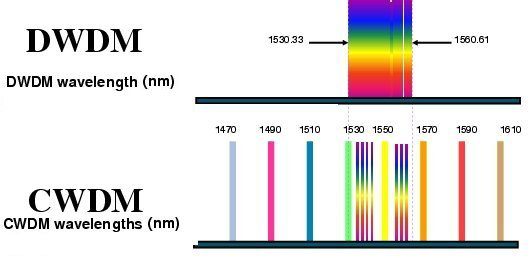
CWDM puts wavelength channels far apart from each other, typically 20 nm between each one. The ITU-T G.694.2 standard defines 18 channels across a range from 1270 nm to 1610 nm. In practice, most deployments only use 8 of those channels, from 1470 nm to 1610 nm, because those sit in the part of the fiber where signal loss is lowest.
That wide spacing is the key to why CWDM is cheap. When channels are far apart, the optical filters that separate them do not have to be super precise. You can use fewer filter layers, manufacturing is simpler, and more units pass quality checks. All of this means lower costs for the end buyer.
Real-World Example: City Metro Networks
A good example is how smaller city ISPs and municipal fiber networks use CWDM. The city of Amsterdam's municipal fiber network, CityNet, used CWDM for its access-layer links in the early 2010s to connect hundreds of business customers across short urban spans without overspending on infrastructure. The distances were well under 20 km, and the capacity per link was enough for the traffic at that time. They got the job done at a fraction of what a DWDM rollout would have cost.
Source: Amsterdam CityNet project reports, cited in Ovum Telecom Infrastructure Analysis (2013). Similar cost-driven CWDM deployments are documented in IEEE Communications Magazine, Vol. 41, No. 2.
Another common use case is enterprise campus networks. A university connecting its data centers across a few buildings, or a hospital linking imaging servers between facilities 10 km apart, will almost always choose CWDM. The math works out: lower upfront cost, simple gear, good enough capacity.
The Limits You Should Know
CWDM has two hard limits that matter a lot. First, you get a maximum of 18 channels. That sounds like plenty until your traffic doubles in three years and you realize the fiber is full. Second, CWDM does not work with Erbium-Doped Fiber Amplifiers (EDFA), which are the standard tools for extending signal range. This means CWDM links top out at around 80 km without adding expensive regeneration equipment. For a city-scale deployment, that is usually fine. For anything bigger, it is a real problem.
II. DWDM: High Capacity, Long Distance, Higher Cost
How It Works
DWDM packs channels very close together. The ITU-T G.694.1 standard defines spacings of 0.4 nm (50 GHz), 0.8 nm (100 GHz), and 1.6 nm (200 GHz). Most systems work in the C-band, roughly 1525 nm to 1565 nm, though newer systems are pushing into the L-band as well to grab even more capacity.
Because the channels are so close together, DWDM equipment has to be much more precise. The lasers need active cooling and wavelength-locking to stay stable. The filters need far more coating layers. All of this drives up manufacturing cost and system price. But what you get in return is dramatic: 40, 80, 96, or even 160+ channels on a single fiber pair, each running at 10, 100, or 400 Gbps.
Real-World Example: Backbone Networks
Look at any major internet backbone and you are looking at DWDM. Google's private fiber network, which connects its data centers globally, runs on DWDM infrastructure capable of carrying hundreds of terabits per second. According to Google's 2022 infrastructure disclosures, their backbone network uses 400G wavelengths on DWDM systems, with plans to scale to 800G per wavelength using advanced modulation formats.
Source: Google Cloud Next 2022 keynote and Google Network Infrastructure team blog post, 'Building a planet-scale network' (2022). See also: Journal of Lightwave Technology, Vol. 40, No. 11 - 'Trends in Submarine and Terrestrial DWDM Systems.'
Submarine cables are another area where DWDM is the only real option. The 2Africa cable system, one of the longest submarine cables in the world at over 45,000 km, relies entirely on DWDM to carry traffic between Africa, Europe, and Asia. There is no other technology that could make that work. EDFA amplifiers placed every 50-80 km along the cable boost all the DWDM channels at once, which is what makes ultra-long-haul transmission economically possible.
Source: Meta and partners' 2Africa cable announcement (2021); technical specifications from SubCom and Alcatel Submarine Networks (ASN).
The Real Advantage: EDFA Compatibility
I think the EDFA compatibility point does not get enough attention. When you use DWDM in the C-band, a single EDFA can amplify every channel on the fiber at the same time. You do not need to convert the signal back to electrical form and then back to light again. This keeps the system simple, lowers latency, and makes it practical to build links that span thousands of kilometers. This is the single biggest reason DWDM dominates long-haul and backbone networks.
III. CWDM vs. DWDM: Side-by-Side
Quick Comparison Table
Here is a straightforward look at how the two technologies compare across the dimensions that matter most for network planning:
|
Dimension |
CWDM |
DWDM |
|
Channel Spacing |
Wide (20 nm) |
Narrow (0.4 / 0.8 / 1.6 nm) |
|
Wavelength Range |
1270-1610 nm |
Primarily C-band, extendable to L-band |
|
Channel Count |
Up to 18 |
40-160+ |
|
Transmission Distance |
80 km max |
Hundreds to thousands of km |
|
Optical Amplification |
Not supported |
Supported (EDFA) |
|
Cost |
Low |
High |
|
Typical Applications |
Metro access, enterprise/campus networks |
Long-haul backbone, metro core |
Which One Should You Pick?
The honest answer: if your links are under 80 km and you need less than 10 Gbps per channel with 18 or fewer channels, CWDM will save you real money. A 2021 Dell'Oro Group report on optical transport noted that CWDM remains the dominant choice for enterprise and metro access deployments under 80 km, where it can cut initial capital spending by 30-60% compared to DWDM alternatives.
Source: Dell'Oro Group, 'Optical Transport Market Report Q4 2021.' Also referenced in Light Reading coverage of metro fiber trends, January 2022.
If you need more than 18 channels, more than 80 km of reach, or you are building something that has to scale to hundreds of Gbps or terabits, then DWDM is the right call. The higher upfront cost is real, but so is the capacity ceiling you hit with CWDM. A lot of operators have learned this the hard way, deploying CWDM for cost savings and then having to rip and replace within five years when traffic outgrew it.
One thing worth noting: in many real networks, both technologies coexist. DWDM handles the backbone and core layers. CWDM covers the access and distribution edges. This is not a compromise. It is actually a smart design that uses each technology where it fits best.
Conclusion
CWDM and DWDM are not competing products. They are tools for different jobs. CWDM is simple, affordable, and well-suited for short links with moderate capacity needs. DWDM is the only serious option when you need massive capacity, long reach, or a network that can scale for years to come.
If I had to give one piece of advice: do not just plan for today. Look at your traffic growth estimates over the next five to seven years before committing to a technology. A CWDM deployment that looks perfect today can become a headache fast if your data needs grow faster than expected. DWDM costs more upfront, but it ages a lot better.
The good news is that the optical networking industry has matured enough that both technologies are well-supported, well-documented, and available from multiple vendors. Whether you are building a campus link or a continental backbone, the tools exist. The key is just making sure you are using the right one.