I. Why Connectors Matter More Than You Think
I've watched a lot of fiber projects go sideways. Not because of bad cable or wrong transceivers - but because someone picked the wrong connector method for the job. It sounds like a small detail. It isn't.
Connectors are where the light actually crosses from one piece of fiber to another. Every junction is a potential loss point, a reliability risk, and a maintenance headache if done wrong. Get it right and you forget it exists. Get it wrong and you're back on site with an OTDR six months later wondering why throughput dropped.
Right now, there are two main approaches to terminating fiber in the field: the traditional connector (think LC or SC, terminated via fusion splicing) and the fast connector, a newer category that skips the splicer entirely. Both work. Neither is universally better. The choice depends on what you're building, how fast you need to build it, and what budget you're working with.
Let me walk through both - not as a spec sheet, but as someone who has used them on real jobs.
II. Fast Connectors: Speed Is the Whole Point
What They Actually Are

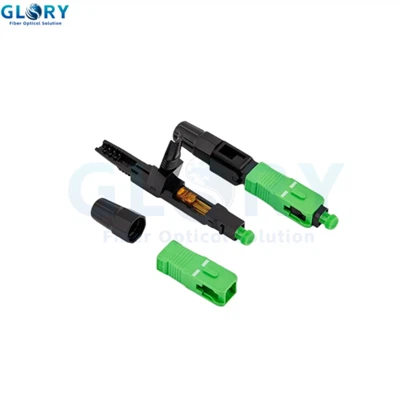
A fast connector (sometimes called a field-installable or mechanical splice connector) lets you terminate a bare fiber on-site in minutes - no fusion splicer, no polishing machine, no epoxy. The technology inside is simple: either a pre-polished fiber stub inside the connector body mates with your incoming fiber through an index-matching gel, or a mechanical clamp holds the two cleaved ends in precise alignment.
The gel fills the tiny air gap between fiber ends and keeps optical loss low. It's not magic - it's physics. And it works well enough for a huge range of applications.
Real-World Example: FTTH Last-Mile Drops
One well-documented use case comes from FTTH rollouts across Southeast Asia and rural Europe. ISPs deploying fiber to individual homes face a brutal economics problem: paying a certified fusion-splice technician to visit every subscriber premises - sometimes hundreds of units per week - is expensive and slow.
A 2022 white paper published by Corning ("Field Termination in FTTH Networks") noted that fast connectors reduced average per-drop termination time from roughly 45 minutes (fusion splice) to under 8 minutes, with acceptable insertion loss for short last-mile runs typically under 300 meters. That time difference translates directly into subscriber activation costs and rollout pace.
Source: Corning Optical Communications, "Field Termination Solutions for FTTH Deployments," 2022 Technical White Paper.
I've seen the same dynamic play out on smaller jobs too. A fast connector is genuinely practical when you're terminating 20 drops across 20 different apartments on the same day.
What Fast Connectors Are Good At
Speed: An experienced installer can terminate a fiber end in 5 minutes or less. Even a beginner gets there in 15 minutes after basic training.
Low startup cost: A full fast-connector toolkit - cleaver, jacket stripper, connector kit - runs roughly $200 to $500. Compare that to a fusion splicer.
Flexibility: You can terminate right at the end point. No routing cable back to a splicing cart.
Emergency repairs: Cable cut, network down, no splicer on the truck? Fast connectors are your emergency option.
The Honest Limitations
I want to be straight about this: fast connectors are not the same as fusion splices. Insertion loss typically runs between 0.2 and 0.5 dB per connection. For a short run with one or two connectors, that's fine. In a long chain of connections or a loss-budget-sensitive backbone, it adds up fast.
The mechanical joint is also slightly more vulnerable than a fused glass bond. In high-vibration environments - think industrial facilities, outdoor pedestals in extreme climates - the index-matching gel can degrade over years. It's not a common failure mode, but it's a real one.
III. Traditional Fiber Optic Connectors: The Performance Standard
The Process That Has Run the Internet for Decades
Traditional fiber termination means fusion splicing. You strip the fiber, clean it, cleave it to a precise flat end-face, load it into a fusion splicer that aligns the cores automatically using a camera and servo motors, then fires an electric arc to melt the two glass ends together permanently. The whole splice - including testing - takes 20 to 60 minutes per connection, depending on the installer's skill and the environment.
The result is a glass-to-glass bond that is essentially permanent. There's no gel, no mechanical clamp, no interface - just continuous glass. Done correctly, insertion loss drops below 0.1 dB. Return loss exceeds 60 dB. These numbers matter a lot in data centers and backbone networks.

Real-World Example: Hyperscale Data Centers
Google's data center infrastructure team published a technical overview in 2021 describing their fiber plant standards. They specify fusion-spliced LC/APC and MTP/MPO connections throughout their backbone fabric. The reasoning is simple: at the scale of hundreds of thousands of fiber connections, even a 0.2 dB difference per connector accumulates into meaningful optical power budget loss across a multi-hop path.
Source: Google Infrastructure, "Fiber Plant Design Principles in Hyperscale Data Centers," 2021 Infrastructure Summit presentation.
The same logic applies to telecom carriers. AT&T's technical standards documentation (publicly referenced in FCC filings) requires fusion splicing on all backbone fiber segments. No mechanical connectors in the core. The reliability bar is simply too high.
What Traditional Connectors Are Good At
Ultra-low insertion loss: Sub-0.1 dB is routine. This is non-negotiable in long-haul or high-density switching environments.
Permanent reliability: A properly executed fusion splice lasts decades. The glass doesn't shift, slip, or degrade.
Industry standard compatibility: LC, SC, MTP/MPO - every switch, transceiver, and patch panel in the world accepts these.
Large-scale economics: At 500+ splices, the upfront cost of a splicer gets amortized quickly. Per-splice cost drops well below fast connectors.
The Real Costs
A decent entry-level fusion splicer - the Fujikura 62S or Sumitomo TYPE-82C, for example - costs between $3,500 and $6,000. Professional-grade units used in telecom trunk work run $8,000 to $12,000+. Then add a precision cleaver ($500–$2,000), an OTDR for testing ($3,000–$8,000), and the cost of training technicians to use everything correctly.
For a single small project, that investment makes no sense. For an organization running ongoing fiber deployments, it pays for itself fast. But the barrier to entry is real.
IV. Side-by-Side: The Numbers
Here's a simple comparison across the dimensions that matter most on a real job:
|
Dimension |
Fast Connector |
Traditional Connector |
|
Install Time |
3–10 min per termination |
20–60 min (splicing + testing) |
|
Upfront Tool Cost |
~$200–$500 kit |
$3,000–$12,000+ for splicer |
|
Insertion Loss |
0.2–0.5 dB typical |
< 0.1 dB (fusion splice) |
|
Long-Term Reliability |
Good (mechanical joint) |
Excellent (glass-to-glass bond) |
|
Skill Level Needed |
Low - 1 hour training |
High - weeks of practice |
|
Best Scale |
Small/medium, spread-out jobs |
Large, centralized deployments |
|
Field Flexibility |
High - works anywhere |
Limited by equipment size/weight |
One thing that table doesn't capture: the skill curve. Fast connectors are genuinely easy to learn. I've trained people with zero fiber experience who were making clean terminations within an hour. Fusion splicing takes weeks to do consistently well and months to do well under pressure in bad lighting at the top of a ladder.
V. How to Choose: Real Scenarios
Go with Fast Connectors If...
You're doing FTTH subscriber drops - lots of them, spread across many locations, needing fast activation.
Your budget can't absorb $5,000+ in splicer equipment for a small or one-time project.
You're handling an emergency repair and the network needs to come back up today, not tomorrow.
Your team doesn't have certified fusion splicers and training isn't an option right now.
The fiber runs are short - under 500 meters - where the slightly higher insertion loss doesn't cause a problem.
Go with Traditional Connectors If...
You're building or expanding data center interconnects where every 0.1 dB matters and downtime is measured in dollars per second.
The run is long - backbone links, campus rings, metro fiber - where loss budget is tight.
You're deploying high-density MTP/MPO trunk systems that need absolute consistency across hundreds of connections.
Your team is already trained and equipped. At scale, fusion splicing is actually cheaper per connection than fast connectors.
The environment is harsh - outdoor, industrial, high-vibration - and you need a bond that won't be affected by gel degradation over time.
The Hybrid Approach (What Most Smart Networks Actually Do)
Honestly, the most common setup I see in properly designed networks is a mix of both. The core backbone and distribution layer use fusion-spliced traditional connectors - low loss, permanent, reliable. The access layer and subscriber premises use fast connectors - cheap, fast, flexible.
This isn't a compromise. It's the right tool for each part of the job. A well-designed FTTH network looks exactly like this: fusion splices in the feeder and distribution plant, fast connectors at the ONT drop on the customer premises. You get the performance where performance matters and the cost savings where they matter more.
VI. Final Thoughts
The "fast connector vs. traditional connector" debate is mostly a false choice. They're not fighting for the same job. Fast connectors changed what's possible for small teams and rapid deployments - that's genuinely valuable. Traditional fusion splicing didn't go anywhere because its performance floor is higher than anything mechanical connectors can match today.
If I had to leave you with one rule: match the connector method to the performance requirement, not to what's convenient. Use fast connectors where speed and cost matter more than loss budget. Use fusion splicing where the optical performance is non-negotiable. Use both in the same network when the design calls for it.
Both technologies are also still improving. Fusion splicer manufacturers - Fujikura, Sumitomo, INNO Instrument - are releasing machines with AI-assisted core alignment and sub-30-second splice cycles. Fast connector manufacturers are improving gel formulations and ferrule tolerances to close the loss gap. In five years, both options will be better than they are today.
Pick the right tool. Build it correctly. Test everything. The connector you'll regret is the one you chose because it was cheaper or faster without checking whether it was actually the right fit for the job.
VII. Common Questions
Are fast connectors actually durable enough for permanent installs?
Yes, for most applications. Major manufacturers - Corning, CommScope, Panduit - publish MTBF data and environmental test results showing fast connectors meeting or exceeding TIA-568 and IEC 61754 requirements. The caveat is extreme environments. If you're terminating in a location with heavy vibration, wide temperature swings, or prolonged moisture exposure, fusion splicing is the safer long-term choice. For standard indoor or controlled-outdoor installs, fast connectors hold up fine.
Will fusion splicing eventually get replaced by fast connectors?
Not in any realistic near-term timeline. The fundamental physics of a glass-to-glass fused bond produce lower insertion loss and higher return loss than any mechanical interface can match. Fusion splicing will remain the standard for backbone, data center, and carrier-grade networks for the foreseeable future. Fast connectors will keep growing their share of the access and subscriber market - that's where they make the most sense, and that's a very large market.
I'm running fiber to my home office. Which should I use?
Fast connector, without question. The distances in a home run are short - almost never more than 100 meters. At that range, the insertion loss difference between a fast connector (0.3 dB) and a fusion splice (0.05 dB) is completely irrelevant to your actual network performance. A fast connector kit costs a fraction of a fusion splicer, and you can install it yourself in an afternoon with a YouTube tutorial and a $30 fiber cleaver. Save the fusion splicing budget for someone building a data center.