Author:Willa Shang willa@gloryoptic.com
Your drone is hovering 50 meters above a tactical combat zone. Suddenly, a gust of wind (Force 6, approximately 13.8 m/s) hits. The drone shakes violently, the tether tightens, and in an instant, the entire mission is in grave danger-truly a matter of life and death.
If the fiber optic cable's tensile strength is insufficient, you face the risk of signal loss, data corruption, or even worse-a crash.
FPV drone fiber optic offers a definitive solution: a minimum tensile strength of 55 Newtons. This isn't a laboratory concept; it's a proven, real-world-ready safety feature.
What exactly does 55 Newtons mean? - Survivability in Dynamic Environments
Under static laboratory conditions, fiber optic cables only need to withstand their own weight (approximately 200-300 grams per kilometer). However, in actual flight, cables are subjected to dynamic composite loads:
Wind drag and inertial shock: A 9mm diameter cable can withstand several Newtons of lateral force in a Force 6 wind. Combined with the sudden maneuvers of the drone, the instantaneous tensile force can be 5-10 times higher than the static load.
Bending and torsion: During turns and maneuvers, the cable repeatedly bends at the exit point. Material fatigue gradually lowers the fracture threshold.
Extreme temperatures: Plastics harden in extreme cold and soften in extreme heat. Military-grade standards require stable performance throughout the entire operating range.
The 55N rating fully considers all these harsh realities. This means your drone can tilt its fuselage significantly, navigate turbulent waters, and fly over complex terrain-without breaking the cable. Real-time video and control signals remain consistently reliable.
The paradox of lightweight versus strength: How PP+ABS composites achieve both
The conventional wisdom is that strength equals weight. FPV drone fiber optic breaks this myth through innovative PP+ABS composite engineering:
40% Weight Reduction: Compared to standard engineering plastics, the composite spool significantly reduces density while maintaining rigidity. Your drone will barely feel its presence.
55N High Tensile Strength: Fiber-reinforced structure and molecular-level mixing process give it military-grade tensile modulus and impact resistance. "Light" no longer means "fragile."
This weight reduction directly translates to a 27% increase in drone payload. This means it can carry additional sensors, larger capacity batteries for 15 minutes more flight time, or other mission-specific equipment. For micro-drones with a takeoff weight of less than 2 kg, a 40% weight reduction often makes fiber optic integration possible.
9mm Ultra-Thin Design: Seamless Integration into a Miniature Payload Cabin
"We really wanted to use fiber optics, but spools were too bulky-they affected our aerodynamics."
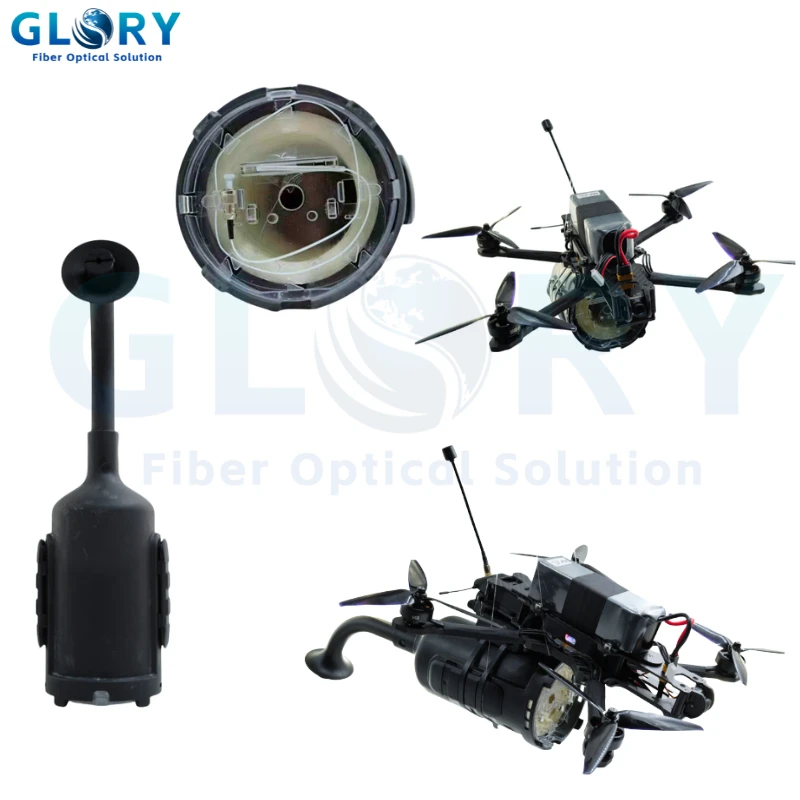
We've heard this complaint from countless drone manufacturers. The 9mm ultra-thin spool is the solution. The precisely wound fiber optic cable, only slightly thicker than a coin, can be easily embedded inside the fuselage or mounted on external mounting points with negligible drag.
Combined with a reusable deployment and recovery mechanism, your drone is no longer limited to single-flight missions. After flight, the cable is retrieved, rewound, and ready to fly again. This dramatically changes the way training exercises, long-duration surveillance, and multi-flight operations are conducted.