A Quick Overview: LC vs. SC
|
Feature |
LC Connector |
SC Connector |
|
Full name |
Lucent Connector |
Subscriber Connector (or Standard Connector) |
|
Ferrule size |
1.25 mm (small form-factor) |
2.5 mm (standard) |
|
Latching mechanism |
Push-pull with latch |
Push-pull with snap-in |
|
Typical insertion loss |
≤0.2 dB (single-mode) |
≤0.2 dB (single-mode) |
|
Typical return loss (UPC) |
≥50 dB |
≥50 dB |
|
Typical return loss (APC) |
≥60 dB |
≥60 dB |
|
Durability |
500+ mating cycles |
500+ mating cycles |
|
Primary applications |
High-density, data centers, transceivers |
FTTH, telecom, patch panels |
1. Physical Size and Port Density

The most obvious difference is the ferrule diameter. LC uses a 1.25 mm ferrule-half the size of SC's 2.5 mm ferrule. This makes LC connectors ideal for high-density applications.
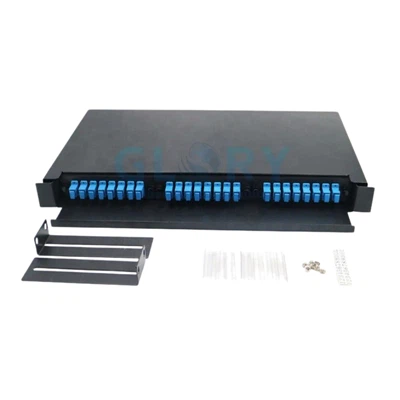
• LC can fit twice as many ports in the same panel space. A 1U patch panel can hold 48 LC duplex ports, compared to 24 SC ports.
• SC, while larger, offers a more robust feel and easier handling for technicians with larger hands or when wearing gloves.
When to prioritize density:
Choose LC for data center top-of-rack (ToR) switches, high-density distribution frames, or any environment where rack space is at a premium.
2. Latching Mechanism and Handling
• LC uses a latching (push-pull) mechanism similar to an RJ45 Ethernet plug. It snaps securely into place and releases by pressing the latch. This provides excellent retention but can be slightly trickier to release in very tight spaces.
• SC uses a push-pull snap-in design with a simple, square-shaped body. It is known for its ruggedness and ease of use-just push to insert, pull to remove. No latch to depress.
When to choose SC:
For field installations where quick, tool‑free mating and unmating are frequent, or for technicians who prefer a no‑latch, straightforward interface.

3. Performance – Are They Different?
From an optical performance standpoint, both connectors achieve identical loss specs when manufactured to high standards. Typical insertion loss is ≤0.2 dB for single‑mode, and return loss is ≥50 dB for UPC or ≥60 dB for APC polish.
The real performance difference comes from polish type (UPC vs. APC) and connector quality, not from LC vs. SC itself.
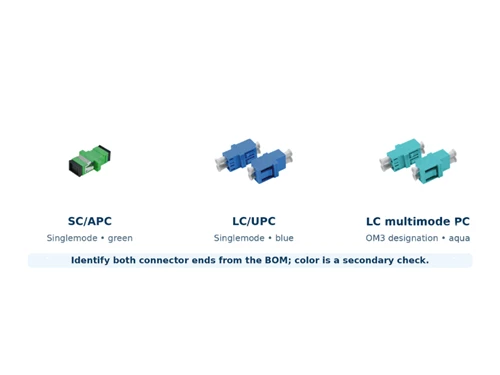
• APC (Angled Physical Contact) – Green housing, minimizes back reflection. Essential for analog video, FTTx, and high‑sensitivity analog RF.
• UPC (Ultra Physical Contact) – Blue housing, good for most digital applications.
Both LC and SC are available in UPC and APC versions.
4. Typical Applications – Where Each Excels
|
Application |
Recommended Connector |
Why |
|
Data center (40G/100G/400G) |
LC |
High density, compatible with QSFP transceivers |
|
FTTH (home/office drop) |
SC (often SC/APC) |
Rugged, easy field termination, standard for PON |
|
Enterprise patch panels |
Either – depends on density |
LC for more ports, SC for simpler handling |
|
Telecom central office |
SC (legacy) / LC (modern) |
Migration toward LC for new high density equipment |
|
Test equipment & instruments |
SC (common) |
Robust, widely available |
|
Cable TV (CATV)/RFoG |
SC/APC |
Low back reflection critical for analog signals |
5. Compatibility with Transceivers
Modern optical transceivers (SFP, SFP+, QSFP, etc.) almost exclusively use LC duplex interfaces because of the small footprint. If your equipment uses SFP/SFP+ modules, you will need LC connectors on the cable end.
Older or larger form‑factor transceivers (e.g., GBIC) may use SC, but these are increasingly rare.
Bottom line: For new deployments involving standard small‑form‑factor pluggables, LC is the default choice.
6. Hybrid Cables and Migration
Many networks transition from SC‑based legacy equipment to LC‑based modern switches. This is where hybrid patch cords (SC to LC) come in handy. A common scenario: an SC/APC wall outlet in an FTTH home connects to an LC/UPC router or ONT via a hybrid cable.
At Glory Optical, we manufacture a full range of both LC and SC patch cords, pigtails, and hybrid assemblies-in UPC or APC polish, single‑mode or multimode, and with various jacket ratings (LSZH, OFNR, etc.).
Summary: Which One Should You Choose?
Choose LC when:
• You need maximum port density (data centers, high‑capacity ODFs).
• Your equipment uses SFP/SFP+/QSFP transceivers.
• You are building a new greenfield network and want the modern standard.
Choose SC when:
• You are working with FTTH drop applications (especially SC/APC for PON).
• You prefer a larger, more rugged connector for field work.
• You have legacy equipment or patch panels already using SC.
In many networks, both coexist. The feeder side may use SC/APC for outdoor plant, while the equipment side uses LC/UPC for switch connectivity. The key is understanding the interface requirements at both ends of your link.
Why Quality Matters – Regardless of Connector Type
Whether you choose LC or SC, the reliability of your fiber connection depends on precision polishing, proper ferrule alignment, and consistent insertion loss. At Glory Optical, every connector is manufactured under ISO 9001 standards, tested for insertion loss and return loss, and backed by over a decade of fiber optic expertise.