
A large-scale fiber network is not a single cable - it is thousands of segments joined at thousands of points, each one sealed inside a splice closure that someone has to find, open, document, maintain, and eventually repair. The reference article on this topic offered sensible advice: plan well, install carefully, keep an inventory. That is the greeting-card version. The real playbook is messier, more expensive, and a lot more interesting.
The Scale Problem: Why "Just Keep Track" Does Not Work
Consider what "large-scale" actually means. A regional telecom operator running an FTTH network across a metropolitan area may have 10,000 to 50,000 splice closures in the field. A national carrier's backbone and distribution network can exceed 100,000 closures. Each closure contains anywhere from 12 to 288 individual fiber splices, each with its own loss value, position, and service assignment. That is millions of data points - and every one of them matters when a customer calls with an outage.
The reference article suggested implementing "an inventory management system to monitor the quantity, location, and status of each splice closure." That is correct in principle, but it glosses over the central challenge: most fiber networks are documented badly, documented late, or not documented at all. Spreadsheets exist on individual technicians' laptops. As-built drawings were accurate on installation day and wrong by the end of the first maintenance window. GPS coordinates, when captured, are often imprecise because they were taken from a vehicle rather than at the closure itself.
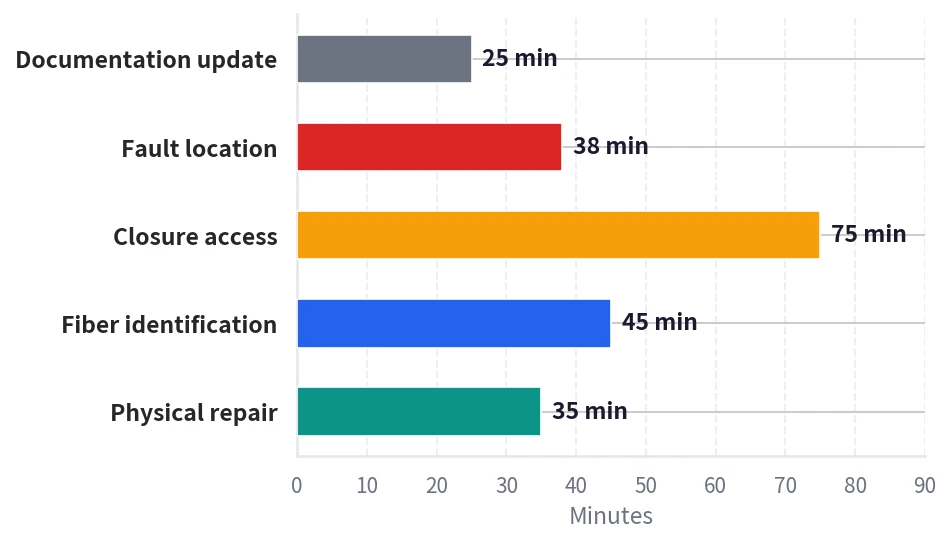
The result is a documentation debt that compounds over time. When a technician arrives to repair a fault and cannot find the closure - or finds it but cannot identify which of the 144 fibers inside carries the affected circuit - the mean time to repair (MTTR) balloons. According to 2025 data from China's national communications emergency dispatch platform, the average fault location time across 68 representative cases was 38 minutes, and the average restoration time was 4.7 hours - figures that improved 1.2 hours from 2023 thanks to intelligent monitoring and AI-assisted diagnostics, but still represent significant service disruption.
|
38 min Avg. fault location time (2025) |
4.7 hrs Avg. restoration time |
67% Outages linked to joint/closure issues |
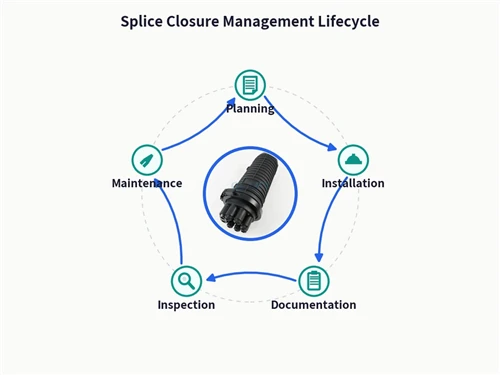
The path to managing closures at scale is not a single tool or a single process. It is a lifecycle discipline that spans planning, installation, documentation, inspection, maintenance, and eventual retirement - each phase feeding data into the next. This article breaks down each phase with the level of detail that field teams actually need.
The Management Lifecycle: Five Phases, One Discipline
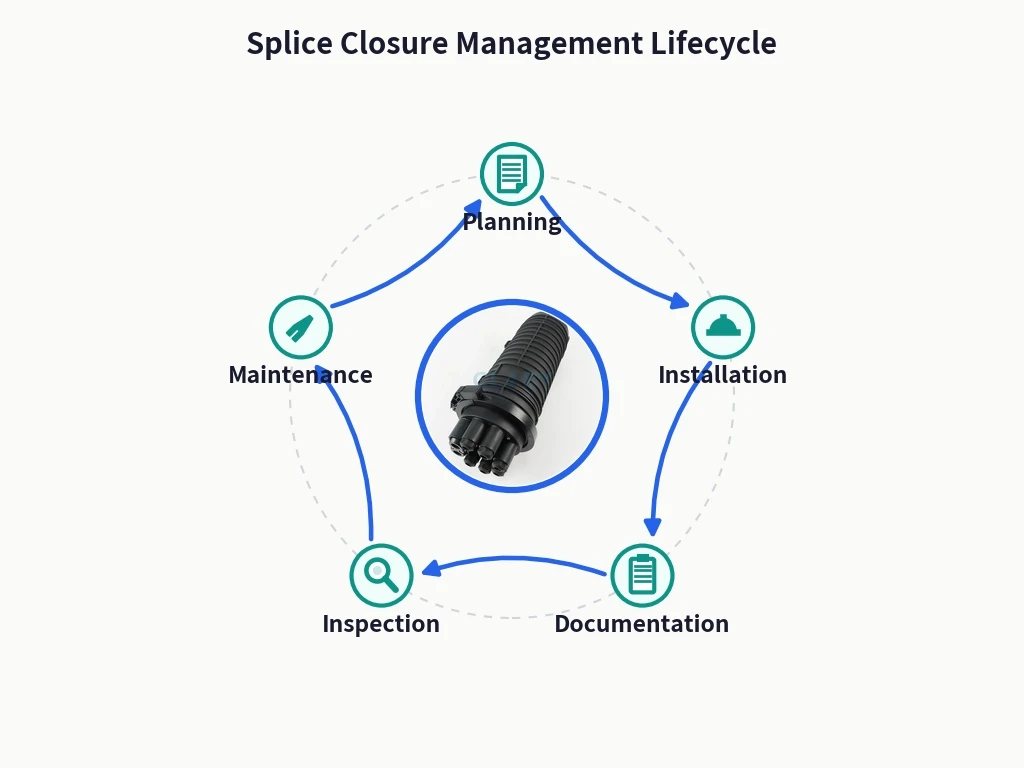
The biggest mistake network operators make is treating closure management as a series of discrete tasks rather than a continuous cycle. A closure is installed, documented, and then forgotten until something breaks. By the time a technician opens it five years later, the documentation is stale, the internal organization has been modified by previous repairs, and nobody knows what is inside. The lifecycle approach - where each phase deliberately feeds the next - prevents this decay.
Phase 1: Planning - Specifying Closures Before You Need Them
Closure management starts long before any closure is installed. The planning phase determines what gets deployed, where, and with what capacity - and getting these decisions wrong creates problems that no amount of maintenance can fix.
Network Topology Mapping
The topology map drives closure placement decisions. In a backbone network, closures appear at regeneration sites, branch points, and cable access points - typically every 2–4 km for long-haul routes. In an FTTH distribution network, closures cluster at the neighborhood level: one closure at the fiber distribution hub (FDH) splitting the feeder to multiple distribution cables, then smaller closures at each drop point where fibers branch to individual homes.
Capacity Planning: The 30% Rule
The most common planning error is specifying closures with exactly the capacity needed on day one. A closure filled to 100% leaves no room for growth, makes re-entry a nightmare, and forces technicians to install a second closure when the first one runs out of space - a costly and space-consuming workaround.
The industry best practice is the 30% spare capacity rule: specify closures with at least 30% more fiber capacity than the initial requirement. If a junction point needs 96 splices today, install a 144-fiber closure. This spare capacity accommodates future network expansion, emergency restoration splicing, and the inevitable "one more fiber" requests that arrive after the network is commissioned.
Environmental Specification
Closure type and IP rating must match the deployment environment. This sounds obvious, but field surveys routinely find IP54 closures in underground handholes where IP68 is required, or non-UV-stabilized closures on aerial runs where they embrittle within five years. The specification matrix should account for:
|
Deployment Location |
Min. IP Rating |
Closure Type |
Special Requirements |
|
Underground handhole |
IP68 |
Dome or horizontal |
Chemical resistance, flood tolerance |
|
Aerial strand mount |
IP67 |
Dome (UV-stabilized) |
UV resistance, wind load rating |
|
Building basement / riser |
IP65 |
Wall-mount box |
Fire rating per local code |
|
Outdoor cabinet (FDH) |
IP65 |
Rack-mount module |
Thermal management, condensation drain |
|
Direct buried |
IP68 |
Dome (heavy-duty) |
Impact resistance IK10, corrosion proof |
Phase 2: Installation - Where Most Problems Begin
Industry data is unequivocal: the majority of closure failures trace back to installation errors, not product defects. A closure installed correctly will perform for decades. A closure installed incorrectly will fail - the only question is when.
Strain Relief and Strength Member Anchoring
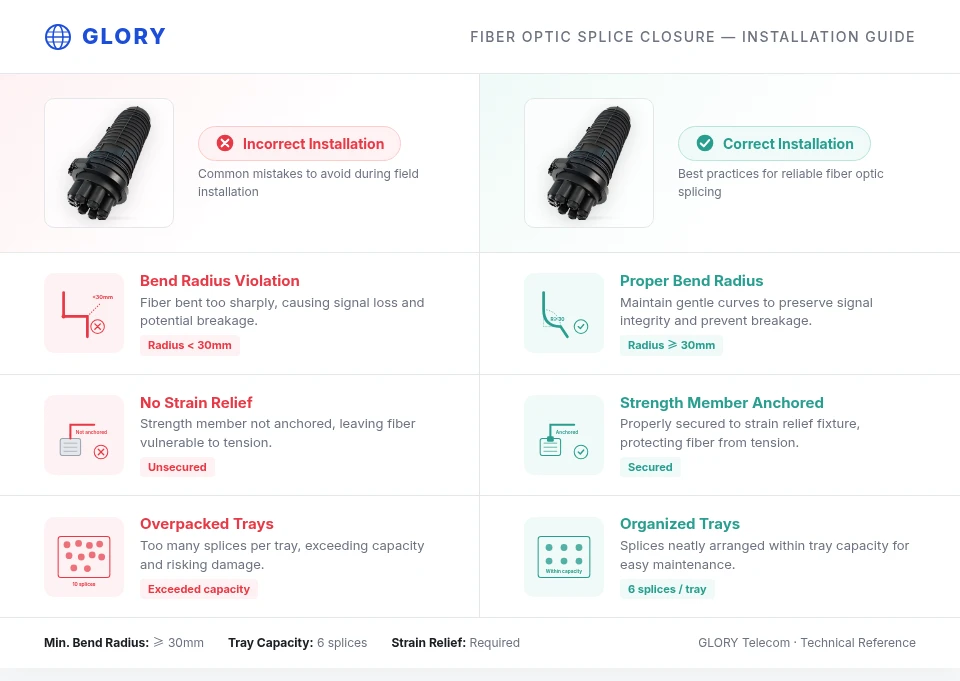
Every fiber cable contains strength members - aramid yarn (Kevlar), steel wire, or fiberglass rods - designed to carry tensile loads so the glass fiber does not. When a cable enters a splice closure, these strength members must be anchored to the closure's strain relief fixture, not just left loose inside. If the cable is pulled, the load transfers to the strength member and the closure housing, not to the fiber splices. Failing to anchor the strength member is the single most common installation error, and it leads directly to splice failure under thermal cycling or vibration.
Bend Radius Control
Single-mode fiber under tension requires a minimum bend radius of 30mm; relaxed fiber can tolerate 15mm, but in any environment with vibration or thermal cycling, the conservative figure should govern. Inside a splice closure, fibers must be routed through the designated tray channels - never across trays or through shortcut paths that violate bend radius. Overpacked closures where fibers are forced into tight bends to fit under the lid are a leading cause of macrobending loss that develops over months rather than appearing immediately.
Sealing: The Last Step That Matters Most
The closure seal is the final barrier between the splices and the environment. Whether using mechanical seals (gasket-based, reusable) or heat-shrink seals (adhesive-bonded, permanent), the sealing process must be performed meticulously. Common sealing failures include:
• Incomplete gasket seating: The O-ring gasket is not fully seated in its groove, creating a gap that admits moisture from day one.
• Wrong cable diameter range: Using a gasket or heat-shrink sleeve rated for a different cable diameter than the actual cable, leaving an annular gap.
• Insufficient heat application: Heat-shrink sleeves that are not heated uniformly, leaving uncured adhesive that fails under thermal cycling.
• Skipped port sealing: Unused cable ports left without sealing plugs, creating direct moisture pathways into the closure.
Environmental Conditions During Splicing
The quality of the fusion splice itself depends heavily on the conditions under which it was made. Outdoor FTTH installations expose technicians to high temperatures, humidity, dust, and wind - all of which increase the risk of fiber contamination, improper splice conditions, and damage to fiber ends. A splice made in a dusty environment may pass initial testing but develop excess loss within months as particulate contamination degrades the joint. The solution is splicing tents or enclosed vehicles for outdoor work, and strict clean-cleave protocols regardless of environment.
Phase3: Inspection and Testing - Finding Problems Before They Find You
Preventive maintenance is the phase most likely to be skipped - and the one with the highest return on investment. A closure inspected and repaired proactively costs a fraction of one that fails in service. The challenge is scaling inspection across thousands of closures with limited technician resources.
Inspection Frequency: Risk-Based Scheduling
Not all closures need the same inspection frequency. A risk-based approach prioritizes closures by environmental exposure, network criticality, and age. The following schedule represents industry consensus for large-scale networks:
|
Risk Category |
Inspection Frequency |
OTDR Testing |
Typical Closure Profile |
|
Critical / High-risk |
Monthly to quarterly |
Every 6 months |
Underground flood zones, coastal, high-vibration |
|
Standard outdoor |
Every 6 months |
Annually |
Aerial, standard buried, roadside cabinets |
|
Indoor / controlled |
Annually |
Every 2 years |
Building basements, data center interiors |
|
Aged closures (8+ years) |
Quarterly |
Every 6 months |
Any closure approaching material aging threshold |
During visual inspections, technicians should check the exterior for cracks, dents, loose seals, and water ingress signs. Mounting brackets must be secure. For closures in high-dust or high-pollen areas, monthly exterior cleaning prevents accumulation that can trap moisture against the housing.
OTDR Testing: The Diagnostic Gold Standard
Visual inspection tells you whether a closure looks healthy. OTDR testing tells you whether the splices inside are actually performing. An OTDR sends light pulses down the fiber and measures backscatter to create a trace that shows every splice point, connector, bend, and break along the route - with distance and loss values for each event.
Phase 4: Maintenance and Repair - When Things Go Wrong
Despite the best planning, installation, and inspection programs, closures will fail. The question is not whether maintenance will be needed, but how quickly and effectively it can be performed when it is.
The Maintenance Hierarchy
Maintenance tasks fall into four categories, each with different urgency and resource requirements:
• Routine cleaning: Exterior cleaning of closures in dusty or pollen-heavy environments. Monthly for high-exposure closures, quarterly for standard outdoor units.
• Seal renewal: Replacement of degraded gaskets or re-application of heat-shrink sleeves during scheduled re-entry. Typically performed every 5–7 years for mechanical seals, or whenever a closure is opened for any reason.
• Comprehensive internal inspection: Annual disassembly, internal component check, cleaning of fiber connectors and connection parts, reassembly and testing. This is the most resource-intensive maintenance task and is often deferred - which is exactly when problems accumulate.
• Emergency repair: Unscheduled response to outage events. The goal is restoration, not perfection - get the circuit back up, then schedule a permanent repair.
Re-Entry Best Practices
Every time a closure is opened, there is an opportunity to improve its condition - or to make it worse. Re-entry best practices include:
• Always bring the documentation: Never open a closure without the splice matrix and OTDR baseline. If the documentation does not exist, create it before closing the closure again.
• Replace the gasket every time: Mechanical seals are designed for multiple re-entries, but the gasket should be inspected and replaced if it shows any sign of compression set, cracking, or deformation.
• Update the record: Any change made inside the closure - a new splice, a re-routed fiber, a replaced tray - must be documented and the digital record updated before the technician leaves the site.
• Test before sealing: Verify all splices with an OTDR or visual fault locator before sealing the closure. Sealing a closure with a bad splice inside means the entire process must be repeated.
Emergency Response: Reducing MTTR
When a fault occurs, the clock starts. The restoration process follows a predictable sequence: locate the fault, identify the affected closure, access the closure, identify the affected fiber, perform the repair, verify the fix, and close out the ticket. Each step has potential bottlenecks.
MTTR varies dramatically by environment: 4–8 hours for terrestrial networks, 12–30 hours for shallow water installations, and 1–3 weeks for deep submarine systems. For terrestrial large-scale networks, the biggest MTTR contributors are not the physical repair - which typically takes 30–60 minutes - but the fault location and closure access phases, which can consume hours when documentation is poor or GPS coordinates are inaccurate.
Fusion splicing remains the gold standard for permanent repairs, achieving 0.02–0.10 dB loss compared to 0.1–0.5 dB for mechanical splices. However, mechanical splices have a role in emergency restoration: they can be deployed in minutes without a fusion splicer, restoring service while a permanent repair is scheduled. The key is to treat mechanical splices as temporary and always schedule a fusion splice replacement.
Cost-Effective Management: The Economics of Doing It Right
The reference article mentioned that proper management "doesn't have to be expensive." That is technically true but misleadingly simple. Effective closure management requires real investment - in tools, training, software, and labor. The question is not whether to spend, but where spending delivers the highest return.
Where to Invest First
For networks at the spreadsheet stage of documentation maturity, the highest-ROI investment is a purpose-built fiber management system. The cost of such systems varies widely - from a few thousand dollars per year for cloud-based SaaS platforms to six-figure enterprise deployments - but the MTTR reduction alone typically justifies the investment within the first year.
The second priority is technician training. A well-trained technician can install, document, and maintain closures in half the time of an untrained one, with dramatically fewer errors. Training should cover not just splicing technique but closure-specific skills: gasket installation, strain relief anchoring, bend radius management, and documentation protocols.
The Cost of Not Managing
The alternative to investment is accepting the cost of failures. Network downtime averages $5,600 per minute across industries, with financial services and hyperscale data centers exceeding $10,000 per minute. If joint and closure issues account for 67% of network interruptions, then closure management is not a cost center - it is the single highest-leverage reliability investment available to a fiber network operator.
The Human Factor: Training, Standards, and Culture
Technology and process are necessary but not sufficient. The final variable in closure management is the people who install, inspect, and repair closures in the field. Even the best tools and processes fail if technicians are not trained to use them or not incentivized to follow them.
Standardized Procedures
Every network operator should have written, standardized procedures for closure installation, re-entry, documentation, and testing. These procedures should be specific enough to be actionable - not "seal the closure properly" but "torque the gland nut to 8 Nm using a calibrated torque wrench, then verify the seal with a 30-second pressure test." Standardization ensures that every technician performs tasks the same way, regardless of experience level or location.
Certification and Continuing Education
Technician certification programs - from organizations like FOA (Fiber Optic Association), ETA International, or manufacturer-specific programs - establish a baseline of competency. But certification is a starting point, not an endpoint. Continuing education should cover new closure technologies, updated testing procedures, and lessons learned from field failures. The best programs include hands-on assessments where technicians demonstrate their skills on actual closures, not just written exams.
The Documentation Culture
The hardest part of closure management is cultural, not technical. Technicians under pressure to close tickets quickly will skip documentation. The fix is not to demand more paperwork - it is to make documentation as frictionless as possible. Mobile apps that capture GPS coordinates, photos, and splice data on-site; barcode or RFID tags on closures that auto-populate records; and OTDR equipment that uploads traces directly to the central database - all of these reduce the friction that leads to documentation shortcuts.
When documentation is easy, technicians do it. When it is hard, they do not. The technology stack should be designed around this reality, not against it.
Conclusion: Management Is the Product, Not the Closure
The reference article that prompted this deep dive offered a straightforward message: understand your closures, plan deployment, install carefully, manage inventory, train technicians, and control costs. That advice is not wrong - it is simply incomplete. Managing splice closures in a large-scale fiber optic network is not a checklist. It is a continuous operational discipline that integrates planning, installation, documentation, inspection, maintenance, and technology into a single lifecycle.
The networks that do this well share common traits: they invest in purpose-built documentation tools rather than relying on spreadsheets; they schedule maintenance based on risk, not on convenience; they treat every closure re-entry as an opportunity to improve the documentation; and they recognize that the cost of preventive maintenance is always lower than the cost of failure.
The networks that do this poorly also share common traits: they defer maintenance until failures force action, they lose institutional knowledge when experienced technicians leave, and they spend more on emergency repairs than they would have spent on prevention. The difference between the two is not budget - it is discipline. And discipline, unlike hardware, scales infinitely once established.