Fiber Termination Box vs Fiber Distribution Box: What's the Actual Difference?

May 26, 2026

Leave a message

Glory Optical Engineering Team
The Glory Optical Engineering Team​ is an elite group of senior telecommunications experts, structural engineers, and network architects. Serving as the core technical engine behind Glory Optical Communication.

§1  The Terminology Problem - Why These Two Words Blur Together

Before comparing them, we have to admit the obvious: the industry uses these terms loosely. Search any supplier catalog and you will find a single product titled something like "FTTH Fiber Distribution Box / FAT / OTB / FTB." On our own site, several distribution boxes are filed inside the termination box category. This is not sloppiness - it reflects a genuine reality: the two enclosures share most of their internal hardware. Both fix the incoming cable, both hold a splice tray, both present adapters, and both manage bend radius.

So the labels overlap because the hardware overlaps. What does not overlap is the function in the network. Here is the terminology map to align on before reading the rest:
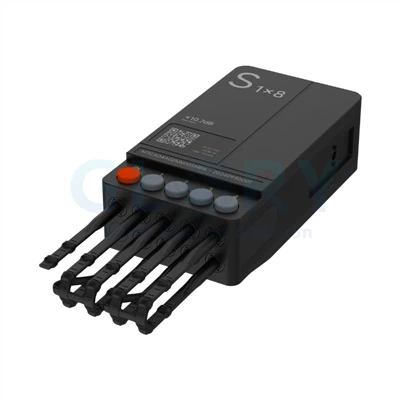
The Marvel Pre‑connectorized Terminal Family: Speed, Space, Cascade, and Total Cost
Term Stands For What It Actually Means
FTB Fiber Termination Box A box that terminates fibers and presents connector ports. No splitting.
OTB Optical Termination Box Synonym for FTB. Common in Southeast Asian and Middle Eastern procurement.
FDB Fiber Distribution Box A box that distributes one feeder into many drops, usually via a PLC splitter.
FAT Fiber Access Terminal An outdoor (pole/wall) distribution box. Functionally an FDB built for the field.
ODF Optical Distribution Frame A different animal - a rack-mounted, high-density frame in the central office, not a field box.
FAT and FDB are the same role, different packaging.A "Fiber Access Terminal" is simply a distribution box hardened for outdoor pole or wall mounting. If a quote says FAT and you expected FDB, you are almost certainly looking at the right product - confirm by checking whether it accepts a splitter.
 What we see on inbound RFQs: When a first-time buyer writes "I need a fiber termination box," about 4 in 10 actually need a distribution box with a splitter slot - they just call everything a "termination box" because that is the phrase they found first. The fastest way we disambiguate is one question: "Does one cable come in and split to serve several subscribers, or does it pass through to a single point?" That single answer reroutes the quote correctly more reliably than any spec sheet.

§2  The 3-Axis Comparison: Function, Position, Splitter

Forget the names. These three axes are the entire difference. If you internalize this table, you will never mis-order again.

Axis Fiber Termination Box (FTB) Fiber Distribution Box (FDB / FAT)
Core function Terminate & connect - splice incoming fibers to pigtails, present them on adapter ports Split & distribute - divide one feeder fiber into multiple drop outputs
Signal topology One in → one out (pass-through / cross-connect) One in → many out (branching)
Contains a PLC splitter? No - splice trays & adapters only* Yes - a 1×8 / 1×16 / 1×32 PLC splitter is the defining component
Network position Last leg: building entry, MDU riser, subscriber premises, data-center wall Distribution layer: street cabinet, pole-top node, between feeder and drops
Typical core count 2–24 cores (often 2–4 at the subscriber end) 8–24 drop ports + 1–2 feeder inputs + splitter slot
Users served One subscriber, or a small fixed group Multiple subscribers from a single feeder
Mounting Wall, flush, or rack (indoor-leaning) Wall or pole, hardened for outdoor (IP65–IP68)
Insertion loss added ~0 dB (connectors/splices only) Splitter loss - e.g. ~11 dB for 1×8, ~14 dB for 1×16


*The asterisk matters: many compact FTTH boxes can accept a small splitter. That hybrid case is §5. The clean definition above is the starting point, not the whole story.

The loss line is the one engineers care about most.A termination box adds essentially nothing to your optical loss budget. A distribution box adds the full insertion loss of whatever splitter sits inside it. Putting a splitter in the wrong place - or double-counting it because you forgot it was already in the FDB - is the single most common loss-budget error we see in field designs.

§3  Two Scenarios That Make the Difference Concrete

Scenario A - MDU building entry (termination box)

A drop cable from the street reaches a 12-unit apartment building. The fibers are already split upstream at a street cabinet. At the building you need to splice the incoming cable to pigtails and present clean SC/APC ports so each unit's drop can be patched. No branching happens here - the split already occurred. This is a termination box. Core count tracks the units served plus growth headroom; a 12–24 port wall-mount FTB is typical.

What goes on the PO

A wall-mount FTB, 12–24 ports, SC/APC adapters, IP65 if the entry point sees weather, IP40 if it is a clean indoor riser. Fire rating (UL94 V-0 housing) matters more than IP rating in an indoor riser. No splitter line item.

Scenario B - Street/pole distribution node (distribution box)

One feeder fiber arrives at a pole serving a cluster of 16 homes. Here is where the one-to-many split must happen. The box needs to hold a 1×16 PLC splitter, accept the feeder input, and present 16 drop-cable ports - all hardened against UV, rain, and temperature swing. This is a distribution box (or, since it is pole-mounted outdoors, a FAT). The splitter is the reason the box exists.

What goes on the PO

An outdoor FDB / FAT, 16 drop ports + feeder input, pre-loaded 1×16 PLC splitter (SC/APC, G657A2 pigtails), IP65 minimum - IP68 for pole-top or below-grade. UV-stabilized PC+ABS or PP+GF housing. This is one line item that includes the splitter, not two.
In cascaded FTTH designs the two boxes appear in sequence: a distribution box (FDB/FAT) does the splitting out in the field, and a termination box (FTB) finishes the last leg at the building or premises. Getting the order - and the splitter placement - right is what keeps the loss budget closed. See our PON / ODN design guide for the centralized-vs-cascaded tradeoff.

§4  Where the Overlap Is Real - Hybrid Boxes

The clean definition in §2 has one honest exception. Many compact FTTH boxes are built to do either job: they include a small tray slot that accepts a 1×2, 1×4, or 1×8 mini PLC splitter if you want one, and function as a plain termination box if you do not. This is why a single product legitimately carries both labels.

This flexibility is useful - one SKU covers both roles, simplifying inventory - but it creates the procurement trap: buyers assume "it has a splitter slot" means "it ships with a splitter." It usually does not. Splitters are specified separately unless you request a pre-loaded configuration.

Specify "loaded" or "unloaded" explicitly."Unloaded" ships the empty box. "Pre-loaded" or "with 1×N splitter installed" ships ready to deploy. State the split ratio, connector type (SC/APC for PON), and pigtail length. On hybrid boxes this one clarification removes the most common back-and-forth in the quote cycle.
0 dB
Loss a termination box adds to your budget
~11 dB
Loss a 1×8 distribution box adds (splitter inside)
2–4 wk
Typical delay from ordering the wrong box type
~15%
Forecast CAGR for the splitter/distribution segment to 2030

§5  Matching Real Products to Each Role

If you need a termination box (pass-through, no split)

 
2 Port Fiber Termination Box (GL-FTB-4F) - compact indoor/outdoor, configurable internally; subscriber and small-MDU termination.
 
FTB Fiber Termination Box (GL-FTB-4A) - IP65, UV-protected, 4-fiber capacity, ≥40 mm bend radius.
 
16-Port Pre-connectorized Terminal Box (GL-FTB-16C) - IP65 outdoor, wall/pole, 16 waterproof mini-SC adapters.
 
Fiber Optic Wall Outlet - flush-mount subscriber premises termination, single SC/APC port.

If you need a distribution box (one-to-many, splitter inside)

 
Fiber Distribution Box (GL-FDB-H208) - 8-core outdoor wall-mount distribution node.
 
Outdoor Fiber Distribution Box (GL-FDB16) - IP65, 16-core FTTH NAP box for pole/wall.
 
Outdoor Cable Distribution Box (GL-FDB-H508) - accepts a 1×16 PLC splitter; ABS, SC adapters.
 
PLC Splitters (1×2 to 1×64) - the component that makes a distribution box a distribution box. Specify ratio and connector when ordering loaded boxes.

For outdoor splice protection upstream of either box

 
Fiber Optic Enclosures & Splice Closures - dome and inline closures (IP68) for trunk and feeder splicing before the distribution layer.
Pillar Guide
Fiber Box: The Complete Buyer's Guide

IP ratings, materials, indoor vs outdoor, and the procurement checklist that covers every box type.

Component Physics
How Fiber Splitters Work

Why a distribution box adds loss - the splitter math behind the insertion-loss numbers in §2.

Network Design
PON / ODN Design

Centralized vs cascaded splitting - where the FDB and FTB sit in the architecture.

Access Node Selection
FAT and ONT: The Critical Distance

How to place the access terminal (FAT) relative to the subscriber's ONT.

§7  FAQ 

Q: Is a fiber distribution box the same as a fiber termination box?

A: No, though the names are often used interchangeably and many products carry both labels. The functional difference is branching: a distribution box (FDB) contains a PLC splitter and turns one feeder fiber into many drop outputs, while a termination box (FTB) only terminates and connects fibers - one in, one out - with no splitter. If the box splits one signal to serve multiple subscribers, it is a distribution box.

Q: Does a fiber termination box have a splitter inside?

A: By definition, no - a pure termination box holds only splice trays and adapters. However, many compact FTTH boxes are hybrids with a slot that can accept a small 1×2, 1×4, or 1×8 mini splitter if you specify it. The slot existing does not mean a splitter ships with the box; "unloaded" units arrive empty. Always state whether you want it loaded or unloaded.

Q: What is a FAT box, and how is it different from an FDB?

A: A FAT (Fiber Access Terminal) is functionally a distribution box built for outdoor pole or wall mounting. The role is identical to an FDB - split a feeder into drops - but the packaging is hardened for UV, rain, and temperature. If a supplier quotes a FAT where you expected an FDB, you are almost certainly looking at the right product; confirm it accepts the splitter ratio you need.

Q: How many ports does each box have?

A: Termination boxes commonly run 2–24 cores, often just 2–4 at the subscriber end. Distribution boxes typically present 8–24 drop ports plus 1–2 feeder inputs and a splitter slot sized to the ratio (a 1×16 splitter implies 16 drop ports). Size either box at roughly 120–150% of current need to leave growth headroom - the cost gap between sizes is small versus a field swap later.

Q: Where is each box installed in an FTTH network?

A: Distribution boxes (FDB/FAT) sit at the distribution layer - street cabinets and pole-top nodes between the feeder and the drops, where the one-to-many split happens. Termination boxes (FTB) sit on the last leg - building entry, MDU risers, and subscriber premises - where fibers are terminated and connected after the split has already occurred upstream.

Q: Is a distribution box the same as an ODF?

A: No. An ODF (Optical Distribution Frame) is a rack-mounted, high-density frame used in central offices and data centers for large-scale cross-connection - not a field enclosure. A distribution box (FDB/FAT) is a compact field box that splits a feeder into subscriber drops. They occupy completely different layers of the network and are not interchangeable.

Termination Boxes & Distribution Boxes - Factory Direct

Glory Optical - vertically integrated manufacturer in Ningbo since 2008. FTB termination boxes, FDB/FAT distribution boxes (loaded or unloaded), matching PLC splitters 1×2 to 1×64, and IP68 splice closures. Shipped to operators and ISPs in 50+ countries. Tell us where the box sits in your network and we will confirm the right type before you order.

Standards & references: ITU-T G.984 (GPON / ODN architecture & link budget) · Telcordia GR-1209-CORE (Generic criteria for passive optical components) · Telcordia GR-1221-CORE (Reliability qualification of passive components) · ITU-T G.652D · ITU-T G.657A2 (bend-insensitive drop fiber) · IEC 60529 (IP ingress protection ratings)
Send Inquiry