
§1 What Is a Fiber Box - and Why the Terminology Varies by Region
"Fiber box" is not a product category. It is a catch-all term for at least six different enclosure types that serve different functions at different points in a fiber access network. A US ISP engineer asking for a "splice closure" and a European ISP procurement manager asking for a "fiber optic box" may be describing the same installation environment but looking for completely different hardware.
The table below maps the terminology to function. Use this before issuing any RFQ.

| Product Name | Also Called | Primary Function | Network Position | Has Connectors? |
|---|---|---|---|---|
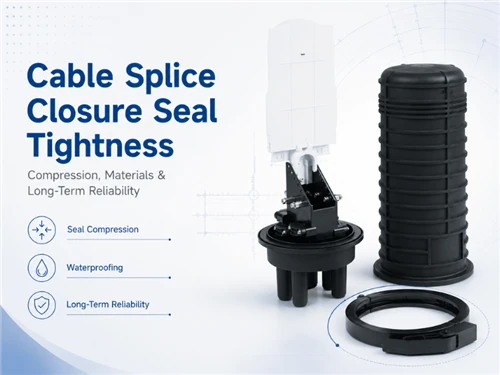
| Fiber Optic Splice Closure | Dome closure, splice enclosure, joint box | Protects fusion splices in outdoor / buried environments | Trunk, feeder, mid-span | No - splice trays only |
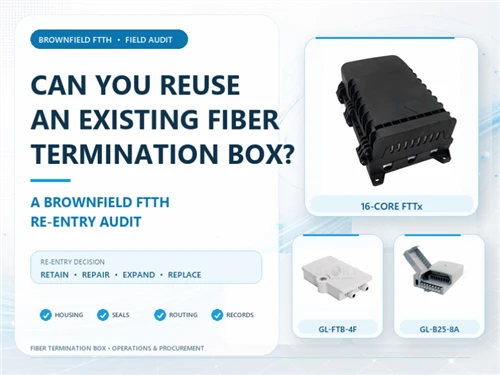
| Fiber Termination Box (FTB) | Fiber optic box, optical termination box | Splice + SC/APC adapter interface; connects drop cables to subscribers | Building entry, riser, MDU MDF room | Yes - SC/APC or LC/APC |
| Fiber Distribution Box (FDB) | Street cabinet insert, optical distribution box | Splits feeder fiber into multiple drop outputs via PLC splitter | Street cabinet, pole-mount distribution node | Yes - drop cable ports |
| Fiber Optic Wall Outlet | FTTH rosette, subscriber outlet, ONT wall socket | Flush-mount subscriber premises termination | Inside subscriber premises | Yes - single SC/APC port |
| Rackmount Fiber Panel / ODF | Patch panel, optical distribution frame | High-density connector management in racks | Central office, data center, headend | Yes - high density SC/LC/MPO |
| Fiber Access Terminal (FAT) | Aerial distribution box, pole-top FAT | Outdoor pole-mount: PLC splitter + drop cable ports in one unit | Aerial FTTH distribution node | Yes - drop cable ports |
§2 How to Choose the Right Fiber Box - By Scenario, Climate, and Maintenance Strategy
The fastest path to the right answer is three questions: Where is it going? (installation environment) → What climate zone? (material and gasket adjustments) → How often will you open it? (sealing mechanism). IP rating is the output of those three answers, not the input. Start here.
§2.1 Selection by Deployment Scenario
| Deployment Scenario | Recommended Type | Key Spec | Glory Optical Product |
|---|---|---|---|
| Underground / direct-buried splice | Dome or horizontal splice closure | IP68 ≥ 3 m / 24 h; HDPE or stainless; EPDM gasket; re-enterable | Dome Splice Closure |
| Aerial (strand or pole-mount) splice | Dome or inline aerial closure | IP66; UV-stabilized housing; cable grip for strand attachment; pressure equalization vent | Aerial Dome Closure |
| Street cabinet distribution node (FTTH) | Fiber distribution box with PLC splitter tray | IP67; lockable lid; tamper-evident fasteners; compatible with ABS-box 1×8–1×32 PLC splitter slot | Outdoor FDB |
| Pole-top FTTH aerial distribution | Fiber access terminal (FAT) | IP66; UV-stabilized PC; cable gland for self-supporting drop; integrated splitter holder | Aerial FAT |
| MDU building entrance / riser | Fiber termination box, wall-mount | IP40–IP65 depending on exposure; SC/APC adapter plate; splice tray + slack storage | Wall-Mount FTB 8–24 port |
| Single-family subscriber premises (FTTH) | Fiber optic wall outlet | IP20 (indoor); flush-mount; 1 m slack loop; SC/APC or SC/UPC single port | FTTH Wall Outlet |
| Central office / ISP headend | Rackmount fiber panel / ODF | 1U/2U 19"; high-density SC or LC; front-access; cable management tray | Rackmount Fiber Panel |
| Data center spine-leaf interconnect | MPO/MTP cassette module in rackmount enclosure | 12/24-fiber MPO; OM4 multimode or OS2 SM; low-loss factory-terminated | MPO/MTP Modules |
| Industrial or coastal outdoor installation | Stainless steel or die-cast aluminium closure | IP68; Grade 316 SS for salt-air; UV-resistant coating; pressure equalization vent | Metal Dome Closure |
§2.2 Selection by Climate Zone - What Changes Region by Region
Climate zone affects material selection, gasket specification, and housing grade more than it affects IP rating. The same IP67 specification can mean a 15-year service life in a temperate climate or a 3-year service life in a tropical or subarctic environment, depending on housing material and gasket compound.
§2.3 Selection by Maintenance Strategy
Two ISPs can deploy identical hardware in the same climate and experience completely different lifecycle costs, depending on whether their maintenance strategy matches the re-entry design of the enclosures they chose.
| Maintenance Strategy | Re-entry Frequency | Sealing Mechanism to Specify | Avoid |
|---|---|---|---|
| High-growth ISP - adding subscribers quarterly | Every 3–6 months | Mechanical gasket; rated ≥ 10 re-entry cycles; quick-release lid fasteners | Heat-shrink closures; gel-fill closures |
| Mature network - low subscriber churn, rare adds | Every 3–5 years | Mechanical gasket re-enterable or gel-fill entry ports acceptable | Oversize enclosures with empty tray capacity |
| Low-resource ISP - minimal field technician capacity | Emergency only | Dome closure with heat-shrink entry seals; high-reliability choice at installation | Gel-fill (technician error risk); mechanical gasket (requires training to reseal correctly) |
| Dense urban MDU deployment | Monthly (subscriber moves) | Quick-access wall-mount FTB with tool-free lid; labeled adapter ports; pre-connectorized pigtails | Fusion-splice-only termination requiring splice equipment on site |
§2.4 CAPEX vs OPEX - Where to Spend More and Where Not To
The right answer isn't "always buy premium" or "always optimize cost." It depends on what failure costs at each position. Here is how the math actually works across the three critical positions in an FTTH deployment:
| Network Position | Failure Cost | Unit Cost Delta (budget vs. premium) | Right Call |
|---|---|---|---|
| Buried trunk splice closure | $1,200–$2,500 excavation + re-splice per event | ~$30 more for IP68 HDPE + EPDM vs. IP65 ABS | Spend the $30. Every time. |
| Street cabinet FDB | $80–$150 maintenance visit + connector cleaning per event | ~$8 more for UV-stabilized PC+ABS + EPDM + pressure vent | Mid-range with confirmed UV stabilization. Stainless is overkill. |
| Subscriber wall outlet (indoor) | $25–$60 replacement + install labor | $3–$5 between cost-optimized and premium indoor units | Cost-optimize. Failure rate is low; replacement is cheap. |
§3 IP Ratings - What the Label Means, What It Does Not, and Where It Gets Misapplied
The IP (Ingress Protection) rating system is defined in IEC 60529. Two digits: the first describes solid particle protection, the second describes liquid protection. It is the single most cited specification in fiber box procurement and - in our experience - the single most commonly misread one.
§3.1 IP Rating Quick Reference
| Rating | Solid | Liquid | Fiber Box Application | Common Mistake |
|---|---|---|---|---|
| IP20 | Fingers (>12 mm) | None | Indoor wall outlets, server room patch panels | - |
| IP40 | Tools (>1 mm) | None | Indoor MDF rooms, conditioned spaces | - |
| IP54 | Dust-limited | Splash (any direction) | Sheltered outdoor under eave or inside cabinet | Ordered for direct outdoor wall-mount - fails in rain |
| IP65 | Dust-tight | Low-pressure jet (any direction) | Outdoor wall-mount (sheltered); aerial FAT in mild climates | Used for pedestal/buried installations - floods in spring |
| IP67 | Dust-tight | Immersion ≤ 1 m / 30 min | ABS splitter boxes in street cabinets; outdoor termination boxes; pedestals in low water-table areas | Misread as "waterproof" - the 30-minute test is lab-controlled, not long-term field submersion |
| IP68 | Dust-tight | Continuous immersion - manufacturer-defined depth & duration | Direct-buried closures, underground vaults, flood-prone pedestals | Ordered without specifying depth/duration - vendor ships IP68 rated at 1 m / 30 min, indistinguishable from IP67 on label |
§3.2 Three Things IP Ratings Do Not Tell You
1. Duration and depth for IP68 vary enormously. The IEC standard requires only that the manufacturer specify and test their own conditions. Two enclosures labeled IP68 may have been tested at 1 m / 30 min vs. 10 m / 72 hours. For buried closures in flood-prone areas, specify the depth and duration explicitly in your RFQ: "IP68 rated to minimum 3 m / 24 hours per IEC 60529."
2. IP ratings are tested on new, undamaged units. A gasket that maintains IP68 when new may not maintain it after five years of compression-and-release cycles from thermal expansion, especially if the gasket material is NBR (nitrile) rather than EPDM or silicone. The IP rating certificate tells you nothing about long-term sealing durability.
3. Re-entry degrades the rating unless specifically designed for it. Every time you open and reseal a closure, the sealing mechanism is stressed. Mechanical gasket closures retain their rating if the gasket is intact and correctly compressed. Heat-shrink closures are single-use - cutting the sleeve to re-enter destroys the seal permanently. Gel-fill entries can be re-sealed but gel contamination of internal components is a risk if excess gel is present.
§4 Housing Materials - The Spec That Actually Determines Field Lifespan
The IP rating describes how well the enclosure seals. The housing material determines whether the enclosure retains its shape - and therefore its sealing performance - over 15–20 years. Focusing only on IP rating while accepting whatever housing material the vendor defaults to is the most common procurement oversight in outdoor fiber box sourcing.
| Material | UV Resistance | Temp Range | Impact | Best Application | Avoid When |
|---|---|---|---|---|---|
| Standard ABS | Poor - chalks & cracks in 2–3 yrs outdoors | −40 to +80°C | Good | Indoor FTBs, wall outlets | Any direct outdoor exposure |
| UV-stabilized ABS | Moderate - acceptable ≤ 5 yrs outdoor | −40 to +80°C | Good | Sheltered outdoor, street cabinet inserts | High-UV direct sun (>5 years) |
| PC + ABS blend (UV-stabilized) | Good - 10+ yrs outdoor with UV additive | −40 to +110°C | Excellent | Outdoor FTBs, FATs, distribution boxes | Direct-buried (no mechanical advantage over HDPE) |
| PP (Polypropylene) | Good | −10 to +100°C - brittle below −10°C | Moderate | Inline splice closures in temperate climates | Cold-climate buried applications |
| HDPE | Excellent | −50 to +80°C | Good | Direct-buried closures anywhere; standard in North America and Northern Europe | Where dimensional precision is needed (HDPE has higher creep) |
| Stainless Steel 316 | Excellent | −60 to +300°C | Excellent | Coastal (salt-air), industrial, high-security outdoor | Weight-sensitive aerial; budget-constrained FTTH at scale (3–4× cost premium) |
| Die-cast Aluminium | Excellent with coating | −60 to +150°C | Excellent | High-security outdoor enclosures, industrial sites, government infrastructure | Any location where grounding adds complexity; aerial installations |
§4.1 Gasket Materials - The Most Overlooked Spec in Fiber Box Procurement
| Gasket Material | Low-Temp Limit | High-Temp Limit | UV Resistance | Recommendation |
|---|---|---|---|---|
| EPDM | −50°C | +150°C | Excellent | Default spec for all outdoor fiber boxes |
| Silicone | −60°C | +200°C | Excellent | Desert high-temp environments; coastal |
| NBR (Nitrile) | −15°C (hardens below) | +100°C | Moderate | Reject for any deployment where ambient temperature falls below −15°C |
| Neoprene | −25°C | +100°C | Moderate | Acceptable in temperate climates; marginal for continental subarctic zones |
§5 Indoor vs Outdoor Fiber Box - Five Differences Beyond IP Rating
The indoor/outdoor distinction is not just about environmental sealing. It covers five distinct engineering requirements that determine whether a fiber box performs its intended function throughout the network service life.
| Requirement | Indoor | Outdoor |
|---|---|---|
| Fire safety compliance | UL94 V-0 required for riser/plenum; LSZH or CMP-rated pigtails in US; CPR classification in EU. Standard ABS is not riser-rated - a common and potentially code-violating substitution. | Fire rating less critical for direct-outdoor; UV and thermal stability dominate. Exception: outdoor enclosures inside buildings (e.g. mechanical rooms) still need UL94 V-0. |
| Thermal design | Stable 18–26°C; gasket and material cycling amplitude is low. Over-specifying thermal rating wastes budget. | Daily cycling of 25–40°C in most climates. Design for thermal expansion/contraction at housing seams and cable glands. EPDM gasket; pressure equalization vent on large enclosures. |
| Access and density | Frequent MACs; front-access panels; tool-free cassette modules. High port density per U. 48–72 LC per 1U typical in data center. | Infrequent access; re-enterable sealing with defined re-entry process. Lower port density; focus on slack management. Lockable lid for anti-tamper. |
| Bend radius management | Internal cable routing through tight conduit. Require internal bend radius guides. Minimum 10 mm for G.657A2, 30 mm for G.652D - verify in product datasheet, not just trust it. | Cable entry from outdoor cables which are typically stiffer (PE-jacketed). Cable gland design must accommodate cable OD range (2.0–12 mm typical). Verify compatibility against your specific cable OD before ordering. |
| Fiber slack storage | 1 m minimum per fiber. Often squeezed in high-density panels - verify before ordering. | 1.0–1.5 m per fiber minimum; standard practice. Insufficient slack in outdoor closures means re-splicing from outside the enclosure on every maintenance event - add 30–90 min per fiber per visit. |
§6 FTTH vs Data Center - Why They Need Different Products Even When the Connectors Look the Same
Both FTTH termination boxes and data center fiber panels use SC or LC adapters. Both are described as "fiber optic boxes." Specifying the wrong one in the wrong environment is more common than it should be - especially in enterprise networks that straddle both worlds.
| Parameter | FTTH Access Network | Data Center |
|---|---|---|
| Fiber type | OS2 single-mode exclusively | OM3/OM4/OM5 multimode for short-reach parallel optics; OS2 SM for inter-building |
| Connector polish | SC/APC required - APC reduces back-reflection critical for GPON/XGS-PON burst-mode receivers (RL ≥ 60 dB) | LC/UPC standard - back-reflection less critical in point-to-point coherent links; APC used in long-haul DCO |
| Port density | 4–48 SC/APC ports per enclosure typical; low density, wide geographic spread | 48–96 LC duplex per 1U; 6–8 MPO-12 per 1U; density maximized in conditioned rack space |
| Environmental sealing | IP65–IP68 for outdoor; IP40 for indoor MDU; critical design requirement | ASHRAE Class A1–A4 conditioned environment; IP rating irrelevant; focus on fire rating (UL94 V-0) |
| Access frequency | Months to years between re-entries (except high-growth MDU) | Weekly or daily MACs during infrastructure changes; tool-free cassette modules essential |
| Failure mode | Environmental ingress → end-face contamination → subscriber signal degradation | Incorrect patching or cassette polarity reversal → link down; fiber bending in crowded racks → elevated insertion loss |
The most common mistake in small business and campus network deployments: ordering FTTH SC/APC termination boxes for server room patch panel applications. The SC/APC connector is correct for the fiber type, but the enclosure design - sized for 8–12 ports, not rack-integrated, no cable management for high-frequency changes - creates a cable management problem as the network grows. Use the right product category for the deployment context.
§7 Five Fiber Box Procurement Mistakes That Cause Field Failures
Every one of these has come through our post-sale support channel in the past three years. None of them are exotic edge cases. They are the ordinary, repeatable errors that occur when a procurement decision is made by someone who hasn't installed fiber boxes in the field, using a spec written by someone who hasn't seen the site, buying from a datasheet that answers the question asked rather than the question that mattered.
Ranked by frequency in incoming warranty claims and project post-mortems, not by severity.
§8 The Pre-Purchase Checklist - 10 Questions Before Any PO
A field engineer who has commissioned a few hundred fiber nodes could answer these in ten minutes. For procurement teams working from datasheets, they catch 80–90% of the errors that become post-installation problems. Print it, paste it into your RFQ template, or email it to the vendor and judge them by how specifically they answer.
-
1What is the exact installation environment? Indoor conditioned / indoor unconditioned / sheltered outdoor / exposed outdoor / buried / aerial. This single answer determines IP rating floor, housing material, and gasket specification before looking at any product datasheet.
-
2Is the IP rating backed by a third-party IEC 60529 test certificate? For IP68: what depth (meters) and duration (hours) was tested? Not a label - a test report. Ask for it; legitimate manufacturers provide it.
-
3What is the gasket material? If the answer is "rubber" without specifying EPDM, silicone, or NBR - and the deployment temperature will fall below −15°C - reject and ask again.
-
4Is the housing material UV-stabilized? For any direct-outdoor enclosure. Request the material grade designation and ISO 4892-2 weathering test data if the deployment is in a high-UV climate.
-
5Is the closure re-enterable, and how many re-entry cycles is it rated for? For any distribution-layer position with planned future fiber adds: require re-enterable sealing with minimum 5 re-entry cycles. Document the reseal procedure in your installation manual.
-
6What is the internal fiber slack storage capacity? Minimum 1.0 m per fiber at ≥ 30 mm bend radius for G.652D. Verify against the product datasheet dimensional drawing, not the marketing description.
-
7Does the splice tray capacity match your planned fiber count plus 20% headroom? Undersizing is the most common "invisible" mistake - it only becomes visible when a technician overstuffs the tray and violates bend radius on 4 fibers.
-
8Are the cable entry ports compatible with the cable OD range being installed? Flat-drop FTTH cable (2.0 × 4.5 mm) needs different entry geometry than round-drop (3.0 mm OD) or standard distribution cable (10–16 mm OD). Check the product drawing, not just the description.
-
9Does the enclosure support the connector and splitter format you are specifying? SC/APC adapter plate, not SC/UPC. PLC splitter tray compatible with your specific splitter package (ABS box 100 × 80 mm vs mini-module vs LGX). These are not interchangeable.
-
10Does the housing material have the required fire rating for the installation location? Any indoor riser or plenum installation in the US: UL94 V-0 minimum. In Europe: confirm CPR reaction-to-fire class per EN 13501. This is a code compliance requirement, not a performance preference.
§9 Glory Optical Fiber Box Range
Glory Optical has manufactured passive ODN components in Ningbo since 2008. We are a vertically integrated factory - not a trading company. This means you can request batch-level QC data, process audit access, and OEM configuration changes on actual production runs, not through a third-party intermediary.
§10 Related Articles in This Cluster
The insertion loss mechanisms inside the distribution box splitter slot - and the power budget math that determines whether your ODN design holds.
Which splitter belongs inside your distribution box - and why the FBT thermal and wavelength specs matter more than the price difference.
Full ODN architecture: split ratios, centralized vs. cascaded splitting, XGS-PON migration, and the power budget decisions that determine which fiber box goes where.
SC/APC vs SC/UPC vs LC/APC - why the adapter polish type inside your fiber termination box matters to every subscriber on the port.
Complete product catalog: splice closures, termination boxes, distribution boxes, wall outlets - with specifications and OEM configuration options.
Dome and horizontal closures rated IP68 with EPDM gasket sealing, stainless steel reinforcement, and pressure equalization vents.
§11 Frequently Asked Questions
Q: What is the difference between a fiber box and a splice closure?
A: A splice closure protects fusion-spliced fiber joints in uncontrolled outdoor or underground environments. It has no connector ports - only splice trays. A "fiber box" is an umbrella term that includes splice closures plus fiber termination boxes (which have SC/APC connector ports), distribution boxes (which combine splicing with subscriber-facing outputs), and wall outlets (subscriber-side indoor units). Specify the right sub-category before comparing IP ratings or fiber counts: ordering a termination box when you need a splice closure means no environmental protection for bare fiber, no splice tray, and likely a project delay.
Q: What IP rating do I need for an outdoor fiber box?
A: It depends on the installation sub-environment. Sheltered outdoor (inside a street cabinet, under building eave): IP65 minimum. Unsheltered outdoor (pole-top, building exterior, exposed pedestal): IP66 minimum. Any location where water pooling is possible (ground-level pedestal, duct entry): IP67. Direct-buried or underground vault: IP68 - and specify the test depth and duration (e.g., "IP68 at 3 m / 24 h minimum") because IP68 labels vary widely in the conditions actually tested. The most frequent procurement error we see is selecting IP65 for applications that require IP67 or IP68.
Q: How long does a fiber enclosure last outdoors?
A: It depends almost entirely on housing material and gasket compound - not IP rating. A properly specified outdoor fiber enclosure (UV-stabilized PC+ABS housing, EPDM gasket, IP67 or IP68) in a temperate climate should perform without seal failure for 15–20 years. In high-UV or coastal environments, stainless steel or HDPE enclosures extend that reliably to 20+ years. Standard ABS without UV stabilization typically starts showing structural degradation within 3–4 years of direct sun exposure. Most outdoor enclosures that fail early do so because of housing material or gasket selection, not IP rating.
Q: Are metal fiber boxes better than plastic?
A: For most FTTH deployments, no - the cost premium of stainless steel or aluminium enclosures (3–4× vs plastic equivalents) is not justified except in specific high-risk environments: coastal salt-air, industrial sites with chemical exposure, or high-security installations requiring tamper resistance. In standard outdoor FTTH deployments, UV-stabilized PC+ABS with EPDM gaskets provides adequate durability at much lower cost. Metal enclosures also add installation complexity (grounding requirements, higher weight for aerial mounting) that complicates deployment at scale. Use metal where the lifecycle cost analysis justifies it; use quality plastic for most FTTH distribution and access layer applications.
Q: Can indoor fiber boxes be used outdoors?
A: No, with narrow exceptions. Indoor fiber boxes typically use standard ABS housing (not UV-stabilized), no gasket sealing, and IP20–IP40 rating. Deploying them outdoors causes UV degradation within 18–24 months, moisture ingress at connector end-faces, and potential fire safety code violations in some jurisdictions (indoor fire rating materials in outdoor mechanical exposures). The only legitimate exception is installing an indoor fiber box inside a sealed, IP-rated street cabinet that provides full environmental protection - in which case the cabinet provides the outdoor protection, and the indoor box is never directly exposed to weather. Verify this architecture with your project engineer before assuming it is acceptable.
Q: What size fiber box do I need?
A: Size your fiber box at 120–150% of your current fiber count plan, not exactly at current need. At a subscriber premises wall outlet: 1–2 fiber capacity is standard. At an MDU building entry termination box: 8–24 ports covering current subscribers plus 30% growth headroom. At a street cabinet distribution node: 16–48 subscriber drop ports plus 2–4 feeder inputs, plus a PLC splitter slot sized for the split ratio you are deploying. The cost difference between a 16-port and a 24-port termination box is typically < $5. The cost of swapping an undersized box in the field after subscriber adds is typically $80–$150 in labor plus the box cost.
Q: What lead time should I expect for OEM or custom-configured fiber boxes?
A: For standard catalog configurations, 15–25 days ex-works is typical from a factory-direct manufacturer with inventory. For OEM configurations - custom colors, branding, non-standard port counts, or modified cable entry geometry - plan for 25–40 days for the first production run, which includes tooling adjustments and a first-article inspection cycle. High-volume repeat orders of OEM configs typically return to 15–25 days. Where lead time consistently runs longer, the manufacturer is usually a trading company adding a layer between you and the factory. Ask specifically: "Is this your factory production or a third-party order?"
Q: How do I verify IP rating claims from a supplier without doing my own testing?
A: Request the third-party IEC 60529 test certificate, not an in-house test report. Legitimate manufacturers have these from accredited test labs (SGS, TÜV, Intertek are the most common for fiber enclosures). For IP68 specifically, the certificate must state the depth in meters and duration in hours - not just "IP68." A supplier who cannot produce a third-party certificate for IP68 claims is either working from self-certification (no independent verification) or the product has not been formally tested. In both cases, treat the IP68 label as unverified until the certificate is provided. For large orders - 500+ units - it is reasonable to request a production-batch sample for independent immersion testing before shipment.