What a Passive Optical Network Actually Is - and Why "Passive" Does More Work Than You Think
A passive optical network (PON) is a point-to-multipoint fiber access architecture in which a single optical fiber from a central office (the OLT) serves multiple subscribers through passive optical splitters-no powered active equipment in the distribution path. The three core elements:
- OLT (Optical Line Terminal): The central office device. Aggregates upstream traffic, manages time-division multiple access (TDMA) burst scheduling, and connects to the core network.
- ODN (Optical Distribution Network): The passive infrastructure between OLT and subscribers-fiber trunk, distribution cables, PLC splitters, optical closures, patch panels, and connectors. This is where the majority of CAPEX and all long-term maintenance risk is concentrated.
- ONU/ONT (Optical Network Unit/Terminal): At the customer premises. Converts optical signal to Ethernet, POTS, or CATV.
The Geometry That Makes PON Work (and the Math That Breaks It)
The "passive" claim rests on the PLC splitter-a planar lightwave circuit chip that divides an optical signal into 2, 4, 8, 16, 32, or 64 equal paths, with no power required. Each 1:2 split introduces approximately 3.5 dB of insertion loss. A 1:32 split cascades five doublings: 5 × 3.5 = 17.5 dB theoretical minimum, real-world figures typically 17–18 dB. A 1:64 split reaches approximately 20.5–21.5 dB.
The OLT optical module defines the maximum allowable link loss (power budget). Standard GPON Class B+ modules support up to 28 dB. Class C+ extends to 32 dB. XGS-PON N1 class supports 29 dB; N2 supports 33 dB. The budget must absorb:
- Splitter insertion loss
- Fiber attenuation (~0.35 dB/km for standard G.652D at 1310/1490 nm)
- Connector losses (~0.2–0.5 dB per mated pair)
- Splice losses (~0.05–0.1 dB per fusion splice)
- Safety margin (typically 3 dB)
Why Your Year-1 ODN Decision Becomes Your Year-7 Liability
The ODN is the part of a PON you build once and live with for 20+ years. The OLT refreshes every 5–7 years. ONUs refresh every 3–5 years. But the fiber in the ground, the splitter in the street cabinet, and the enclosure on the pole-those stay. Any architectural decision made at buildout becomes a constraint on every future upgrade.
XGS-PON can coexist on the same ODN as GPON using wavelength separation (GPON: 1490 nm downstream / 1310 nm upstream; XGS-PON: 1577 nm downstream / 1270 nm upstream), but this coexistence requires that the splitter passes all three wavelength bands uniformly. Most commodity PLC splitters on the market today do-but buyers need to verify the spectral response specification, not assume it.
GPON vs. XGS-PON vs. 50G PON - Choosing the Right Generation Without Stranding Your ODN
| Standard | ITU-T Spec | Downstream | Upstream | OLT Budget Class | Typical Max Range |
|---|---|---|---|---|---|
| GPON | G.984 | 2.5 Gbps | 1.25 Gbps | B+ (28 dB), C+ (32 dB) | 20 km |
| XG-PON | G.987 | 10 Gbps | 2.5 Gbps | N1 (29 dB), N2 (33 dB) | 20 km |
| XGS-PON | G.9807.1 | 10 Gbps | 10 Gbps | N1 (29 dB), N2 (33 dB) | 20 km |
| 50G PON | G.2984 | 50 Gbps | 25 Gbps | TBD (targeting 35+ dB) | 20–40 km |
Note on XG-PON vs. XGS-PON: XG-PON is asymmetric (10/2.5G). XGS-PON is symmetric (10/10G). XGS-PON is the current mainstream recommendation for all greenfield deployments as of 2025. XG-PON is effectively a transitional standard.
The Wavelength Coexistence Window - And When It Closes
GPON and XGS-PON can share the same ODN fiber and splitters because they operate on different wavelengths. The coexistence window is maintained by a WDM filter at the ONU, blocking the XGS-PON downstream wavelength (1577 nm) from entering legacy GPON ONUs. This arrangement-sometimes called "combo PON"-allows operators to upgrade subscribers incrementally without replacing the entire ODN.
The coexistence window closes when a third overlay (CATV RF at 1550 nm, or NG-PON2 at multiple wavelengths) is introduced. At that point, the spectral plan requires a complete ODN audit.
Operator decision checklist for coexistence deployment:
- Confirm all installed splitters pass the 1260–1650 nm band (most PLC splitters do; some older FBT units do not)
- Verify ONU WDM filter specification from each ONU vendor
- Check that fiber patch cords at OLT frames are rated for 1577 nm without significant additional loss
- Audit connector polish type - APC connectors at distribution points reduce back-reflection that can interfere with burst-mode receivers
- Confirm that no WDM couplers for CATV overlay are installed at wavelengths that would conflict with XGS-PON signals
Real Split Ratio Math - Why 1:64 Is Not Always the Economical Answer
Network planners default to 1:64 splits to minimize fiber infrastructure cost. But 1:64 creates compounding risks:
- Bandwidth saturation: A 10G XGS-PON port shared among 64 active subscribers delivers approximately 156 Mbps per subscriber at peak. In markets where subscribers expect multi-gigabit service, this ceiling arrives quickly.
- Fault impact radius: When a fiber cut or connector failure occurs upstream of a 1:64 splitter, 64 subscribers lose service. With 1:32 splits, fault impact is halved.
- OTDR blind zone: OTDR equipment cannot penetrate beyond the first split point without a PON-specific OTDR. A 1:64 split introduces 21+ dB of loss in the OTDR signal path, exceeding the dynamic range of most standard OTDRs.
XGS-PON Migration Checklist - 9 Things to Verify Before Touching the OLT
- ODN power budget: Does your current ODN fit within XGS-PON N1 (29 dB) or N2 (33 dB) budget?
- Splitter wavelength response: Confirm PLC splitters pass 1270 nm and 1577 nm with spec-compliant insertion loss
- Connector type at distribution frames: SC/APC is preferred; SC/UPC can work but increases back-reflection
- ONU WDM filter: Not all GPON ONUs have WDM rejection filters; those without will see XGS-PON downstream light as interference
- Fiber drop cable condition: Inspect for bends, staple damage, or water ingress; G.657A1/A2 bend-insensitive fiber is required
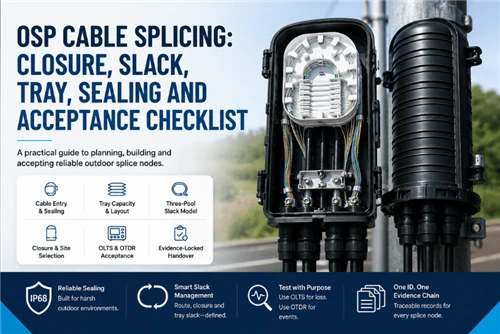
- Enclosure IP rating: All outdoor splice closures must maintain IP68 rating; reseal any closures opened during previous maintenance
- Connector end-face cleanliness: Dirty connectors are the single most common cause of commissioning failure; use IEC 61300-3-35 inspection scope before activation
- Splitter mounting and labeling: Update ODN documentation with splitter port-to-subscriber mapping before cutover
- OTDR reference traces: Take new OTDR traces from OLT toward each splitter port before and after cutover; store as baseline for future fault diagnosis
How to Design an ODN That Does Not Kill Your Power Budget
Centralized vs. Cascaded Splitting - The Architecture Choice Nobody Talks About Enough
Centralized splitting places all optical splitting at a single point-typically a street cabinet or outside plant hub. One 1:32 or 1:64 PLC splitter serves all subscribers in the distribution area from a single location.
- Pros: Simpler ODN documentation; single-point fault isolation; lower fiber count in feeder
- Cons: Single point of failure; OTDR cannot resolve faults past the split point; limits future split ratio adjustment
Cascaded splitting uses two or more splitting stages at different points in the distribution network. Common configurations: 1:4 at the feeder cabinet, then 1:8 at the street box per cluster of homes.
- Pros: Narrower OTDR blind zone (first stage is visible); smaller fault radius; easier incremental expansion
- Cons: More components; slightly higher total insertion loss from multiple splitter stages; more complex ODN documentation
PLC vs. FBT Splitters - The Right Answer Depends on Your Climate Zone
| Characteristic | PLC Splitter | FBT Splitter |
|---|---|---|
| Port count | 1×2 to 1×64 (and 2×N) | Practical max 1×8; higher via cascading |
| Wavelength range | 1260–1650 nm (full PON spectrum) | 1310/1550 nm typical; WDM models available |
| Insertion loss uniformity | ±0.5–1.0 dB across ports | ±1.0–2.5 dB; varies by port |
| Temperature stability | −40°C to +85°C standard | Degrades at extremes; −5°C to +75°C typical |
| Size | Compact; suitable for high-density cassette | Larger per port count |
| Cost per port | Higher unit cost; lower per-port at 1:32+ | Lower unit cost at low port counts |
| ITU-T / GR certification | GR-1209 / GR-1221 readily available | Same certifications available; vendor variance higher |
Procurement guidance: PLC splitters are the correct choice for virtually all GPON and XGS-PON deployments today. FBT splitters remain appropriate for low-port-count (1:2, 1:4) applications in controlled indoor environments where their cost advantage is meaningful. For outdoor deployments in regions with wide temperature variation (continental Europe, Canada, Central Asia), verify the PLC splitter specification covers the full operating temperature range.
Glory Optical's PLC splitter range covers bare fiber, ABS box, rackmount cassette, and LGX module form factors, all manufactured to GR-1209-CORE and GR-1221-CORE specifications, with operating temperature range of −40°C to +85°C.
Insertion Loss Reference Table by Split Ratio
Typical PLC splitter insertion loss for single-mode fiber at 1310/1490/1550 nm, per ITU-T G.671 and Telcordia GR-1209-CORE:
| Split Ratio | Typical Insertion Loss (dB) | Max Allowed (GR-1209) |
|---|---|---|
| 1×2 | 3.7 | 4.1 |
| 1×4 | 7.0 | 7.4 |
| 1×8 | 10.3 | 10.8 |
| 1×16 | 13.5 | 14.0 |
| 1×32 | 17.0 | 17.7 |
| 1×64 | 20.5 | 21.5 |
| 2×32 | 20.5 | 21.2 |
Values do not include connector losses at splitter input/output ports. Add 0.3–0.5 dB per connector pair for SC/APC connections.
The Top 5 PON Deployment Failures - and the Component Decisions That Caused Them
Failure 1 - Dirty Connectors as the Silent Budget Killer
In a properly installed PON, every connector end face should be inspected under an IEC 61300-3-35 grade microscope before mating. In practice, this step is skipped under schedule pressure. A single contaminated SC/APC connector can introduce 1–3 dB of additional loss-equivalent to adding 3–9 km of extra fiber to the budget.
What to specify: All fiber optic connectors and patch cords should ship with end-face inspection certificates showing IL ≤ 0.3 dB and RL ≥ 50 dB (APC) or ≥ 45 dB (UPC). Glory Optical provides 100% end-face inspection on all factory-terminated pigtails and patch cords.
Failure 2 - Wrong Enclosure IP Rating for the Deployment Environment
An outdoor fiber splice closure rated IP55 will survive a rain event. It will not survive two winters of freeze-thaw cycling, UV exposure, and pressure washing. IP68 is the correct specification for buried, aerial, and pole-mounted enclosures in all climates.
The failure mode is slow: moisture ingresses through the degraded seal, condensation forms on connector end-faces inside the enclosure, optical power drops by 0.5 dB per event, then 1 dB, then 2 dB-over 18 months. The subscriber experience degrades; the root cause is invisible without opening the enclosure.
What to specify: All outdoor closures should carry IP68 certification (30-minute submersion at 1 m depth per IEC 60529). Glory Optical's outdoor fiber enclosures are rated IP68 with stainless steel reinforcement, available in dome, horizontal, and inline configurations.
Failure 3 - ODN Designed for GPON That Cannot Support XGS-PON Upgrade
An operator built a 1:64 GPON network at 22 km reach, which worked within Class B+ (28 dB) budget. When XGS-PON is introduced at the OLT, the same ODN must now support XGS-PON N1 (29 dB). At 1:64 split and 22 km, total link loss is approximately 29–30 dB-right at the edge of the N1 budget, with no safety margin.
Prevention: Design ODN with a 3 dB contingency margin beyond your current technology's budget. This means either specifying Class C+ GPON OLTs at buildout, or reducing split ratio to 1:32 to buy 3 dB of headroom.
Failure 4 - FBT Splitters in Outdoor Cabinets in Cold Climates
FBT splitters are manufactured by heating and stretching two fused optical fibers. The coupling ratio is temperature-dependent. In continental climates where outdoor cabinet temperatures range from −30°C to +55°C, FBT splitters can exhibit insertion loss variations of 2–4 dB across the temperature range. A network that tests fine in summer may generate mass subscriber complaints in January.
The fix-replacing FBT splitters with PLC units-is expensive. The prevention costs nothing: specify PLC splitters in all outdoor applications.
Failure 5 - Supply Chain Single-Sourcing for Critical Passive Components
In 2020–2022, global fiber optic component supply chains experienced 12–20 week lead times for PLC splitters and ODN enclosures. Operators who had single-sourced from one manufacturer faced project delays; those with diversified supplier qualification experienced lead times of 4–6 weeks.
As of 2025, lead times have normalized to 4–8 weeks for standard configurations, but the risk of single-sourcing has not disappeared. Government BEAD program funding in the US, EU broadband subsidy programs, and 5G small cell rollout are all competing for the same passive component supply simultaneously.
Glory Optical's position: As a vertically integrated factory (not a trading company), Glory Optical maintains production capacity for PLC splitters, fiber boxes, FTTH cables, and connectors under one roof in Ningbo, enabling consolidated OEM ordering with shorter coordination overhead.
What Procurement Teams Get Wrong When Sourcing PON Passive Components
The GR-1209-CORE / GR-1221-CORE Certification Gap
GR-1209-CORE (Generic Requirements for Passive Optical Components) and GR-1221-CORE (Generic Reliability Assurance Requirements for Passive Optical Components) are the Telcordia standards that define performance and reliability requirements for PLC splitters, FBT couplers, and WDM devices used in telecom networks. They are mandatory for operators participating in US carrier infrastructure programs and widely referenced by European and Asian operators.
The certifications require: insertion loss and return loss measurement across the full wavelength band (1260–1650 nm); temperature cycling from −40°C to +75°C over 85 cycles; humidity endurance at 85°C / 85% RH for 2,000 hours; and mechanical durability testing.
Why OEM Labeling Hides Component Grade
Many passive optical components sold under brand names are manufactured at a small number of ODM factories in China. The physical component may be identical between a $4 PLC splitter and a $12 PLC splitter-or it may differ in waveguide process control, fiber quality, or packaging seal quality. Without test data, the brand name tells you nothing about the underlying component grade.
The procurement question is: can you obtain the manufacturer's process control data? Specifically: wafer-level insertion loss uniformity (σ across ports within a chip lot), fiber lead pull force test results, and enclosure IP rating test report (not just specification claim). Glory Optical operates its own production and quality control, enabling direct access to batch-level test data. For ISPs sourcing at volume (>500 units per order), batch-level insertion loss reports are provided as standard.
Lead Time Reality in 2025 - How to Avoid Project Delays
Standard PLC splitter configurations (1×8, 1×16, 1×32 SC/APC ABS box) are typically available from qualified manufacturers in 3–5 weeks for orders under 5,000 units. Non-standard configurations may require 6–10 weeks.
Procurement risk mitigation checklist:
- Qualify at least two manufacturers per component category before award
- Issue purchase orders with 10–15% buffer quantities to absorb field attrition and spare requirements
- For projects under government program funding (BEAD, EU broadband), allow 12-week lead time in project scheduling
- Specify connector type (SC/APC vs. SC/UPC, LC/APC vs. LC/UPC) explicitly in RFQ - connector substitution is the most common source of mis-shipment
Building the Right Component Stack - A Procurement Reference for GPON/XGS-PON Networks
PLC Splitter Selection Guide
| Application | Recommended Configuration | Glory Optical Product |
|---|---|---|
| Central office / headend (1U rack) | 1×32 or 1×16 rackmount PLC, SC/APC | Rackmount PLC Splitter |
| Street cabinet / outdoor distribution | 1×8 or 1×16 ABS box, SC/APC, −40 to +85°C | ABS Box PLC Splitter |
| MDU building riser | 1×8 or 1×16 mini-module, LC/APC or SC/APC | PLC Splitter Module |
| High-density data center PON | 1×32 or 2×16 LGX cassette | LGX PLC Splitter |
| Single-subscriber drop (1:2 tap) | Bare fiber / mini-tube 1×2 SC/APC | Optical Fiber Coupler |
Fiber Drop Cable Specifications for FTTH Last-Mile
FTTH drop cable connects the distribution fiber to the subscriber premise. Key specifications:
- Fiber type: G.657A1 (macro-bend radius ≥ 10 mm) for standard drops; G.657A2 (macro-bend radius ≥ 7.5 mm) for tight-routing through conduit bends
- Jacket material: LSZH for indoor/riser segments; PE for direct-burial; UV-stabilized HDPE for aerial
- Tensile strength member: FRP (for indoor/plenum LSZH compliance); steel wire for aerial self-supporting
- Connector pre-termination: Factory-terminated SC/APC fast connectors reduce splicing labor by 60–70% vs. field splicing
Glory Optical's FTTH drop cable range includes flat-drop, round-drop, figure-8 aerial self-supporting, and micro-duct versions, available with factory-terminated fast connectors for pre-connectorized FTTH deployment.
ODN Closure and Fiber Box Selection for FTTH Deployment
| Environment | Recommended Product | Key Spec |
|---|---|---|
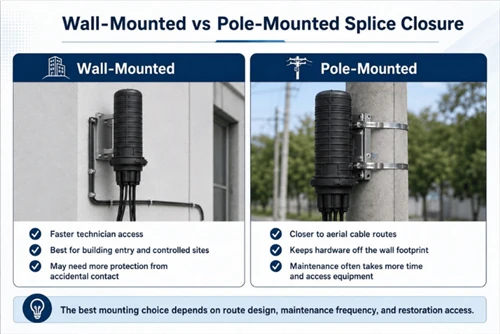
| Aerial (pole-mounted) | Dome closure or inline closure | IP68; UV-stabilized; 48–144 splice capacity |
| Underground (direct-buried or duct) | Horizontal cylindrical closure | IP68; re-enterable; gasket resealable |
| Basement/MDF room (MDU) | Wall-mount fiber termination box | IP40 minimum; 4–48 fiber capacity |
| Outdoor wall-mount | Fiber optic distribution box | IP65; lockable; splitter tray integrated |
| Customer premise (indoor) | Fiber optic wall outlet | IP20; flush-mount; SC/APC port |
Glory Optical's fiber box and enclosure portfolio covers all of the above environments, with OEM customization available for telecom operators requiring branded or operator-specific configurations.
Market Forecast and Where PON Technology Is Going
The PON Market in Numbers
- Global PON market valued at USD $20.63 billion in 2024, projected to reach USD $125.34 billion by 2033 at a 22.2% CAGR (SkyQuestt Research)
- GPON equipment specifically projected to grow from USD $8.0 billion (2025) to $19.6 billion by 2035 (Future Market Insights)
- 25G PON equipment growing from $1.91 billion (2024) to $5.26 billion by 2029 at 22.4% CAGR
- In the US alone, the BEAD Program has designated over $42 billion for broadband infrastructure, the majority flowing through PON-based FTTH deployments
- 80% of cable operators planned PON deployment of some type by 2024 (Omdia survey)
50G PON Is Coming - How to Future-Proof Your ODN Today
The ITU-T G.2984 standard for 50G PON (50 Gbps downstream / 25 Gbps upstream) has been approved, with widespread operator deployment expected by 2026–2027. The critical point for network planners: 50G PON is expected to coexist on the same ODN infrastructure as GPON and XGS-PON, provided the ODN fiber and splitters meet full-spectrum (1260–1650 nm) requirements.
50G PON ODN readiness checklist:
- Fiber type G.652D or G.654 (low-loss for extended reach)
- PLC splitters rated for 1260–1650 nm across all ports
- Connector type SC/APC (APC connectors reduce back-reflection interference critical for coherent detection in 50G+)
- ODN power budget: 50G PON is targeting class N2 (33 dB) and extended class (up to 38 dB)
- OTDR test baseline: establish reference traces now, while signal-to-noise ratio is favorable
5G Mobile Backhaul and the PON Convergence Opportunity
XGS-PON and next-generation PON are increasingly deployed as small cell backhaul for 5G networks. A single OLT port can backhaul multiple 5G small cells simultaneously, using the same ODN infrastructure that serves residential subscribers. The backhaul use case places different demands on the ODN:
- Latency: 5G fronthaul (CPRI/eCPRI) requires <100 µs one-way latency; XGS-PON supports this with proper timing configuration
- Availability: Small cell backhaul is classified as critical infrastructure; enclosure and connector specifications must support maintenance-free operation for 5+ years
- Symmetry: XGS-PON's symmetric 10/10G capacity is specifically suited to fronthaul traffic patterns; GPON's asymmetric 2.5G upstream is a bottleneck for eCPRI
Glory Optical - Factory-Direct ODN Components for GPON and XGS-PON Networks
Ningbo Glory Optical Communication Co., Ltd. has been manufacturing passive fiber optic components since 2008. The company operates as a vertically integrated factory-not a distributor or trading company-with production and quality control under one roof in Ningbo, Zhejiang, China.
Product coverage for complete ODN sourcing:
- PLC Splitters: ABS box, rackmount, LGX cassette, bare fiber; 1×2 to 1×64; SC/APC, SC/UPC, LC/APC, FC/APC; GR-1209-CORE / GR-1221-CORE compliant; −40°C to +85°C operating range
- Optical Fiber Couplers: FBT-based WDM couplers for CATV overlay applications
- FTTH Drop Cables: G.657A1/A2 flat-drop, round-drop, figure-8 aerial, micro-duct; LSZH, PE, HDPE jacket options; factory-terminated options available
- Indoor Fiber Optic Cables: Distribution and breakout cables for MDU riser and horizontal plant
- Fiber Optic Enclosures: IP68 dome, horizontal, and inline outdoor closures; 12 to 288 fiber capacity
- Fiber Optic Termination Boxes: Wall-mount, rack-mount; for building distribution and central office
- Fiber Optic Wall Outlets: Subscriber-premise termination; SC/APC, SC/UPC
- Fiber Patch Cords: SC/APC, LC/APC, FC/APC; OS2 single-mode; 100% end-face inspected
- Fiber Optic Pigtails: Factory-terminated; 0.9mm, 2.0mm, 3.0mm; all standard connector types
- Fast Connectors: For field-installable pre-connectorized FTTH drop; tool-less or semi-tool assembly
- MPO/MTP Cables: For high-density feeder and data center spine/leaf interconnects
- Fiber Optic Adapters: SC, LC, FC, ST; APC and UPC; simplex and duplex; bulkhead and panel-mount
Request a Quote Explore the Factory OEM/ODM Program
Quick Reference: PON Acronym Glossary for Procurement Teams
| Term | Full Form | Role in PON |
|---|---|---|
| PON | Passive Optical Network | The overall architecture |
| GPON | Gigabit Passive Optical Network | ITU-T G.984; 2.5G/1.25G |
| XGS-PON | 10-Gigabit Symmetric PON | ITU-T G.9807.1; 10G/10G |
| 50G PON | 50-Gigabit PON | ITU-T G.2984; 50G/25G |
| OLT | Optical Line Terminal | Service provider central office device |
| ONU | Optical Network Unit | Customer-side device (shared or MDU) |
| ONT | Optical Network Terminal | Customer-side device (single subscriber) |
| ODN | Optical Distribution Network | Passive fiber plant between OLT and ONU |
| PLC | Planar Lightwave Circuit | Technology for PLC splitter manufacturing |
| FBT | Fused Biconical Taper | Technology for coupler manufacturing |
| OTDR | Optical Time-Domain Reflectometer | Fiber fault location instrument |
| WDM | Wavelength Division Multiplexing | Multiplexing multiple wavelengths on one fiber |
| FTTH | Fiber to the Home | PON deployment to single-family residence |
| FTTB | Fiber to the Building | PON deployment to MDU building |
| IL | Insertion Loss | Signal power reduction through a passive device (dB) |
| RL | Return Loss | Back-reflection attenuation at a connector or splice (dB) |
Glory Optical - Ningbo Glory Optical Communication Co., Ltd. | sales@gloryoptic.com | Supplying passive ODN components to telecom operators and ISPs in 50+ countries since 2008.
Standards references: ITU-T G.984 (GPON), ITU-T G.9807.1 (XGS-PON), ITU-T G.2984 (50G PON), Telcordia GR-1209-CORE, Telcordia GR-1221-CORE, IEC 60529 (IP ratings), IEC 61300-3-35 (connector end-face inspection).