
1. Where Does the FAT Sit in the ODN Hierarchy?

A typical FTTH Optical Distribution Network (ODN) follows this path:
OLT (Central Office) → Feeder Cable → 1st‑stage splitter (1×N) → Distribution Cable → 2nd‑stage splitter / FDB → Drop Cable → FAT → Short indoor drop cable → ONT → User device
The Fiber Access Terminal (FAT) occupies a unique position:
• It terminates the drop cable coming from the distribution point (FDB) or the last splitter.
• Inside the FAT, the fiber is either spliced to a short pigtail or directly connected via an adapter.
• From the FAT to the ONT, the distance is usually short (typically less than 30 metres). However, this "last metre" is where most field problems occur – kinked cables, contaminated connectors, improper bending, or rodent damage.
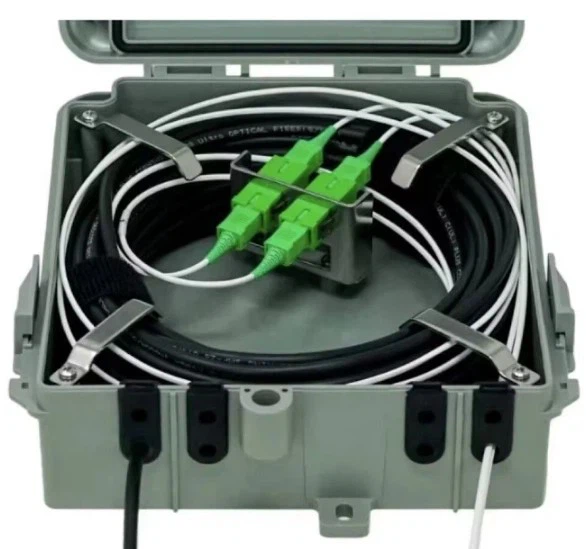
The GL‑DW‑7‑A is designed for exactly these scenarios: compact size (212×175×60 mm), four SC adapter ports, IP54 rating, and wide temperature tolerance (–45°C to +85°C). It can be installed on walls, in corridors, on building exteriors, or even in outdoor cabinets.
2. The FAT as a Network Demarcation Point
In practical OSP engineering, the FAT serves a vital role: the demarcation point (or minimum point of entry).
• Operator side: From the OLT to the FAT's adapter port – including all feeder cables, splitters, distribution cables, and internal splices – is the operator's responsibility.
• Customer side: From the FAT's adapter port to the ONT and the customer's router – including the short indoor patch cord – is the customer's (or their installer's) responsibility.
This clear separation brings three important benefits:
1.Faster fault isolation – When a subscriber reports a loss of service, a technician can quickly test the optical power at the FAT port. If power is within specification, the problem lies inside the customer's premises. No wasted truck rolls, no guessing.
2.Privacy and convenience – Many customers are uncomfortable with technicians entering their homes for simple tests. With a FAT installed at the building entrance or corridor, most tests can be done without disturbing the subscriber.
3.Simplified upgrades and expansion – With the rise of FTTR (Fiber to the Room), a customer may later need a second or third optical port. A multi‑port FAT (like the 4‑port GL‑DW‑7‑A) allows the operator to activate an additional port without touching the existing drop cable or entering the home.
The GL‑DW‑7‑A's four ports make it an ideal demarcation point for small MDUs, villas, or single commercial units – one port for broadband, a second for IPTV, and two spare for future services (e.g., smart home, FTTR).
3. Scenario‑Based Selection of FATs
Not all FTTH projects should use the same FAT. Selection must consider subscriber density, installation environment, and future expansion needs.
3.1 Single‑family homes / Rural subscribers
• Characteristics: Low density, long distances from the distribution point, but only one or two service ports needed per home.
• Selection advice: Choose a FAT with 4 ports or fewer, IP54 or higher, wall‑mountable. Example: GL‑DW‑7‑A. Its four ports can serve one household with two services (broadband + IPTV) and leave two spare, or serve two adjacent homes sharing one FAT.
• Key parameters: Compact size (saves wall space), wide temperature range (–45°C to +85°C), UV‑resistant housing (PC+ABS, passes 500h UV test).
3.2 Multi‑storey / Small apartment buildings
• Characteristics: 2–4 units per floor. Corridors are semi‑protected but still vulnerable to dust and humidity.
• Selection advice: Install one FAT per floor with 4–8 ports. For higher floors, consider one 8‑port FAT per two floors to reduce the number of enclosures.
• GL‑DW‑7‑A applicability: A 4‑port FAT can serve 4 units directly, or 2 units with dual‑service ports. Its flip‑up cover design allows easy access for on‑site splicing or maintenance.
3.3 Small commercial premises (shops, offices)
• Characteristics: A single business may need multiple independent circuits (data, VoIP, CCTV, Wi‑Fi). Alternatively, a small business park may have several tenants.
• Selection advice: Use a 4–8 port FAT, ideally with port labelling to distinguish different services.
• GL‑DW‑7‑A applicability: The four ports can be assigned respectively to broadband, IP phone, surveillance, and backup. The internal slack storage coil can hold up to 10 metres of flat drop cable or 8 metres of round cable – plenty for routing inside the premises.
3.4 5G small cells or outdoor access points
• Characteristics: Deployed on rooftops, light poles, or external walls. Needs moderate environmental protection (IP54 is often sufficient) and typically only 1‑2 fiber ports.
• Selection advice: Choose a compact, weather‑resistant FAT. The GL‑DW‑7‑A's IP54, IK08 impact resistance, UV stability, and wide temperature range make it a suitable candidate.
4. A Practical Checklist for FAT Selection
When finalising your FAT choice, run through this checklist:
|
Consideration |
Checkpoints |
|
Port count |
How many subscribers now? How many in 3 years? Any dual service needs? |
|
Installation environment |
Indoor corridor, outdoor wall, pole, or manhole? Requires IP54 or IP68? |
|
Fiber type |
Flat drop cable or round cable? Does the FAT have compatible entry ports? (GL DW 7 A supports both with 4 cable entries.) |
|
Slack storage |
Is there enough space to coil excess fiber? GL DW 7 A holds 10m flat or 8m round cable. |
|
Maintenance access |
Will technicians need to open it often? Flip up cover is more convenient than screw fastened types. |
|
Durability |
Is it exposed to sunlight? Needs UV stabilised PC+ABS. |
|
Cost and stock management |
Can one model cover multiple scenarios? Fewer SKUs = lower inventory cost. |
5. Case Study: FAT Selection in an Old Residential Renovation

A city project renovated an old residential neighbourhood, replacing copper with fibre. Each building had 6 floors, 2 units per floor – 12 units total. The original design used one 16‑port FDB per building, but field installation revealed three problems:
1.Space constraints: The telecom cabinet in the stairwell was too small for a 16‑port enclosure.
2.Complex routing: Drop cables from the central FDB had to be routed through narrow conduits to each unit, causing congestion.
3.Maintenance interference: Any change to one subscriber's connection required opening the main FDB, potentially disrupting others.
Solution: Install one GL‑DW‑7‑A (4‑port FAT) per floor, serving the two units on that floor (each unit using two ports – one for data, one for IPTV).
Results:
• Small form factor fit easily into the existing cabinets.
• Fault isolation per floor – maintenance on one floor does not affect others.
• Future expansions (e.g., adding a smart‑home gateway) can be done by changing the FAT on that floor only.
• Total material cost was comparable to the original 16‑port plan, but operational efficiency and customer satisfaction improved significantly.
Conclusion
The Fiber Access Terminal may be a small component in the ODN, but it carries three critical responsibilities: network demarcation, signal integrity for the final metres, and operational efficiency for maintenance and upgrades. When selecting a FAT, resist the temptation to choose the largest model "just in case". Instead, match the device to subscriber density, environmental conditions, and future growth.
The GL‑DW‑7‑A 4‑port FAT exemplifies this philosophy: compact, weather‑resistant (IP54, –45°C to +85°C), UV‑stabilised, and simple to install and maintain. It proves that, in FTTH, "the right size" really does matter.