
When we talk about fiber optic networks, the conversation tends to gravitate toward the big, exciting things: massive core counts, terabit transmission speeds, next-generation PON technologies, and AI-optimized optical routing. We talk about the OLT in the central office and the ONT on the customer's desk. But what about the small, unassuming component that physically connects the two?
The fiber optic wall outlet - also called a fiber wall plate, optical termination outlet, or FTTH socket panel - is arguably the most overlooked component in the entire FTTH architecture. It sits at the very end of the fiber path, often hidden behind furniture or tucked into a corner. Yet without it, the network simply cannot reach the user.
This article explores the fiber wall outlet from multiple angles: its role in the FTTH architecture, the technical choices it embodies, the engineering challenges of indoor termination, and why this small component matters more than most people realize.
Part 1: The Last Passive Node in the FTTH Chain
In a typical FTTH network, the optical signal travels a long and complex path:
Central Office (OLT) → Feeder Cable → Fiber Distribution Hub → Distribution Cable → Fiber Distribution Box (FDB) → Network Interface Device (NID) → Fiber Optic Wall Plate → Patch Cord → ONT / Router → End User
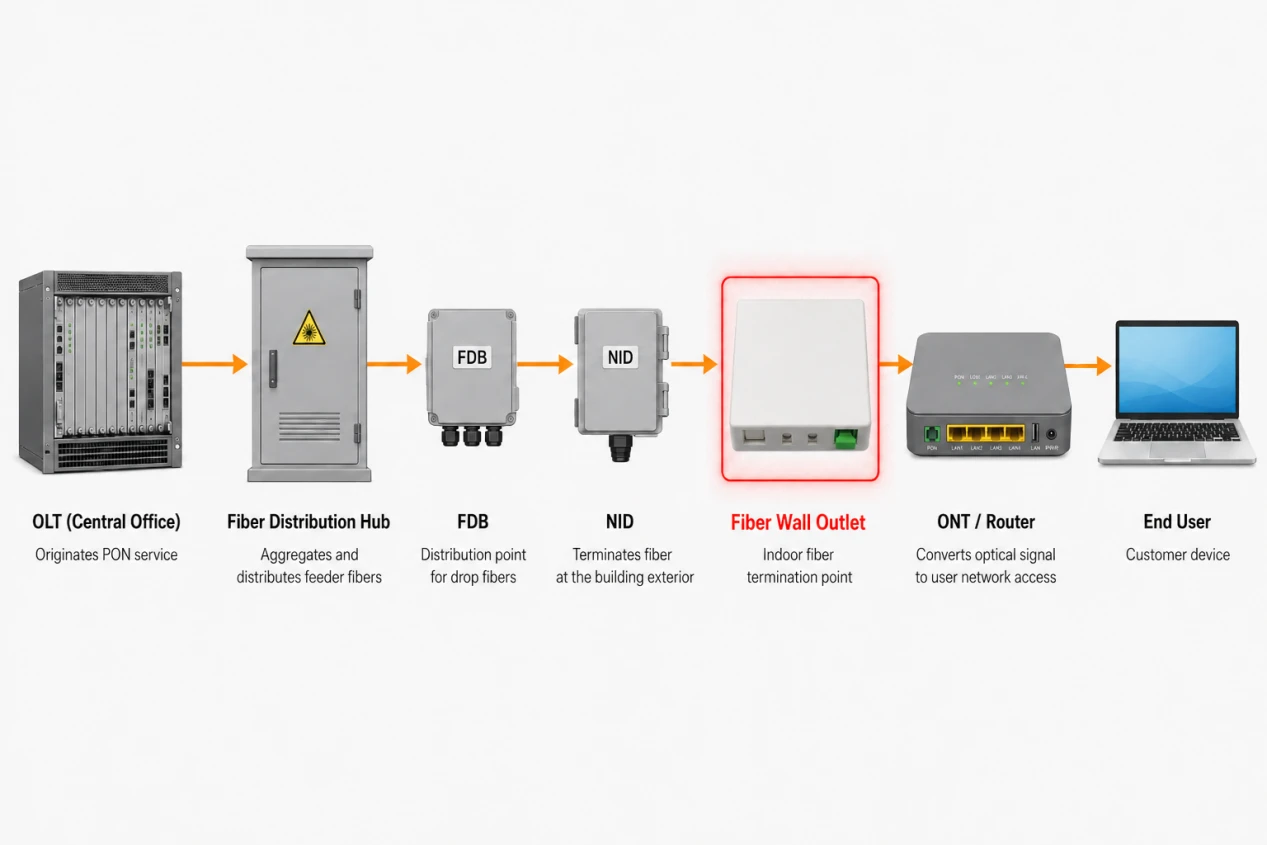
The fiber wall outlet is the final passive interface before the signal reaches the ONT. It is the point where the service provider's network physically ends and the customer's equipment begins. This is the demarcation point in its most literal sense - the physical wall between "their network" and "your network."
The wall outlet does several jobs:
• It terminates the incoming fiber drop cable in a protected, accessible enclosure
• It provides a standardized interface for connecting a patch cord to the ONT
• It protects the fiber termination from dust, physical damage, and accidental stress
• It organizes and conceals the fiber for a clean, professional appearance
Unlike the NID (Network Interface Device), which is typically installed outdoors, the wall outlet lives indoors. Unlike the ODF, which manages dozens or hundreds of fibers in a central office, the wall outlet typically handles just 1–2 fibers. This is the "last meter" of the fiber network. And in many ways, it is the most sensitive meter.
Part 2: The Technical Choice - Which Adapter and Polish?
One of the first decisions any network planner or installer faces is: what kind of wall outlet do I install?
The answer depends on several factors, but the most important is the connector type and polish required by the network. The choice is not arbitrary - it directly affects optical performance, system compatibility, and long-term reliability.
SC vs. LC: The Connector Question
Two connector types dominate the FTTH wall outlet market: SC and LC.
SC (Subscriber Connector) is the traditional workhorse of FTTH. It features a 2.5mm ferrule and a push-pull locking mechanism. SC connectors are larger and easier to handle, which makes them popular in residential installations where technicians may be working with gloved hands or in less-than-ideal conditions. SC is also the connector of choice for most PON networks globally.
LC (Lucent Connector) features a smaller 1.25mm ferrule, about half the size of SC. LC connectors are favored in high-density environments - data centers, central offices, and multi-dwelling units where space is at a premium. The smaller form factor allows more ports in the same wall plate real estate.
The choice between SC and LC often comes down to the equipment at the other end. If the ONT or router uses an SC port, an SC wall outlet is the natural choice. If the ONT uses LC, the wall outlet should match.
UPC vs. APC: The Polish Question
Beyond the connector type, there is a more subtle but equally important choice: the polish of the connector end-face.
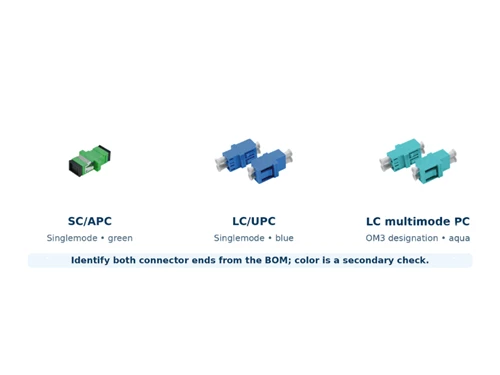
UPC (Ultra Physical Contact) connectors have a slightly domed end-face with a flat polish. They are typically blue and provide return loss (reflection performance) of around -50dB. UPC is widely used in enterprise networks, data centers, and general-purpose fiber applications.
APC (Angled Physical Contact) connectors have an 8-degree angled end-face. They are typically green and provide significantly better return loss performance - up to -60dB. The angled polish directs reflected light away from the source, reducing interference and improving signal quality.
For residential FTTH, SC/APC is the most common choice globally. The superior return loss performance of APC is critical in PON networks, where reflections from the end-face can interfere with upstream transmissions. SC/APC wall outlets are the standard for GPON and XGS-PON deployments.
Some wall outlets support LC/APC or LC/UPC configurations, depending on regional preferences and equipment standards.
What This Means for the Wall Outlet
A wall outlet must match the connector and polish required by the network. Choosing the wrong one - for example, installing a UPC outlet in an APC network - can introduce reflections, increase insertion loss, and degrade performance. It is a small decision with large consequences. The final connector type should always match the ONT, splitter, adapter, and project specification.
Part 3: The Indoor Environment - Fiber in the "Last Meter"
The outdoor part of the FTTH network is built to withstand the elements: UV radiation, temperature extremes, moisture, and physical impact. But the indoor environment presents its own unique set of challenges.
The Space Constraint
Wall outlets are installed in confined spaces: the cavity behind a wall plate, the gap between drywall and stud, a shallow electrical box. These spaces are measured in millimeters, not centimeters. Within this tight volume, the fiber must be:
• Terminated cleanly
• Routed without sharp bends
• Stored with enough slack for future re-termination
• Protected from accidental pulling or crushing
The engineering challenge is significant. Standard single-mode fiber has a minimum bend radius of about 30mm. Exceed that, and signal loss increases. In the confined space behind a wall plate, maintaining proper bend radius requires careful design. Many wall outlets include internal routing structures to help manage fiber routing, protect the bending radius, and keep adapters and pigtails organized inside the faceplate.
Connector Contamination
The connector end-face is the single most sensitive point in the entire FTTH chain. A single speck of dust on the end-face can scatter light, increase insertion loss, and degrade signal quality. In outdoor environments, connectors are protected by hardened housings and sealed closures. Indoors, the wall outlet must provide its own protection.
Many wall outlets include dust caps or shuttered adapters to protect the connector when not in use. These small features make a big difference in long-term reliability. A connector that is left exposed for months or years will accumulate dust, leading to intermittent issues that are difficult to diagnose.
Fiber Management
Behind the wall plate, there is often a small amount of slack fiber - enough to allow for future re-termination or reconfiguration. This slack must be stored without violating bend radius requirements. Poor fiber management inside the wall outlet can lead to micro-bending, increased loss, and eventual fiber breakage.
Some wall outlets include built-in spools or routing channels to manage slack fiber. Others rely on the installer to route the fiber carefully. The difference between a well-designed outlet and a poorly designed one often shows up years later, when a network that "worked fine" suddenly starts experiencing unexplained problems.
Part 4: Material and Design - Beyond the Simple Faceplate
A wall outlet is not just a plastic plate with a hole in it. The materials and design choices behind it have real engineering consequences.
Material Selection
The housing material must meet several requirements:
• Flame retardancy: Wall outlets must meet UL 94 V-0 standards, meaning they are self-extinguishing and do not propagate flames
• Mechanical strength: The outlet must withstand normal handling, cleaning, and accidental impacts
• Dimensional stability: The outlet must maintain its shape and alignment over time, even with temperature changes
• Aesthetic durability: The outlet should not yellow, crack, or degrade with age
Most high-quality wall outlets use flame-retardant ABS or PC (polycarbonate) plastic. These materials provide the necessary fire safety and mechanical strength while allowing for a clean, modern appearance.
The Aesthetic Dimension
The fiber wall outlet is not just a technical component - it is also a visible fixture in a customer's home or office. A bulky, unattractive outlet can be a source of customer dissatisfaction, especially in high-end residential or commercial environments.
Modern wall outlets emphasize clean lines, neutral colors, and minimalist design. The goal is to blend into the wall, not draw attention to itself. The compact white housing is suitable for indoor wall-mounted applications where a clean appearance and small installation footprint are required.
This aesthetic consideration is not superficial. A wall outlet that looks professional and well-designed signals to the customer that the network has been installed with care and attention to detail. It is a small thing, but it matters.
Flush-Mount vs. Surface-Mount
Two mounting styles dominate the market:
Flush-mount outlets are installed inside the wall, with only the faceplate visible. They provide a seamless, integrated appearance but require more effort to install (cutting into the drywall, mounting a back box). Flush-mount is the preferred choice for new construction and high-end installations.
Surface-mount outlets are attached directly to the wall surface. They are easier to install and can be added to existing walls without cutting. However, they are more visible and may protrude from the wall surface.
The choice between flush-mount and surface-mount depends on the installation environment, the customer's preferences, and the installer's capabilities.
Part 5: Application Scenarios - Where the Wall Outlet Fits
The fiber optic wall outlet is designed for indoor subscriber-side fiber termination where the final optical connection needs to be protected, organized, and easy to access. Its versatility allows it to serve a wide range of deployment scenarios:
FTTH Home Broadband Access
In residential settings, the wall outlet is the final indoor termination point where the drop cable from the outside connects to the customer's ONT or router. It provides a neat, protected fiber access point that is both functional and visually unobtrusive.
Apartment and Residential Fiber Termination
In multi-dwelling units (MDUs), wall outlets are installed in each apartment unit to provide individual fiber access. The compact design (90×90×16mm) makes it suitable for confined spaces. A single wall outlet serves one subscriber, and multiple outlets can be distributed across different units without consuming excessive wall space.
Office Fiber-to-the-Desk Connection
In modern office environments, fiber is increasingly being run directly to workstations to support high-bandwidth applications. The wall outlet provides a clean, professional termination point on the office wall or cubicle partition, enabling easy connection to desktop equipment.
Hotel Room Optical Network Access
Hotels are rapidly adopting fiber networks to support in-room high-speed internet, IPTV, and VoIP services. The wall outlet's compact, aesthetic design makes it suitable for hotel room installations where guest experience and room appearance matter.
Indoor GPON / EPON / XGS-PON Access Networks
For all passive optical network architectures, the wall outlet serves as the final passive component before the ONT. It terminates the drop fiber and provides a standardized interface that matches the PON equipment.
CATV Optical Fiber Access
Cable television networks that use fiber distribution also require indoor termination points. The wall outlet provides a protected interface for CATV optical receivers and set-top boxes.
Fiber Distribution from Terminal Box to ONT
In installations where a larger terminal box is located in a basement or corridor, the wall outlet serves as the final connection point inside the subscriber's unit. A patch cord connects the wall outlet to the ONT, completing the fiber path from the terminal box to the user equipment.
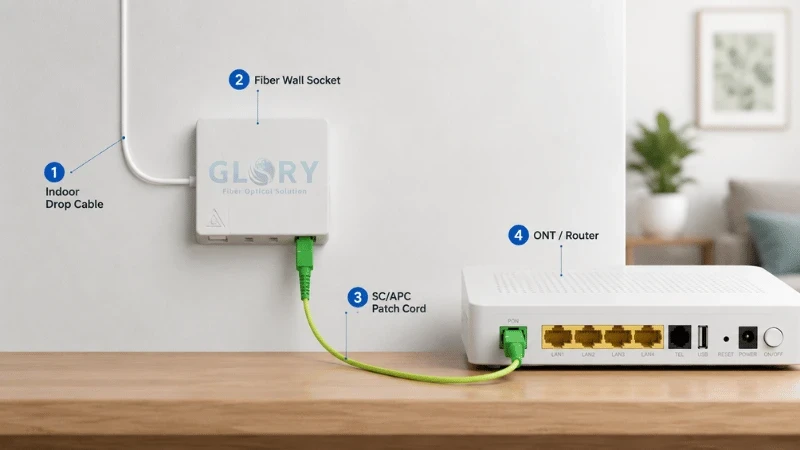
Compared with larger indoor termination boxes, the mini fiber optic wall outlet is more suitable for compact installation areas where only 1–2 fibers are required. This makes it an ideal choice for the vast majority of residential and small-office FTTH deployments.
Part 6: Adapter and Pigtail Options - Getting the Connection Right
The wall socket can be supplied with different adapter and pigtail combinations depending on the project requirement. Understanding these options is essential for ensuring compatibility and optical performance.
Common Adapter Options
|
Adapter Type |
Typical Use |
|
SC/APC Simplex |
FTTH GPON / XGS-PON subscriber access |
|
SC/UPC Simplex |
General optical connection and testing |
|
LC/UPC Duplex |
Compact indoor fiber access |
|
LC/APC Duplex |
Project-specific low-reflection applications |
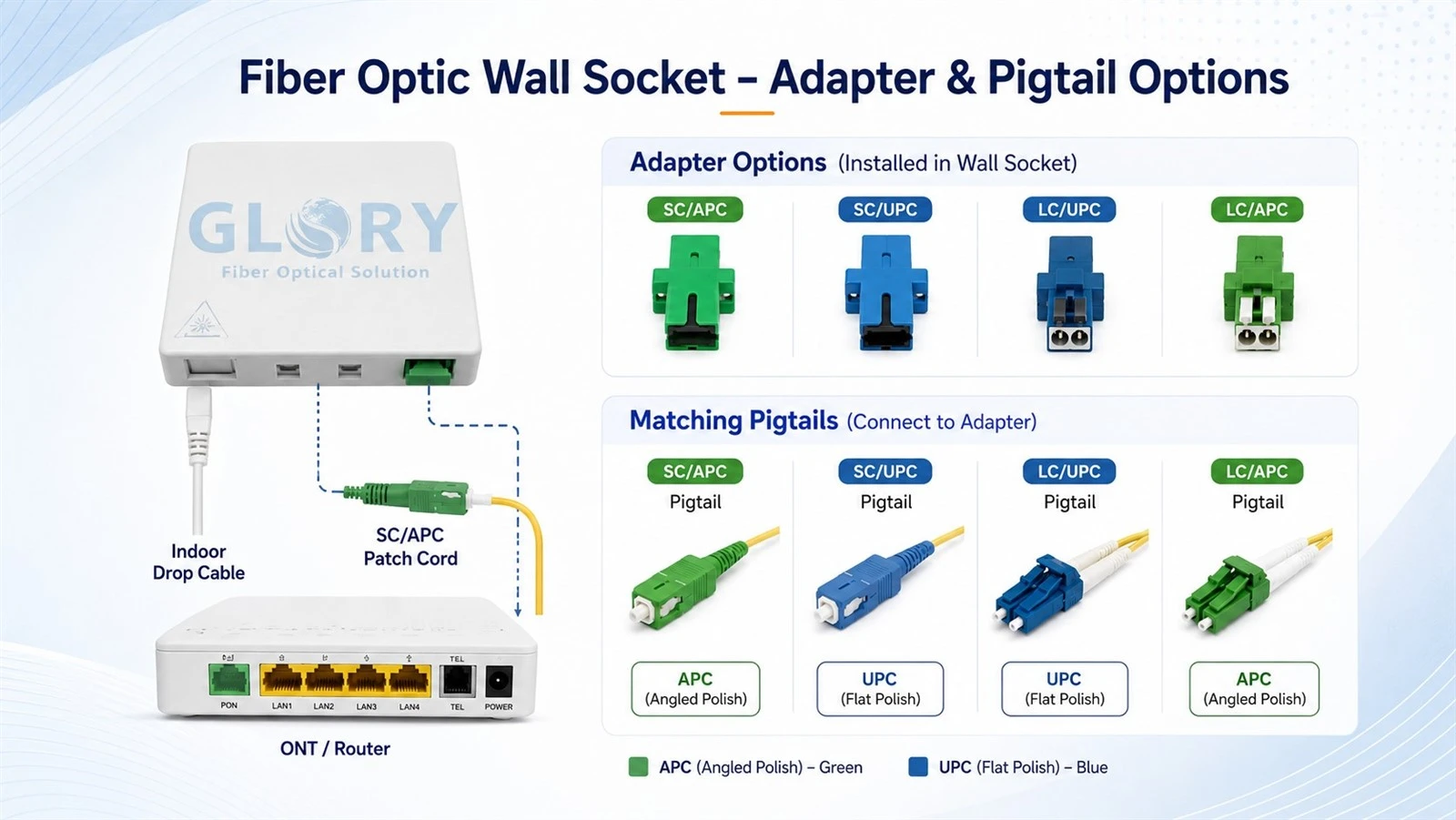
SC/APC Simplex is the most commonly selected option for FTTH deployments because many PON systems require low back reflection to prevent upstream signal interference. The angled polish provides return loss performance of -65dB or better, which is critical for GPON and XGS-PON networks where reflections from the customer premises can affect OLT receivers.
SC/UPC Simplex is suitable for general optical connections and testing scenarios where the superior reflection performance of APC is not required. UPC connectors are widely used in enterprise networks and data centers.
LC/UPC Duplex is chosen for compact indoor fiber access where space is limited. The smaller LC form factor allows more ports in the same wall plate area, making it suitable for high-density environments.
LC/APC Duplex is used for project-specific low-reflection applications where both compact size and APC polish are required.
Common Pigtail Options
|
Pigtail Type |
Typical Configuration |
|
0.9 mm pigtail |
Compact internal splicing |
|
2.0 mm pigtail |
Stronger handling for field installation |
0.9 mm pigtails are preferred for compact internal splicing within the wall outlet. The thinner profile allows for easier routing and storage inside the faceplate's limited space.
2.0 mm pigtails provide stronger handling characteristics and are more durable during field installation. They are suitable for installations where the pigtail may be subject to more handling stress.
Key Consideration
The final connector type should always match the ONT, splitter, adapter, and project specification. Mixing connector types - for example, using an APC outlet with a UPC patch cord - can introduce reflections, increase insertion loss, and degrade network performance. Similarly, using an SC outlet with an LC patch cord requires an adapter, which adds another potential point of failure.
For most residential FTTH deployments, the SC/APC configuration remains the recommended choice due to its widespread compatibility with PON equipment and superior optical performance.
Conclusion
The fiber optic wall outlet is the smallest, most visible, and most overlooked component in the FTTH network. It is the final passive node before the signal reaches the customer's equipment. It is the physical interface between the network and the user.
Its engineering is deceptively simple: a plate, a connector, a few millimeters of fiber management. Yet behind that simplicity lies a series of important engineering choices - connector type, polish, materials, mounting style, fiber management - that determine the quality of the final connection.
A well-chosen, well-installed wall outlet provides:
• Reliable signal transmission through the final meter of fiber
• Protection for the most sensitive point in the FTTH chain
• A clean, professional appearance that reflects well on the installer and service provider
• Future-proofing for upgrades to faster PON technologies
A poorly chosen or poorly installed wall outlet can introduce loss, reflections, and intermittent problems that are difficult to diagnose and costly to fix.
In the end, the wall outlet is a reminder that in fiber optics, every connection matters - especially the last one.