
1. Flame Retardancy: The Last Line of Defense When Accidents Happen
1.1 Flame Retardancy Is More Than Just "Fire Prevention" – It Protects the Entire Network

Many assume flame retardancy is solely about preventing fire. But in telecommunications infrastructure, its significance goes far beyond that.
A splice closure housing with its excellent flame-retardant properties, will not ignite and spread rapidly upon contact with external flames. Instead, it can self-extinguish or slow the spread of flames, buying valuable time for emergency response. More importantly, the flame-retardant material does not release large amounts of toxic fumes at high temperatures-a crucial safety feature for covers installed on building exteriors, in corridors, or inside manholes.
Furthermore, flame retardancy is closely related to the overall heat resistance of a material. Materials that pass rigorous flame retardancy tests typically maintain structural stability under high-temperature conditions and are less prone to softening or deformation due to prolonged exposure to sunlight or nearby heat sources in summer.
1.2 UL94 V-0: The "Gold Standard" for Flame Retardancy
In the telecommunications equipment industry, UL94 is the most widely used standard for testing the flame retardancy of plastic materials. It assesses a material's ability to self-extinguish after ignition through a vertical burning test. The ratings, from lowest to highest, are: HB, V2, V1, V0, 5VB, and 5VA.
Among these, V-0 is one of the highest flame-retardant ratings. Materials rated V-0 must self-extinguish within 30 seconds after two 10-second flame applications, and no flaming drips are permitted.
For outdoor splice closures, UL94 V-0 has become the industry mainstream requirement. High-quality closures typically use engineering plastics that achieve V-0 rating, such as PC/ABS alloys or modified polypropylene. This ensures that even in extreme scenarios involving an external fire source, the closure will not become an accomplice in spreading the blaze.
1.3 It's Not Just About the Rating – Formulation Matters Too
It is worth noting that even materials with the same flame retardant rating can have vastly different properties. Take polycarbonate (PC) and modified polypropylene (PP) as examples:
PC has inherent flame-retardant properties and can reliably achieve V-0 with the addition of flame retardants. Its strengths are high impact strength and good transparency, but its UV resistance in long-term outdoor use is relatively weaker.
Modified polypropylene, enhanced with glass fiber and flame retardants, can also achieve V-0. Its advantage lies in combining good flame retardancy, weatherability, and impact resistance, making it especially suitable for aerial installations.
Industry research indicates that for fiber optic splice boxes, glass fiber reinforced modified polypropylene (PP) is suitable for conduit and direct burial installations, while UV-stabilized glass fiber reinforced polypropylene (PP) is better suited for overhead installations. This suggests that leading splice box manufacturers must select the most appropriate material formulation based on different installation scenarios.

2 UV Resistance: The Invisible Armor Against the "Sunlight Killer"
If flame retardancy is about responding to "sudden disasters," then UV resistance is about fighting "chronic degradation."
2.1 The "Slow Strangulation" of Plastics by UV Radiation
Ultraviolet radiation is one of the main causes of polymer material aging. When a plastic casing is exposed to sunlight for a long time, high-energy ultraviolet photons damage the polymer molecular chains, triggering a series of irreversible chemical reactions:
1.Surface powdering: The outer layer gradually loses its gloss and develops a white, chalky residue.
2.Discoloration: The original black or gray housing fades, yellows, or develops spots.
3.Cracking and embrittlement: The material loses flexibility and may shatter upon light impact.
4.Loss of mechanical properties: Impact strength and tensile strength degrade significantly.
Fiber optic splice boxes that lack UV protection will show obvious signs of aging after 3-5 years of outdoor exposure. Once the casing cracks, seal failure is only a matter of time-and seal failure means that the fiber optic splice points will be exposed to a humid and dusty environment, directly leading to signal attenuation or service interruption.
2.2 The "Hard Metric" for UV Resistance: How Many Hours Are Enough?
UV resistance is typically quantified through accelerated aging tests. Common industry methods include:
QUV accelerated weathering test: Fluorescent ultraviolet lamps are used to simulate the ultraviolet rays in natural sunlight. High-quality outdoor enclosure materials typically need to withstand 3000 hours of ultraviolet radiation without showing signs of powdering or cracking.
Xenon-arc weathering test: Uses a xenon-arc lamp to simulate full-spectrum sunlight, providing more severe test conditions. ISO 4892-2 and ASTM G155 are the commonly referenced standards.
2,160-hour UV test: In the International Electrotechnical Commission's (IEC) latest ODN product long-term reliability testing program, the 2160-hour ultraviolet test has been listed as a key evaluation item.
In terms of material selection, UV resistance is typically achieved through two approaches:
Adding UV stabilizers: Incorporating UV absorbers or hindered amine light stabilizers (HALS) into the plastic matrix to absorb or quench UV energy.
Choosing UV-resistant resin grades: Some engineering plastic grades are inherently UV-modified, such as UV-stabilized glass-fiber-reinforced PP.
2.3 The "Unwritten Rule" Between UV Resistance and Color
Interestingly, the color of the closure housing also directly affects UV resistance.
Black is the most common color for outdoor junction boxes. The carbon black pigment used in black materials has excellent UV absorption properties, acting like "built-in sunscreen." This is why the vast majority of outdoor telecommunications equipment uses black or dark-colored casings-black is not only stain-resistant but also sun-resistant.
In contrast, lighter-colored or transparent housings face a greater UV challenge outdoors and require higher-grade UV stabilizer formulations.
3 Flame Retardancy + UV Resistance: How Do These Two Properties Work Together?
Flame retardancy and UV resistance may seem like independent technical specifications, but during the long-term service life of a splice closure, they interact and reinforce each other:
UV protection preserves flame retardancy: As the material ages, flame retardants can leach out or degrade along with polymer chain scission. A housing with excellent UV resistance maintains material integrity over time, indirectly preserving the effectiveness of the flame-retardant formulation.
Flame retardants can affect UV stability: Adding certain flame retardants can accelerate photo-oxidation. Therefore, achieving both excellent flame retardancy and UV resistance requires careful formulation-this is the core technical challenge that distinguishes top-tier bottle cap manufacturers.
Industry practice has shown that material solutions using PC/ABS alloys or modified polypropylene, with the addition of UV stabilizers, to achieve a UL94 V0 flame retardant rating have become the "standard configuration" for high-quality outdoor junction boxes.
4.Procurement Advice: How to Evaluate Closure Material Quality
For procurement and technical personnel, the following points should be considered when evaluating splice closures:
Request flame-retardant test reports: Ask the supplier for third-party UL94 test reports confirming that the material rating reaches V-0.
Verify UV test duration: Ask whether the product has undergone QUV or xenon-arc aging testing, and whether the test duration exceeds 2,000 hours. Industry-leading products typically achieve 3,000 hours.
Check the specific material grade: Confirm the actual material used (e.g., PC/ABS, modified PP) and whether UV stabilizers have been added.
4.Review real-world application cases: Ask the supplier about the product's actual service life and performance in different climate zones (e.g., high-altitude, high-UV regions; coastal, high-salt-spray areas).
Conclusion
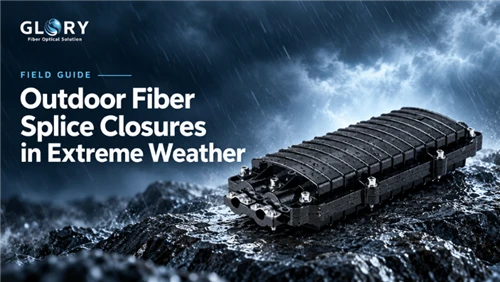
The outdoor service life of a splice closure is not determined by its strongest metal components, but by its most vulnerable plastic housing. Flame retardancy determines its survivability in the event of a fire, while UV resistance determines how long it can endure day-after-day sunlight exposure.