
Part 1: The Copper Era – A Simple Demarcation Point
The NID was first introduced in the 1980s, but its role as a formal demarcation point was cemented by the Telecommunications Act of 1996 in the United States. This legislation mandated a clear separation between the carrier's network and the customer's premises equipment, driving the need for a standardized interface point.
Before the NID, troubleshooting network problems was chaotic. When a customer reported a service issue, there was no clear way to determine whether the problem lay with the carrier's outside plant or with the customer's own equipment and wiring. The NID solved this by establishing a physical and legal boundary: the carrier's responsibility ended at the NID; the customer's began there.
In copper telephone networks, the NID was a "dumb" device-a simple, passive enclosure containing terminal blocks where the carrier's twisted-pair wires ended and the customer's inside wiring began. It performed no active signal processing; its job was simply to provide a physical boundary and a test access point for technicians. The NID was typically mounted on the exterior of a building, placed for easy access by technicians while remaining weather-protected. Carriers preferred outside placement to ensure they could access the demarcation point without needing to enter the customer's premises.
Inside a typical copper NID, you'd find insulation displacement connectivity (IDC) punch blocks that terminated the copper cables without needing to strip them first-a simple, reliable technology that worked for decades. Over-voltage protectors and grounding means were also housed in the carrier's compartment, protecting the customer's equipment from power surges.
For decades, this model worked perfectly for copper-based telephone and DSL services. The NID was a passive, reliable, and inexpensive component-hardly worth a second thought.
Part 2: The Fiber Revolution – A New Set of Demands
Then came fiber optics. The transition from copper to fiber for broadband access-what we now call FTTH (Fiber to the Home) and FTTP (Fiber to the Premises)-fundamentally changed what was required of a demarcation point.
The journey to fiber began decades earlier. The first commercial FTTH deployments emerged in Japan in 1997, when NTT began offering FTTH services with speeds of just 2 channels for POTS/ISDN and analog RF video broadcasting. But it wasn't until around 2000 that FTTH internet access moved into full swing. By 2003, the U.S., Japan, and South Korea had entered what analysts called the "third wave" of FTTH deployment.
In the United States, SBC Communications (now part of AT&T) initiated FTTH services in 2001, followed by Verizon's Fios launch in 2004, which provided early speeds of around 30 Mbps. Europe's largest early project, Stockholm's Stokab, launched in 2002 providing "dark fiber" infrastructure-just the physical fiber, with no direct internet service-and by 2012, 90% of Stockholm's residences had fiber access. Google Fiber's high-profile entry in 2010, offering 1 Gbps speeds, spurred broader industry interest and investment.
However, early FTTH faced significant challenges. By the 1990s, fiber networks were beginning to be taken seriously, but in most situations the last few metres were still planned to be twisted-copper pair. In 2004, driven by technological advances and policy incentives, FTTH prices dropped to around $300 per household-approximately 2.5 times the cost of ADSL.
As FTTH gained momentum, a problem emerged: the traditional copper NID was not designed for fiber. Fiber optic cables are fundamentally different from copper wires. They are more fragile, require more careful handling, and demand precise management of bend radius to prevent signal loss. Moreover, fiber networks often require active electronics at the demarcation point to convert the optical signal into electrical signals-a function that copper NIDs never had to perform.
A new type of NID was needed-one that could:
• Protect delicate fiber connections from moisture, dust, and physical damage
• Provide secure storage for excess fiber slack without violating bend radius requirements
• House active electronics like the Optical Network Terminal (ONT) or Optical Network Unit (ONU)
• Serve as a clear demarcation point while accommodating the technical demands of fiber optics
Part 3: The Modern Fiber NID – A Transformation
Today's fiber optic NID bears little resemblance to its copper predecessor. Where the copper NID was a passive terminal block, the fiber NID is an integrated enclosure that performs multiple critical functions.
First and foremost, the fiber NID remains the official demarcation point. It clearly separates the Internet Service Provider's (ISP) network from the customer's premises wiring-the same fundamental role it has played for decades. This demarcation is not just a technical convenience; it has legal and operational implications. It determines who is responsible for troubleshooting and repairs, and it provides a clear test access point for technicians.
Beyond demarcation, the fiber NID is a protective enclosure. It shields fiber terminations, splices, and connectors from harsh outdoor conditions. Modern fiber NIDs are built from high-quality materials like PC+ABS engineering plastic, designed to withstand vibration, shock, cable tension, and severe temperature changes. They incorporate mechanical sealing designs that allow the enclosure to be opened and resealed multiple times without compromising protection.
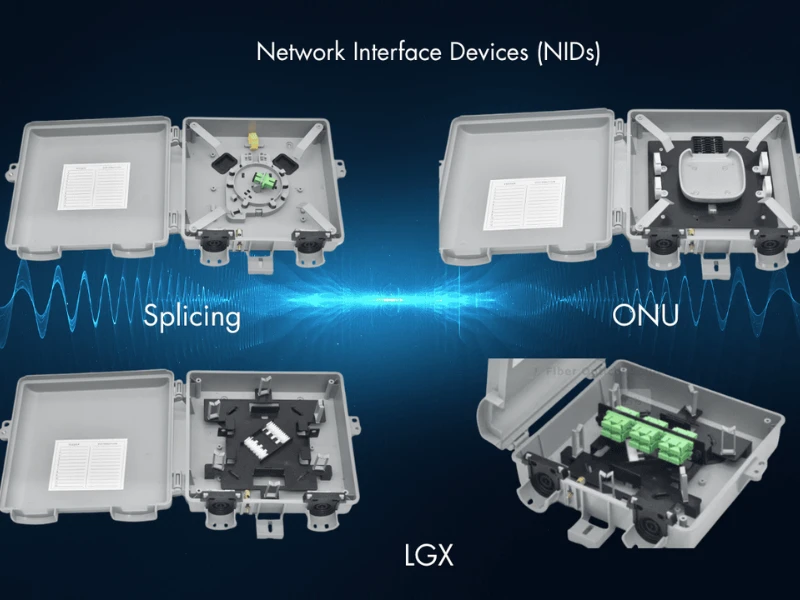
The fiber NID is also a fiber management hub. Inside the enclosure, there is space for slack storage-often up to 50 feet of fiber-ensuring that excess cable can be neatly stored without exceeding minimum bend radius requirements. The NID supports various termination methods, including direct termination, fusion splicing, and mechanical splicing. It can hold adapters for simplex SC, duplex LC, or MTP connectors.
Perhaps most significantly, the fiber NID often houses the ONT or ONU. This is a fundamental shift from the copper era. Optical Network Terminals only became widespread in the late 1990s and early 2000s with the rollout of FTTH networks. The ONT is not a passive component; it is an active electronic device that converts optical signals into electrical signals for the customer's devices. By integrating the ONT into the NID, service providers can offer a complete, weather-protected termination point that includes both the optical-to-electrical conversion and the demarcation function in a single enclosure. A passive splitter in the network allows one port on an OLT to connect 32 users, and the ONT transmits back on the same fiber in the opposite direction at a different wavelength.
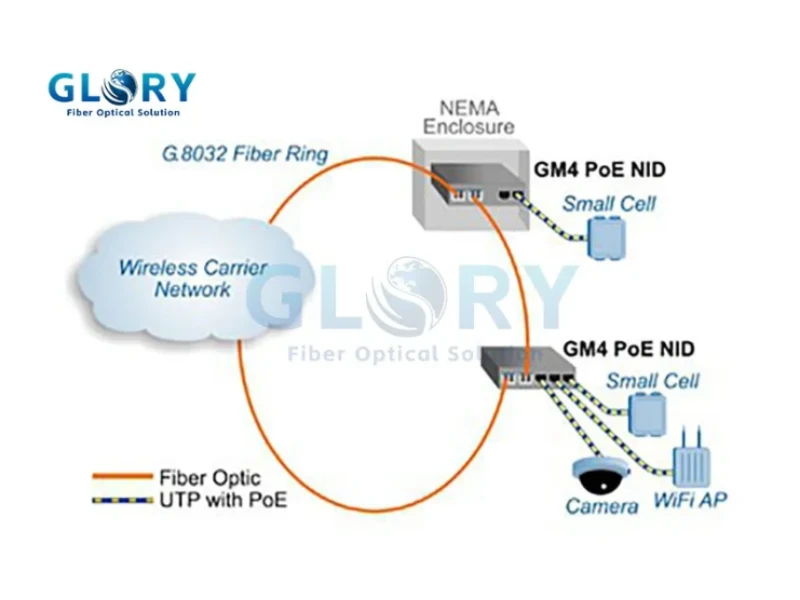
This evolution from a "dumb" demarcation point to an intelligent network termination has been described as the NID's "makeover". The NID now symbolizes all the transitions taking place in carrier access networks: deploying data services alongside POTS, migrating fiber deeper into the network, and adding video services.
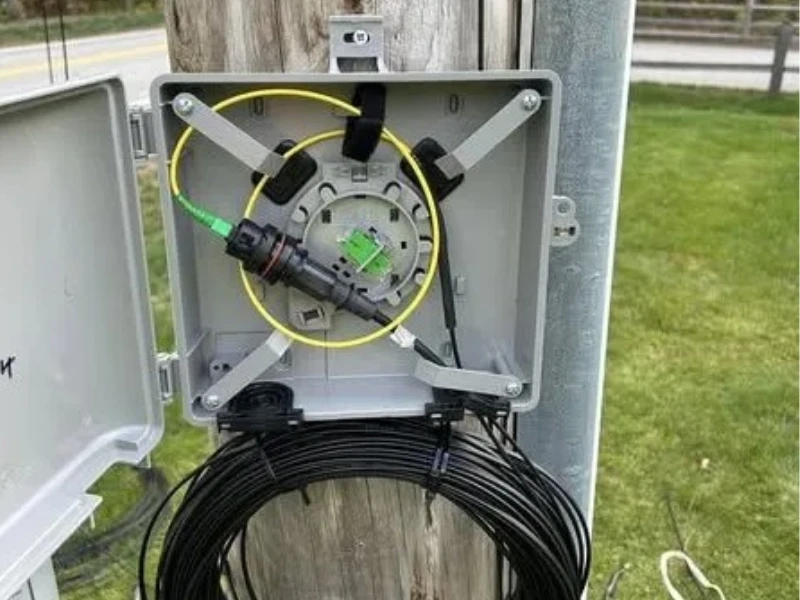
The NID's physical design has also evolved. It now includes separate compartments-one accessible only to the carrier for safety and security, and another for the customer's side. This design reflects the industry's migration from pure outside plant equipment to managing customer premises equipment as well. To ensure a superior consumer experience has become increasingly important for maintaining a provider's customer base.
Technological changes have enabled this transformation-from fiber splicing to pre-connectorized solutions in the outside plant, and from standard single-mode to ultra bend-insensitive fiber cables indoors. The industry has moved from BPON to GPON, enabling carriers to offer Triple Play or even more services.
Part 4: The Scale of the Transformation
The transition from copper to fiber NIDs is happening on a massive scale-and the numbers are staggering.
In 2024, the global FTTH market was valued at approximately $27.58 billion. By 2030, it is projected to reach $36.5 billion, growing at a compound annual rate of 7.2%. Other projections suggest the market could reach $1.27 trillion by 2034.
In the United States alone, fiber deployments reached a new annual record in 2024, with 10.3 million homes passed. Fiber now passes 88.1 million U.S. homes-56.5% of all U.S. households-with take-rates averaging over 45%. Approximately 35.1 million U.S. homes were connected with fiber in 2024. RVA estimates there are at least 150 million or more U.S. home fiber passings that can be done over the next decade. The fiber broadband industry is experiencing record-breaking success, and the addressable FTTH market remaining is still very large.
The U.S. is in the early stages of the largest fiber investment cycle in the country's history, with the government planning to connect every home by the end of the decade.
Globally, the numbers are even more impressive. By June 2023, there were 815 million homes passed with fiber globally, a 7.9% increase. Subscribers grew to 645 million, a 7.1% increase. Over the last decade, subscribers have grown 6.3 times. In Europe, FTTH/B coverage reached 74.6% in September 2024, with the take-up rate increasing to 53.1%. By September 2025, full-fibre networks passed 295 million homes across EU39, corresponding to a 79% coverage rate. The Asia-Pacific region is the most mature, with China, Japan, and South Korea achieving more than 80% coverage.
Each of those homes requires a fiber NID. Each NID must be installed, terminated, and tested. The scale of this transformation is staggering, and it underscores just how critical the NID has become in the modern broadband ecosystem.
Part 5: The GL-NID01 – A Modern Fiber NID in Action
The GL-NID01 Outdoor Fiber Optic Junction Box exemplifies the evolution of the NID into a sophisticated fiber management hub. It is engineered for the fiber-to-the-premises (FTTP) and broadband access markets, providing a secure, weather-protected enclosure that serves as the official demarcation point between the ISP's network and the customer's premises.
The GL-NID01 incorporates the key features that define a modern fiber NID:
Built for harsh outdoor conditions: The enclosure is constructed from high-quality PC+ABS material that withstands vibration, shock, cable tension distortion, and severe temperature changes. Its mechanical sealing design allows the NID to be opened after sealing and reused-a critical feature for service calls and troubleshooting.
Flexible termination options: The GL-NID01 supports both direct termination and fusion or mechanical splicing. It can hold one simplex SC, one duplex LC, or one MTP adapter, with splicing capacity for up to two single fibers or one mass fusion.
Generous slack storage: With storage for up to 50 feet of fiber, the GL-NID01 ensures that excess cable can be neatly managed without compromising bend radius requirements.
Wide cable compatibility: The NID accepts round cables from 3mm to 16.2mm in diameter and flat cables from 2mm to 4.5×8.1mm. Its 1-inch conduit entry points with tie-downs provide secure cable management.
Versatile mounting options: The GL-NID01 supports wall-mount and rotatable rack designs, making it suitable for a wide range of deployment scenarios.
Deployment flexibility across network environments: The GL-NID01 serves multiple critical roles across different network tiers:
• As a demarcation point in wall-mount and rack-mount configurations: Wall-mounted units are installed directly on building exteriors, allowing carrier technicians to perform testing and maintenance without entering the premises. Rotatable rack designs are ideal for multi-dwelling units (MDUs) and equipment rooms, where multiple NIDs can be centrally installed in standard 19-inch racks for efficient space utilization and unified management. Each NID clearly defines the physical boundary between carrier-side and customer-side responsibility.
• In FTTH residential and commercial building deployments: The GL-NID01's waterproof housing and high port density protect splices and terminations. Inside, the enclosure integrates splice trays, adapter panels, and slack storage, effectively managing splitters and pigtails to ensure low-loss, high-reliability signal distribution. The sealed weatherproof structure withstands rain, moisture, and temperature swings, making it suitable for everything from single-family homes to large commercial buildings.
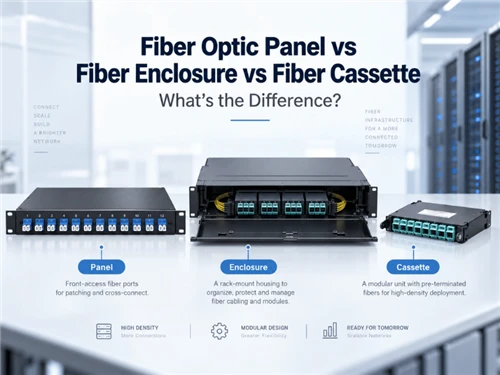
• In data center server racks for high-density cabling: Compact NID fiber enclosures organize high-density fiber connections via slide-out rack-mount units and ultra-high-density cassettes. The slide-out design allows technicians to pull the entire panel forward for front-side access, eliminating blind patching in tight spaces. Ultra-high-density cassettes pack a large number of fiber ports into 1U of rack space, significantly improving rack utilization in data center row-end cabinets and high-density patching areas.
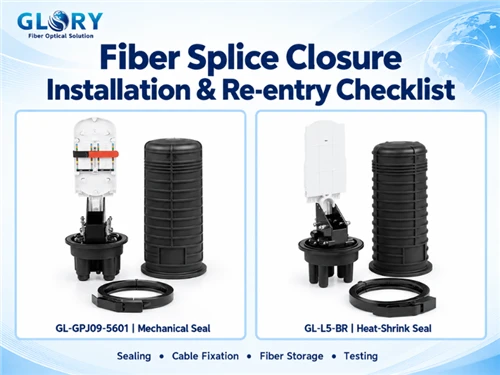
• For fiber joint protection in harsh outdoor environments: The GL-NID01's mechanical dome design, combined with heat-shrink tubing, safeguards fiber joints against physical strain, moisture, and temperature extremes across all applications. The dome structure provides exceptional compression resistance, able to withstand backfill pressure and traffic loads. Heat-shrink sealing technology delivers permanent watertight and airtight protection, preventing moisture ingress. Multi-port routing accommodates various cable diameters and counts, ensuring long-term splice integrity in all-weather conditions.
• For centralized fiber distribution in offices and campuses: The GL-NID01's modular design integrates PLC splitters, adapter panels, and slack spools, enabling efficient routing between mainframes and end-devices. Modularity supports flexible configuration and future expansion-users can add or change splitter and adapter modules as needs evolve. Transparent covers allow visual inspection without opening the sealed area, significantly improving routine inspection efficiency. From backbone equipment to end-user devices, the NID provides clear, organized fiber routing that ensures bend radius compliance and controlled signal loss.
Conclusion: From Simple to Sophisticated
The NID has traveled a remarkable journey over the past four decades. What began as a simple copper terminal block, mandated by the Telecommunications Act of 1996 to separate carrier from customer, has evolved into a sophisticated fiber management hub that integrates demarcation, protection, fiber management, and active electronics into a single weather-protected enclosure.
This evolution reflects a broader transformation in telecommunications-from copper to fiber, from passive to active, from voice-only to gigabit broadband. As FTTH continues to expand globally-with 815 million homes passed and hundreds of millions more to come-the fiber NID will remain an essential component of every connection, quietly doing its job on the exterior wall of homes and businesses around the world.
The NID may be small, but its role in the broadband ecosystem is anything but minor. It is the point where the network meets the customer-the final outdoor stop before the signal enters the home. And in that role, it has never been more important.