
Part 1: Technical Classification – Six Dimensions of a Pigtail
Many people think a pigtail is just "a fibre with a connector". But when you look at a datasheet, the options can be overwhelming. In reality, it boils down to six dimensions.
1. Fibre Mode – Singlemode or Multimode?
This is the most fundamental choice.• Singlemode fibre (SM) has a 9 µm core. Only one mode propagates, so modal dispersion is zero. Attenuation is roughly 0.35 dB/km at 1310 nm and 0.22 dB/km at 1550 nm. A Class B+ GPON system can easily reach 20 km. Singlemode is used for long-haul, metro, FTTH, and 5G fronthaul/backhaul.• Multimode fibre (MM) has a 50 µm or 62.5 µm core. Hundreds of modes travel simultaneously, causing modal dispersion that limits distance. At 850 nm, bandwidth is typically 200-500 MHz·km. 10 Gbps transmission is limited to about 300 m. Multimode is used for short-reach, high-bandwidth links inside data centres, enterprise LANs, and equipment rooms.• Colour coding is your friend: Yellow jacket = singlemode; orange or aqua = multimode. Orange is OM1/OM2, aqua is OM3/OM4 (10G/40G/100G). OM5 (lime green) is emerging for multi-wavelength transmission. GLORY offers both Single Mode Fiber Pigtail and Multimode Fiber Pigtail 12Core LC/UPC covering these two main families.
A subtle but important detail: Multimode has sub-types – OM1 (62.5 µm), OM2 (50 µm), OM3 (laser-optimised 50 µm), OM4 (enhanced), OM5 (wideband). OM1 is obsolete for new projects; OM3 is the current mainstream; OM4 gives more margin; OM5 supports SWDM for 40G/100G over fewer fibres.

2. Connector Type – LC, SC, FC, ST, or MPO?
This is where confusion often starts. The table below summarises the most common types:
| Connector | Ferrule dia. | Typical IL | Key features | Typical use |
| LC | 1.25 mm | ≤0.2 dB | Small footprint, high density, push-pull latch | Data centre panels, switches, high-density ODF |
| SC | 2.5 mm | ≤0.2 dB | Push-pull, rugged, gloved-hand friendly | FTTH terminals, ODF, enterprise networks |
| FC | 2.5 mm | ≤0.3 dB | Metal thread, vibration resistant | Test equipment, long-haul singlemode, harsh environments |
| ST | 2.5 mm | ≤0.3 dB | Bayonet, legacy standard | Old LANs, retrofit projects |
| MPO/MTP | Multi-fibre | ≤0.35 dB | 12/24 fibres in one, polarity critical | 40G/100G/400G parallel optics, trunk cabling |
GLORY's LC Singlemode Fiber Optic Pigtail and LC UPC Pigtail are LC-based; the Single Mode Fiber Pigtail with SC connector is SC-based. A simple rule: for high density (e.g. 1U panel with 48 ports), use LC; for outdoor or building entries where workers wear gloves, use SC.
One often-ignored point: Both LC and SC can achieve similar insertion loss, but long
-term reliability differs. SC has a simpler spring-loaded structure – very robust, preferred for outdoor boxes. LC is more delicate; poor-quality LC may suffer from ferrule misalignment. Always buy from a reputable supplier.
3. Polish – UPC or APC?
This is a classic pitfall. Using the wrong polish can ruin a link.
UPC (Ultra Physical Contact) has a slightly domed end
-face, blue connector housing, return loss ≥50 dB (typical 55 dB). APC (Angled Physical Contact) has an 8° angled end-face, green connector housing, return loss ≥60 dB (typical 65 dB).Why the angle? APC directs reflected light out of the fibre core. This is critical for analogue video, PON upstream, and long single-mode links where even -55 dB reflections can cause interference.Never mix them! Plugging a blue UPC into a green APC adapter – or the reverse – damages the end-face and creates a large air gap, leading to high loss and reflections. Our product pages clearly label LC UPC Pigtail and Single Mode Fiber Pigtail with SC connector to avoid confusion.How to decide? If the equipment port is green or marked "APC", buy APC pigtails. If it's blue or unmarked, UPC is fine. For FTTH PON signals (especially upstream), APC is strongly recommended. For data centre switch-to-switch links, UPC is sufficient.
4. Fibre Count – Single, Dual, or Ribbon?
• Single-fibre pigtails are the most common – one connector per fibre. Used for point-to-point links.• Dual-fibre (often duplex LC) holds two fibres in one housing, typically for bi-directional equipment (one transmit, one receive). Many switch ports are duplex LC.• Ribbon pigtails (multi-fibre) splice 4, 6, 12 or even 24 fibres at once. GLORY's Ribbon Pigtail 12-core is a good example – instead of splicing 12 individual pigtails, you splice one ribbon in seconds. Ideal for high-count trunk cables entering an ODF.Guideline: For ordinary patching, single/dual is fine. For backbone termination (e.g. 144-fibre cable), use a ribbon pigtail – much faster and neater.

5. Jacket Type – 0.9 mm, 2.0 mm, or 3.0 mm?
This causes the most confusion in ordering.• 0.9 mm tight-buffer is thin, light, and flexible, but offers little mechanical protection. Use inside enclosures (ODF, splice trays) where the fibre is already protected by the box.• 2.0 mm tight-buffer adds aramid strength members and a thicker outer jacket. Use for short patches between racks, or from a distribution box to the ONT. It's tougher than 0.9 mm but still flexible.• 3.0 mm tight-buffer is the thickest and strongest, but less flexible. Use for frequently handled test cords, industrial environments, or when customers prefer a "solid feel".
Fire rating matters: PVC (general, cheap but toxic when burned), LSZH (low smoke zero halogen, Europe, safe, slightly more expensive), OFNR (riser, vertical shafts), OFNP (plenum, air handling spaces). For indoor use, LSZH is recommended. Outdoor use PVC or PE.
6. Special Designs – Bend-Insensitive, Armoured, Waterproof
Bend-insensitive fibre (G.657) : G.657.A1 minimum bend radius 10 mm, A2 down to 7.5 mm, B3 as low as 5 mm. Essential for tight spaces like street cabinets or indoor wall boxes. GLORY's singlemode pigtails all support G.657.A1 or A2.
Armoured pigtail adds a stainless steel tube under the jacket – rodent
-proof, crush-resistant. Use for direct burial, industrial plants, or places with squirrels/rats. Drawback: heavier, stiffer, more expensive.
Waterproof pigtail adds sealing rings and a waterproof housing, rated IP67/IP68. Used in outdoor splice closures and tower
-top FTTA connections.
Part 2: Application Scenarios – Which Pigtail for Which Network Node?
Theory is fine, but real projects matter. Below are typical scenarios with product recommendations and a few lessons learned from field failures.
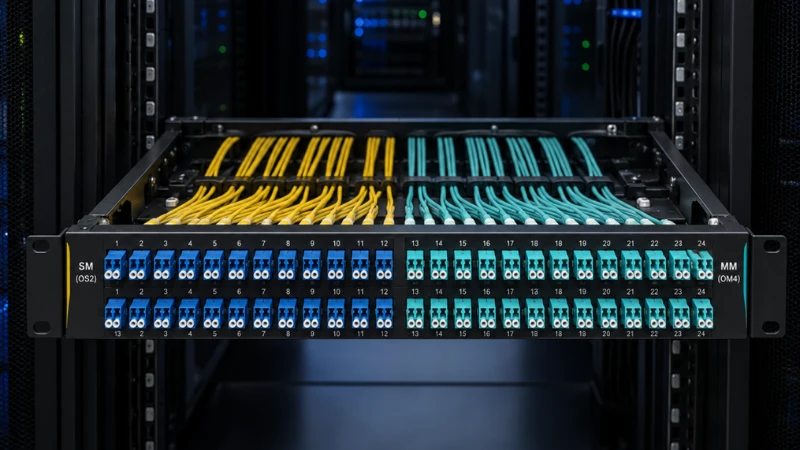
Scenario A: Data Centre (High Density)
Data centres are space-constrained, port-dense, and high-speed. A 1U panel may need 48 or 96 LC ports. Solution: LC connector + 0.9 mm tight-buffer + multimode OM3/OM4 fibre. Multimode is cheaper and lower power than singlemode for short distances (<300 m).
Recommended products:
• For trunk cable termination: Multimode Fiber Pigtail 12Core LC/UPC – splice 12 fibres in one go.• For direct server or TOR switch connections: LC/UPC Multimode 50/125 (OM3) Pigtail – single or dual, 0.9 mm jacket.• For 100G SR4 or 200G/400G: OM4 Pigtail (higher bandwidth), available with LC or MPO.
Real-life case: A data centre bought cheap LC pigtails. Acceptance testing showed insertion loss of 0.5
-0.8 dB – far above the claimed 0.3 dB. The culprit: poor ferrule concentricity. They replaced the lot with our products. Lesson: never chase only price; ferrule quality is critical.
Scenario B: FTTH / PON Access Network
FTTH is characterised by high volume, cost sensitivity, and mixed environments. A feeder cable enters a street cabinet, passes through a PLC splitter, and individual drops go to homes. Each splitter output needs a pigtail to splice to the drop cable.
Recommended products:
• Splitter output to splice tray: Single Mode Fiber Pigtail with SC connector (SC/APC). Why APC? PON is reflection-sensitive. Why SC? Easier to handle with gloves outdoors.• If the splitter uses LC ports (some compact devices): LC Singlemode Fiber Optic Pigtail with APC polish.• Jacket: 0.9 mm inside the cabinet is fine; if the pigtail exits the box, use 2.0 mm for added strength.
Field lesson: A southern China city FTTH upgrade initially used UPC pigtails to save money. During monsoon season, reflections caused OLT upstream packet loss. They swapped to APC – problem gone. The small extra cost avoided weeks of trouble.
Scenario C: Long-Haul / Metro Backbone
Backbone links demand the highest quality. Distances can exceed 50 km, and every 0.1 dB matters.
Recommended products:
• LC Singlemode Fiber Optic Pigtail (UPC), factory-tested ≤0.25 dB insertion loss.• If equipment uses FC ports (older gear), custom FC/UPC pigtail.• Jacket: LSZH for indoor equipment rooms.
Important: Request individual test reports for each pigtail – insertion loss, return loss, end
-face image. We supply these by default.
Scenario D: Enterprise / Campus Network
Enterprise networks are indoor, medium distance (few hundred metres), mostly multimode. Use OM3/OM4 for the backbone, singlemode for long runs to remote buildings.
Recommended products:
• LC/UPC Multimode 50/125 (OM3) Pigtail – for core to distribution switches.• Multimode Fiber Pigtail 62.5/125 – for legacy OM1/OM2 upgrades.• For horizontal cabling with SC panels: Single Mode Fiber Pigtail with SC connector (singlemode) or SC multimode pigtail.
Note: For vertical risers, use OFNR or LSZH rated jackets – PVC is not allowed.
Scenario E: Broadcast/CCTV/Special Applications
Broadcast often uses FC/APC because analogue video is extremely reflection
-sensitive. We can custom-make FC/APC pigtails.
CCTV – long distances, singlemode fibre, typically SC/UPC. For outdoor cameras, use waterproof termination boxes to protect the pigtail.
Offshore platforms / mines – need armoured pigtails (steel tube) for rodent and crush protection. Our Ribbon Pigtail can be armoured on request.
Emergency / temporary links – require ultra
-flexible pigtails. Use 0.9 mm G.657.B3 fibre, bend radius as low as 5 mm.
Part 3: Manufacturing – How a Quality Pigtail Is Made
Price differences often hide huge quality gaps. Here's what happens inside our factory.
Step 1: Raw Material Selection
Fibre: We source from top Chinese suppliers (YOFC, FiberHome). Each fibre batch comes with test reports for attenuation, dispersion, geometry. We never use second
-tier fibre – it directly affects performance and life.
Ceramic ferrule: From premium brands (Kyocera, Sanhuan). Inner diameter tolerance 125±0.5 µm, concentricity strictly controlled. Cheap ferrules cause fibre eccentricity, raising insertion loss.
Jacket materials: LSZH, PVC, OFNR as specified. Each batch is tested for flame resistance (VW
-1 or IEC60332-1) and mechanical strength.
Epoxy and lapping film: Epoxy must be heat‑ and humidity
-resistant with low shrinkage. Lapping film from 3M or UltraTec ensures a smooth end-face.
Step 2: Stripping and Cleaning
Use dedicated strippers – never nick the glass fibre. After stripping, clean the bare fibre with lint-free wipes and pure alcohol. Any dust will raise splice loss. Our workstations have anti-static benches and air filtration.For ribbon fibre, stripping requires extra care to keep all fibre lengths consistent.
Step 3: Connector Assembly
Two main methods:
Epoxy / heat-cure – Fibre is inserted into a ferrule pre
-filled with epoxy, then cured at ~80 °C for 15-20 minutes. Very reliable, especially for outdoor use. The downside: slower production.
Crimp / no-epoxy – Fibre is mechanically crimped inside the ferrule. Faster for high volume, but less forgiving; poor crimping causes fibre shift.
We use both depending on product type. For premium series, we favour epoxy for long-term stability.MPO assembly requires loading 12 fibres into the MT ferrule in the correct polarity order (TIA-568 Type A/B/C). Our Ribbon Pigtail follows the standard strictly.
Step 4: Polishing
Polishing determines insertion and return loss. It proceeds from coarse to fine lapping, ending with 0.3 µm diamond film.
UPC vs APC: UPC uses a spherical fixture; APC uses an 8° angled fixture. Fixture precision directly affects radius of curvature, apex offset, and fibre undercut. We use imported polishing machines and perform 3D interferometry on each batch – radius of curvature 7
-25 mm (UPC) or 5-12 mm (APC), apex offset ≤50 µm, fibre undercut ≤50 nm.A common mistake: over-polishing creates excessive undercut, causing an air gap. Time, pressure and speed are tightly controlled.
Step 5: Testing and Inspection
Every pigtail goes through:
•Insertion loss: Light source and power meter at 1310/1550 nm (SM) or 850/1300 nm (MM). Our spec: SM ≤0.3 dB, MM ≤0.2 dB.
• Return loss: Return loss meter – UPC ≥50 dB, APC ≥65 dB.
• End-face inspection: 200x/400x microscope, checking for scratches, cracks, dirt per IEC 61300
-3-35.
• 3D interferometry (sampling) – radius, apex offset, undercut.
Each pigtail gets a barcode for traceability.
Step 6: Environmental and Mechanical Sampling
For batch orders, we perform random tests:
• Thermal cycling: -40 °C to +85 °C, 10 cycles, IL change ≤0.2 dB.
• Salt spray: 5% NaCl, 35 °C, 48 hours – no corrosion (for coastal projects).
• Durability: 500
-1000 mating cycles, IL change ≤0.1 dB.
• Tensile strength: For 2.0/3.0 mm jackets, ≥100 N for 1 minute – no fibre break.
Our Ribbon Pigtail and OM4 Pigtail have passed all these tests, with reports available.
Part 4: Common Questions and Misconceptions
Q1: Why do some pigtails break easily?
A: Possible causes: damaged glass fibre during stripping (poor stripper); fibre with low mechanical strength (Type-B fibre not meant for repeated bending); excessive bend radius. Solution: use G.657.A2 bend-insensitive fibre and train installers.
Q2: What if I accidentally mix UPC and APC?
A: Unplug immediately. Inspect the end-face. If damaged, replace the pigtail. If only dirty, clean with alcohol and use correctly matched parts. Never force mismated connectors.
Q3: Can I use a multimode pigtail on a singlemode system?
A: Absolutely not. The core sizes are mismatched – severe modal dispersion and loss. The reverse is also impossible.
Q4: Ribbon pigtail vs. Single-fibre pigtail – which is better?
A: Depends. Ribbon is far faster for mass fusion (12 fibres at once). But individual fibres inside a ribbon can't be replaced separately. Single-fibre is more flexible for later changes.
Q5: How much extra length should I order?
A: Typically 1-2 m longer than the measured distance, to allow for slack and future re-termination. For ODF internal pigtails, 1.5-2.5 m is common. For rack-to-rack, measure the path and add 0.5 m.
Q6: How can I quickly judge pigtail quality?
A: Use a visual fault locator (red laser) – a cheap pigtail will show light leaking from the connector body. Measure insertion loss – >0.5 dB indicates poor quality. Inspect the end-face with a microscope – scratches or bubbles are red flags.
Final words
A fibre optic pigtail looks simple, but behind it are many engineering choices – fibre type, connector, polish, jacket, and manufacturing quality. Each parameter matches a specific application and budget.At GLORY, we never compromise on fibre quality, polishing steps, or testing. Every omitted step eventually shows up as unstable links and high maintenance costs.