

At the end of a Fiber to the Home (FTTH) network, there is an often overlooked but crucial component: the indoor fiber optic outlet. It is not only the physical terminus of the fiber optic "last half-meter" access point, but also the bridge connecting the operator's distribution cable and the user terminal equipment (ONT/ONU).
However, many traditional indoor fiber optic outlets tend to go to two extremes: either prioritizing functionality, resulting in a bulky and unsightly design-like a "patch" on the wall; or sacrificing internal fiber management for aesthetics, leading to insufficient bending radius, causing macro-bending loss, or even fiber breakage.
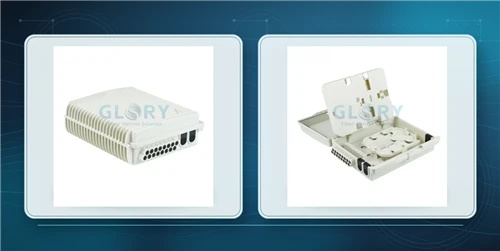
How can we find a balance between these two? The GL-FN-12 indoor fiber optic outlet, made of ABS engineering plastic and featuring a carefully designed structure, provides the answer.
I. ABS Engineering Plastic: The "Sweet Spot" Between Lightweight and High Strength
Outdoors, fiber distribution boxes often require metal or PC+ABS alloys to withstand harsh environments. But indoors, the material selection logic is quite different.
1. Installation Benefits of Lightweight Construction
The GL-FN-12 indoor fiber optic outlet uses high-quality ABS (Acrylonitrile Butadiene Styrene) as its main material. Compared to traditional metal panels, ABS has a lower density, making this indoor fiber optic socket exceptionally lightweight. For on-site installation technicians, this means:
Easy single-point installation-When fixed to a standard 86mm wall box, there's no need to worry about the panel's weight causing the wall box to sag or loosen over time.
Easy surface mounting-In renovation environments without pre-installed wall boxes, the lightweight ABS housing can be securely fixed using simple adhesives or small screws, minimizing damage to the wall structure.
2. Reasonable Structural Stiffness
ABS is not "soft plastic." This indoor fiber optic socket, through its carefully designed reinforcing ribs and structure, maintains a lightweight feel while also possessing sufficient impact resistance. In daily use, it can withstand the pressure of plugging and unplugging jumpers, accidental collisions, and even the impact of closing doors, thus protecting the internal wiring points and adapters from external stress.
II. Curved Appearance: Not Just Good Looks, but Ergonomics
Traditional Indoor Outlet Fiber Sockets often have sharp, square corners that lack texture. The GL-FN-12 indoor fiber optic outlet's curved design does far more than provide a "slinky" visual impression.
1. Reduced Visual Intrusion
Baseboards and light switch panels in homes typically feature rounded corners. Curved indoor fiber optic outlets blend more naturally into modern interior design styles-whether minimalist Scandinavian or warm wood-their understated design making them a background element on the wall rather than a visual focal point.
2. Hidden Cable Management Space
The curved design is not only aesthetically pleasing but also beneficial to the internal structure. Compared to square housings, circular housings typically offer more internal space, making it easier to control the bending radius. According to the ITU-T G.657 standard, the minimum bending radius of bend-resistant fiber can be as low as 7.5 mm, but a greater safety margin always benefits long-term reliability. The curved housing helps prevent 90° bends within the housing, thereby reducing the risk of macro-bending loss.
III. Dual-Port Design: Flexible Adaptation of SC Simplex and LC Duplex
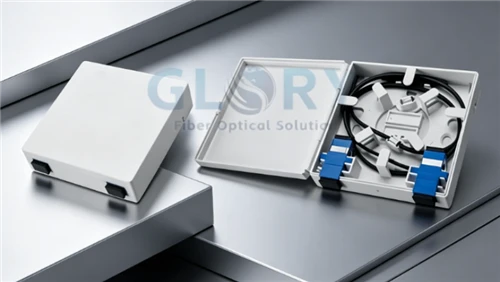
Within the compact 86 mm × 86 mm standard wall box footprint, the GL-FN-12 indoor fiber optic outlet achieves two-port density – a true testament to smart design.
1. Connector Compatibility
The indoor fiber optic outlet supports two mainstream indoor fiber optic interface types:
SC Simplex Adapter – The most common interface standard for FTTH (Fiber to the Home) in many markets. Its push-pull locking mechanism provides security, low insertion loss, and is suitable for the main optical path.
LC Duplex Adapter – With the increasing popularity of 10G-PON and FTTR (Fiber to the Home) technologies, the small form factor of LC adapters is becoming increasingly popular in high-density scenarios. The LC duplex design allows for simultaneous connection of upstream (ONT side) and downstream (modem to TV/computer) links on the same panel.
2. Support for Both MM and SM Fiber
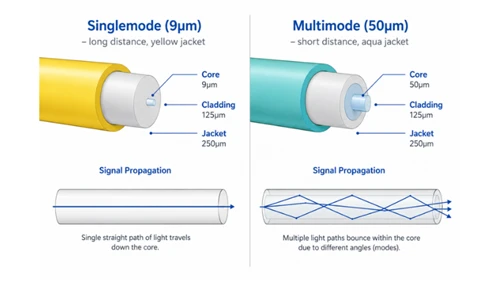
This indoor fiber optic connector features a universal optical design that supports both multimode (MM) and single-mode (SM) fiber. Whether using 50/125μm multimode fiber for short-distance high-speed transmission or 9/125μm single-mode fiber for long-distance transmission, the connector maintains extremely low reflection loss, ensuring signal purity.
IV. Hinged Cover: The Perfect Combination of Dust Protection and Ease of Maintenance
Quality is in the details. The GL-FN-12 indoor fiber optic outlet features a hinged cover instead of traditional independent dust caps.
1. Physical Protection
When the port is not in use, the hinge cover will close naturally, effectively preventing indoor dust, fumes, and other contaminants from reaching the ceramic ferrule end face. Contamination of the connector end face is the main cause of abnormal reflection spikes on the OTDR (Optical Time Domain Reflectometer) trace, and may even damage the laser diode in the optical module.
2. User Convenience
Traditional dust covers are easily lost, while hinged dust covers are attached to the panel via a hinge, preventing them from being lost. When users need to insert jumpers, they can easily open the dust cover and insert the connector with just one hand-the operation is smooth and convenient.
V. Smart Internal Routing and Splice Management
The core value of a qualified indoor fiber optic outlet lies in "hidden complexity"-securely securing the delicate pigtail splices within the wall.
Pigtail securing-Internal slots and clips are designed to secure the internal pigtails, preventing stress caused by movement after splicing.
Surplus storage-A clever internal layout allows installers to coil an appropriate amount of excess fiber within the wall box, reserving valuable slack for future re-splicing or maintenance.
Conclusion
The success of the GL-FN-12 indoor fiber outlet lies in not simply treating ABS as a cheap plastic, but as a medium to achieve lightweight structure and refined appearance.
It uses a curved design to soften the coldness of industrial products, ABS engineering plastic to unify lightness and strength, a two-port modular configuration to be compatible with today's SC standards and tomorrow's LC evolution, and a hinged cover to balance dust protection with ease of use.
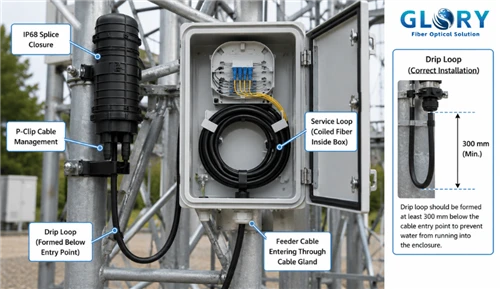
Now that FTTH has become widespread, the optical signal travels through kilometres of outdoor cable and complex splice enclosures. The final "one metre" of in-home experience should not be ruined by an unattractive or poorly designed faceplate. The GL-FN-12 indoor fiber optic outlet is the kind of product that, once installed on your wall, you forget it is there – and that is the highest praise for great industrial design.