
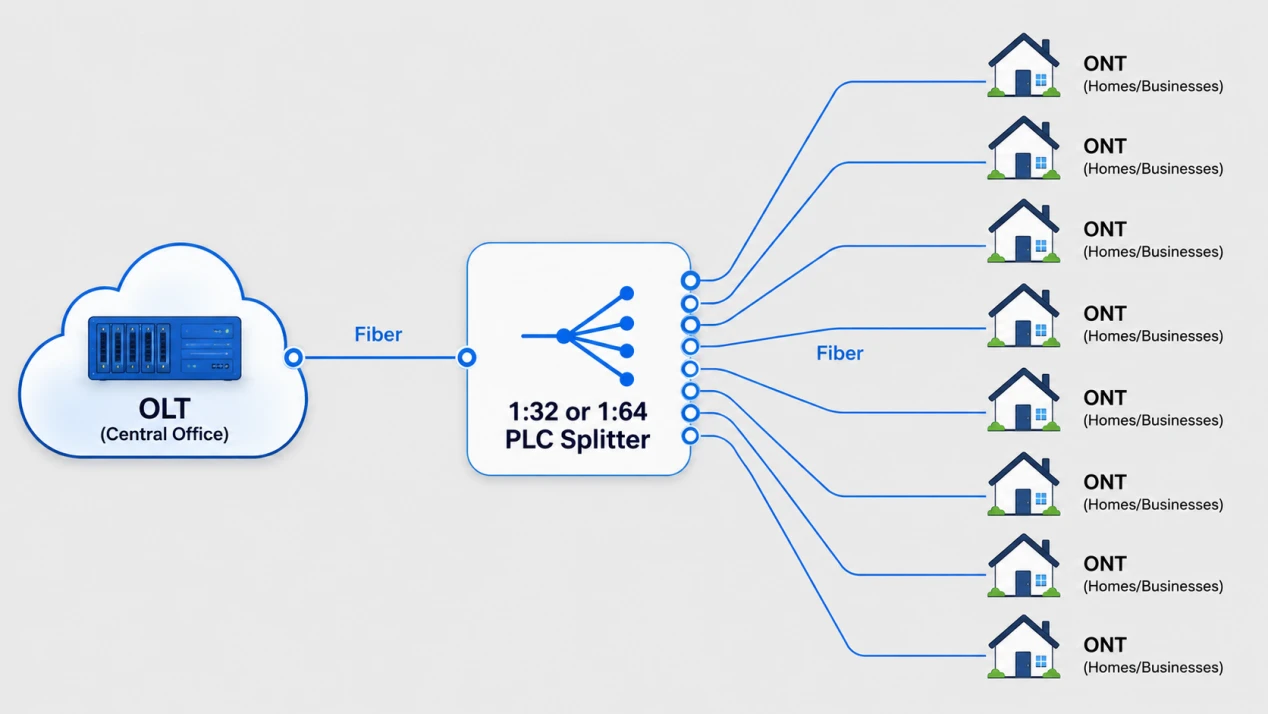
Every FTTH engineer knows the struggle: designing an ODN, you spend more time agonising over the split ratio than over the fibre route. Two identical residential blocks – one design uses 1:32, the other 1:64. Ask why, and you often hear "that's what we always use" or "it's the template". But optical power doesn't lie. Doubling the split ratio costs about 3 dB in link budget. In the last kilometre of an access network, those 3 dB can be the difference between "works fine" and "randomly goes offline".
Recently I went through the measured data for our GLORY LGX Cassette PLC splitters, comparing 1:32 and 1:64 side by side. Together with a few painful lessons from real projects, here's what I've learned about choosing the split ratio.
1. Technology primer: FBT vs. PLC – why it matters
Before digging into split ratios, it helps to know how a splitter is made. Two main technologies exist: Fused Biconical Taper (FBT) and Planar Lightwave Circuit (PLC) .
FBT works by twisting two or more fibres together and heating them until they fuse and taper. It's a mature, low-cost technology. For small split ratios (1:2, 1:4) at a specific wavelength, it's still competitive.
But FBT has serious limits for FTTH:
• Splitting beyond 1:8 is difficult; 1:32 is the practical limit, and uniformity suffers.
• Sensitive to temperature – the fused region expands and contracts, causing loss variation.
• Wavelength-dependent behaviour, which is problematic for multi‑wavelength PONs.
PLC technology takes a different approach. It uses semiconductor fabrication to lithographically create waveguides on a silica substrate. A typical PLC chip has three precisely etched layers: a substrate for mechanical support, a waveguide layer for optical routing, and an overcladding for protection. This chip-like process delivers several advantages:
• Split ratios easily reach 1:32, 1:64 and even 1:128 – perfect for high-density urban areas.
• Excellent uniformity – each output gets almost exactly the same amount of power.
• Broad wavelength range (1260-1650 nm) covering O, E, S, C and L bands, ideal for GPON/XGS-PON coexistence.
• High temperature stability – loss changes very little from -40 °C to +85 °C, critical for outdoor cabinets and pole-mount boxes.
• Compact size – a 1:32 device can be as small as 4×12×60 mm, allowing many LGX modules in a 1U rack.
The global PLC splitter market is expected to grow from about $1.615 billion in 2025 to $2.307 billion by 2031, at a CAGR of roughly 6.1%. The cassette (LGX) segment alone is projected to reach $945 million by 2032, driven by FTTH/FTTx rollouts and the demand for high-performance passive components in 5G and data centres. LGX packaging is a key part of this trend because it brings modular, hot-swappable, standardised management to ODN designs – exactly what a growing network needs.
For FTTH applications, there's little reason to consider FBT. GLORY's LGX series uses high-quality PLC chips with G.657A1 bend-insensitive fibre (minimum bend radius 10 mm, perfect for tight rack cabinets) and insertion loss / uniformity figures that meet or exceed international standards.
2. Hard data: comparing 1:32 and 1:64
Here are the specification numbers from our LGX Cassette splitters:
|
Typical IL (dB) |
Max IL (dB) |
Uniformity (dB) |
WDL (dB) |
PDL (dB) |
|
|
1:2 |
≤3.6 |
≤3.8 |
≤0.6 |
≤0.2 |
≤0.15 |
|
|
1:4 |
≤6.8 |
≤7.1 |
≤0.6 |
≤0.3 |
≤0.15 |
|
|
1:8 |
≤10.0 |
≤10.3 |
≤0.8 |
≤0.4 |
≤0.25 |
|
|
1:16 |
≤13.0 |
≤13.5 |
≤1.2 |
≤0.6 |
≤0.3 |
|
|
1:32 |
≤16.0 |
≤16.5 |
≤1.5 |
≤0.8 |
≤0.3 |
|
|
1:64 |
≤19.5 |
≤20.5 |
≤2.5 |
≤1.0 |
≤0.3 |
The 3 dB difference
Typical loss for 1:32 is about 16.0 dB, for 1:64 about 19.5 dB – a 3.5 dB delta. In a PON system, the OLT typically launches +3 to +5 dBm (Class B+). The ONT's sensitivity is around -27 dBm (GPON) or -28 dBm (XGS-PON). Include fibre attenuation (say 0.35 dB/km × 5 km = 1.75 dB), connector loss (four connectors at 0.3 dB each = 1.2 dB) and splice loss (three splices at 0.1 dB = 0.3 dB).
With a 1:32 splitter:
+5 dBm – 16.0 dB – 1.75 dB – 1.2 dB – 0.3 dB = –14.25 dBm – well within the ONT's sensitivity.
With a 1:64 splitter:
+5 dBm – 19.5 dB – 1.75 dB – 1.2 dB – 0.3 dB = –17.75 dBm – still acceptable, but margins are tighter.
But note: the table shows maximum insertion loss. For 1:64, the worst-case loss is 20.5 dB. Using the same calculation: +5 dBm – 20.5 dB – 1.75 dB – 1.2 dB – 0.3 dB = –18.75 dBm. Still within an ONT's -27 dBm, but the margin has shrunk further.
Uniformity: from 1.5 dB to 2.5 dB – what that means in practice
Look at the uniformity row: 1:32 has ≤1.5 dB, 1:64 jumps to ≤2.5 dB. This is often overlooked. Suppose you install a 1:64 splitter in a 4-floor MDU. The output port with the highest loss could be 2.5 dB weaker than the lowest-loss port. That variation directly affects the optical power that each ONU sees – and more importantly, the upstream path.
In the upstream direction, ONUs transmit at powers typically between +0.5 and +5 dBm. After passing through the splitter (in reverse), the signals combine at the OLT. The OLT has to deal with a wide dynamic range. A uniformity of 2.5 dB means some ONU signals will arrive 2.5 dB weaker than others. While modern OLTs have automatic gain control and burst-mode receivers, large variations can increase the bit-error rate (BER) and occasionally cause an ONU to be de-registered during high-load periods. This is the kind of "random" trouble that's very hard to diagnose after the fact.
Temperature stability – a hidden factor
The table gives typical temperature-dependent loss of 0.3-0.4 dB and a maximum of 0.5 dB. However, a 1:64 splitter is inherently more sensitive to thermal cycling. The difference in coefficient of thermal expansion between the PLC chip, the fibre and the housing can add extra loss on top of the static numbers, especially in outdoor cabinets where day-night temperature swings are large. That's why many conservatively engineered ODN designs still prefer 1:32 over 1:64 – they want a safer cushion.
3. A real-world failure caused by blindly choosing 1:64
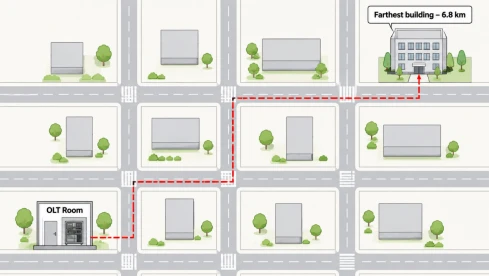
Last year we helped with a brownfield FTTH upgrade in a southern Chinese city. The community had about 60 flats. The telecom room was at the far corner of the estate; the longest fibre run to the farthest building was about 6.8 km. The original design used two 1:32 splitters, each serving around 30 subscribers. Purchasing decided to use 1:64 splitters instead because "the price is almost the same and it's future-proof".
Installation went smoothly. Acceptance testing showed acceptable receive levels – just. The eight farthest ONTs measured between -26.5 and -28 dBm, right on the threshold. That was in the dry autumn.
Then came the monsoon season. High humidity caused condensation inside a couple of splice closures. Three ONTs dropped offline. On-site inspection found a slightly loose SC/APC connector on the splitter output port. Re-seating it brought the receive power from -27.3 dBm back to -25.2 dBm. Problem solved, but the helpdesk had been flooded with calls for weeks.
Root cause: the 1:64 splitter had left almost no margin for unexpected losses (connector oxidation, humidity-induced micro-bends, ageing). The extra 3 dB that a 1:32 would have provided would have absorbed the connector issue without any service interruption.
Since then, we've followed a simple rule: within 3 km of the OLT, 1:64 is acceptable; for distances beyond 3 km, or if cascaded splitting is used, stick to 1:32.
4. Lab test: GLORY LGX Cassette 1:32 vs 1:64
We subjected both 1:32 and 1:64 LGX modules to a 48-hour thermal cycle test (-40 °C to +85 °C). Every four hours we measured insertion loss.
• The 1:32 module started at 16.7 dB and crept up to 17.1 dB – an increase of 0.4 dB, still within specification.
• The 1:64 module went from 20.1 dB to 20.9 dB – a 0.8 dB increase, also within the guaranteed ≤21.5 dB.
After the modules returned to room temperature, both recovered to their original loss values. No permanent damage – the temporary change was caused by slight mechanical deformation of connectors and seals at extreme temperatures. But the 1:64 showed almost twice the variation, confirming that higher split ratios are more sensitive to environmental stress.
We also tested 1:8 and 1:16 LGX modules. The 1:8 modules stayed stable at 10.1-10.3 dB, barely moving. If your budget allows, using two 1:8 splitters in cascade (total loss ~20.6 dB) is nearly the same as one 1:64 (20.5 dB), but the 1:8 modules are much more stable and the intermediate splice point provides a useful test access for fault isolation.
5. Centralised vs. distributed splitting – how it changes the choice
The split ratio decision interacts strongly with the splitting architecture.
Centralised splitting (single-level) places one large 1:32 or 1:64 splitter in the central office or a large ODF cabinet. Every drop fibre goes directly from that splitter to the subscriber. Advantages: simple management, few failure points, straightforward fibre routing. Disadvantages: many feeder fibres from the OLT to the splitter (64 fibres for a 1:64 splitter) and a lot of fibre capacity is unused until every flat is connected. Centralised splitting works best for business parks or new-build office towers where take-up is immediate and high.
Distributed splitting (cascaded) uses two stages: a 1:4 splitter in a street cabinet, then 1:8 or 1:16 splitters in building entry points or stairwells. The feeder cable needs only 2-4 fibres, and you only install splitter modules as subscribers sign up. This is ideal for residential areas with gradual take-up. The downside: more field splices and higher total insertion loss (a 1:4 + 1:8 cascade has about 7.1+10.4 = 17.5 dB, between 1:32 and 1:64).
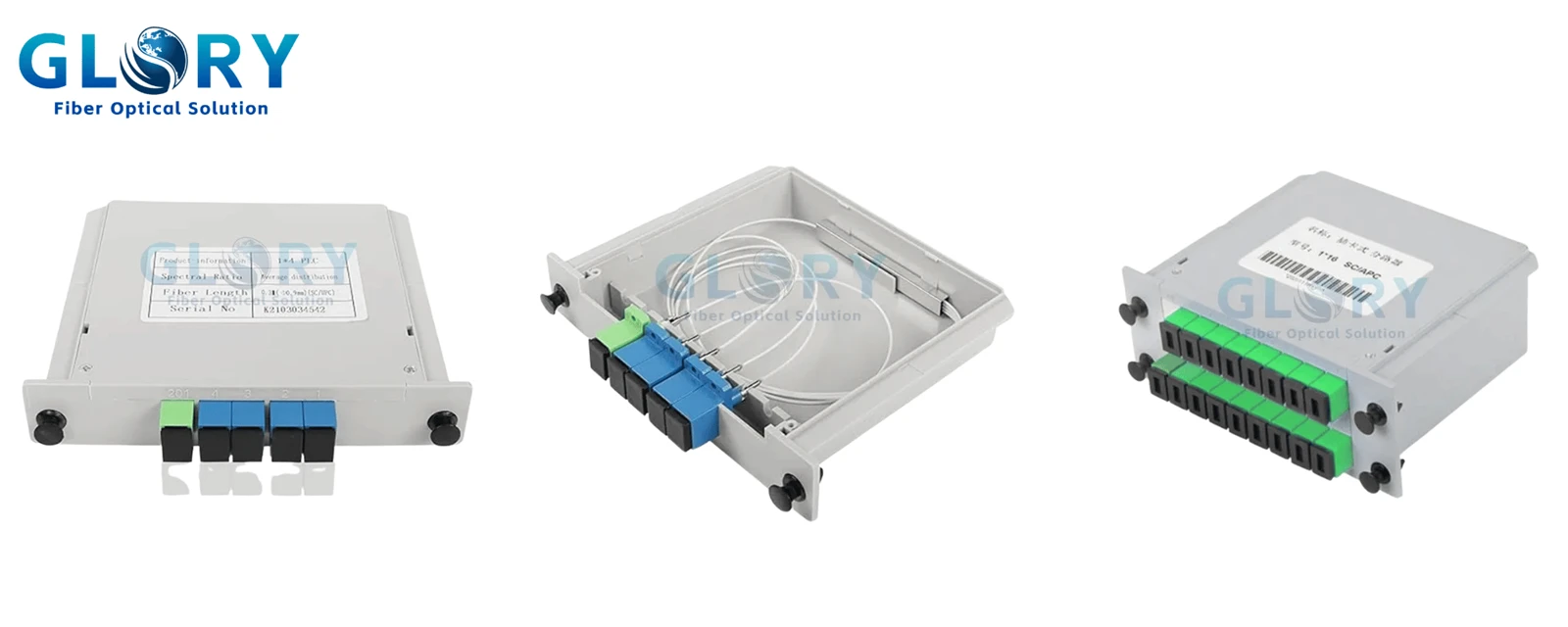
The LGX Cassette shines here: one 1U or 2U rack can host a mix of 1:8, 1:16, 1:32 and 1:64 modules. You can start with a few 1:8 modules, then later slide in a 1:16 or 1:32 without touching the fibre or the rack. No need to commit to a large 1:64 from day one. That "pay-as-you-grow" flexibility saves both capital expense and operational hassle.
6. Don't forget connector and splice losses – they add up
Designers often focus only on the splitter's insertion loss, but a real ODN accumulates loss from many sources.
• Connector loss: each SC/APC or SC/UPC connection adds about 0.3-0.5 dB. A typical path may have 8-10 connectors, easily adding 3-4 dB.
• Splice loss: each fusion splice adds 0.1-0.2 dB. With 3-5 splices, that's another 0.5-1 dB.
• Ageing margin: over 5-8 years, connector ferrule wear, dust accumulation and fibre micro-bends can slowly increase loss. A conservative design reserves at least 3 dB for ageing.
Adding these: splitter 20.5 dB + connectors 3.0 dB + splices 1.0 dB + ageing 3.0 dB = 27.5 dB. A Class B+ GPON link budget is 28 dB – leaving only 0.5 dB margin. That's too tight. That's why 1:64 is only recommended when using Class C+ OLTs (32 dB budget) or when the ODN is very short and clean.
7. What about 25G PON and 50G PON? Will you need to redesign?
Many operators worry that future PON upgrades will render their ODN obsolete. For 25G PON, the transition from NRZ to PAM4 modulation worsens receiver sensitivity by about 3 dB. That means a two-stage split (e.g. 1:8+1:8, ~21 dB loss) that worked fine for GPON may no longer be usable for 25G PON unless you convert to a single-stage 1:32 (~17.5 dB loss). That would require re-engineering the cabinet layout and fibre routing – expensive and disruptive.
However, the move from GPON to XGS-PON is the immediate priority. Combo-PON technology (WDM inside the OLT) allows GPON and XGS-PON to coexist on the same ODN without changing splitters or fibre. The XGS-PON budget (29-31 dB) is similar to GPON Class B+/C+. As for 25G/50G PON, workable co‑existence solutions are emerging, and the odds are that the existing passive infrastructure will survive for many years. Still, a well-designed ODN with high-uniformity, low-loss LGX modules (whether 1:32 or 1:64) gives you the most breathing room for the future.
8. Practical selection guide
Based on field experience, I use the following rules of thumb:
• Start with the OLT optical module. Many deployed GPON OLTs use Class B+ (28 dB budget). For 1:64, you really want Class C+ (32 dB). XGS-PON modules typically offer 29-31 dB – check the datasheet before committing.
• Distance and margin. If the farthest ONT is ≤2 km and fibre attenuation is low (≤0.33 dB/km), 1:64 is possible with a good budget. For 2-5 km, stick to 1:32. Beyond 5 km, use 1:16 or a cascade.
• Cascaded architectures. A 1:4 + 1:8 cascade totals about 17.5 dB – between 1:32 and 1:64. It gives you intermediate test points and easier phased investment, but increases the number of active nodes.
• Leave room for growth. If a 1:64 splitter only uses 30 ports, the other 34 ports are idle – but still vulnerable to dust and contamination. It's often better to deploy two 1:32 splitters and only populate the second when needed.
• Standardise on LGX cassettes. Using the same LGX form factor across projects simplifies inventory management and reduces the risk of ordering the wrong part.
Our LGX Cassette series supports hot-swappable modules. You can start with a 1:32, and later replace it with a 1:64 (or add a second unit) without disturbing the fibre or the rack. Several operators have chosen this approach because they couldn't predict the final take-up rate – the flexibility paid off.
9. Upstream – the often ignored direction
We tend to fixate on downstream (OLT→ONT) but the upstream path matters equally. In GPON, ONT transmit power is typically +0.5 to +5 dBm. After passing through the splitter (in reverse) and combining with other ONT signals, the power arriving at the OLT can be significantly lower.
For a 1:64 splitter, the upstream loss is about-20 dB. An ONT transmitting at only +0.5 dBm would deliver about -19.5 dBm to the OLT – still above the typical OLT sensitivity (-28 to -30 dBm), but the margin is small.
Moreover, the OLT's burst-mode receiver must handle widely different input powers from different ONTs. A splitter with poor uniformity (2.5 dB) makes this worse, potentially causing packet errors and ONU de-registrations. That's why, when a 1:64 is unavoidable, we recommend selecting modules with the best possible uniformity – we can provide per-port test reports for each batch.
10. Production consistency and traceability
Unlike a field-spliced module, a cassette splitter can't be adjusted on site. If an order arrives with the wrong model or one channel has excessive loss, the project gets delayed. Therefore we perform batch-level accelerated life tests and provide per-channel loss data for each shipment. Customers can also specify custom acceptance criteria in the contract.
The result is that multiple project sites using LGX cassettes work from the same baseline. Testing, documentation and troubleshooting become standardised – a huge time-saver for field teams.
Conclusion
Choosing a split ratio is never simply "bigger is better". The difference between 1:32 and 1:64 is about 3-4 dB of optical budget, but in real-world outside plant deployments those decibels translate directly into installation margins, long-term ageing tolerance, and ease of maintenance.
1:32 and 1:64 each have their place: high-density short-reach urban buildings might be fine with 1:64, while longer-distance or harsh-environment links often demand the extra cushion of 1:32. GLORY's LGX Cassette series offers both, and the ability to mix them in the same rack gives you a true "pay-as-you-grow" toolkit.
Next time you design a PON network, don't just look at the splitter's label. Calculate the cumulative link loss, consider the future take-up rate, the uniformity of the modules, and the cost of a few truck rolls. A little extra margin today is worth many times the price of a splitter.