
Heat Shrink Sealing: Simple on the Surface, Troublesome in Reality

The working principle of heat shrink sealing is simple: heat shrink tubing is placed over the connection between the cable and the connector, heated with a heat gun to shrink it, allowing the hot melt adhesive inside to flow and fill the gap, then cooling to form a seal. It sounds simple, but in practice, it's fraught with problems:
1. Installation quality depends on "feel"-heating temperature, duration, heat shrink tubing placement, and sufficient adhesive flow-all these critical variables rely on the operator's experience. Inexperienced workers may overheat and damage the cable, underheat resulting in an incomplete seal, or misplace the heat shrink tubing.
2. Poor environmental adaptability-in low temperatures, windy conditions, or humid environments, the efficiency of the heat gun decreases significantly. The heat shrink tubing may not shrink completely, or the adhesive flow may be uneven. In cold winters, the failure rate of heat shrink seals increases dramatically.
3. Almost impossible to reopen-once a heat shrink seal is completed, reopening it for maintenance or expansion requires destroying the heat shrink tubing. Cleaning residual adhesive and preparing new heat shrink material is tedious, time-consuming, and carries the risk of damaging the cable.
Long-term aging risk – Heat shrink tubing and hot melt adhesive will gradually become brittle under long-term exposure to ultraviolet light, temperature cycling, and chemical corrosion. After a few years, the sealing performance may decline significantly.
Mechanical Seal: The "Triple Guarantee" of Vulcanized Rubber + Plastic Screws
The GPJ09-9401 mechanical seal uses two core components: a highly elastic vulcanized rubber gasket and a high-strength plastic clamping screw. Its principle is simple and reliable: by evenly tightening the plastic screw, the controllable compression force causes the rubber gasket to elastically deform and press it firmly against the cable sheath and sealing housing, thus forming a permanent waterproof barrier.
Advantage 1: Quantifiable and Repeatable Installation Quality
The tightening torque of the plastic screws has a clear mechanical limit-no "feel" is required. Even inexperienced novices can achieve consistent sealing results by following standard procedures. More importantly, a pressure test can be performed immediately after sealing-inflate the sealed joint and observe if the pressure gauge reading drops. A perfect seal can be verified in just 30 seconds, without waiting for rain.
Advantage 2: Reusable and Zero Consumables for Maintenance
The biggest highlight of mechanical seals is their reusability. When the joint needs to be opened for fiber optic reconfiguration, extension, or troubleshooting, simply loosen the plastic screws. After the work is done, tighten the screws again-the vulcanized rubber gaskets still provide a reliable seal. No consumables need to be replaced. This is crucial for long-life pipelines: over a service life of up to 25 years, multiple re-entries may be required, and mechanical seals make every maintenance operation as simple as the first.
Advantage 3: Wide Temperature Stability, No Need to Worry About Aging
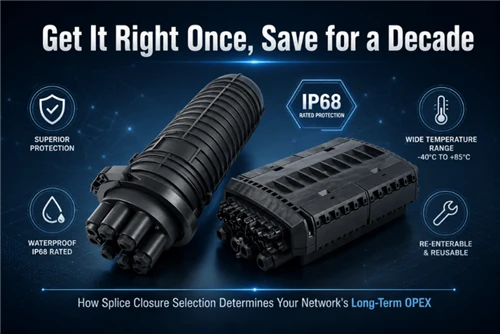
This specially formulated vulcanized rubber maintains stable elasticity and resistance to compression set over a wide temperature range of -40°C to +65°C. Even after years of temperature cycling, UV exposure, and chemical corrosion, it continues to provide reliable sealing performance. In contrast, the hot melt adhesive in heat-shrink seals loses its tack over time, leading to micro-leakage.
Hard Data: The Real Strength Behind IP68 Certification
The GPJ09-9401 has achieved the highest IP68 protection rating. This means it can be submerged in 1.5 meters of water for over 72 hours and remain completely dry internally. This protection rating is based on its vulcanized rubber + plastic screw mechanical seal-each unit undergoes rigorous pressure testing before leaving the factory to ensure zero leakage.
Conclusion: Choosing the Seal Means Choosing Your Network's Future
For decades, heat-shrink sealing technology has played a vital role in fiber optic networks. However, its limitations are becoming increasingly apparent today as the demand for high reliability, long lifespan, and ease of maintenance grows. Mechanical seals-especially the vulcanized rubber + plastic screw design-offer advantages such as quantifiable installation, verifiable sealing performance, reusability without consumables, and long-term stable performance, making them ideal for outdoor splice boxes.