
Quick Answer: Why Do Fiber Modes Matter?
A mode is a stable electromagnetic field pattern that can propagate through a fiber core. In project language, that means the number of modes directly shapes how cleanly an optical signal survives distance.
- Single-mode fiber (SMF) supports essentially one guided mode, so it avoids intermodal or modal dispersion. That is why it is the normal starting point for FTTH, PON, metro, campus backbone and DCI links.
- Multimode fiber (MMF) supports many guided modes. Those modes arrive at slightly different times, which broadens the optical pulse and limits bandwidth-distance performance.
- The buyer decision is not cable-only. At 10G, 100G, 400G and 800G, the transceiver type, connector format, fiber count, installed base and migration plan can outweigh the cable price difference.
The FOA fiber reference is a useful baseline for single-mode and multimode fiber definitions, while RP Photonics explains why bandwidth-distance limits differ between multimode and single-mode fibers.

What Is a Mode in Optical Fiber?
A mode is not just "one light ray"
The ray picture is useful for beginners: single-mode looks like one path, while multimode looks like several paths bouncing inside a larger core. The more accurate definition is that a mode is a stable field pattern supported by the waveguide. This matters because it explains why a fiber can be "single-mode" even though light still occupies a physical core with width.
For a deeper physics reference, RP Photonics explains mode concepts in waveguides and multimode fibers, including how the number and behavior of guided modes affect optical transmission. Use that source for technical support, but keep the article language buyer-friendly.
Single-mode vs multimode at the mode level
| Property | Single-mode Fiber (SMF) | Multimode Fiber (MMF) |
|---|---|---|
| Core geometry | Typically 9/125 µm class | 50/125 µm or legacy 62.5/125 µm |
| Supported modes | One primary guided mode | Many guided modes |
| Main bandwidth-distance limit | Chromatic dispersion and PMD on long links | Modal / intermodal dispersion |
| Typical network use | FTTH, PON, metro, campus backbone, DCI | LAN, short-reach data center, some campus links |
Why Multimode Fiber Has Modal Dispersion
Different modes arrive at different times
In multimode fiber, the launched signal energy is distributed across many modes. These modes do not reach the receiver at exactly the same time. The result is pulse broadening: a short input pulse becomes wider at the output. When the data rate increases, the receiver has less time to distinguish one pulse from the next, so the same installed fiber can become distance-limited at higher speeds.
ScienceDirect defines modal dispersion as the condition where different modes travel at different velocities and cause pulse broadening. RP Photonics also treats intermodal dispersion as a main bandwidth-distance limitation in multimode fibers.
More mode delay → wider optical pulse → less clean signal eye → lower usable bandwidth or shorter reach. This is why an MMF link that was acceptable at one speed may require a shorter reach, better OM grade or different optics at the next upgrade.

Why Single-Mode Fiber Supports Longer Reach
No intermodal dispersion
SMF reaches farther because it removes the fastest-mode-versus-slowest-mode problem. With essentially one guided mode, there is no intermodal delay spread to crush the bandwidth-distance product. This is the technical reason SMF is normally selected for FTTH cable, PON, metro, campus backbone, long-haul and DCI applications.
But SMF is not dispersion-free
Single-mode fiber still has limits. On long high-speed links, chromatic dispersion and polarization mode dispersion can matter. The difference is that these effects generally appear over much longer distances than the modal dispersion limits that constrain MMF. For practical sourcing, this means SMF is the safer long-reach default, while MMF should be justified by short reach, existing infrastructure or a specific optical module plan.
OM3, OM4, OM5 and OS2: What the Grade Really Means
Modern MMF is about effective modal bandwidth
Better multimode fiber is not just a different jacket color. OM3, OM4 and OM5 are selected because their modal bandwidth performance supports higher-speed short-reach links better than legacy OM1/OM2. The TIA Fiber Optics Tech Consortium states that new installations should use OM3, OM4 or OM5 multimode fiber types. Fluke Networks is a useful source for OM/OS terminology, modal bandwidth and testing context.
| Fiber grade | Where it fits | Buyer note |
|---|---|---|
| OM3 | 10G / 40G short data-center links | Cost-effective short reach where the optics and distance match |
| OM4 | Higher-performance short / medium data-center links | Often a safer MMF starting point for newer short-reach projects |
| OM5 | SWDM / wideband MMF use cases | Only adds value when optics use the supported wavelength strategy |
| OS2 | FTTH, PON, metro, campus backbone, DCI | Best long-reach and future-scalability starting point |
Transceiver Choice: SR, LR, ER, DR, FR and VCSEL
Fiber type and optics must be specified together
Do not specify the cable and the optical module as separate decisions. MMF is normally paired with SR / VCSEL-based short-reach optics. SMF is normally paired with LR, ER, DR, FR or similar single-mode optics. A mismatch can create high loss, unstable links or no link.
For connectorized assemblies, connect the fiber mode to the module plan in the RFQ. Glory Optical's fiber optic cable assemblies, fiber patch cords, MTP/MPO assemblies and data center cabling pages are the most relevant internal links for this section.
| Link type | Common fiber | Common optics | Buyer note |
|---|---|---|---|
| 10G SR | OM3 / OM4 | SFP+ SR | Short data-center / LAN; verify supported reach |
| 10G LR | OS2 | SFP+ LR | Longer campus, access or metro links |
| 100G SR4 | OM4 | QSFP28 SR4 | Usually parallel fiber / MPO; count fibers and connectors |
| 100G LR4 / FR | OS2 | QSFP28 LR4 / FR | Duplex or single-mode architecture depending on module type |
| 400G SR8 / SR4.2 | OM4 / OM5 | QSFP-DD / OSFP SR | Short reach; confirm lane count and fiber count |
| 400G DR4 / FR4 | OS2 | DR4 / FR4 optics | Stronger long-term migration path for backbone and DCI |
Module naming varies by vendor and generation. Always verify reach, wavelength, fiber count, connector interface and loss budget against the specific transceiver datasheet before confirming the cable BOM.
Application Matrix: FTTH, LAN, Campus, Data Center and DCI
| Project condition | Better starting point | Why |
|---|---|---|
| FTTH / GPON / XGS-PON | OS2 single-mode | PON reach and splitter loss budget assume SMF architecture |
| Long campus backbone | OS2 single-mode | Distance and future speed upgrades matter more than short-reach optics cost |
| Short building LAN | OM3 / OM4 or OS2 | Compare optics, existing cabling and expected upgrade path |
| Existing OM3 / OM4 infrastructure | Verify before reuse | Do not assume older MMF will support a new speed at the same reach |
| 100G+ data-center upgrade | Compare fiber count + optics + connector | Parallel MMF optics may require more fibers; SMF may cost more in optics but simplify reach |
| AI cluster / DCI / long-term scalability | OS2 single-mode | Longer reach and migration flexibility usually dominate |

For the FTTH side, connect this article to Glory's FTTH ODN design guide, PLC splitter and FTTH cable pages. For the data-center side, connect it to 400G/800G AI data-center cabling, MTP/MPO assemblies and patch panels.
Common Mistakes When Buyers Specify SMF or MMF
- Choosing by cable price only. The optical module, fiber count, connector type, patching density and future recabling risk often change the total cost more than the cable itself.
- Mixing SMF and MMF. Core-size mismatch and wrong optics can create excessive loss or unstable links. Keep each link mode-consistent from end to end.
- Assuming OM5 helps every project. OM5 only adds value when the optics and wavelength strategy use its wideband capability.
- Reusing legacy OM1/OM2 for high-speed upgrades. New projects should start from OM3/OM4/OM5 or OS2 rather than relying on old MMF assumptions.
- Not specifying transceiver PMD in the RFQ. "OM4 cable" or "OS2 patch cord" is not enough; include SR, LR, DR, FR, wavelength, connector and distance.
RFQ Checklist: What to Specify Before Ordering Fiber Cable
A precise RFQ turns a technical article into a usable procurement document. Include the fields below before asking suppliers to quote.
| RFQ field | What to specify | Why it matters |
|---|---|---|
| Fiber mode | SMF / MMF | Prevents optics mismatch |
| Fiber grade | OS2 / OM3 / OM4 / OM5 | Determines reach, modal bandwidth and sourcing options |
| Fiber standard | G.652.D / G.657.A1 / G.657.A2 where relevant | Important for FTTH, bend radius and ODN compatibility |
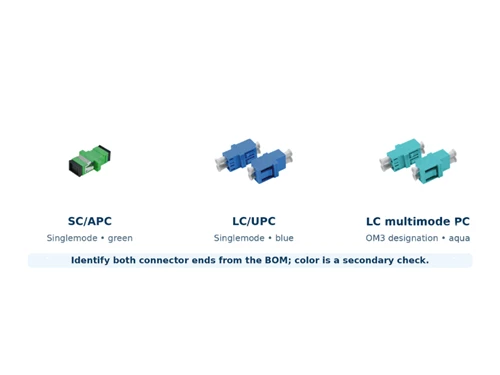
| Connector | LC / SC / MPO / MTP; UPC / APC | Matches patch panel, optics and field equipment |
| Transceiver plan | 10G SR, 100G SR4, 400G DR4, 400G FR4, etc. | Links cable design to the actual optical interface |
| Cable construction | Indoor / outdoor / armored / drop / trunk | Matches routing environment and installation method |
| Jacket | LSZH / PVC / PE / OFNP | Compliance with indoor, outdoor or plenum requirements |
| Test documents | IL/RL, polarity, end-face inspection, batch label | Creates acceptance evidence before shipment |
For finished links and patching practice, use Glory's Fiber Patch Cable Installation Guide as a companion article. When the link distances, fiber grade and module plan are clear, send the BOM through Glory Optical's RFQ form.
Field Notes From Practitioner Communities
The notes below summarize public network-engineering discussions on Reddit and LinkedIn. They are qualitative field observations, not statistical survey data.
Why not use SMF everywhere?
Community discussions repeatedly show that buyers understand SMF has reach advantages, but still ask whether MMF remains useful. The real question is usually system cost: short-reach optics, existing OM4 cabling, fiber count and patching format.
Is multimode dead?
A safer answer is: multimode is not dead, but it is becoming more conditional. Short links can still justify MMF. New long-term backbone, AI cluster and DCI designs increasingly lean SMF.
Cable type and optics must be paired
Do not order "OM4 cable" alone. Order "OM4, MPO/MTP, 100G SR4, required link distance." Do not order "OS2 cable" alone. Pair it with LR, DR, FR or another module plan.
Cheaper optics can require more fibers
Parallel short-reach MMF optics may need more fibers and MPO/MTP infrastructure. A lower module unit price does not always mean a lower installed cost.
FAQ
-
Q: Is single-mode fiber better than multimode fiber?
A: Single-mode is better for long reach, FTTH, PON, campus backbone, metro, DCI and long-term upgrade paths. Multimode can still be better for short links where existing cabling and SR optics make the total cost attractive.
Q: Why does multimode fiber have modal dispersion?
A: Because it carries many guided modes that arrive at different times. The received pulse becomes wider, which limits data rate and distance.
Q: Can I mix single-mode and multimode fiber?
A: Do not design a normal production link that way. Core-size mismatch and optics mismatch can cause high loss, unstable links or no link.
Q: Is multimode fiber still used?
A: Yes. It remains common in short-reach data-center, LAN and some campus environments. It should be justified by distance, existing infrastructure and optics cost rather than chosen by habit.
Q: Does single-mode fiber have modal dispersion?
A: No. SMF is not affected by intermodal dispersion. It can still be limited by chromatic dispersion and polarization mode dispersion on long, high-speed links.
Q: Should new projects still use OM1 or OM2?
A: For new high-speed installations, no. Use OM3, OM4 or OM5 for multimode projects, or OS2 where long reach and migration flexibility matter.
Q: What is the safest fiber choice for FTTH?
A: OS2 single-mode fiber is the normal starting point, with G.652.D or bend-insensitive G.657.A1/A2 selected according to routing and bend-radius requirements.
Authority references used in this article:
- FOA Reference for Fiber Optics - Optical Fiber: basic single-mode and multimode fiber definitions.
- RP Photonics - Bandwidth–distance product: intermodal dispersion as a multimode limit and chromatic dispersion as a single-mode limit.
- TIA Fiber Optics Tech Consortium - Optical Fiber Types: OM3, OM4 and OM5 guidance for new multimode installations.
- Fluke Networks - OM1/OM2/OM3/OM4/OM5 and OS1/OS2 Fiber: OM/OS terminology and testing context.
- IEC 60793 optical fibre measurement methods: standards context for optical-fibre measurement parameters.
- ANSI/TIA-568.3-E update: structured optical fiber cabling, components and testing context.
Article authored by the Glory Optical engineering team. Ningbo Glory Optical Communication Co., Ltd. manufactures FTTH cable, fiber optic cable assemblies, MTP/MPO trunks, patch cords, PLC splitters and passive ODN components for telecom, ISP, data-center and OEM projects.