
The Quick Verdict
Use LC for data-centre transceiver ports and high-density panels, SC APC for FTTH/GPON subscriber drops, FC APC for OTDR and test instruments, and ST only to maintain legacy multimode campus links. The four are not interchangeable - the table below shows why, and the rest of this guide explains how to choose, verify, and clean each one.
LC vs SC vs FC vs ST at a Glance
Every value below is traceable to the relevant IEC standard or to Telcordia GR-326-CORE Issue 4. Scan the decision parameters side by side, then read the connector profiles for context.
| Parameter | LC | SC | FC | ST |
|---|---|---|---|---|
| Governing IEC standard | IEC 61754-20:2012 +AMD1:2022 | IEC 61754-4:2021 | IEC 61754-13:2024 | IEC 61754-2 |
| Ferrule diameter | 1.25 mm | 2.5 mm | 2.5 mm | 2.5 mm |
| Coupling mechanism | Push-pull latch (RJ45-style) | Push-pull snap latch | Threaded (M8×0.75) | Bayonet ¼-turn lock |
| Typical insertion loss | ≤0.20 dB std; ≤0.10 dB premium | ≤0.25 dB std; ≤0.10 dB premium | ≤0.30 dB std; ≤0.10 dB premium | 0.25–0.50 dB typical |
| Return loss - UPC | ≥55 dB | ≥50 dB | ≥50 dB | ≥40 dB |
| Return loss - APC (8°) | ≥65 dB | ≥65 dB | ≥65 dB | Not standard |
| Mating speed | 2–3 s (fastest) | 2–3 s | 15–20 s (thread) | ~3 s (twist) |
| Port density (1U panel) | Up to 144 ports | Up to 72 ports | Up to 36 ports | Up to 48 ports |
| Primary use case | Data centres, SFP/SFP+, 10G–400G | FTTH, GPON, CATV, ODF | OTDR, test instruments, industrial | Legacy multimode (maintenance) |
Start with the table for a quick connector comparison, then use the selection matrix to match connector type, polish type, and deployment scenario. For procurement, verify the supplier's IEC 61300 test method, IL/RL report format, and end-face inspection criteria before approving a batch.
1. LC Connector - The High-Density Standard
The LC (Lucent Connector), developed at Bell Laboratories in the mid-1990s, uses a 1.25 mm zirconia ceramic ferrule - exactly half the diameter of SC, FC, and ST - and an RJ-45-style push-pull latch defined under IEC 61754-20. That single dimension explains its dominance: LC fits twice as many ports in the same panel (up to 144 in 1U versus 72 for SC) and is the native interface on SFP, SFP+, SFP28, and QSFP28 transceivers. It is also the fastest connector to mate, with no twist or thread. At premium grade, Glory Optical LC connectors run a batch-mean insertion loss near 0.07 dB, supplied in UPC and APC, simplex, duplex, and uniboot (which lets you reverse polarity without re-cabling).

Where LC is used: data-centre structured cabling (TOR/EOR/MOR); 10G–400G transceiver links; enterprise LAN uplinks; 5G fronthaul (SFP28/QSFP28); high-density ODN; and FTTH drop cables in the LC APC version.
2. SC Connector - Built for FTTH and Field Handling
The SC (Subscriber Connector), developed by NTT in Japan, pairs a 2.5 mm ferrule with a keyed push-pull snap latch (IEC 61754-4:2021). The larger ferrule is robust under non-laboratory field handling, which is why SC APC is the global standard at the GPON/XGS-PON subscriber interface - mandated by every major carrier and deeply entrenched across Asia-Pacific. The 2021 third edition added ferrule-compression testing (IEC 61300-3-22) and adapter-strength requirements that matter for outdoor and FTTH qualification. Glory Optical SC connectors run a batch-mean insertion loss near 0.06 dB and return loss above 67 dB for APC, with per-batch test reports on request.

Where SC is used: FTTH/FTTB/FTTx subscriber terminations (especially Asia-Pacific); GPON/XGS-PON/NG-PON2 ONT interfaces; CATV/HFC networks (where high return loss prevents optical beat interference); and central-office ODF enclosures where ease of maintenance outweighs density.
3. FC Connector - Vibration Resistance and Precision Measurement
The FC (Ferrule Connector) shares the 2.5 mm ferrule but locks with a threaded M8×0.75 coupling nut. Thread plus spring pre-load produces the most vibration-stable joint of the four: under FOTP-11 vibration, FC shows roughly 3× lower insertion-loss variation than LC or SC. The trade-off is speed - 15–20 seconds to mate versus 2–3 for LC - so FC is not for high-churn racks. The 2024 third edition of IEC 61754-13 added cross-manufacturer intermateability rules and new Grade Am/Bm/Cm tolerances.
Where FC is used: OTDR test ports (FC APC is the default on Viavi, EXFO, Anritsu, and Yokogawa instruments); optical power meters and spectrum analysers; OTDR launch-cable assemblies; industrial fibre sensors in harsh environments; and military or aerospace applications. It is not recommended for new data-centre or LAN builds.
4. ST Connector - The Legacy Bayonet
The ST (Straight Tip), an AT&T design, uses a quarter-turn bayonet lock on a 2.5 mm ferrule. It ran multimode campus networks from the late 1980s and survives in millions of installed ports, but it has three disqualifications for new work: no APC polish (so it cannot serve single-mode FTTH), no SFP/QSFP interface, and the widest insertion-loss spread of the four (0.25–0.50 dB) because bayonet pin tolerances are less repeatable than push-pull or thread mechanisms.

Where ST is used: maintenance and repair of existing multimode campus and industrial plant only. Keep ST stock and ST-LC or ST-SC hybrid adapters on hand for repairs, and specify LC OM4/OM5 for every new run, migrating fully at the next hardware refresh.
5. APC vs UPC vs PC: End-Face Polish Types
Insertion loss is mostly about fibre alignment; return loss is mostly about end-face geometry. That second metric is what the polish type decides - and it is what keeps a sensitive laser stable. Three geometries are in use:

- PC (Physical Contact) - a shallow domed end-face, return loss ≥40 dB. Legacy applications only; rarely specified new.
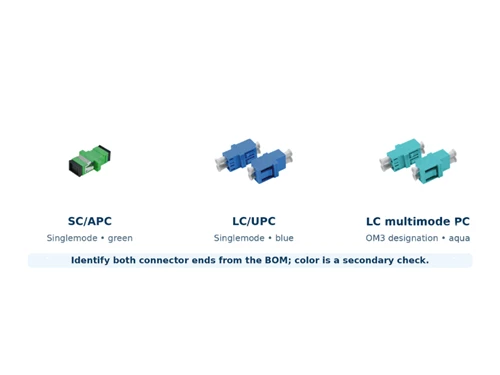
- UPC (Ultra Physical Contact) - a tighter dome with precise core alignment, return loss ≥55 dB, blue housing. The standard for data-centre links and general single-mode.
- APC (Angled Physical Contact) - an 8° angled face that redirects back-reflections into the cladding rather than the core, return loss ≥65 dB, green housing. Required for FTTH/GPON, CATV, and any link where reflection could destabilise a DFB laser.
| Parameter | PC | UPC | APC (8°) |
|---|---|---|---|
| Return loss - typical | ≥40 dB | ≥55 dB (often 57–60) | ≥65 dB (often 67–70) |
| End-face angle | 0° (domed) | 0° (tightly domed) | 8° (angled) |
| Housing colour (single-mode) | Beige/black (legacy) | Blue | Green |
| Suitable for GPON / PON | No | Not recommended | Yes - required by most carriers |
| Suitable for OTDR test port | No | Campus-level only | Yes - standard |
Identifying APC vs UPC in the field
- Green plug = APC - a hard rule with no standard exceptions.
- Blue plug = UPC (single-mode). Aqua/teal = OM3, violet = OM4, orange = OM1/OM2 multimode.
- If the housing colour is ambiguous, inspect under a 200× scope: an APC end-face shows a visible diagonal polish angle.
Never mate an APC plug into a UPC adapter. The angled face meets the flat sleeve at a single point, abrades both ferrule surfaces, and collapses return loss to roughly −10 dB - enough to cause mode-hopping in a GPON OLT laser. The damage is usually permanent. Verify colour before every connection; don't rely on labels alone.
6. Which Connector Should You Use?
6.1 Select by application
| Application | Connector | Polish | Reason |
|---|---|---|---|
| Data centre: server-to-switch, TOR/EOR | LC | UPC | Native SFP+/QSFP interface; 2× density vs SC |
| 100G–400G parallel optics (SR4/DR4) | LC or MPO/MTP | UPC | LC for CWDM4/FR4; MPO for parallel optics |
| FTTH / GPON / XGS-PON subscriber drop | SC APC | APC | Carrier standard; high return loss required |
| CATV / HFC node connections | SC APC | APC | High RL prevents optical beat interference |
| OTDR / optical test instrument | FC APC | APC | FC thread gives reference-grade repeatability |
| Industrial / vibration environment | FC | UPC or APC | Thread survives FOTP-11 where latches don't |
| 5G fronthaul (CPRI/eCPRI) | LC | UPC or APC | SFP28/QSFP28 transceivers use LC |
| Legacy ST campus (maintenance) | ST → migrate to LC | UPC | ST for repairs; LC OM4 for every new run |
6.2 Select by fibre type
- OS2 single-mode (G.652.D / G.657): LC, SC, or FC - always APC for FTTH/PON; UPC acceptable for data-centre links.
- OM3 / OM4 / OM5 multimode: LC duplex UPC for all new builds - 10G–100G short reach, forward-compatible.
- OM1 / OM2 legacy: ST or SC for maintenance; LC when replacing active equipment.
6.3 When to move from LC to MPO/MTP
LC becomes the bottleneck once you aggregate 8 or more fibres into one point - the case for 40G/100G-SR4 and 400G-DR4 parallel optics. A single MPO-12 connector replaces six LC duplex, and a 1U MPO panel reaches up to 144 fibres versus 96 for LC duplex. Install an MPO backbone with MPO-to-LC breakout cassettes at each zone distribution point to keep LC compatibility at equipment ports, and verify polarity before activation (see Section 9).
7. Loss Budget Impact
Connector grade is a loss-budget decision, not only a mechanical preference. In a GPON or XGS-PON ODN, connector loss accumulates across OLT, ODF, splitter cabinet, terminal box, and ONT interfaces. The example below shows how eight mated pairs can shift from low-risk to marginal simply by changing connector grade or cleanliness.
| Connector scenario | Per-connector IL | 8× IL | Headroom vs 28 dB |
|---|---|---|---|
| Premium SC APC | 0.08 dB | 0.64 dB | 7.73 dB - comfortable |
| Standard-grade SC APC | 0.25 dB | 2.00 dB | 6.37 dB - acceptable |
| Contaminated SC APC | 0.50–1.00 dB | 4.00–8.00 dB | 0.37–4.37 dB - marginal or failed |
Use this table as a planning example only. Final acceptance should be based on the active equipment budget, splitter specification, installed fibre length, splice count, connector count, and field test results at the operating wavelength.
8. Test-Data Note and Source Limits
The connector limits and geometry references in this guide are based on the IEC 61754 connector-interface series, IEC 61300 test methods, Telcordia GR-326-CORE requirements, and Glory Optical internal production QC records from 2022–2024. Internal QC figures should be read as factory batch observations, not universal industry guarantees.
| Data type | How to interpret it | What to verify before procurement |
|---|---|---|
| IEC / Telcordia limits | Baseline interface, environmental, and optical-performance requirements. | Confirm the exact standard edition and test method used by the supplier. |
| Typical IL / RL values | Indicative production performance for premium-grade assemblies. | Ask for batch test reports at 1310 / 1550 nm and pass/fail thresholds. |
| End-face inspection | Contamination and scratches are judged by inspection zones, not by naked-eye appearance. | Require IEC 61300-3-35 inspection images or automated pass/fail reports for critical links. |
9. Related Technical Guides
This page should remain the main comparison guide. For deeper subtopics, use dedicated pages instead of overloading the connector-comparison article:
- Fiber connector cleaning guide - inspect-clean-inspect workflow, IEC 61300-3-35 zones, dry vs wet cleaning, and field mistakes.
- MTP/MPO cable assemblies - MPO-12 / MPO-24 trunks, polarity A/B/C, cassettes, and LC breakout planning.
- Fiber optic pigtails - when to use pigtails instead of patch cords in ODFs, closures, and splice trays.
- Fiber patch cords - removable LC, SC, FC, and ST jumper assemblies for equipment-side cross-connections.
10. Frequently Asked Questions
-
Q: What is the difference between LC and SC fiber connectors?
A: LC uses a 1.25 mm ferrule and an RJ-45-style push-pull latch (IEC 61754-20); SC uses a 2.5 mm ferrule and a keyed push-pull snap latch (IEC 61754-4:2021). LC's smaller ferrule means roughly double the panel density - a 1U panel holds about 144 LC ports versus 72 SC. LC is the standard for SFP/SFP+ transceivers and data centres; SC APC is the standard for FTTH/GPON and most Asia-Pacific carrier networks. Both reach about 0.06–0.10 dB insertion loss at premium grade.
Q: Can I connect an APC connector to a UPC port?
A: No, and doing so causes physical damage. An APC plug's 8° angled end-face cannot sit flush against the flat bore of a UPC adapter, so it contacts at a single point and abrades both surfaces. Return loss degrades to roughly −10 dB and the damage is usually not recoverable. Verify housing colour (green = APC, blue = UPC) before mating.
Q: What is the difference between APC and UPC fiber connectors?
A: UPC has a flat 0° spherically polished end-face with ≥55 dB return loss and a blue housing - suitable for data-centre and general single-mode links. APC has an 8° angled end-face with ≥65 dB return loss and a green housing - required for FTTH/GPON, CATV, and any link where back-reflection could destabilise a DFB laser. Never mate the two types together.
Q: Which fiber connector has the lowest insertion loss?
A: At premium grade, LC and SC achieve the lowest and most consistent insertion loss, with batch means around 0.06–0.08 dB - well below the standard limits of 0.20 dB (LC) and 0.25 dB (SC). FC Grade A matches this with tighter mating repeatability thanks to its threaded pre-load. ST shows the highest variance, typically 0.25–0.50 dB, due to bayonet alignment tolerances.
Q: What is the best fiber connector for FTTH and GPON?
A: SC APC is the global standard for FTTH and GPON subscriber terminations. Its 2.5 mm ferrule is robust for field handling, the 8° APC polish gives the high return loss GPON systems require, and it is specified by every major carrier deploying GPON, XGS-PON, and NG-PON2. LC APC is common at the OLT side and in higher-density ODN equipment.
Q: When should I use FC connectors instead of LC or SC?
A: Use FC when vibration resistance or test-instrument compatibility matters: OTDR test ports (FC APC is the global default), optical power meters, industrial fibre sensors, and military or aerospace work. FC's threaded coupling withstands FOTP-11 vibration with about 3× lower insertion-loss variation than LC or SC. For data-centre or FTTH work, LC or SC are more practical because FC takes 15–20 seconds to mate.
Q: Are ST connectors still used in 2026?
A: Yes, but only to maintain existing installations, not for new builds. Many 1990s and early-2000s campus, government, and industrial networks still run ST multimode plant that needs repairs. ST has three disqualifications for new work: no APC polish (so it cannot serve single-mode FTTH), no SFP/QSFP interface, and lower density than LC. New multimode builds should use OM4 or OM5 with LC.
Q: Can I use a hybrid adapter to connect LC to SC?
A: Yes. A hybrid simplex adapter mates different connector types at one coupling point - for example LC on one side and SC on the other. It is the standard approach for cross-connecting equipment that uses different interfaces and for OTDR testing of installed SC networks from an LC-port instrument. An LC-SC hybrid uses an internal reducing sleeve that adds roughly 0.05–0.10 dB. Glory Optical supplies LC-SC, LC-FC, SC-FC, and SC-ST hybrid adapters.
Article by the Glory Optical engineering team. Ningbo Glory Optical Communication Co., Ltd. is an ISO 9001:2015-certified fiber optic component manufacturer and ODN solution provider serving telecom operators, data centres, and ISPs in 50+ countries. Insertion loss, return loss, and endface-geometry figures combine published IEC 61754 / IEC 61300 / Telcordia GR-326 requirements with Glory Optical internal factory QC observations from 2022–2024; internal figures are indicative and should be verified against current batch reports before procurement.
Request a quote · Contact the technical team · OEM / ODM services · About Glory Optical
Standards referenced: IEC 61754-20:2012+AMD1:2022 (LC); IEC 61754-4:2021 (SC); IEC 61754-13:2024 (FC); IEC 61754-2 (ST); IEC 61754-7 (MPO); IEC 61300-3-35 (endface geometry); IEC 61300-3-6 (return loss); IEC 61300-2-2 (mating durability); Telcordia GR-326-CORE Issue 4; ITU-T G.984.2 / G.9807.1 / G.989.2 (PON); ITU-T G.671 (passive components); FOTP-11 (vibration). Always verify against current product datasheets before design or procurement.