
The 2026 Fiber Optic Supply Crisis: Three Forces Colliding
Beginning in mid-2025 and intensifying through early 2026, the global fiber optic cable market experienced a structural price rally unlike anything since the dot-com bubble of 2001. This is not a temporary hiccup in the supply chain - it is the simultaneous collision of three massive, independent demand waves against a supply base that cannot scale quickly.
Force 1: AI Hyperscale Data Centers Are Consuming Fiber at Historic Rates
The explosion of large language model (LLM) training infrastructure has fundamentally altered the economics of fiber demand. Industry analytics confirm that an AI-optimized hyperscale data center consumes 5 to 10 times more fiber than a conventional cloud facility. A single GPU cluster requires roughly 36 times more fiber interconnects than the CPU-based racks it replaces.
The numbers are staggering: global data center fiber demand surged by 75.9% year-on-year in 2025, and this segment is projected to account for 30% of all global fiber demand by 2027 - up from just 5% in 2024. Corning's enterprise sales grew 58% year-over-year in Q3 2025, driven almost entirely by AI network growth. When hyperscalers like Meta commit to a $6 billion single supply contract with Corning, they effectively pull fiber capacity out of the market for years at a time.
Force 2: BEAD and Global Broadband Programs Are Triggering Peak Deployment
The US BEAD program - a $42.45 billion federal investment to extend broadband to every American - is finally converting from planning documents into active construction. Eighteen states are approved; peak construction years are 2026 and 2027. About 63% of eligible BEAD locations will be connected by fiber, targeting approximately 8 million unserved homes and businesses.
Critically, BEAD requires compliance with the Build America, Buy America (BABA) Act: all iron, steel, and manufactured products - including fiber and optical cable - must be produced in the United States. This creates a structural bottleneck, because US domestic fiber capacity is finite. US manufacturers' combined annual output runs around 135 million fiber-kilometers. Even at peak BEAD deployment, program demand represents less than 5% of that total - but the simultaneous hyperscaler competition for the same US-made glass is squeezing supply allocation mercilessly.
Force 3: Military Drone Demand Has Created a New Structural Fiber Consumer
A third and largely underreported driver emerged in late 2025: fiber-guided military drones. Drone spools require G.657A1 and G.657A2 bend-insensitive fiber for their extreme coiling requirements. Monthly drone-related fiber demand in Q4 2025 alone reached an estimated 150,000–250,000 fiber-kilometers - roughly equivalent to a mid-sized country's entire annual FTTH rollout. This demand is not cyclical; it has become structural, directly absorbing the same specialty fiber grades that FTTH deployments depend on.
Fiber Price Comparison: Mid-2025 vs Q1 2026
| Fiber Grade | Primary Application | Price Mid-2025 | Price Q1 2026 | Change | Lead Time (US) |
|---|---|---|---|---|---|
| G.652D | Standard FTTH feeder, telecom | ~¥20/fkm | ¥35–44/fkm | +45–70% | 52 weeks |
| G.657A1 | FTTH drop cable, drones | $12–14/km | ~$22/km | +80% | 40–52 weeks |
| G.657A2 | Dense FTTH, data centers | $18–22/km | ~$35/km | +90% | 40–52 weeks |
| G.654.E | Ultra-low loss, long haul | Baseline | +20–30% premium | +20–30% | 24–36 weeks |
| OM5 Multimode | Data center short reach | Baseline | +20–30% premium | +20–30% | 16–24 weeks |
Sources: CRU Group, industry supply chain intelligence, oyii.net market data, commmesh.com analysis (2026). Prices indicative; verify current quotes before procurement.
Supply-Side Structural Bottleneck
Optical fiber preform - the critical upstream raw material - requires 18–24 months to expand production capacity. New capacity initiated in 2025 will not come online until late 2026 or 2027. The shortage cannot be resolved quickly regardless of how much money is thrown at it.
BEAD ISPs on the Front Line: Real Pain Points
Four major US fiber manufacturers - Corning, AFL, Lightera, and Prysmian - issued a joint statement affirming their ability to supply fiber for the full BEAD deployment cycle. In practice, multiple small and mid-size ISPs tell a very different story. Based on interviews reported by Light Reading, the on-the-ground reality for BEAD project winners includes:
Pain Point 1: Order Cancellations With No Warning
Multiple ISPs with BEAD grants ranging from $1 million to $45 million for Midwest deployments found their fiber cable orders cancelled - sometimes months after placement. The most-cited case: ISPs who ordered from CommScope (whose connectivity and cable solutions business was acquired by Amphenol in January 2026) discovered that CommScope could not source BABA-compliant glass rod from Corning. Corning had effectively stopped selling raw glass to third parties, preferring to retain control over its own cable production allocation.
Pain Point 2: Price Increases of 70–80% on Revised Orders
For ISPs who were able to renegotiate after cancellations, the replacement quotes arrived with cost increases of 70% to 80% over the original order. Budget assumptions from the BEAD grant application - typically built on 2023–2024 price floors - are no longer valid. Tender documents and BOMs built on old G.657A2 prices can now undershoot actual costs by margins large enough to eliminate project viability.
Pain Point 3: 52-Week Lead Times for Standard Loose-Tube Cable
One BEAD-funded ISP was informed that Corning's standard loose-tube G.652D fiber cable now carries a 52-week delivery lead time. Normal market lead times for loose-tube cable run 8–12 weeks. Even in previous periods of mild tightness, they rarely exceeded 15–20 weeks. A 52-week lead time means ordering today for delivery in April 2027 - effectively halting construction ramp-up for 2026.
Pain Point 4: Quotation Validity Collapsing to 1–3 Days
In a stable market, cable suppliers hold prices for 30–90 days. In the current market, quotation validity for fiber-intensive products has collapsed to 1–3 working days. ISPs with long internal procurement approval cycles are routinely arriving to confirm orders after the quoted price has already expired. The result is an anxiety-ridden supply environment where even ISPs who have found workable solutions describe the situation as continuously fragile.
The BABA Constraint Creates a Two-Tier Market
BABA rules apply to fiber and optical cable used in BEAD-funded construction - meaning the glass and cable must be US-manufactured. However, passive ODN components such asfiber optic splice closures, termination boxes, PLC splitters, patch panels, and fiber optic adapters are not subject to BABA restrictions. ISPs can legally source these components internationally, opening the door to factory-direct supply from certified Asian manufacturers with significantly shorter lead times and more stable pricing.
Market Forecast: How Long Will Shortages Last?
The industry consensus from analysts, manufacturers, and supply chain intelligence firms points to a three-phase timeline:
Short Term (Q1–Q2 2026): Prices Remain High or Rise Further
Military drone demand continues at structural volumes. Hyperscaler bulk contracts remain in force. BEAD construction ramping up adds further load. New preform capacity is not yet available. Expect continued price pressure on G.657A grades and tightening on G.652D. Quotation validity windows will stay compressed at 3–7 days for fiber-heavy BOMs.
Mid Term (Q3–Q4 2026): Possible Stabilization
If military procurement moderates or new preform drawing tower capacity from investments made in 2025 comes online ahead of schedule, the market could see modest easing in specialty grades. However, the simultaneous BEAD construction peak in the US may sustain demand pressure on standard G.652D grades even as specialty prices cool.
Long Term (2027 and Beyond): Significant Easing Expected
Multiple manufacturers announced new preform and drawing tower investments in late 2025. These are expected to materially ease price pressure by late 2027 or early 2028. By 2028, fiber broadband is projected to overtake cable as the dominant US broadband platform, by which time deployment will have shifted from greenfield to infill and upgrade - a less fiber-intensive phase.
Emerging technologies including hollow-core fiber (currently at ~1,000× the price of standard G.652D) and 50G-PON for next-generation FTTH will create new demand categories, but these will emerge alongside, not instead of, the supply capacity expansion. Structural market tightness is a 2026–2027 problem with a clear resolution horizon.
Procurement Strategy: How to Stay Ahead of the Shortage
Experienced procurement teams navigating this market have converged on a set of practical tactics that mitigate risk without abandoning project timelines.
1. Separate Fiber-Intensive Items From Passive ODN Components
Not all FTTH components are equally supply-constrained. Split your BOM into two tracks:
Track A - BABA-restricted fiber cable: G.652D feeder, G.657A drop cable. These require US-domestic sourcing for BEAD projects. Plan 40–52 week lead times and use framework agreements with quarterly price reviews.
Track B - Passive ODN components: Fiber optic splice closures, termination boxes, PLC splitters, patch panels, MTP/MPO trunks, adapters, pigtails. These are not subject to BABA restrictions and can be sourced globally. Lead times of 4–8 weeks with factory-direct pricing are achievable.
Separating these tracks lets you move faster on what you can control and plan properly for what you cannot.
2. Pre-Stock Passive Components 6–12 Months Ahead
Passive ODN components - splice closures, termination boxes, splitters - are not perishable and store easily. Pre-stocking 6–12 months of passive inventory at current prices protects against price escalation and eliminates the risk of passive component delays holding up fiber installation once your cables arrive. This is a proven approach used by large telecom operators managing multi-year rollout programs.
3. Use Framework Agreements With Indexed Pricing
Replace single large purchase orders with framework agreements that specify volume commitments but allow pricing to be reviewed quarterly against published fiber benchmarks (e.g., CRU G.652D index). This preserves volume leverage while avoiding the scenario of being locked into pricing assumptions that the market has already left behind. Add a clear re-quote trigger clause - for example, if project start slips by 90 days, pricing resets.
4. Optimize Network Topology to Reduce Fiber Consumption
The choice of ODN topology directly affects how much fiber you need. Modern lean-fiber topologies - including distributed splitting architectures and pre-connectorized solutions - can meaningfully reduce total fiber consumption compared to traditional centralized architectures, without sacrificing performance. Operators planning BEAD deployments should model topology alternatives before finalizing cable BOM quantities.
5. Validate Quotation Validity Before Internal Approval
If your internal procurement approval cycle runs longer than 3–5 business days for fiber-intensive items, reform it immediately for this market. Structure approvals so that price-sensitive line items can be confirmed within 48 hours of receiving a quote. The cost of a delayed confirmation is now routinely a 10–20% price increase on the same product.
ODN Planning: Choosing the Right Components for FTTH Deployment
Understanding which passive component to deploy at each point in the ODN is fundamental to building a reliable, maintainable, and cost-effective FTTH network. Here is a practical guide to the key decision points - and the products that address each one.
The FTTH ODN Architecture at a Glance
A standard passive optical network (PON) ODN runs from the OLT (Optical Line Terminal) at the central office through feeder cable to distribution points, then through distribution cable and FTTH drop cable to subscriber premises. At each stage, different passive components protect, organize, split, and connect the fiber.
| ODN Segment | Key Function | Primary Component | Glory Product |
|---|---|---|---|
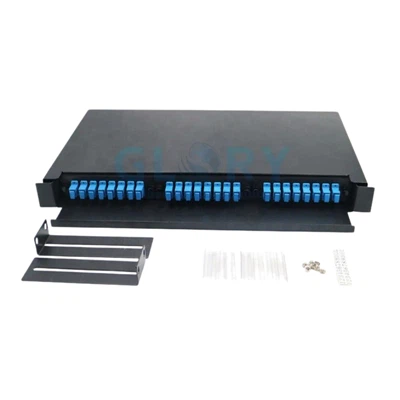
| Central Office / ODF | Fiber distribution, patch management | Optical Distribution Frame / Fiber Patch Panel | Fiber Optic Patch Panel |
| Feeder Route (aerial/duct/buried) | Protect and branch feeder cable splices | Dome or Horizontal Fiber Optic Splice Closure | Fiber Optic Splice Closure |
| Distribution Point (street cabinet, pedestal) | House PLC splitter, manage distribution fibers | Fiber Optic Enclosure + PLC Splitter | PLC Splitter |
| Access Point (pole, wall, pedestal) | Terminate feeder, connect drop cables | Fiber Access Terminal (FAT/NAP) - Termination Box | Fiber Optic Termination Box |
| Subscriber Premises Entry | Protect drop cable entry, connect ONT | Fiber Optic Wall Outlet / Wall Box | Fiber Optic Wall Outlet |
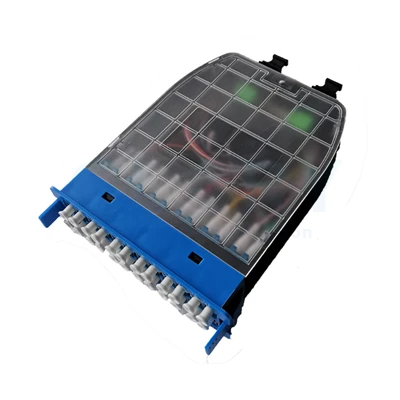
| High-Density / Data Center Links | High-fiber-count trunk connections | MTP/MPO Trunk Cable + Fiber Optic Patch Panel | MTP/MPO Cable |
Fiber Optic Splice Closure: Dome vs. Horizontal - How to Choose
The fiber optic splice closure (FOSC) is the most frequently misspecified passive component in FTTH builds. Getting this decision wrong increases truck rolls, reduces network longevity, and can cause signal degradation years after deployment.
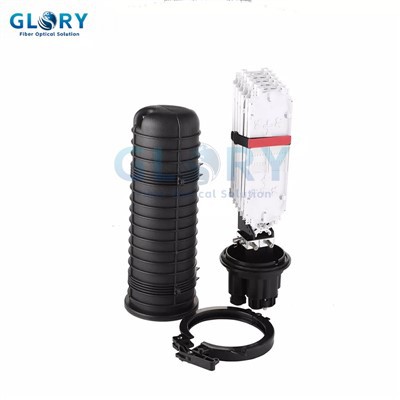
Dome (Vertical) Splice Closures
Dome closures are designed for branching applications - locations where multiple distribution cables fan out from a single feeder cable. Their cylindrical form allows multiple cable entries from the base, making them ideal for distribution points on aerial routes, in pedestals, and at buried handholes. Capacity ranges from 48 fibers to 864 fibers. The dome design naturally sheds water and provides excellent IP68 sealing when properly installed.
Best for: Aerial branching points, buried distribution nodes, rural feeder distribution, backbone-to-distribution transitions.
Horizontal (Inline) Splice Closures
Horizontal closures are designed for straight-through or pass-through applications - locations where a cable needs to be spliced without significant branching. Their elongated, clamshell or cylindrical form is more compact and easier to mount on aerial messenger wire or in narrow duct conduits. Capacity typically ranges from 48 to 288 fibers. They offer excellent mechanical protection and IP66/IP68 ratings when sealed correctly.
Best for: In-line aerial splices, duct route mid-span splices, cable extension joints, locations with limited space.

PLC Splitter Selection: Ratio, Housing, and Insertion Loss

The planar lightwave circuit (PLC) splitter divides the optical signal from the OLT among multiple subscriber connections. The most common ratios in FTTH deployments are 1×8, 1×16, 1×32, and 1×64. Key selection parameters:
Split ratio: Higher ratios reduce fiber and OLT port costs but increase insertion loss. A 1×32 splitter adds approximately 15.5 dB of insertion loss. Verify your optical power budget before selecting ratio.
Housing type: Bare chip splitters for integration into custom enclosures; ABS module or LGX cassette for plug-in patch panel deployment; mini tube for dense ribbon cable integration.
Operating wavelength: Ensure the splitter supports your PON standard - typically 1310/1490/1550 nm for GPON, or 1270/1577 nm for XGS-PON / 10G-PON.
MTP/MPO Cabling for High-Density and Data Center Applications
For BEAD ISPs also building or upgrading headend data centers, or for operators deploying aggregation nodes, MTP/MPO-based pre-terminated trunk cabling dramatically reduces installation time and eliminates field splicing errors at high-density connection points. A single 24-fiber MTP trunk replaces 24 individual patch cords, reducing rack space and insertion loss.
Key data center cabling decisions: trunk polarity (Method A, B, or C), fiber type (OM4 or OM5 for 40/100/400G multimode; OS2 G.652D for singlemode), and cassette vs. hardened panel for your management preference.

Glory Optic: Complete ODN Component Portfolio
We are looking for a cooperative partner to expand our business.
Fiber Optic Splice Closure
IP68 dome and horizontal closures. 48–864 fiber capacity. Aerial, buried, duct deployments.
Fiber Optic Termination Box
FAT/NAP boxes for subscriber access points. Including Sticklok rapid-deploy connector system.
FTTH Drop Cable
G.657A1/A2 bend-insensitive drop cables. Indoor, outdoor, figure-8 self-support options.
PLC Splitter
1×2 to 1×64. Bare chip, ABS module, LGX cassette, mini tube housing options.
Fiber Optic Patch Panel
SC/LC/MPO 1U–4U rack panels. ODF 24–96 port. Data center and headend management.
MTP/MPO Trunk Cable
Pre-terminated 12/24 fiber MTP–MTP and MTP–LC breakout. OS2 singlemode and OM4/OM5.
FAQ: People Also Ask About FTTH Fiber Optic Supply and ODN Components
Q: Why are FTTH fiber optic cable prices rising in 2026?
A: Three simultaneous demand waves hit a structurally limited supply base. First, AI hyperscale data centers require 5–10× more fiber than traditional cloud facilities - a single GPU cluster needs 36× more fiber interconnects than equivalent CPU racks. Second, the $42.45 billion US BEAD broadband program reached peak deployment in 2026, adding massive domestic demand. Third, fiber-guided military drones created a new structural consumer of G.657A bend-insensitive grades, absorbing an estimated 25–45% of specialty fiber production capacity. Meanwhile, optical fiber preform production - the upstream raw material - requires 18–24 months to expand, so new capacity cannot arrive quickly. The result: G.652D prices up 30–70%, G.657A2 prices nearly doubled since mid-2025.
Q: What is the current lead time for fiber optic cable in the US in 2026?
A: For US-domestic BABA-compliant fiber cable (required for BEAD project construction), Corning is quoting approximately 52 weeks for standard loose-tube G.652D cable. Normal market lead times are 8–12 weeks; historically, tightness never pushed them past 15–20 weeks. For passive ODN components (splice closures, termination boxes, PLC splitters) sourced internationally from ISO-certified Asian manufacturers, lead times remain 4–8 weeks factory-to-port, plus shipping.
Q: What is a fiber optic splice closure and how is it used?
A: A fiber optic splice closure (FOSC) is a weather-sealed enclosure that protects fiber fusion splices at distribution and branching points in an outdoor optical distribution network (ODN). FOSCs are placed at locations where cables are joined (inline) or where feeder cables branch into distribution cables. They protect against moisture, dust, UV radiation, temperature swings, and mechanical impact - all of which can cause signal loss or service failure in unprotected splices. IP68-rated FOSCs are tested for water ingress resistance at 1 meter depth for 24 hours and are suitable for aerial, buried, duct, and pedestal deployment.
Q: What is the difference between dome and horizontal fiber optic splice closures?
A: Dome (vertical) splice closures have a rounded, cylindrical body with cable entries at the base and are designed for branching applications - multiple cables fan out from a single feeder at distribution nodes. They handle higher fiber counts (48–864 fibers) and are commonly used in aerial, pedestal, and buried deployments. Horizontal (inline) splice closures have an elongated, flat-profile body designed for straight-through cable splices on aerial runs or in narrow ducts. They are more compact (48–288 fibers) and easier to install on messenger wire. Choose dome for branching points; choose horizontal for inline route splices.
Q: What passive ODN components does a complete FTTH network require?
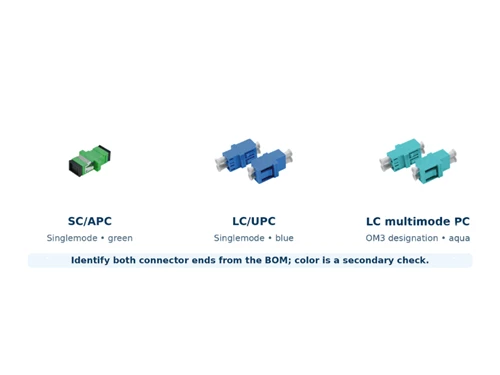
A: A complete FTTH passive optical distribution network requires: (1) Fiber optic splice closures (FOSC) at feeder and distribution splice points; (2) Fiber optic termination boxes / FAT boxes at subscriber access points; (3) PLC splitters (1×4 to 1×64) at distribution points to divide the optical signal; (4) FTTH drop cable (G.657A1/A2) from access terminal to subscriber; (5) Fiber optic wall outlets at subscriber premises; (6) Fiber optic patch panels and ODFs at the central office or headend; (7) Fiber optic patch cords, pigtails, and adapters for connections and splicing throughout.
Q: Can BEAD ISPs source fiber optic components from China?
A: BABA (Build America, Buy America) rules apply specifically to optical fiber and optical cable used in BEAD-funded construction, requiring these to be US-manufactured. However, passive ODN components - including fiber optic splice closures, termination boxes, PLC splitters, fiber optic patch panels, MTP/MPO cables, fiber optic adapters, and pigtails - are not classified as "optical fiber cable" under BABA and may legally be sourced internationally. BEAD ISPs can reduce procurement costs and lead times significantly by sourcing these passive components from ISO-certified international manufacturers like Glory Optics, while reserving US-domestic sourcing for the fiber cable itself.
Q: How do I choose between G.652D and G.657A fiber for FTTH?
A: G.652D is the standard single-mode fiber used for feeder and distribution cable runs in FTTH networks. It has excellent attenuation (≤0.20 dB/km at 1550 nm) and is the industry-standard choice for trunk and distribution routes where cables are handled carefully and bend radii are not constrained. G.657A (A1 and A2 variants) is a bend-insensitive single-mode fiber with the same 9/125 µm core and attenuation specs, but capable of much tighter minimum bend radii - down to 7.5 mm for G.657A2 vs 30 mm for G.652D. G.657A should be specified for FTTH drop cables running into subscriber premises, through tight cable ducts, around building corners, and anywhere cable handling may cause tight bends. Use G.652D for trunk routes; use G.657A for the last-mile drop.
Q: How long will the fiber optic supply shortage last?
A: Industry consensus points to continued price pressure through Q1–Q2 2026, potential stabilization in Q3–Q4 2026 if military drone demand moderates, and meaningful easing by late 2027 when new preform and drawing tower capacity comes online. The shortage is structural - driven by simultaneous AI, broadband, and military demand spikes - not cyclical. Plan procurement assuming tight market conditions through at least end of 2026, with gradual normalization through 2027.