
Optical splitters all divide or route light, but they do not all solve the same installation problem. A splitter that works well as a 90/10 monitoring tap may be a poor choice for a 1×32 FTTH fan-out. A compact PLC module that fits neatly inside an eight-port distribution box may be unnecessarily difficult to service in a central-office rack.
In practice, splitter selection is shaped by more than the split ratio. Enclosure space, factory integration, field labor, connector strategy, environmental protection and future maintenance all influence which product format makes sense.
That is why the most useful question is not simply "FBT or PLC?" It is: where will the splitter be installed, who will handle it, and how will it be tested or replaced over the life of the network?
Why Do Different Deployment Conditions Create Different Splitter Requirements?
The optical function may be similar, but the installation pressure changes from one location to another. In compact closures, every millimeter matters. In outdoor cabinets, handling protection becomes more important. In central offices, labeling and replaceability often matter more than minimum module size.
Power Distribution
Some links need an equal 1×N fan-out, while monitoring and control systems may need an unequal 90/10 or 95/5 optical tap.
Available Space
A splice closure, compact NAP and rack-mounted ODF provide very different space for modules, pigtails and service loops.
Installation Method
Factory integration favors compact splice-in formats; field installation may favor protected and connector-ready modules.
Maintenance Model
A module that is rarely touched can prioritize density, while a field-replaceable unit needs clear access, labeling and protection.
These design pressures explain why FBT couplers, bare fiber PLC, blockless PLC, ABS box PLC and cassette PLC splitters continue to coexist rather than being replaced by one universal format.
Why Different Splitter Types Stand Out in Real Deployment Scenarios
Case 1: A 90/10 FBT Coupler for Optical Power Monitoring
Consider a test system, optical sensor network or equipment-monitoring link where most of the optical power must continue along the main path, but a small portion is needed for a detector or measurement port. Sending equal power to both branches would waste link budget and may provide more power to the monitoring path than the receiver needs.
In this case, an FBT fused fiber coupler with a 90/10, 95/5 or other specified coupling ratio is a natural fit. The FBT process is especially useful for low-port-count, unequal power division rather than large equal-output fan-outs.

FBT couplers are useful when a design needs a controlled unequal split rather than many equal output ports.
Case 2: Bare Fiber PLC Inside a Factory-Assembled Splice Closure
A compact splice closure or custom passive module may already provide a protected tray, a dedicated chip pocket and controlled fiber routing. The splitter will be installed and fusion-spliced during factory assembly, then remain inside the enclosure without routine field handling.
Here, a bare fiber PLC configuration can reduce unnecessary packaging. Its role is not to act as a standalone field product, but to provide equal 1×N splitting inside a larger assembly that already supplies mechanical protection.

Bare fiber formats are intended for controlled integration where the surrounding enclosure provides the final protection.
Case 3: Blockless PLC Inside a Compact 8- or 16-Port FDB
Small FTTH distribution boxes often need a 1×8 or 1×16 splitter, splice storage, adapters and incoming-cable fixation in the same enclosure. A full ABS module may consume too much room, while a bare fiber unit may offer too little protection for normal assembly and maintenance.
A blockless PLC splitter provides a middle ground. The compact protected module can be fixed inside the FDB, while 0.9 mm buffered pigtails are routed to the splice or adapter area.

A blockless PLC splitter balances module protection with the limited space available inside a compact FDB or NAP.
Case 4: ABS Box PLC in an Outdoor Distribution Cabinet
An outdoor distribution cabinet or larger wall-mounted FDB may need a 1×16 or 1×32 splitter that can be installed, tested and replaced as an identifiable module. Technicians may access the cabinet during subscriber activation or troubleshooting, so the splitting component needs more handling protection than an internal OEM module.
An ABS box PLC splitter suits this maintenance model. The housing protects the PLC assembly, while the external pigtails can be supplied unterminated, connectorized on one side or connectorized on both sides depending on the cabinet design.
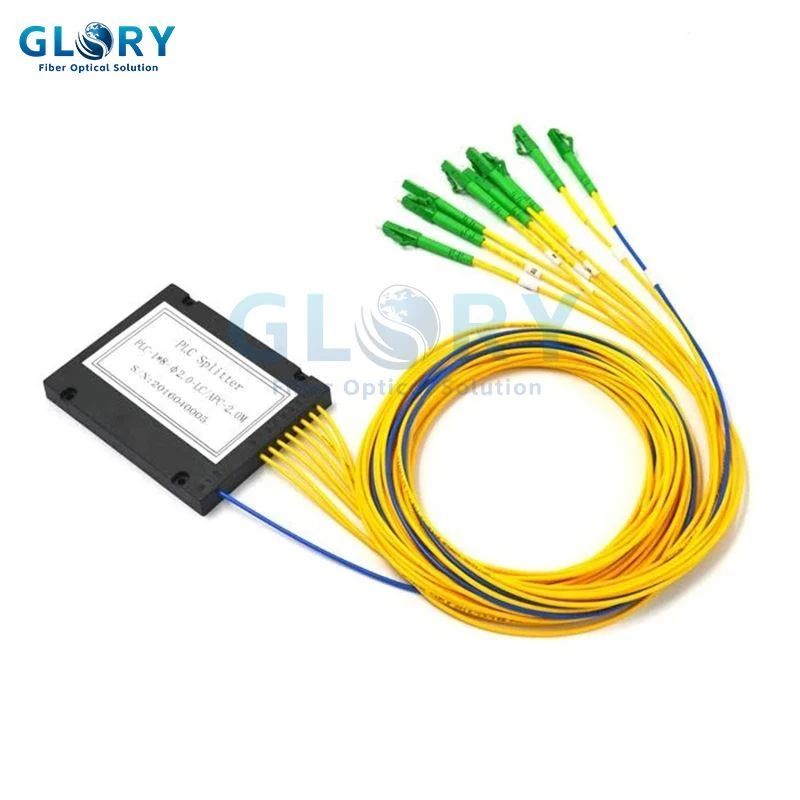
ABS box PLC splitters provide a more protected, identifiable module for larger FDBs and field-accessed cabinets.
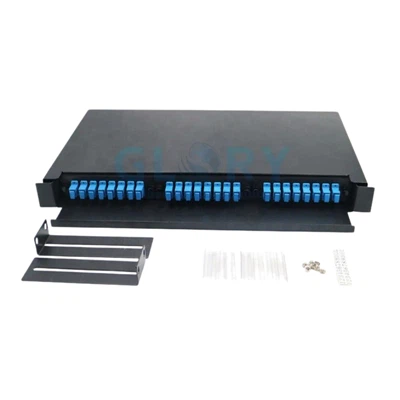
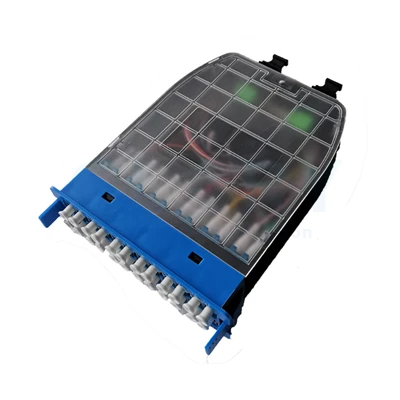
Case 5: Cassette PLC for Centralized Splitting in an ODF or Rack
At a central office, equipment room or building distribution frame, the priority often shifts from minimum module size to organized port access. Technicians need clear labels, consistent adapter positions and the ability to replace or expand splitter modules without disturbing nearby fiber routes.
A plug-in PLC splitter cassette is designed for this environment. The PLC component, adapters and fiber routing are contained in a module that can be installed into a compatible chassis or panel.
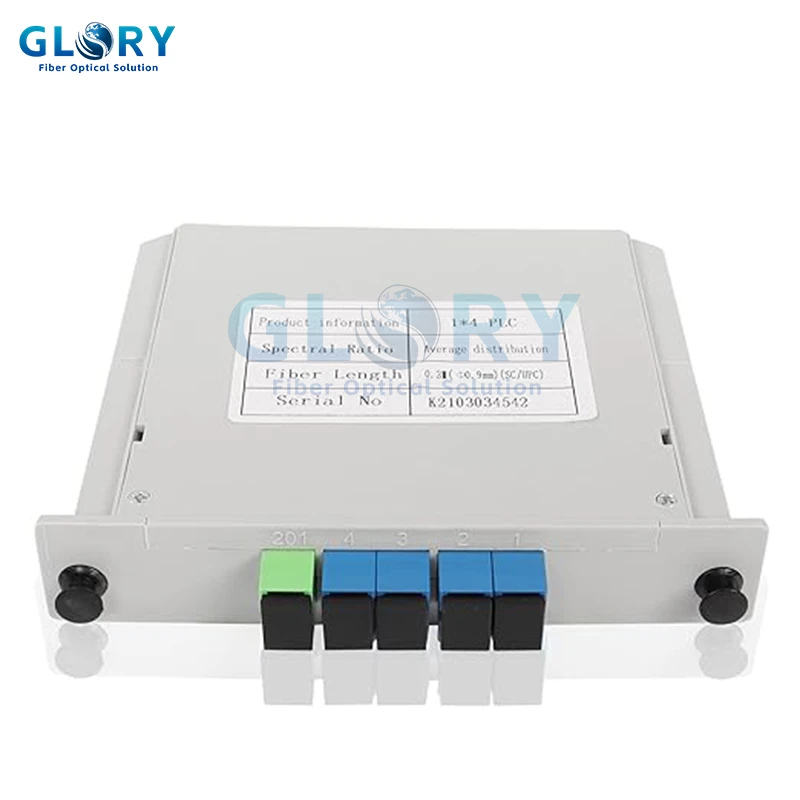
Cassette PLC modules prioritize organized access, labeling and replacement in centralized distribution locations.
Best-Fit Scenarios for Common Optical Splitter Formats
No single package is "best" for every project. The most suitable format is the one that matches the optical function and the physical maintenance model at the same time.
| Deployment Scenario | Typical Need | Recommended Format | Why It Fits |
|---|---|---|---|
| Optical monitoring or power sampling | Send most power onward and divert a small percentage to a detector | Unequal-ratio FBT coupler | Supports controlled low-port ratios such as 90/10 or 95/5 |
| Factory-built splice closure or custom passive module | Fit equal splitting into the smallest protected internal space | Bare fiber PLC | Avoids duplicate housing when the host product already provides protection |
| Compact 8- or 16-port FDB/NAP | Combine high-ratio splitting with tight internal routing | Blockless PLC | Balances compact size, chip protection and factory integration |
| Outdoor FDB or street cabinet | Install and service an identifiable standalone splitter module | ABS box PLC | Offers better handling protection and flexible pigtail/connector options |
| Central office, ODF or equipment-room rack | Organize, label and replace multiple splitter modules efficiently | Cassette/LGX PLC | Prioritizes standardized port access and modular maintenance |
What Should Be Confirmed Before Ordering?
Even when the application case is clear, the package name alone is not enough for a purchase order. The RFQ should define the complete configuration.
| RFQ Item | What to Specify | Why It Matters |
|---|---|---|
| Optical function | Equal 1×N split or unequal coupling ratio | Separates PLC fan-out requirements from FBT tap applications |
| Split count | 1×2, 1×8, 1×16, 1×32, 1×64 or 2×N | Directly affects insertion loss and available PON margin |
| Package | Bare fiber, blockless, ABS box or cassette | Determines how the splitter fits, mounts and is maintained |
| Fiber and pigtail | Fiber type, 250 μm/0.9 mm/2.0 mm/3.0 mm, and length | Controls routing, splicing, bend management and mechanical protection |
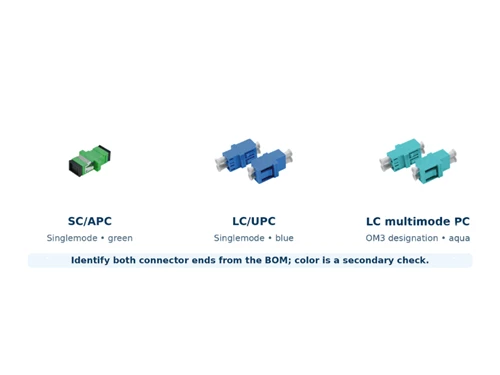
| Connector configuration | No connector, input only, output only or both sides; APC/UPC type | Changes field labor, serviceability and connection loss |
| Performance evidence | Worst-port insertion loss, uniformity, PDL, return loss and test wavelength | Allows the splitter to be checked against the actual link budget |
| Host enclosure | Internal dimensions, fixing point, adapter layout and routing clearance | Prevents a module from fitting on paper but failing during assembly |
For ratio planning, compare the complete worst-case path rather than the subscriber count alone. Glory Optical's 1×16 vs 1×32 PLC splitter guide explains the link-budget trade-off, while the PLC splitter test-report guide shows how to check port-level test data before bulk ordering.
Conclusion
Splitter selection becomes clearer when the installation problem is defined first. FBT fits controlled unequal taps. Bare fiber PLC fits protected factory integration. Blockless PLC fits compact FDBs. ABS box PLC fits field-accessed cabinets. Cassette PLC fits centralized, modular distribution.
The final choice should connect optical performance with real installation conditions: enclosure space, handling protection, connector strategy, maintenance access and test requirements.
Discuss Your Splitter Configuration