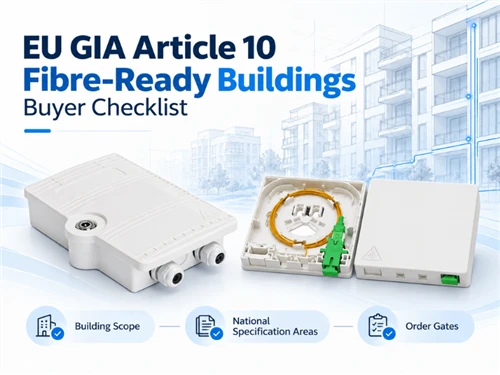

Quick answer. For new buildings and major renovation works, check whether the building permit application was submitted after 12 February 2026. For renovations covered by Article 10(3), check the separate energy-performance definition, cost and feasibility conditions. Then identify the national technical specification before ordering fibre, pathways, sockets or an access point.
Last updated: 29 September 2026
Article 10 of the Gigabit Infrastructure Act (Regulation (EU) 2024/1309) requires certain buildings to be equipped with a fibre-ready in-building physical infrastructure and in-building fibre wiring, and multi-dwelling buildings also with an access point. Article 10(1), (2) and (3) have applied since 12 February 2026. This guide is written for the point at which a passive package is being specified or ordered: which of the three Article 10 obligations applies to a given project, what the national technical specification has to cover, and what to check before an order is placed.
Claims in this guide come from four sources that do not carry the same force. The regulation itself is binding. The standards or technical specifications Member States adopt under Article 10(4), and the compliance procedures they set up under Article 10(5), are binding in the Member State that adopts them, and vary between Member States. BEREC guidance recommends rather than requires. Where this guide draws an engineering conclusion of its own from those sources, that conclusion is marked as an engineering observation rather than a legal test.
Is the project in scope? Three paths, three answers
Article 10 attaches the equipping duty in three different ways, and the three are not interchangeable. The fastest way to place a project is to identify which paragraph it falls under.
Path 1 - new construction and major renovation works, Article 10(1).
All newly constructed buildings and buildings undergoing major renovation works, including elements under joint ownership, are to be equipped with a fibre-ready in-building physical infrastructure and in-building fibre wiring, "including connections up to the physical point where the end user connects to the public network". The qualifying condition is the permit: the paragraph applies to buildings "for which applications for building permits have been submitted after 12 February 2026".
Path 2 - the access point, Article 10(2).
Newly constructed multi-dwelling buildings and multi-dwelling buildings undergoing major renovation works, again with permit applications submitted after 12 February 2026, are additionally to be equipped with an access point. Article 10(2) places no access-point duty on a single-occupancy building.
Path 3 - energy-performance renovation, Article 10(3).
This paragraph carries its own conditions and is not a copy of the first two. It requires all buildings undergoing major renovations as defined in Article 2, point (10), of Directive 2010/31/EU to be equipped with a fibre-ready in-building physical infrastructure and in-building fibre wiring, subject to two qualifications that attach to the whole duty: the equipping must not disproportionately increase the costs of the renovation works, and it must be technically feasible. Multi-dwelling buildings undergoing such renovations are also to be equipped with an access point.
The distinction between Paths 1 and 3 is worth holding on to, because Article 10(3) does not carry the permit-application cut-off that Article 10(1) and (2) carry. Where a building falls under Path 3, the questions are whether the works meet the energy-performance definition and whether the two conditions hold - not whether a permit application was submitted after 12 February 2026.
Wording note on the boundary. Article 10(1) and (2) use the word after, so on the literal wording of the regulation a permit application submitted on 12 February 2026 itself is not caught. That is the EU-law result and it does not depend on any national specification. Whether a national rule adds a requirement at that boundary is a separate question, and for a project sitting exactly on the date it is better put to the national authority than assumed either way.
Two definitions sit behind "major renovation". The GIA defines its own term in Article 2, point (9): civil works at the end user's location that encompass structural modifications of the entire in-building physical infrastructure or a significant part of it and that require a building permit under national law. That is the test in Article 10(1) and (2). Article 10(3) points instead to the energy-performance definition, so a deep energy retrofit can fall inside Article 10(3) without meeting the GIA's own definition.
That cross-reference has moved. Directive 2010/31/EU was repealed by the recast Energy Performance of Buildings Directive, Directive (EU) 2024/1275, with effect from 30 May 2026. The recast carries the test forward in Article 2, point (22): a renovation where the total cost relating to the building envelope or to the technical building systems is higher than 25% of the value of the building excluding land, or where more than 25% of the surface of the building envelope undergoes renovation, with Member States permitted to apply either limb. Anyone reading Article 10(3) is therefore reading it against the successor directive, and the operative text is the national measure that implements it.
Regulation and national rules. The GIA applies directly in Member States. Member States still adopt the technical specifications and compliance procedures required by Article 10(4) and (5), and the energy-performance definition used by Article 10(3) comes from a directive implemented nationally. Germany's digital ministry says its 2026 Telecommunications Act amendment is currently in the parliamentary process; until national rules are adjusted, the German act and the GIA must be read together (BMDS GIA FAQ).
"Multi-dwelling" is not defined in the regulation. The definitions in Article 2 run from (1) to (12) and do not include it, although recital 48 describes multi-dwelling buildings as the class that receives the access point and expects empty ducts from every dwelling to the access point. How a given building is classified is a matter for national law and for the technical specification adopted under Article 10(4); the regulation does not settle it, though its recitals describe the class the access point requirement is aimed at.
Three dates attach to this regulation and they govern different things.
| Date | What it governs | Source |
|---|---|---|
| 12 November 2025 | The general date of application of the regulation, under Article 19(2). It is also the date by which Member States had to adopt the Article 10(4) standards or technical specifications, and the date by which BEREC had to publish its Article 11(6) access guidelines. Article 19(3)(a) had already applied Article 11(6) from 11 May 2024. | Regulation (EU) 2024/1309, Articles 19(2), 19(3)(a), 10(4) and 11(6) |
| 12 February 2026 | The date from which Article 10(1), (2) and (3) apply, under Article 19(3)(c). It is also the permit-application cut-off written into Article 10(1) and (2). | Regulation (EU) 2024/1309, Articles 19(3)(c) and 10 |
| 12 May 2026 | The date the European Commission describes as the point at which the act "fully applies". It corresponds to Article 19(3)(d), which defers Article 4(3), Article 6(1), Article 7(2) and (3) and Article 12(1), (2) and (3) - the single-information-point machinery, not Article 10. | European Commission, Gigabit Infrastructure Act; Regulation (EU) 2024/1309, Article 19(3)(d) |
The 12 May 2026 milestone concerns other provisions; the Article 10 dates are shown in the table above.
| Building situation | Article 10(1) and (2) apply? | Access point required? |
|---|---|---|
| New construction, permit application submitted after 12 February 2026 | Yes - fibre-ready infrastructure and fibre wiring | Only for multi-dwelling buildings, under Article 10(2) |
| New construction, permit application submitted before 12 February 2026 | No, under Article 10(1) and (2) | No, under Article 10(2) |
| Major renovation works meeting the GIA Article 2(9) definition, permit application after 12 February 2026 | Yes | Only for multi-dwelling buildings |
| Major renovation meeting the energy-performance definition, with the cost and feasibility conditions of Article 10(3) | Yes, subject to those two conditions. The permit-application cut-off does not apply to this paragraph | Only for multi-dwelling buildings |
| Building in a category identified by the Member State as disproportionate under Article 10(7), or identified as exempt under Article 10(8) | No | No |
Worked example. A new 24-dwelling building with a permit application submitted on 1 March 2026 falls under Article 10(1) and (2): the project needs fibre-ready infrastructure, in-building fibre wiring and an access point. The buyer must still check the Member State's specification, any applicable exemption and the project drawings before selecting components.
Two exemption routes exist and neither is a general escape clause. Article 10(7) removes paragraphs 1, 2 and 3 from categories of buildings where compliance is disproportionate in terms of cost for individual or joint owners on objective grounds, and instructs Member States to identify those categories on duly justified and proportionate reasons. Article 10(8) deals with building types - monuments, historic buildings, military buildings and buildings used for national security purposes, as defined in national law - which Member States must identify as either exempt or subject to the obligations with proper technical adaptations, and must publish through a single information point.
A third item is voluntary. Under Article 10(6), buildings equipped in accordance with Article 10 are eligible to receive a "fibre-ready" label on a voluntary basis and following national procedures, where a Member State has chosen to introduce such a label. Absence of the label is not evidence of non-compliance, and no European body issues it.
Article 10 buyer checklist: seven specification areas and five order gates
Article 10(4) is the most directly useful part of the regulation for a buyer, because it is where the EU legislator names the physical items a compliant building has to be able to receive. It requires each Member State, in consultation with interested parties, to adopt the standards or technical specifications needed to implement paragraphs 1, 2 and 3, and it sets a floor for their content. Two features of that floor are easy to miss: the specifications must "easily allow ordinary maintenance activities for the individual fibre wirings used by each operator", and they must cover at least seven named areas.
Seven areas to check against the national specification
Those seven areas are a sound frame for a package review, with one caveat. They are not seven supplied products. Some are product specifications, some are design requirements, and some are installation or verification requirements, and different parties are answerable for each.
| Article 10(4) item | What the national specification must set | Main owner of the check | Buyer check before ordering |
|---|---|---|---|
| (a) | Building access point specifications and fibre interface specifications | The passive supplier for the interfaces presented; the designer for where the access point sits, since it may be inside or outside the building. The regulation does not prescribe a particular housing for it - that is a matter for the national specification. | Match the planned access-point position, usable space, entries and fibre interface to the applicable clause and drawing. |
| (b) | Cable specifications | The passive supplier: riser runs, floor distribution and the drop to each unit. | Record the required fibre type, cable construction and declared performance for each route. |
| (c) | Socket specifications | The passive supplier, for the outlet or termination point inside the dwelling. This is a specified item, not a fit-out afterthought. | Confirm socket type, adapter/interface, port count and location for each dwelling. |
| (d) | Specifications of conduits or micro-ducts | Supplier or contractor, depending on scope: the pathway must exist before any cable can be pulled or blown in. | Check duct or micro-duct dimensions, route capacity and pull/blow method against the plans. |
| (e) | Technical specifications needed to prevent interference with electrical cabling | The designer and the installing contractor. This constrains route and containment choice on the actual floor plans; it is not satisfied by a product datasheet. | Obtain a drawing that shows the required separation or protection from electrical cabling. |
| (f) | Minimum bend radius | The supplier for the cable and pathway limits; the designer for whether the route can respect them. This is what decides whether bend-insensitive single-mode categories are needed on tight indoor routes. | Compare the cable and pathway bend limits with the tightest planned route. |
| (g) | Technical specifications for the cabling installation | The installing contractor, verified at handover: how the cabling is fixed, supported and left. | Name the installation method, contractor responsibility and handover evidence required by the national clause. |
Read together, items (a) to (d) and part of (f) map onto supplied passive components, while (e), (g) and the ordinary-maintenance requirement are design, construction and verification matters. A bill of materials on its own cannot demonstrate compliance with those, and should not be offered as if it could.
The applicable national specification matters as much as the EU list. In Belgium, BIPT published a proposal of technical specifications on 15 June 2026, after two consultations. BIPT states that the proposal is not yet legally binding and may change before publication in the Belgian Official Gazette. A Belgian order should therefore identify the current legal instrument and treat this proposal as a draft, not as an adopted specification.
Spain shows the opposite sequence. Its regime for common telecommunications infrastructure inside buildings, set by Royal Decree 346/2011, predates this regulation and already covers fibre-based access networks among the access networks it regulates (Royal Decree 346/2011, Spanish Official State Gazette). The consequence for a buyer is that a figure quoted from a national regime - a stated number of fibres per dwelling, for instance - is a national figure, not an EU one.
Five order gates
Use these five gates with the seven-area table above. Keep a copy of the national clause, mark the applicable items on the drawing and name the evidence required before the order is released. Items outside the supplier's scope still need an assigned designer or installer.
| # | Check | What to establish | Where it comes from | What releases the order |
|---|---|---|---|---|
| 1 | Applicable obligation | Which of the three Article 10 paths applies, and whether the building type falls in a category the Member State has identified under Article 10(7) or (8) | The regulation, plus the national measure identifying exempt or disproportionate categories | The applicable paragraph is named in the order file, with the exemption question closed |
| 2 | National specification | The standard or technical specification in force where the building stands: which version, which Article 10(4) areas it covers, which of its clauses are mandatory | The national authority that adopted it | The clause numbers the package is specified against |
| 3 | Drawings and rights | Where the access point sits, who holds the right to use it, whether its size and entries allow a second operator to work, whether route separation from electrical cabling works on the floor plans | The drawing set, and the party that will hold the right to use | A marked-up drawing showing the access point, the routes and the separation |
| 4 | Acceptance evidence | Which characteristics are recorded, at which points, against which limit, in what units, and by which method, tied to the assembly or port identifier | Agreed in the order; for the fibre, end-face and loss criteria with the method named | An acceptance plan that names the method and lets each result be traced to one delivered item |
| 5 | Compliance procedure | Which procedure under Article 10(5) applies in that Member State, whether it includes on-site inspection of the building or a representative sample, and who is responsible for producing that evidence | The national procedure under Article 10(5) | The procedure, the responsible party and the stage at which evidence falls due are named in the order. The inspection records themselves belong to handover rather than to order release |
Complete the order gates before purchase. The inspection and test records identified in gate 5 usually arrive at installation or handover. A bill of materials can document supplied components, but it cannot prove that routes were designed, installed or inspected to the national specification.
If national rules are still in draft: identify the status and the responsible authority in the order file. Size pathways and the access point for the project's foreseeable needs, then recheck the package when the final specification is published. This is a procurement precaution, not a substitute for the adopted national requirements. Any "fibre-ready" label under Article 10(6) is voluntary and national; it does not replace the Article 10(5) compliance procedure.
Component examples for the order file
These three component families illustrate the access-point, socket and cable rows of the seven-area check. Match a specific model to the applicable national clause and approved drawing before ordering.

Indoor fibre distribution box
The Article 10 access point may sit inside or outside the building. An indoor distribution box is where a multi-dwelling building's riser, splitter field and operator interface are gathered, so its port count, cable entries and working space decide whether a second operator can be connected later.
View product details →
Fibre optic wall outlet
Article 10(4)(c) requires national specifications to set socket specifications. The outlet inside the dwelling is therefore part of the Article 10 package, and its adapter type, port count and cable entry need to be fixed against the drawing rather than chosen on site.
View product details →
Indoor tight-buffered fibre cable
In-building fibre wiring runs from the access point to the network termination point. Cable construction, jacket and bend performance are what the national specification covering cable and minimum bend radius will be checked against.
View product details →Product photographs are from the linked Glory Optical product pages. They show component types a fibre-ready in-building installation uses; they are not a statement that any model complies with Article 10 or with any national technical specification. The approved datasheet, together with the national specification in force where the building stands, governs the order.
Access point, infrastructure, termination point: the boundary
Three terms sit within a few lines of each other in the regulation and they mark the commercial boundary of a project, so they are worth separating before any order is placed.
Two boundary points. The building access point is where a network provider connects to the building's fibre-ready infrastructure. The network termination point marks the end of the public network at the end-user location. Their precise legal definitions govern; the project drawing should show both points and the fibre route between them.
Article 2(11) of the GIA defines the access point as a physical point inside or outside the building that network providers can access to connect to the fibre-ready in-building physical infrastructure (Regulation (EU) 2024/1309). The GIA borrows the definition of "network termination point" from Directive (EU) 2018/1972 rather than defining that term itself.
Article 2 supplies three related definitions:
- In-building physical infrastructure: installations at the end-user location intended to host access networks connecting the building access point and network termination point.
- Fibre-ready in-building physical infrastructure: that infrastructure when intended to host optical fibre elements.
- In-building fibre wiring: optical fibre cables connecting the access point and network termination point to deliver electronic communications services.
"Fibre-ready" describes infrastructure intended to host optical fibre elements; it does not by itself mean the fibre has been installed. Article 10(1) and (3) require both fibre-ready infrastructure and in-building fibre wiring. Recital 50 allows other technologies to share the in-building infrastructure and allows the owner to add wiring alongside fibre.
For a buyer, the operative point is that the access point is designed to be used by more than one operator, and this is stated in the regulation itself rather than only in guidance. Recital 49 records that a physical point can aggregate the wiring connecting specific end-user locations, and that it is important that access points serving new multi-dwelling buildings and multi-dwelling buildings subject to major renovation works "are easily accessible by more than one operator, without excessive effort". BEREC's Article 11(6) guidelines develop the same point, adding that the access point may be the first concentration or distribution point, that a point nearer to end users is generally more conducive to infrastructure competition, and that it may be located in a basement, in a similar facility just outside the building, or outside the building altogether depending on network topology (BEREC Guidelines on the access to in-building infrastructure, BoR (25) 142). Specifying a single-operator terminal, or an access point too small for a second operator to work in, runs against that expectation; whether it breaches a given national specification is a question for that specification, not for this guide.
Who owes what: Article 10 duties and Article 11 rights
Article 10 and Article 11 face in opposite directions and are read together. Article 10 places the equipping duty on the building project; Article 11 gives network providers the right to reach and use what the building has provided, and places obligations on whoever holds the right to use it. Only the parts that change a procurement decision are set out here.
| Question | Article 10 | Article 11 |
|---|---|---|
| Who carries the duty? | The building, through the project that delivers it - new construction and major renovation, including elements under joint ownership. The regulation states the duty on the building; which party is answerable in practice depends on national law and on the project contracts | The holder of a right to use the access point and the in-building physical infrastructure |
| What is required? | Fibre-ready in-building physical infrastructure, in-building fibre wiring, and for multi-dwelling buildings an access point | Meeting all reasonable written requests for access from network providers on fair, reasonable and non-discriminatory terms and conditions, including price where appropriate |
| What does the operator get? | Nothing at this stage; Article 10 is silent on operators | The right to roll out its network at its own cost up to the access point, and the right to access existing in-building physical infrastructure where duplication is technically impossible or economically inefficient |
| What if there is no fibre-ready infrastructure? | Not applicable | The operator may terminate its network at the subscriber's premises, subject to agreement of the owner and/or subscriber and national law, minimising impact on third-party private property |
| How is it enforced? | Member States must ensure compliance and set up procedures to demonstrate it, which may include on-site inspection | Disputes go to national dispute settlement bodies, following the criteria in the BEREC guidelines |
Two BEREC positions bear on the access-point decision. The guidelines recommend that utilisation of the in-building physical infrastructure remain in general free of charge by the building owner where the owner owns that infrastructure. Where the infrastructure was installed and is owned by a network operator and therefore already hosts fibre, BEREC takes the view that fair and reasonable prices should not deplete a reasonable first-mover advantage, and that access to the fibre itself should be considered first where it is available (BEREC Guidelines on the access to in-building infrastructure, BoR (25) 142). Both positions push in the same direction for a developer: the building's passive layer is the shared asset, and the access point is where sharing happens or fails.
One boundary is worth stating explicitly, because it is easily assumed away. BEREC records that the availability of in-building physical infrastructure is required to be made available to market participants under the Act, whereas access to the in-building fibre wiring is regulated under the European Electronic Communications Code (BEREC Guidelines on the access to in-building infrastructure, BoR (25) 142). In purchasing terms, an operator's right to reach the access point does not by itself carry a right to use fibre that another party has already installed; the two questions rest on different instruments.
Decision rule. If the building is a new build or a major renovation caught by Article 10 and the developer funds the passive layer, specify the access point and pathways as multi-operator shared assets from the start - space, entries, bend radius and identification all decided at order time. If an operator has already installed and owns the in-building infrastructure, establish what exists and who holds the right to use it before ordering anything new, rather than assuming an Article 10 package can simply be layered on top.
What the regulation does not require
Before relying on a compliance claim, check whether it comes from the EU regulation or from a national rule. Three common questions illustrate the distinction.
A minimum number of fibres per dwelling. Article 10 does not set a fibre count. It requires a fibre-ready in-building physical infrastructure and in-building fibre wiring, and Article 10(4) requires national specifications to cover cable, socket, conduit and installation. Where a figure such as a minimum number of fibres from the network termination point, or a minimum number of fibres continuing to each dwelling, appears in a compliance claim, ask for the national clause it comes from. It may be real, but it is a national requirement, not an EU one.
An EU registry of compliant buildings or components. The regulation creates no European registration body and no EU product certification scheme for passive components. What it does create is a national compliance procedure under Article 10(5), a published list of exempt building types under Article 10(8) delivered through a single information point, and a voluntary national label under Article 10(6). A supplier asserting EU registration should be asked which instrument establishes it.
A single EU-wide compliance deadline. Because three dates attach to the same regulation, a claim that buildings must be fibre-ready from 12 May 2026 conflates them. As the date table above sets out, the 12 May 2026 milestone belongs to other articles of the regulation; Article 10 has applied since 12 February 2026.
One further remark on reading the text. Article 10(4) directs Member States to draw on established industry practice in consultation with interested parties. That is a directive to Member States about how the national specification is written; it is not a licence for a supplier to substitute its own product data for the published national specification.
Next step: release a traceable order
Record the applicable Article 10 path and national specification, then attach the seven-area check, drawing, bill of materials and acceptance plan to the request for quotation. Resolve missing national clauses or design responsibilities before releasing the order.
For a project-specific package, OEM/ODM configuration is where the port count, socket type, cable construction and interface are fixed against a drawing. Send the national specification clause number, the access point location, the building type and the drawing set, and the result to ask for is a bill of materials keyed to the Article 10(4) areas that apply to supplied items. Requests go through the quote request form.
Primary legal and regulatory references
Check the regulation and the access rules: Regulation (EU) 2024/1309 (Gigabit Infrastructure Act), European Commission page on the Gigabit Infrastructure Act, BEREC Guidelines on access to in-building infrastructure, BoR (25) 142 and BIPT's June 2026 draft technical specifications.
Check the energy-performance cross-reference: Directive (EU) 2024/1275 (EPBD recast) and the European Commission page on the Energy Performance of Buildings Directive.