
Have you ever walked into a data center or telecom room and been struck by the vibrant, rainbow-like array of fiber optic patch cords and pigtails? Fiber optic pigtails, in particular, come in a spectrum of colors-yellow, orange, blue, green, aqua. Is this just for aesthetics? Absolutely not.
In the world of fiber optics, color is a universal engineering language. Each hue carries specific technical information, forming a critical visual coding system that ensures efficient deployment, error-free maintenance, and long-term network reliability. Let's decrypt this "color code" using industry standards and see how it translates into practical solutions.
Part 1: The Core Function of Color – Instant Identification
The primary role of color is to enable fast, accurate physical layer identification. It serves two fundamental purposes:
1. Identifying the Fiber Type (Singlemode vs. Multimode)
This is the most crucial distinction, directly impacting whether your signal transmits correctly.
• Yellow
The nearly universal color for Singlemode Fiber. With a tiny core (typically 9μm), singlemode fiber is used for long-distance, high-capacity communication like metro backbones. A yellow jacket or connector immediately signals to a technician that it contains singlemode fiber.
• Orange or Aqua
The standard colors for Multimode Fiber. With a larger core (e.g., 50μm or 62.5μm), it's ideal for short-reach, high-bandwidth links inside data centers. Orange is traditional for OM1/OM2, while Aqua (or lime green) is the standard for modern, laser-optimized OM3/OM4 fiber designed for 10G, 40G, and 100G Ethernet.
2. Identifying Connector Polish Type (UPC vs. APC)
Color is also key on the connector ferrule itself, distinguishing the polish type critical for optical performance.
• Blue
Typically denotes the UPC (Ultra Physical Contact) polish. This is the most common type, with a slightly rounded endface that provides very good, low return loss connections for general data and telecom use.
• Green
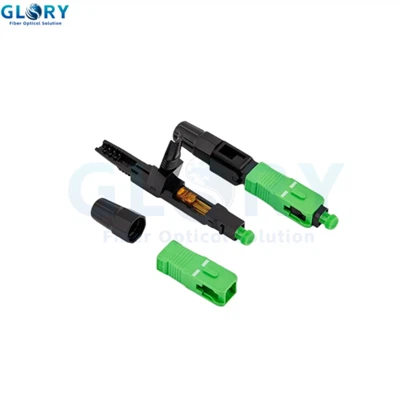
The exclusive identifier for the APC (Angled Physical Contact) polish. The endface is ground at an 8-degree angle to minimize back-reflection, achieving the best possible return loss (typically better than -65dB). You will almost always see a green connector on a yellow (singlemode) pigtail, as it's essential for reflection-sensitive systems like FTTH/PON networks and CATV.
Part 2: How Color Empowers Network Deployment & Operations
Understanding this code unlocks significant operational advantages:
• Boosts Deployment Speed
In a high-density patch panel, an engineer can instantly match a yellow-jacketed LC/APC (green connector) pigtail to the corresponding singlemode PON port, drastically reducing installation errors and time.
• Simplifies Troubleshooting
When a network issue arises, color allows for rapid physical layer audit. Checking all green APC connectors for secure mating is a standard step in diagnosing problems caused by reflective loss.
• Ensures Upgrade Compatibility
Color clearly indicates fiber capability during network upgrades. For instance, an aqua OM4 multimode pigtail explicitly supports 40G/100G SR4 connections, while an orange OM1 may not, preventing costly compatibility mistakes.
Part 3: Making the Right Choice
As a professional manufacturer of passive optical components, we at GLORY build our products around these universal standards. Our fiber optic pigtail lines strictly adhere to this color-coding:
We offer a complete range of Singlemode (yellow jacket) and Multimode (orange or aqua jacket) pigtails.
Connector types include LC, SC, FC, ST, and more, with our APC polish products consistently using the standard green connector for guaranteed compatibility with your PON splitters and OLT equipment.
We also support customization for clients with specific internal color-coding requirements.

A Quick Selection Guide:
1.Define the Application
For FTTH drop? Choose a yellow (singlemode) pigtail with green (APC) connectors. For data center rack interconnect? Choose an aqua (OM4 multimode) pigtail with blue (UPC) connectors.
2.Match the Ends
Ensure the connector types (e.g., LC, SC) and colors on both ends of the pigtail match your equipment ports.
3.Reference the Standards
For critical infrastructure, consulting standards like TIA-598 or IEC 60304 confirms the color code aligns with your project specifications.
Conclusion: Order in the Spectrum
The rich colors of fiber optic pigtails are far from decorative. They represent a sophisticated, globally recognized technical identification system. This system is foundational to the reliability, manageability, and maintainability of the entire fiber network. It translates complex technical parameters into immediate visual information, allowing the silent infrastructure to "speak" clearly and enabling the high-performance digital world we rely on.
The next time you see these colorful strands, you'll see more than just color-you'll see the fiber type, performance grade, and rigorous engineering logic they represent.
Explore Our Color-Coded Solutions: Discover GLORY's comprehensive range of fiber optic pigtails. We provide reliable, easy-to-deploy connectivity with clear, standards-based color coding. Whether you need standard singlemode/multimode pigtails or customized color solutions, we are here to meet your precise requirements.