Part 1: Why Aerial Accessories Matter
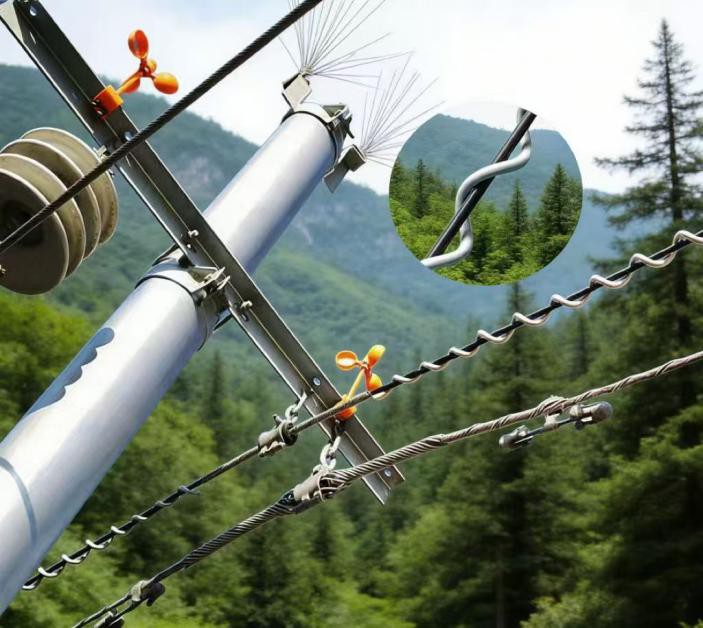
Aerial fiber cables (ADSS, OPGW, or figure‑8 drop cables) face relentless forces: wind, ice, temperature swings, and the cable's own tension over long spans (sometimes exceeding 800 meters). Without proper hardware, the cable would:
• Chafe against steel poles and cut through its jacket
• Slide out of position, changing sag and stressing splices
• Vibrate excessively, causing micro‑bends and eventual fiber breakage
Aerial accessories transfer mechanical loads from the cable to the supporting structure while protecting the delicate optical fibers inside. Choosing the right accessory for each pole position is not optional-it is essential for network reliability.
Part 2: Main Types of Aerial Cable Accessories
|
Accessory Type |
Primary Function |
|
Tension / Dead End Clamp (Fiber Clamp) |
Anchors the cable at terminal poles, angle points, and long span ends. Holds full rated tensile load (e.g., 10–20 kN). |
|
Suspension Clamp |
Supports the cable at intermediate poles where the line is straight or changes direction by less than 25°. Holds weight but not full tension. |
|
Downlead Clamp |
Guides the cable vertically from the pole top down to a splice enclosure, terminal box, or building entry. Prevents abrasion and controls bend radius (≥20× cable diameter). |
|
Spiral Vibration Damper |
Absorbs aeolian (wind induced) vibration that would otherwise fatigue fiber strands over time. Placed near clamps on spans longer than 150 m. |
|
Armor Rods / Preformed Grips |
Protect the cable jacket at clamp attachment points. Distribute stress and prevent crushing, especially for ADSS lines. |
Each accessory has a specific role. Using a suspension clamp where a dead‑end is needed (or vice versa) can create stress concentrations that slowly damage the cable-often without visible warning until a failure occurs. For example, a misapplied clamp on a 300‑m span in a windy coastal area may cause jacket abrasion within two years, leading to water ingress and costly replacement.
Part 3: Focus on Fiber Clamps (Tension / Dead‑End Clamps)
Among all aerial accessories, the fiber clamp-also called tension clamp or dead‑end clamp-is arguably the most critical.
What Does a Fiber Clamp Do?
A fiber clamp provides the anchoring point for an aerial cable. It must withstand the full rated tensile load of the cable: the cable's own weight over the span, plus additional forces from wind, ice, and temperature changes.
Fiber clamps are installed at:
• Terminal poles where the cable ends or transitions to underground
• Angle poles where the line changes direction by more than 25°
• Both ends of long crossing spans (rivers, highways, valleys)
• Entry points to substations or buildings
Tension Clamp Designs
There are two main engineering approaches:
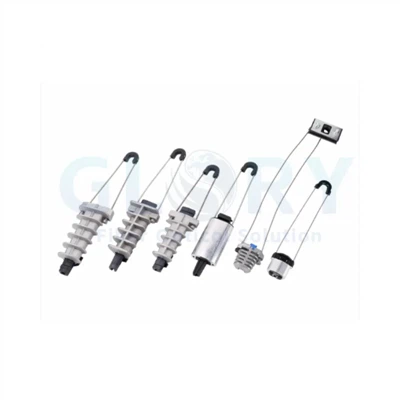
1.Preformed / Helical Tension Clamps: Pre‑shaped wire rods wrap around the cable, distributing tension over a long length. Gentle on the cable but require more space and careful alignment.
2.Wedge Clamps (Mechanical): A wedge block is pushed against the cable inside a tapered housing. As tension increases, wedge compression increases-self‑energizing. Wedge clamps are compact, tool‑friendly, and well suited for pole‑top spaces. Many modern designs use engineering plastics for the housing, offering excellent insulation and corrosion resistance.
Most telecom fiber clamps today use the wedge design because of its speed, reliability, and ease of installation.
Why Are Fiber Clamps So Important?
If a fiber clamp fails-slides, crushes the cable, or breaks-the entire line can sag or fall. Repairing a dropped aerial cable is expensive, dangerous, and time‑consuming (often requiring a bucket truck or climber plus a full re‑tensioning crew). A quality clamp, correctly installed, should last the life of the network (20+ years) without maintenance.
Key performance requirements for a good fiber clamp:
• Correct grip force - holds the cable under maximum load but does not crush the jacket or fibers. Typical acceptance: no slippage at 95% of rated breaking strength.
• Corrosion resistance - housings should be UV‑stable, moisture‑resistant, and salt‑fog tolerant (tested per ASTM B117).
• Material safety - for ADSS lines (which may be near live power conductors), the clamp body should be non‑conductive (engineering plastic) with high dielectric strength.
• Easy installation - wedge‑style clamps should allow quick, tool‑less or minimal‑tool fixing, especially important for work at height.
What If You Choose the Wrong Clamp?
Real‑world consequences of improper clamp selection include:
• Cable slippage leading to excessive sag, tension loss, and eventual pole‑to‑pole contact.
• Jacket crushing causing micro‑bends that increase attenuation (sometimes by 0.1–0.3 dB, enough to degrade a CPRI link).
• Corrosion of metallic parts in coastal or industrial environments, weakening the anchor after only a few seasons.
• Galvanic corrosion between dissimilar metals (e.g., steel loop on a galvanized bracket) if not properly isolated.
Part 4: Our Fiber Clamp Solutions
Glory Optic offers a range of fiber tension clamps designed for different cable diameters and load requirements. All share common engineering principles:
• Thermoplastic or engineering plastic bodies that resist UV, high/low humidity, and temperature extremes from –40°C to +85°C.
• Wedge‑based locking mechanisms for self‑energizing grip; some models achieve zero detectable slippage under 95% of rated tensile load.
• Corrosion‑resistant hardware (stainless steel bails or spring steel loops) that withstand salt spray and industrial pollution.
• Lightweight design (as low as 500 g) for easier pole‑top handling and reduced fatigue for climbing crews.
Our clamps are suitable for:
• FTTH aerial drop terminations (cable diameters from 5 mm to 16 mm)
• 5G backhaul and small cell aerial connections
• CATV and broadband overhead networks
• ADSS lines in power utility environments (with non‑conductive bodies)
We also offer models optimized for rapid deployment (reducing installation time by >30% thanks to push‑pull locking mechanisms) and heavy‑duty long spans (breaking loads up to 19 kN). Custom solutions for specific cable diameters and extreme climates (coastal salt fog, arctic cold, tropical humidity) are available upon request.

Part 5: Installation Best Practices
• Use tension clamps at termination and angle poles - never substitute a suspension clamp for a dead‑end. If unsure, consult the line design drawing.
• Match clamp gripping range to cable diameter - too loose and it will slip; too tight and it damages the jacket. Check the manufacturer's range table.
• Add a spiral vibration damper on spans longer than 150 meters or in steady‑wind areas. Install it approximately 0.5–1 m from the clamp body.
• Inspect after storms - check for loosening or cable movement, especially during the first year of service.
• For ADSS on power poles - ensure the clamp body is fully non‑conductive and rated for the voltage environment. Never use a metal‑bodied clamp near live lines.
Conclusion
Aerial cable accessories may be out of sight, but they should never be out of mind. A properly selected and installed fiber clamp-the tension/dead‑end clamp-provides the secure foundation for every overhead fiber line. It transfers extreme mechanical loads away from the delicate glass fibers, ensuring your network stays up through wind, ice, and time.
Whether you are building a new FTTH network, upgrading rural broadband, or deploying 5G small cells on existing poles, choosing the right fiber clamp is a small decision with a huge impact on long‑term reliability.