
Quick Answer: What Fiber Cabling Is Best for AI Data Centers?
For most AI data centers running 400G or 800G GPU clusters, the recommended physical-layer design is a structured fiber cabling system built around OM4, OM5, or OS2 fiber, low-loss MTP/MPO trunks, high-density patch panels, documented polarity, and full acceptance testing. Use OM4 or OM5 for short GPU-to-leaf links, and use OS2 single-mode fiber for spine, inter-building, DCI, or uncertain future-reach links.
| AI Data Center Link | Recommended Fiber | Recommended Connectivity | Best Internal Resource |
|---|---|---|---|
| GPU server to leaf switch | OM4 or OM5 | MTP/MPO trunk, MPO-12 or MPO-16 | MTP/MPO fiber assemblies |
| Leaf to spine switch | OM5 or OS2 | Low-loss MTP/MPO trunk or LC duplex | Data center cabling solutions |
| Patch panel cross-connect | OM4, OM5, or OS2 | High-density cassette-based patch panel | Fiber optic patch panels |
| Indoor backbone and equipment room | OM4, OM5, or OS2 | Indoor distribution cable or pre-terminated trunk | Indoor fiber optic cables |
If you already have a switch port map, rack elevation, or route sketch, send it to the Glory Optical engineering team. We can help convert it into a 400G/800G cabling bill of materials with fiber type, connector format, polarity, trunk length, patch panel layout, and acceptance-test requirements. Request a cabling quote →

1. Why Fiber Optic Cable Is the Right Foundation for AI Data Centers
AI data centers are not simply larger versions of traditional enterprise data centers. Large language model training, recommender systems, computer-vision workloads, and distributed inference pipelines all depend on high-bandwidth, low-jitter communication across many GPUs. The network must move gradients, model shards, checkpoints, storage traffic, and management traffic without turning cabling into the hidden bottleneck.
Copper still has a role for very short in-rack links, especially DAC runs under a few meters. But as soon as the design spans multiple racks, multiple rows, or multiple switch layers, fiber becomes the more scalable medium. Fiber gives higher bandwidth density, longer reach, lower cable weight, better airflow, and immunity to electromagnetic interference in dense 30–100 kW GPU rack environments.
1.1 Four Properties That Drive Optical-First Design
| Property | Why It Matters for AI Fabrics | Copper Equivalent |
|---|---|---|
| Bandwidth density | Single-mode and multimode fiber support high aggregate bandwidth while keeping pathways manageable. | Very short reach at the highest speeds; bulkier bundles at scale. |
| Latency stability | GPU collective operations are sensitive to inconsistent link behavior across a pod; fiber routes can be planned and matched more predictably. | DAC lengths are limited and harder to normalize across large rooms. |
| EMI immunity | Fiber is immune to electromagnetic interference from high-density power and cooling infrastructure. | Shielding increases diameter, weight, and pathway congestion. |
| Operational scale | Structured fiber cabling supports moves, adds, upgrades, and troubleshooting without a full cable-plant rebuild. | Direct copper becomes difficult to manage beyond rack-level distances. |
2. Choosing the Right Fiber Type: OM3, OM4, OM5, and OS2 Compared
The fiber type decision sets the ceiling for future speed upgrades. Transceivers and switches may be replaced every few years, but the glass can stay in the building for 15–20 years if it is installed and documented correctly. Choosing a lower-grade fiber plant to save a small percentage of the initial cabling cost can create a much larger re-pull cost during the next GPU hardware refresh.
Glory Optical's indoor fiber optic cable range includes OM4, OM5, and OS2 options for controlled data-center environments. The following selection rules apply whether the project is greenfield or a 400G-to-800G upgrade.
2.1 Full Comparison Matrix
| Fiber | Core | Jacket Color | 400G Use | 800G Use | Best Use Case |
|---|---|---|---|---|---|
| OM3 | 50 µm | Aqua | Legacy short links | Not recommended for new 800G builds | Maintain existing plant only. |
| OM4 | 50 µm | Aqua | Cost-effective short-reach multimode | Controlled short 800G-SR8 channels where loss margin is protected | GPU-to-leaf and intra-row links under about 100 m. |
| OM5 | 50 µm WBMMF | Lime green | Longer multimode reach and stronger upgrade path | Preferred multimode option when 1.6T planning matters | Future-proof multimode cabling where transceiver roadmap is uncertain. |
| OS2 | 9 µm | Yellow | Long reach, spine, DCI, campus, inter-building | Longer reach and cleaner future migration path | Spine links, DCI, inter-building routes, and any link above multimode reach. |
2.2 The 30-Second Fiber Selection Rule
| Scenario | Recommended Fiber | Rationale |
|---|---|---|
| Under 100 m, high-density, cost-sensitive GPU-to-leaf | OM4 + low-loss MTP/MPO | Strong $/port for common short-reach GPU pod designs. |
| Under 150 m and planning beyond 800G | OM5 | Better multimode upgrade path and wider wavelength support. |
| Spine, inter-building, DCI, or uncertain future reach | OS2 | Single-mode gives more reach flexibility and protects long-term architecture. |
| In-rack under 5 m | DAC copper where appropriate | Lowest cost and simple deployment for very short links. |
Do not select fiber only by the speed printed on the optics. A 400G link and an 800G link may both be short reach, but the 800G channel normally has tighter optical margin. Count every mated pair, cassette, panel, splice, and service loop before approving the fiber type.

3. Connectors and Polarity: MPO-12, MPO-16, MTP, and Getting Type-B vs. Type-C Right
Once link speeds move beyond 400G, many channels become parallel optical links. Instead of one transmit and one receive fiber, multiple lanes carry the total signal. At this point, connector quality and polarity discipline become leading causes of field failures. A perfect fiber cable can still fail if transmit and receive lanes are flipped incorrectly.
3.1 MPO vs. MTP
MPO is the multi-fiber push-on connector interface defined by IEC/TIA standards. MTP is US Conec's engineered MPO-compatible implementation with tighter mechanical tolerances, a floating ferrule, and typically lower insertion loss. For 400G and 800G, specify low-loss MTP/MPO assemblies where channel margin is narrow.
Glory Optical supplies MTP/MPO assemblies and trunks for high-density data center cabling, including OS2, OM4, OM5, MPO-to-MPO trunks, MPO-to-LC breakouts, polarity-labeled assemblies, and factory test documentation.
3.2 Fiber Count: MPO-8, MPO-12, MPO-16, and MPO-24
| Connector | Active Lanes | Common Speeds | Key Notes |
|---|---|---|---|
| MPO-8 | 4 Tx + 4 Rx | 100G-SR4, 400G-DR4 | Simple and widely supported; no spare fibers. |
| MPO-12 | 8 active + 4 unused in many designs | 100G, 200G, 400G | Workhorse connector for many current deployments. |
| MPO-16 | 8 Tx + 8 Rx | 800G-SR8 / DR8 | Commonly used where all 16 fibers are active. |
| MPO-24 | 24-fiber trunk or breakout | High-density migration trunks | Can break out to multiple lower-count MPO connectors. |
3.3 Polarity Management
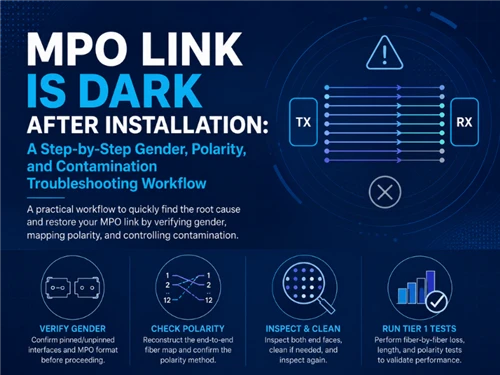
Polarity mismatches are one of the most common "link will not come up" problems in high-density AI fabrics. The problem is recoverable, but production debugging can waste hours if polarity was not documented before installation.
| Polarity Type | Mechanism | Recommended Use |
|---|---|---|
| Type A | Straight-through mapping | Legacy or very specific designs; confirm before using. |
| Type B | End-to-end reversal / pair flipping depending on system design | Dominant in many 40G–400G deployments. |
| Type C | Pair-reversed design used with specific duplex pair systems | May be appropriate for some 800G parallel optic designs; confirm with module and cassette wiring. |

3.4 APC vs. UPC End-Face
UPC connectors are common in multimode and many short single-mode data center links. APC connectors use an 8-degree angled end-face to reduce back-reflection and are common where return loss must be controlled. Never mate APC and UPC connectors together; the geometry mismatch can damage the end-face and create severe insertion loss.
4. Network Architecture: Frontend, Backend, Leaf-Spine, and GPU Rails
Every AI data center operates multiple networks, but the two most important from a cabling point of view are the frontend network and the backend AI fabric. They carry different traffic, behave differently under load, and should not be treated as the same cabling problem.
| Attribute | Frontend Network | Backend AI Fabric |
|---|---|---|
| Traffic pattern | North-south: user API, storage, management, orchestration. | East-west: all-reduce, gradient sync, collective communication. |
| Topology | Traditional three-tier or leaf-spine Ethernet. | Rail-optimized leaf-spine; often InfiniBand or RoCEv2 Ethernet. |
| Link speeds | 25G to 400G depending on layer. | 400G and 800G today; 1.6T planning is beginning. |
| Cabling style | Structured cabling with cross-connects and patch panels. | Pre-terminated MTP/MPO trunks, rail labels, short controlled paths. |
4.1 Rail-Optimized Leaf-Spine Architecture
In a rail-optimized GPU fabric, each GPU or NIC group is mapped to a specific switch rail. This pattern reduces congestion for collective operations and helps keep hot training traffic predictable. For the cabling team, it means the trunk plan must mirror the GPU-to-leaf rail map exactly. A cabling label is not just a label; it becomes part of the cluster topology.
4.2 Recommended Physical-Layer Layout
| Layer | Typical Components | Cabling Recommendation | Why It Matters |
|---|---|---|---|
| GPU rack | GPU servers, NICs, short patch cords | Short, clearly labeled patching with bend-radius control. | Reduces local link faults and simplifies server replacement. |
| Leaf layer | Leaf switches, MTP/MPO trunks, cassette modules | Pre-terminated MTP/MPO trunks with documented polarity. | Supports fast deployment and repeatable loss performance. |
| Spine layer | Spine switches, OS2 or OM5 backbone | Higher-margin backbone links with full test records. | Protects aggregate AI training traffic from physical-layer bottlenecks. |
| MDA / HDA / EDA zones | Patch panels, ODF, trunk management | Structured cabling aligned with data center zones. | Improves expansion, documentation, and maintenance control. |
For clusters exceeding a few hundred GPUs, direct patching becomes difficult to operate. A structured approach using fiber optic patch panels, cassette modules, pre-terminated trunks, and rail-based labeling gives the operations team a path to upgrade, isolate faults, and add capacity without all-night recabling.

5. Loss Budget Math: Why 0.5 dB Can End a Training Run
Every optical link operates within a finite power budget set by the transceiver specification. Fiber attenuation, connector insertion loss, splices, cassettes, patch panels, end-face contamination, temperature drift, and handling wear all consume that budget. When loss exceeds the channel limit, the link may fail to train or run with heavy FEC, increasing power and latency.
5.1 Reference Loss Budgets for 400G and 800G
| Module | Typical Fiber | Representative Reach | Typical Channel Loss Example | Design Note |
|---|---|---|---|---|
| 400G-SR8 | OM4 | Up to about 100 m | Fiber + 2 low-loss MPO pairs | Usually workable with clean connectors and controlled patch count. |
| 400G-DR4 | OS2 | Longer reach than SR optics | Fiber + 2 low-loss MPO or LC pairs | More reach flexibility; optics cost is usually higher. |
| 800G-SR8 | OM4 or OM5 | Short reach, transceiver dependent | Very sensitive to connector count and contamination | Design to leave 15–20% headroom where possible. |
| 800G-DR8 | OS2 | Longer reach than SR optics | Low-loss single-mode channel | Often preferred where reach, margin, or roadmap matters. |
The key insight is simple: at 800G, a single dirty MPO end-face can consume a large part of the available margin. For this reason, connector inspection and cleaning should be a commissioning gate, not a best-effort task after a link fails.
5.2 Loss Budget Calculation Template
| Loss Element | Value to Enter | Notes |
|---|---|---|
| Fiber attenuation | Fiber loss × length | Use the actual fiber type and measured route length. |
| MTP/MPO mated pair | Supplier-specified maximum IL | Specify low-loss assemblies for 800G channels. |
| Patch panel / cassette pairs | Count every mated pair | Hidden cassette pairs are a common source of budget error. |
| Splice loss | Per-splice allowance | Avoid unnecessary splices in structured data center cabling. |
| Design margin | 15–20% target where possible | Protects against wear, handling, temperature, and cleaning variation. |

6. Cable Management, Deployment, and Testing
6.1 Pre-Terminated vs. Field-Terminated
| Factor | Pre-Terminated MTP Trunks | Field Splicing |
|---|---|---|
| Installation speed | Faster where route lengths are known and pathways are ready. | Slower; depends on technician skill and site conditions. |
| Insertion loss consistency | Factory-polished and factory-tested per assembly. | More variable; depends on field environment. |
| Best use case | GPU-to-leaf, leaf-to-spine, and controlled data hall routes. | Outside plant or inter-building routes where exact length cannot be known. |
| Cost profile | Higher component cost, lower labor and rework cost at scale. | Lower component cost, higher labor and acceptance-test risk. |
6.2 Cable Management at High Fiber Density
- Maintain bend radius: follow cable manufacturer limits during pulling and after installation.
- Protect airflow: overhead and underfloor bundles must not block hot-aisle return airflow.
- Label before installation: both ends of every trunk should be labeled before the cable is pulled.
- Color-code by rail and pod: visual verification reduces error during maintenance windows.
- Reserve spare pathway: AI clusters expand non-linearly; pathway saturation is often harder to fix than port saturation.
6.3 Four-Tier Testing Protocol
| Tier | Test Type | Method / Standard | What It Catches |
|---|---|---|---|
| Tier 1 | Visual / end-face inspection | Fiber scope against IEC 61300-3-35 | Contamination, scratches, chips. |
| Tier 2 | Insertion loss + polarity | OLTS against IEC 61280-4-1; VFL for polarity | Loss overruns, polarity mismatch, wrong routing. |
| Tier 3 | OTDR fault isolation | Use when loss is out of spec or a route is suspect. | Connector faults, splices, macrobends, breaks. |
| Tier 4 | Live traffic validation | NCCL all-reduce or production-equivalent test | Whether the physical layer supports application-level bandwidth. |

Connector cleanliness is especially important for 800G. See the Glory Optical fiber optic connector cleaning guide for inspect-clean-inspect procedures and common cleaning mistakes.
7. The 400G to 800G Migration Playbook
Most operators are not building from a blank sheet. They operate 400G today, face pressure to deploy 800G GPU generations, and need a migration plan that preserves as much of the existing cable plant as possible. The right approach is phased, documented, and tested before production cutover.
| Phase | Timing | Key Activities | Risk Control |
|---|---|---|---|
| 1. Audit & Plan | Month 1 | Inventory OM4/OM5/OS2 routes, MPO count, connector loss, panel capacity, and polarity. | Freeze architecture before ordering optics and trunks. |
| 2. Lab Interop | Month 2 | Test optics, switches, breakout cables, polarity, PFC/ECN settings, and NCCL baseline. | Fix issues in lab before production cost multiplies. |
| 3. Spine Upgrade | Month 2–3 | Upgrade spine layer first and run compatibility mode where needed. | Maintain rollback path during transition. |
| 4. Leaf Migration | Month 4–5 | Refresh leaf switches, server NICs, trunks, and patch records. | Keep spare trunks and test every route before cutover. |
| 5. Production Cutover | Month 6 | Move to full 800G operation, re-baseline performance, and archive test reports. | Go live only after Tier 1 and Tier 2 acceptance sign-off. |

8. Preparing for 1.6T: Architecture, Fiber, and Timeline
1.6T Ethernet planning is becoming part of AI data center roadmaps. IEEE 802.3df-2024 covers 400G and 800G Ethernet, and IEEE P802.3dj is the ongoing work for 200G, 400G, 800G, and 1.6T operation. Because standards, module formats, and vendor implementations continue to evolve, 1.6T cabling should be written as a readiness plan rather than a fixed product assumption.
8.1 Four Infrastructure Decisions to Make Today
- Fiber plant: choose OM5 or OS2 for new routes where upgrade uncertainty is high.
- Connector pathway: reserve space for higher-fiber-count MPO formats and future breakout designs.
- Patch panel density: avoid filling the first installation to 100%; spare density is an upgrade asset.
- CPO pathway reservation: keep future switch-front fiber routing in mind for co-packaged optics.

8.2 1.6T Readiness Checklist
| Infrastructure Element | Ready? | Action if Not Ready |
|---|---|---|
| OM5 or OS2 fiber selected for new backbone routes | Yes | No action needed except documentation. |
| OM4 used in short controlled links | Partial | Validate length and loss; do not assume all future 1.6T modules will fit. |
| OM3 plant remains in production | No | Plan replacement before the next major speed upgrade. |
| MPO-16 trunks installed | Partial | Can bridge some transitions; plan panel and pathway for higher-fiber formats. |
| Spare pathway and panel capacity above 20% | Recommended | Add capacity during planned maintenance, not emergency expansion. |
9. ROI and TCO: Making the Fiber Investment Case
Fiber infrastructure is sometimes challenged at the CAPEX approval stage because the cable line item is visible while avoided costs are less obvious. A more complete TCO model includes optics, labor, power, cooling, rework, downtime, MTTR, and future re-pull risk.
| TCO Category | Driver | Planning Note |
|---|---|---|
| CAPEX: fiber + connectors | Port count, route length, connector grade, fiber type. | Usually a small share of total cluster cost compared with GPUs, switches, and optics. |
| CAPEX: optics | 800G optics and future 1.6T optics. | Plan separately by transceiver SKU and vendor roadmap. |
| OPEX: power and cooling | Transceiver power, rack density, PUE. | Use real energy cost and operating hours for financial models. |
| OPEX: downtime avoidance | Fault isolation, labeling, modular patching. | Structured cabling can reduce MTTR when documentation is maintained. |
| Future upgrade cost | Whether cable plant survives the next optics generation. | OM5 or OS2 can avoid disruptive re-pulls in some designs. |
Do not publish a universal ROI number without project assumptions. Energy cost, optics type, cluster size, fiber route, local labor, and SLA exposure all change the payback calculation. Use the table above as a framework, then plug in project-specific values.
10. Standards to Reference in RFPs and Design Documents
Citing the right standards in procurement documents makes vendor proposals comparable and helps acceptance testing stay objective. The standards below should be used as references, with the final version verified during procurement.
| Standard | Scope | RFP Function |
|---|---|---|
| TIA-942-C | Data center telecommunications infrastructure. | Sets baseline pathway, redundancy, and reliability requirements. |
| ANSI/TIA-568.3-E | Optical fiber cabling and components, including OM4/OM5/OS2 definitions. | Defines optical cabling performance and component expectations. |
| ISO/IEC 11801-5 | Generic cabling for data centers. | Useful for international and EMEA-oriented designs. |
| IEEE 802.3df-2024 | Ethernet MAC/PHY management parameters for 400G and 800G. | Reference for 800G Ethernet interoperability requirements. |
| IEEE P802.3dj | Draft work covering 200G, 400G, 800G, and 1.6T operation. | Forward-looking reference for 1.6T-ready infrastructure planning. |
| IEC 61300-3-35 | Fiber end-face visual inspection criteria. | Mandatory reference for Tier 1 inspection and cleaning acceptance. |
| IEC 61280-4-1 | Insertion-loss measurement methodology for installed fiber links. | Required for Tier 2 OLTS acceptance testing. |
11. Procurement Checklist for 400G/800G AI Data Center Fiber Cabling
Before placing an order, the bill of materials should be checked against network architecture and installation conditions. This prevents wrong polarity, insufficient fiber count, connector mismatch, loss-budget failure, and missing spare capacity.
Information to Confirm Before Quotation
- Speed target: 400G, 800G, or 1.6T-ready design.
- Fiber type: OM4, OM5, or OS2 based on distance and upgrade roadmap.
- Connector type: LC, MPO-12, MPO-16, MPO-24, or higher-density planning.
- Polarity method: Type A, Type B, or Type C, documented before production.
- Connector gender and key orientation: especially important for MTP/MPO trunks and cassette systems.
- Insertion loss requirement: standard-loss or low-loss / elite-grade assemblies.
- Jacket rating: LSZH, OFNR, OFNP, or project-specific flame-retardant requirements.
- Length schedule: measured route length plus service loop and slack management plan.
- Labeling rule: pod, rack, rail, switch port, trunk ID, and destination port.
- Factory test report: insertion loss, return loss where applicable, polarity, and visual inspection records.
12. Frequently Asked Questions
-
Q: What fiber is best for 400G and 800G AI data centers?
A: For short GPU-to-leaf links under about 100 m, OM4 or OM5 multimode fiber with low-loss MTP/MPO trunks is typically the most cost-effective choice. For spine, inter-building, DCI, or uncertain future-reach links, OS2 single-mode fiber is usually safer. OM5 or OS2 should be considered when the project needs a stronger 1.6T migration path.
Q: What is the difference between MPO and MTP connectors?
A: MPO is the multi-fiber push-on connector interface defined by IEC/TIA standards. MTP is US Conec's engineered MPO-compatible implementation with tighter mechanical tolerances, a floating ferrule, and typically lower insertion loss. For 400G and 800G channels, low-loss MTP or equivalent MPO assemblies help preserve optical margin.
Q: Which polarity should be used for 800G parallel optics?
A: Type-B remains common in 40G to 400G deployments. For 800G SR8 or DR8 projects, polarity should be confirmed against the exact transceiver, cassette, and trunk design. The key is not to assume: document polarity in the BOM, cable label, patch panel record, and acceptance checklist before production.
Q: Why does 800G cabling need stricter cleaning and inspection?
A: 800G short-reach links often have narrow optical-loss margin. A dirty MPO end-face can consume a large share of the available budget, causing the link to fail or run with heavy FEC. Inspect-clean-inspect procedures based on IEC 61300-3-35 should be part of commissioning, not an optional field step.
Q: Can an existing 400G fiber plant be upgraded to 800G?
A: Often yes, but it depends on fiber type, link length, connector count, polarity, trunk fiber count, and insertion loss. OM4 channels may support 800G-SR8 only over controlled short distances with low-loss connectors. OS2 links normally provide more reach flexibility but require different optics economics.
Q: What information should I provide for an AI data center cabling quote?
A: Provide target speed, rack count, switch model, GPU or NIC port map, fiber type, estimated route length, connector format, polarity preference, patch-panel plan, jacket rating, and required test documentation. A port map or rack elevation drawing helps convert the design into an accurate BOM.
Related Fiber Cabling Products for AI Data Centers
AI data center projects normally require more than one type of fiber component. To reduce compatibility problems, the trunk cable, patch panel, cassette, connector, and test documentation should be planned as one system instead of separate line items.
MTP/MPO Trunk Cables
For parallel optics between GPU racks, leaf switches, and spine switches. Available in OS2, OM4, and OM5 with customized polarity, length, and test documentation.
View MTP/MPOFiber Optic Patch Panels
Organize MTP/MPO trunks, LC breakouts, cassette modules, and ODF connections for structured cabling, future expansion, and fast troubleshooting.
View patch panelsIndoor Fiber Optic Cables
Used for controlled pathway routing inside equipment rooms, data halls, and backbone areas. Select fiber grade based on distance, density, and upgrade strategy.
View indoor cablesConnector Cleaning Tools and Guide
Connector cleanliness is critical for 800G links because small contamination can consume a large part of optical margin.
Read cleaning guideGlory Optical can support AI data center cabling projects with MTP/MPO assemblies, pre-terminated trunks, fiber patch panels, indoor fiber cables, labeling plans, and project-specific configuration guidance. Send the rack count, switch model, target speed, fiber type, connector requirement, and estimated route length to receive a structured BOM recommendation. Send inquiry →
Article by the Glory Optical engineering team. Ningbo Glory Optical Communication Co., Ltd. supplies data center cabling components, MTP/MPO assemblies, fiber optic patch panels, fiber cables, patch cords, splitters, and enclosures for telecom operators, data centers, ISPs, and system integrators.
Request a quote · Contact the technical team · OEM / ODM services · About Glory Optical
Standards and references to verify during procurement: TIA-942-C; ANSI/TIA-568.3-E; ISO/IEC 11801-5; IEEE 802.3df-2024; IEEE P802.3dj; IEC 61300-3-35; IEC 61280-4-1; IEC 61754-7; transceiver vendor datasheets. Always verify channel reach, connector format, and optical budget against the exact products in the bill of materials.