1. The Starting Point: Central Office ODF (High‑Density Rack Mount)
At the headend or central office, dozens or hundreds of feeder fibers are terminated and cross‑connected inside Optical Distribution Frames (ODFs) . Here, space is at a premium, and high‑density patching is essential.
Typical needs:
• High port density in a small footprint.
• Reliable, repeatable mating for frequent reconfiguration.
• Color coding to clearly distinguish single‑mode from multi‑mode or UPC from APC.
Recommended adapters:
• LC Duplex / LC Quad adapters – LC's small form factor (1.25 mm ferrule) allows up to 48 fibers per 1U panel. For even higher density, LC Quad (four LC ports in one housing) packs more ports into the same space.
• SC Duplex adapters – Still widely used, especially in legacy or lower‑density areas.
• MPO adapters – For backbone connections requiring 12 or 24 fibers in one interface, often used to connect to distribution switches or high‑speed uplinks.
In central office environments, adapters are usually flange mount (screw‑fixed to the panel) to ensure stability and long‑term alignment.
2. The Distribution Point: Outdoor / Corridor Termination Box
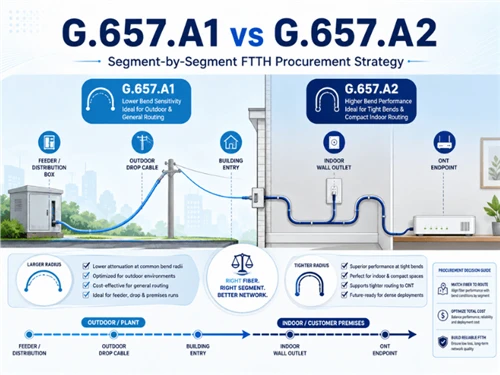
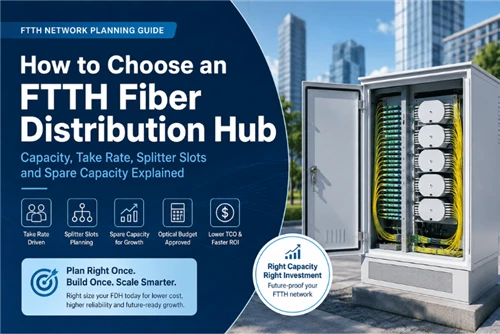
Once the signal leaves the central office, it travels through feeder cables to a street cabinet or a corridor termination box (often mounted on a wall or pole). This is where a single feeder fiber is split into multiple drop fibers using PLC splitters.
What happens here:
• The feeder cable is terminated, often spliced to pigtails.
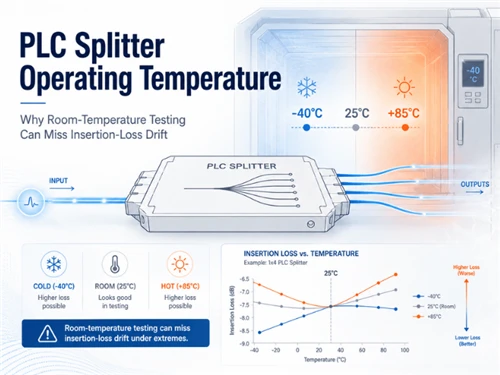
• A PLC splitter (e.g., 1:8, 1:16, or 1:32) divides the signal.
• The split outputs are presented on adapter ports, ready to accept drop cables that go to individual homes.
Recommended adapters:
• SC/APC simplex adapters – Dominant choice for FTTH drop connections because APC (angled physical contact) provides the highest return loss (>60 dB), critical for PON upstream transmission where reflections can cause interference.
• SC/APC to SC/APC – The most common combination for outdoor distribution boxes.
• Flangeless or with compact body – Many terminal boxes use adapters without mounting flanges to save internal space and allow more ports per square inch.
Why not LC here? In many regional FTTH standards (e.g., GPON / XGS‑PON), SC/APC is the de‑facto interface for the outside plant. LC is more common inside data centers or for high‑density equipment rooms. For outdoor termination boxes, SC/APC remains the standard.
3. The Final Step: Indoor Wall Outlet (Subscriber End)
Now the signal has reached your home. The drop cable enters through an exterior wall and ends at a small wall outlet – often called a fiber wall plate or termination box. This is where you plug in your ONT (Optical Network Terminal) or directly your router (if it has an integrated ONT).
What you need:
• A clean, user‑friendly interface that protects the fiber end.
• Usually a single fiber port, sometimes two (for future second line or spare).
• Compatible with standard patch cords that connect to the ONT.
Recommended adapters:
• SC/APC simplex (wall‑plate version) – Most common in residential FTTH deployments. It matches the outdoor drop cable's connector and ensures the same high return loss.
• LC/UPC – Some newer ONTs or routers with integrated optics use LC interfaces (especially in compact devices). In that case, a short hybrid patch cord (SC/APC to LC/UPC) is used.
• Flangeless, snap‑in design – Wall outlets typically use adapters without external flanges, which clip directly into the faceplate.
• Important note for end‑users: Always check whether your ONT expects an APC (green) or UPC (blue) connector. Mixing them can damage the ferrule and cause poor performance.
4. Special Case: Hybrid Adapters for Mixed Environments
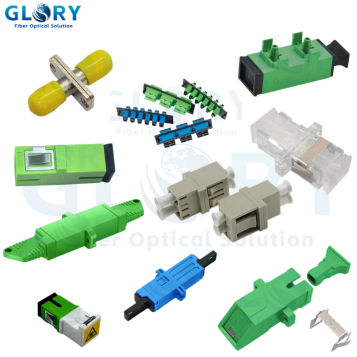
Not all networks are uniform. Sometimes you need to connect a legacy device with one interface to a newer network with a different one. That is where hybrid adapters come in.
Examples from our product line:
• SC/APC to SC/UPC – Allows a drop cable with SC/APC to connect to a test equipment or older device using SC/UPC (not recommended for permanent PON links, but invaluable for testing).
• LC/UPC to SC/APC – Used when a data center patch panel (LC/UPC) needs to feed a FTTH outside plant (SC/APC) – often seen in MDU (multi‑dwelling unit) environments where the backbone is LC but the drop is SC/APC.
• FC/UPC to SC/APC – For connecting legacy FC‑based equipment to modern FTTH networks.
• Why they matter: Hybrid adapters save you from having to replace entire panels or re‑terminate cables. They are a cost‑effective bridge during network transitions.
5. Practical Selection Guide by Node
To summarize, here is a quick reference table for choosing the right adapter at each FTTH node:
|
Network Node |
Typical Adapter Type |
Polish |
Mounting Style |
Key Consideration |
|
Central Office ODF |
LC Duplex / MPO |
UPC |
Flange (screw) |
High density, frequent patching |
|
Outdoor Terminal Box |
SC Simplex |
APC |
Flangeless |
Matches drop cable; high return loss |
|
Indoor Wall Outlet |
SC Simplex |
APC |
Snap in (faceplate) |
User friendly, dust proof |
|
Hybrid/Transition |
SC to LC / SC to FC |
Mixed |
Flange or flangeless |
Connects different interface types |
6. Why Quality Adapters Matter for the "Last Meter"
The "last meter" from the wall outlet to your ONT is often the most neglected part of the network. People use cheap, low‑quality patch cords or mix APC with UPC by mistake. A single dirty or mismatched adapter can introduce enough loss or reflection to cause intermittent connection drops, slower speeds, or even force your ONT to retrain – all blamed on the ISP, while the real culprit is a $2 adapter.
That is why we at Glory Optical manufacture every adapter with:
• Precision‑aligned ceramic sleeves – to ensure low insertion loss (≤0.2 dB typical).
• High‑quality engineering plastic housing – durable, flame‑retardant (UL94‑V0 available), and color‑coded to avoid mix‑ups.
• Rigorous testing – each adapter batch is tested for insertion loss, return loss, and mechanical durability (1,000 mating cycles).
Conclusion
From the central office ODF to the wall outlet in your living room, fiber optic adapters are the unsung heroes of every FTTH network. Choosing the right type – SC vs. LC, UPC vs. APC, flanged vs. flangeless – at each node ensures that your network delivers the speed and reliability your customers expect.
When you're planning your next FTTH project or upgrading an existing one, let the signal path guide you. And when you need adapters that won't let you down, explore Glory Optical's full range – from standard SC/APC to high‑density LC and hybrid types.