
Which fiber optic cable type should you choose?
Choose single-mode fiber where reach, standardization and future flexibility dominate; choose multimode fiber where a defined short-reach interface provides the required performance and economics; and choose plastic optical fiber only where its short range and simplified handling match the application. The final specification must also include cable construction, connector interface and installation environment.
The Fiber-Selection Problem Is Larger Than Core Diameter
Choosing a fiber type is not simply a matter of selecting the longest-distance or lowest-cost option. A cable plant may remain in service through several generations of switches and transceivers, so an early decision affects supported data rates, optical reach, connector interfaces, pathway capacity and future replacement costs. Single-mode fiber, multimode fiber and plastic optical fiber each solve a different problem. The correct choice depends on the complete link-not on core diameter or cable color alone.
For a deeper comparison focused specifically on glass fiber, see Glory Optical's single-mode vs multimode fiber guide.
Why the Traditional Selection Method Is Too Limited
Traditional selection guides usually reduce the decision to three questions: How far must the signal travel? How much bandwidth is required? What is the available budget?
Those questions are useful, but they do not provide a complete specification. A distance value is meaningful only when it is connected to a transmission standard and transceiver. For example, the same OM4 fiber that supports a 10GBASE-SR link up to 400 meters will support shorter distances under many higher-speed parallel-optics standards. Likewise, standard single-mode fiber does not automatically provide a 100-kilometer link; reach depends on the transmitter power, receiver sensitivity, wavelength, dispersion and complete channel loss.
Cost comparisons can also be misleading when they examine only the cable or transceiver price. Installation labor, termination hardware, testing, available conduit space and the cost of future recabling may be more important than the initial difference between single-mode and multimode components.
A useful selection process must answer three broader questions: Can the fiber support the required speed and reach? Can the infrastructure support the next planned upgrade? Is the fiber and cable construction suitable for the physical environment?
1. Match the Fiber to the Required Speed and Reach
The first value of a structured selection process is that it prevents distance claims from being separated from the actual optical interface.
Single-mode fiber for long reach and broad upgrade options
Single-mode fiber uses a small glass core and supports one fundamental propagation mode. Its low attenuation and lack of modal dispersion make it the normal choice for FTTH and PON networks, metropolitan and long-haul routes, 5G transport, campus links, data center interconnects and new structured cabling where future reach is uncertain.
However, single-mode fiber should not be assigned one universal maximum distance. The optical module and link budget define the supported reach. A 10GBASE-LR link may be designed for 10 kilometers, while ER and vendor-specific ZR optics support longer routes over the same general G.652 fiber category. The ITU-T definitions for conventional and bend-insensitive single-mode fiber are available in G.652 and G.657.

An OS2 MPO-to-MPO trunk combines single-mode reach with factory-terminated high-density connectivity.
Multimode fiber for defined short-reach links
Multimode fiber uses a larger glass core and carries multiple propagation modes. Modern graded-index designs reduce-but do not eliminate-the modal dispersion that limits transmission distance as data rates rise.
| Grade | Core | Typical role | Selection note |
|---|---|---|---|
| OM1 | 62.5/125 μm | Legacy LAN installations | Limited upgrade value for modern high-speed links |
| OM2 | 50/125 μm | Legacy and lower-speed links | Not normally preferred for new high-speed data centers |
| OM3 | 50/125 μm | Laser-optimized short reach | Common in existing 10G/40G/100G installations |
| OM4 | 50/125 μm | Higher-bandwidth data center links | Provides more reach than OM3 under compatible standards |
| OM5 | 50/125 μm | Wideband multimode applications | Value depends on the selected SWDM optical ecosystem |
The correct distance depends on both the OM grade and the transceiver standard. For standard 10GBASE-SR, OM3 is commonly specified up to 300 meters and OM4 up to 400 meters. Multimode remains relevant for short server-to-switch links, equipment rooms, enterprise LANs and retrofit projects that already contain serviceable OM3 or OM4 infrastructure.

A factory-tested OM4 duplex LC patch cable is suited to defined short-reach data center and enterprise interfaces.
Plastic optical fiber for short, simple connections
Plastic optical fiber normally uses a large polymer core, commonly around 1 mm. Its large core simplifies alignment and termination, but its attenuation is much higher than that of glass fiber.
Typical applications include automotive infotainment, TOSLINK digital audio, sensors, appliance interconnections and short industrial control links. POF should not be described by one universal bandwidth limit because performance depends on the polymer, refractive-index profile and transceiver system. FOA provides a useful technical overview of plastic optical fiber.
| Fiber type | Main strength | Main limitation | Typical decision basis |
|---|---|---|---|
| Single-mode | Long reach and broad upgrade path | Optics and alignment requirements vary by interface | Telecom, FTTH, campus, DCI and future-oriented cabling |
| Multimode | Efficient short-reach connectivity with compatible optics | Reach decreases as speed and lane rate increase | Defined data center and enterprise links |
| Plastic optical fiber | Simple handling and short-link installation | High attenuation and limited reach | Automotive, audio, sensors and short control links |
This table is a first filter. Final selection still requires the target data rate, transceiver type and allowable channel loss.
2. Protect the Upgrade Path and Total Project Cost
The second value of the selection process is avoiding a cable choice that meets the present requirement but restricts the next equipment generation.
Fiber cable is often more difficult to replace than an optical module. Trunks may pass through crowded trays, raised floors, risers, walls or underground ducts. Replacing them can involve shutdown planning, access restrictions, new testing and removal of abandoned cable.
Evaluate the entire channel cost
The total installed cost includes cable and fiber, optical transceivers, patch panels and cassettes, connectors and splices, installation labor, testing, pathway space, downtime and future replacement.
A lower component price does not always create the lowest lifecycle cost. Multimode may be economical where the link length and upgrade plan remain within a known short-reach standard. Single-mode may provide better value where equipment generations, rack layouts or future distances are uncertain.
Separate existing infrastructure from new construction
An existing OM3 installation should not automatically be replaced simply because OM4 or single-mode offers greater capability. Compare the measured installed length, connector loss, polarity and available optical margin with the intended transceiver specification.
For new construction, the analysis should place greater weight on expected service life. The Glory Optical data center cabling range includes OS2, OM3 and OM4 trunks, patch panels and pre-terminated assemblies that can be specified as one channel rather than as unrelated components.
Do not use jacket color as the specification
Jacket colors are useful identifiers, but they are not proof of fiber type. Existing installations may use nonstandard colors, regional conventions or replacement assemblies that differ from the original system. Confirm the fiber grade through cable printing, product documentation, reel records, test reports and manufacturer specifications.
3. Match the Fiber to the Installation Environment
The third value is preventing a correct optical-fiber choice from being placed inside the wrong cable construction. "Single-mode" and "multimode" describe optical transmission media. They do not define whether the finished cable is suitable for indoor routing, aerial installation, duct use, direct burial or repeated movement.
Indoor and data center cabling
Indoor applications may require low-smoke or flame-rated jackets, tight-buffered or distribution cable, breakout cable, pre-terminated trunks and high-density MTP/MPO or LC connectivity.
For data centers, the decision must include both the fiber type and the connectivity architecture. OM3 or OM4 may support defined short-reach links, while OS2 single-mode can provide a broader reach and upgrade range. The Glory guide to MTP vs MPO fiber cables explains where connector construction and loss class affect high-density channel design.


Outdoor, campus and FTTH cabling
Outdoor projects may require loose-tube construction, water-blocking materials, UV-resistant jackets, armor or rodent protection, aerial strength members, duct or direct-burial ratings and bend-insensitive G.657 fiber for access and building transitions.
An indoor patch cord and an outdoor loose-tube cable can contain the same general single-mode fiber category while having completely different mechanical and environmental capabilities. Compare Glory's indoor fiber optic cables, outdoor cable range and FTTH cable options before finalizing the construction.
Check compatibility at every interface
The selected system must align across fiber category, connector type, connector polish, transceiver wavelength, fiber count, polarity, channel-loss budget and installation environment.
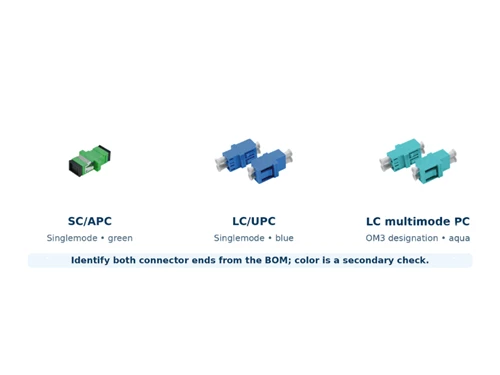
Single-mode and multimode fiber should not normally be mixed within one optical channel. APC and UPC connector interfaces should also not be directly mated, even when both use the same connector family. For equipment-side connections, the fiber patch cord range can be filtered by fiber mode, connector type and jacket requirement.
From Fiber Selection to a Complete Product Solution
The correct product is not simply "SMF," "OM4" or "POF." It is an assembled channel selected for the application.
- FTTH and access networks: G.652.D- or G.657-based outdoor and drop cables, distribution hardware, connectors and splice protection.
- Campus and inter-building networks: OS2 outdoor cable with appropriate water, crush and environmental protection.
- Data centers: OS2, OM3 or OM4 trunks combined with MTP/MPO or LC connectivity and compatible patch panels.
- Enterprise indoor networks: Flame-rated distribution or breakout cables with serviceable termination hardware.
- Short control and consumer links: POF assemblies only where the required distance and bandwidth remain within the selected system's limits.
Glory Optical manufactures indoor and outdoor fiber optic cable, FTTH cable, MTP/MPO assemblies, fiber patch panels, patch cords, pigtails and pre-terminated systems. These categories allow the fiber, cable construction and connection hardware to be evaluated as one channel instead of as separate purchases.
The final decision is straightforward: choose single-mode where reach, standardization and future flexibility dominate; choose multimode where a defined short-reach interface provides the required performance and economics; and choose plastic optical fiber only where its short range and simplified handling match the application. The most reliable result comes from specifying the transmission standard, cable construction and connection system together.
Frequently Asked Questions
Q: What are the three main optical fiber types?
A: The broad media categories are single-mode glass fiber, multimode glass fiber and plastic optical fiber. A complete cable specification must also define the cable construction, installation environment, fiber count, connector interface and jacket rating.
Q: Is single-mode fiber always better than multimode fiber?
A: No. Single-mode offers longer reach and a broader upgrade path, while multimode can be economical for defined short-reach links using compatible optics. The correct choice depends on the transmission standard, installed distance, existing infrastructure and lifecycle cost.
Q: How far can OM4 carry 10 Gigabit Ethernet?
A: For standard 10GBASE-SR links, OM4 is commonly specified up to 400 meters. Longer or shorter limits may apply to other optical interfaces, so the fiber grade must always be checked against the transceiver standard.
Q: Can single-mode and multimode fiber be used in the same link?
A: They should not normally be mixed within one optical channel. Their core sizes, launch conditions, wavelengths and transceiver interfaces differ, which can cause excessive loss or unstable performance.
Q: Is fiber type the same as fiber optic cable type?
A: No. Fiber type describes the optical medium, such as OS2 or OM4. Cable type also describes the mechanical construction and environment, such as tight-buffered indoor cable, loose-tube outdoor cable, armored cable or FTTH drop cable.