Part 1: The Evolution – 5G Fronthaul Moves into the "Deep‑Water" Phase
5G deployment has entered a new stage. After initial rollouts in major cities, operators are now focused on deep coverage, capacity densification, and quality of experience. This shift brings fronthaul networks into more challenging environments: street‑level small cells, rural macro sites, industrial zones, and even underground tunnels.
Market data reflects this growth. According to industry forecasts, the 5G fronthaul optical module market is expected to grow from approximately $4.83 billion in 2025 to over $25 billion by 2035, at a compound annual growth rate (CAGR) of around 17.9%. In China alone, as of the end of 2025, more than 4.838 million 5G base stations were operational, representing 37.6% of all mobile base stations. Coverage has reached all townships and over 95% of administrative villages.
Meanwhile, 5G is evolving into 5G‑Advanced (5.5G) , with features like 50G PON in fixed‑mobile convergence and 400G/800G backbone upgrades. These trends place unprecedented demands on the physical layer: higher fiber counts, tighter latency budgets, and the need for modular, upgradeable interfaces that can support 25G, 50G, and eventually 100G eCPRI links.
Part 2: The Challenge – Why Outdoor FTTA Deployment Is Demanding
Unlike indoor data centers, 5G fronthaul components must survive years of exposure to sun, rain, ice, vibration, and mechanical stress. The typical tower‑top environment presents four major threats:
• Extreme temperatures: From -40°C in winter to +70°C under direct summer sunlight. Thermal cycling can cause connector loosening, seal failure, and fiber micro‑bending.
• Water and dust ingress: Rain, condensation, and airborne particulates are leading causes of signal degradation. Fronthaul enclosures and connectors must achieve IP68 protection (dust‑tight and capable of continuous immersion).
• Mechanical stress: Towers sway in wind. Cables are pulled, bent, and stepped on during installation. Vibration from nearby equipment (fans, cooling units) can fatigue connectors over time.
• Deployment speed: Operators need to roll out thousands of sites per year. Field splicing is slow, requires skilled technicians, and introduces performance variability. Pre‑connectorized, plug‑and‑play solutions are no longer a luxury-they are a necessity.
Traditional field‑terminated solutions also create long‑term maintenance headaches. Each splice point is a potential failure node. When a fault occurs, climbing a tower to re‑splice in freezing conditions is expensive and dangerous.
Part 3: The Solution – A Complete Portfolio of Hardened FTTA Components
To address these challenges, the industry has converged on a set of proven technologies: pre‑connectorized assemblies, hardened connectors (IP68‑rated SC/LC/MPO), armored drop cables, and outdoor‑rated termination boxes and splice closures. All must be tested to meet CPRI/eCPRI specifications for 25G/100G links, with insertion loss and return loss margins that guarantee link budgets over distances up to 10–20 km.
Here is a concise overview of the essential product categories for 5G fronthaul and FTTA:
• Armored Outdoor Drop Cable – Features G.657.B3 bend‑insensitive fiber, steel or FRP armor for rodent and crush resistance, and a UV‑protected jacket. Ideal for AAU to tower‑base connections, outdoor aerial runs, and direct burial.
• Pre‑connectorized FTTA Assemblies – Factory‑terminated, plug‑and‑play, IP68 sealed, and shipped with individual test reports. Perfect for rapid macro and small cell deployment as well as C‑RAN fronthaul.
• Outdoor Dome Splice Closure – Dome‑shaped for high compression strength, IP68 rated, and re‑enterable. Used for trunk cable splicing, branching, and long‑term outdoor protection.
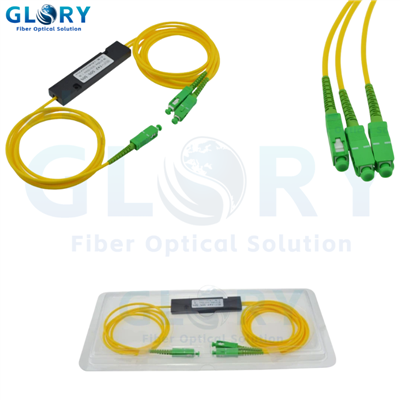
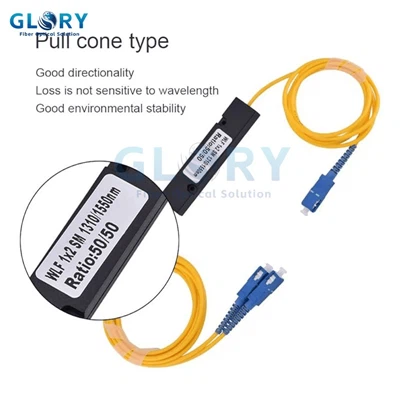
• Multi‑Service Terminal (MST) Box – High‑density, often with a built‑in PLC splitter, modular design, and pole/wall/aerial mounting options. Suited for 5G site fiber distribution and FTTx distribution points.
• Hardened Fiber Patch Cord – IP68 rated, abrasion/water/corrosion resistant, and CPRI/eCPRI compatible. Designed for direct connection from the AAU to the tower‑base patch panel.
• Hardened Connectors (SC/LC/MPO) – IP68, wind‑ and vibration‑rated, with low insertion loss. They serve as the outdoor interface between distribution boxes and base station equipment.
• Tower‑mount Fiber Enclosure – Rugged, anti‑vibration, with multiple mounting brackets. Provides fiber distribution and protection at the AAU side of the tower.
• Hybrid Cable (optional) – Combines fiber and power in a single jacket, simplifying installation and saving tower space. Ideal for remote sites where both data and power are needed.
Part 4: Inside the Central Office – Fiber Management for Aggregation and Core
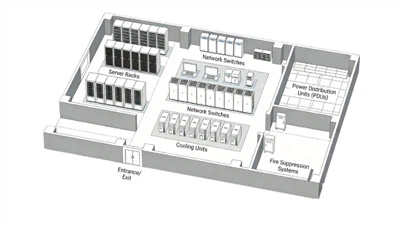
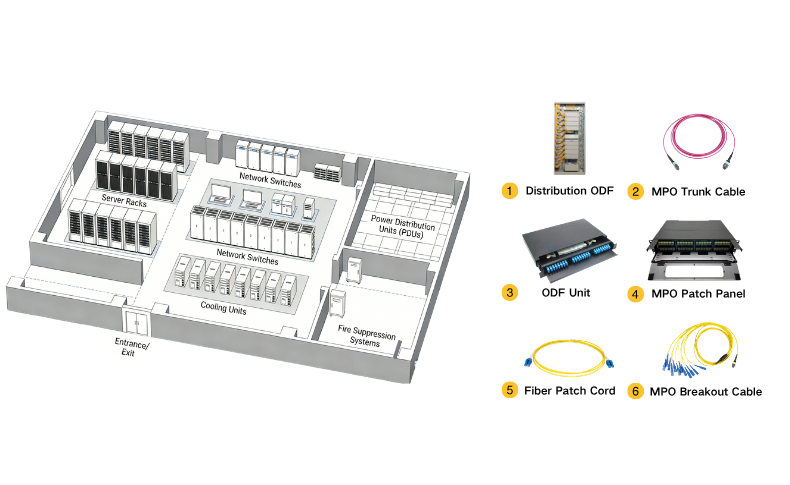
Once the fronthaul signals leave the tower, they travel through distribution and feeder networks to reach central offices, data centers, or aggregation hubs. These indoor environments require a different but equally disciplined approach to fiber management. The diagram below illustrates a typical rack‑based fiber infrastructure inside a central office or data center:
• Distribution ODF – The main distribution frame that terminates feeder cables and provides a patching interface to the rest of the facility.
• MPO Trunk Cable – High‑density backbone linking different ODFs or connecting to core switches, supporting 40G/100G/400G parallel optics.
• ODF Unit – A compact, rack‑mountable unit that combines splicing, termination, and storage for a specific zone or row.
• MPO Patch Panel – A panel dedicated to MPO connectors, enabling multi‑fiber cross‑connects without fan‑outs.
• Fiber Patch Cord – Standard duplex LC/SC jumpers for final equipment connections (servers, routers, switches).
• MPO Breakout Cable – Converts a high‑density MPO port into multiple LC/SC connectors, bridging 40G/100G backbone to 10G/25G servers.
Part 5: Putting It All Together – A Unified Physical Layer for 5G
From the tower‑top AAU to the central office router, the entire 5G network relies on a consistent, high‑quality fiber infrastructure. The table below maps the products discussed to their network location:
|
Network Segment |
Key Products |
Environmental Rating |
|
Tower top (AAU side) |
Hardened patch cords, MST box, tower mount enclosure |
IP68, -40°C to +70°C |
|
Tower base / Outside plant |
Armored drop cable, dome splice closure, pre connectorized FTTA assemblies |
IP68, rodent resistant, UV resistant |
|
Central office / Data center (aggregation) |
Distribution ODF, ODF unit, MPO trunk cable, MPO patch panel |
Indoor (rack mount) |
|
Equipment interconnection |
Fiber patch cord, MPO breakout cable |
Indoor (riser/plenum) |
By selecting the right components for each segment, network operators can:
• Deploy faster – Pre‑connectorized assemblies eliminate field splicing.
• Operate reliably – IP68, armored, and UV‑rated products withstand years of outdoor exposure.
• Scale easily – Modular ODFs and MPO systems allow incremental capacity upgrades.
• Reduce total cost of ownership (TCO) – Fewer faults, shorter repair times, and lower labor costs.
Part 6: The Future – From 5G to 6G and Beyond
As we look toward 6G, the demands on both fronthaul and core fiber infrastructure will intensify. Expected features like terabit speeds, sub‑millisecond latency, and AI‑driven network slicing will require even denser fiber networks. The physical layer will need to support:
• Higher fiber counts per site and per rack (e.g., 144–576 fibers).
• Smaller form factor connectors (e.g., 16‑fiber MPO, SN, or VSFF).
• Intelligent management (RFID‑tagged patch cords, automated infrastructure records).
• Extreme environmental resilience (e.g., operation in high‑altitude, marine, or desert conditions).
Pre‑connectorized, hardened FTTA components and high‑density indoor ODF systems will remain the foundation, but they will evolve toward smaller, smarter, and more automated designs.
Conclusion: Build Your 5G Network on a Rock‑Solid Fiber Foundation
The quality of a 5G network is not solely determined by radio technology. It is equally dependent on the fiber optic links that connect the radios to the core network, and on the fiber management systems inside central offices. For operators, system integrators, and infrastructure providers, understanding the unique demands of FTTA and central office fiber distribution – and selecting the right hardened and indoor components – is essential for achieving reliable, cost‑effective, and scalable 5G deployment.
From armored drop cables and pre‑connectorized FTTA assemblies to dome splice closures, MST boxes, Distribution ODFs, MPO trunks, and breakout cables, each product plays a specific role in protecting the signal and simplifying the work of field and facility engineers.