FBT Technology: A Time-Tested "Master Craftsman"
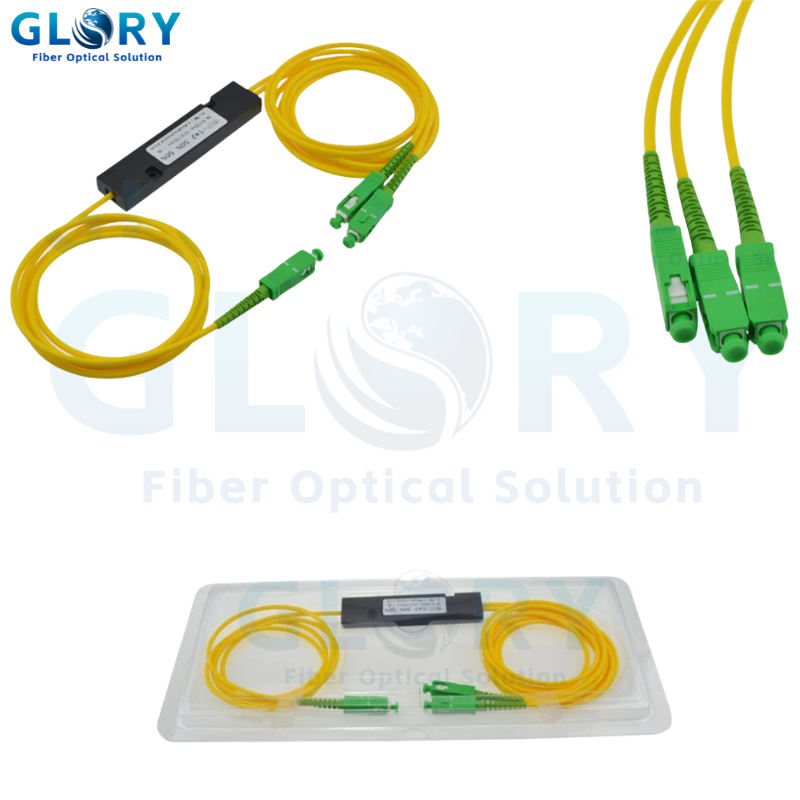
Fused biconical transducer (FBT) is a long-established passive device manufacturing process. Its principle is not complex: two optical fibers are placed side-by-side, heated and fused together at high temperatures, and simultaneously stretched from both ends to form a tapered coupling region. During this process, optical signals "leak" from one fiber to the other, thus achieving optical power distribution.
While it sounds simple, the real technical challenge lies in controlling-the stretching speed, the heating temperature, and the shape of the tapered region-each parameter affects the final performance. After decades of development, FBT technology has matured, enabling the production of stable and consistent couplers at extremely low cost.
Why do FBT splitters still hold a place in today's market dominated by PLC splitters?
Cost Advantage:For small split ratios such as 1x2 and 1x4, the manufacturing cost of FBTs is significantly lower than that of PLCs.
Wavelength Flexibility:FBT couplers can be customized for specific wavelengths (e.g., 1310nm, 1550nm, or dual-window), while PLCs are better suited for broadband applications.
Low Insertion Loss:High-quality FBT 1x2 couplers can achieve typical insertion losses as low as 3.6dB, comparable to PLC.
Dual-Window Design: Data and Video "Same-Fiber Transmission"
This 1x2 coupler operates at wavelengths of 1310nm and 1550nm-two of the most commonly used wavelength windows in single-mode fiber optic communication:
1310nm: Typically used for uplink data transmission (e.g., GPON uplink).
1550nm: Typically used for downlink broadcast signals, such as cable television video.
This means a single coupler can handle both data and video services simultaneously. This dual-wavelength capability is highly practical in scenarios where FTTH and HFC networks converge-a single drop fiber can transmit both internet and television signals simultaneously.
SC/APC: The "Terminator" of Reflected Light
This product's output pigtail is equipped with an SC/APC connector. "APC" (Angled Physical Contact) is its key distinguishing feature.
Unlike the common UPC connector, the APC connector has an 8-degree angled end face. When two APC connectors are mated, the angled end face prevents reflected light from returning along its original path, instead causing it to diverge at a greater angle.
As a result, return loss can typically reach 60dB or higher, far exceeding the 50dB of UPC. This is crucial for analog video transmissions (such as cable television) and high-precision test applications-weaker reflected light means a clearer signal and greater equipment safety.
3.0mm ABS Module: Compact, Durable, Easy to Install
This coupler is encapsulated in a 3.0 mm thick ABS plastic module. ABS material offers good mechanical strength, weather resistance, and flame retardancy, making it suitable for long-term indoor use.
Its 3.0 mm diameter allows it to easily pass through standard conduits and be installed in fiber optic splice boxes, junction boxes, or wall sockets. Its compact size saves valuable space, while the robust housing protects the internal tapered splice section from external damage.
Performance Guarantee: Low Insertion Loss, High Uniformity, Low PDL
This 1x2 coupler meets stringent performance standards:
Insertion loss: ≤3.8dB (3.6dB typical), ensuring efficient signal transmission.
Uniformity: ≤0.8dB, meaning the signal strength at both output ports is nearly identical.
Polarization dependent loss (PDL): ≤0.2dB, maintaining stable performance regardless of changes in the polarization state of the input light.
Return loss: ≥60dB (thanks to the APC connector), extremely low reflected light, protecting the upstream laser.
Each coupler undergoes 100% testing before leaving the factory to ensure compliance with specifications.
Typical Application Scenarios
FTTH Corridor Distribution: A single feeder fiber enters the building and is split into two paths via a 1x2 coupler, serving two households respectively-simple and economical.
CATV Optical Node: Distributes 1550nm video signals evenly across two coverage areas.
OTDR Testing: Parallel testing and monitoring can be achieved by inserting a coupler into the test link.
Device Port Expansion: When a single optical port needs to connect two devices simultaneously, a coupler is the lowest-cost solution.
Conclusion
In today's pursuit of higher speeds and more splits, the 1x2 FBT coupler remains a staple in the toolbox of countless network engineers due to its proven reliability, low cost, and stable performance. It doesn't chase trends, yet it has never become obsolete.
If you need a simple, economical, and reliable 1x2 splitting solution, this FBT coupler is the "classic choice" of FBT technology.