


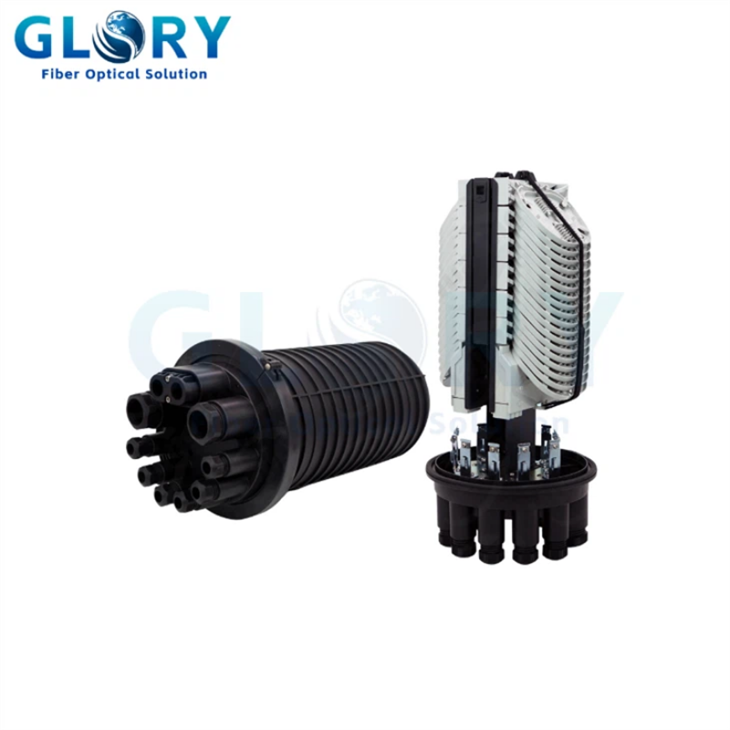
The Four Failure Modes This Closure Was Built Around
After reviewing fiber outage data from ISP deployments across Southeast Asia, Europe, and Latin America, network failures at splice points cluster into four recurring root causes. Every design decision in the GL-M9 maps to one of them.

Seal failure after re-entry
The most common cause of mid-run outages. Closures that aren't designed for repeated opening fail their IP68 rating after the first maintenance visit.
Cable diameter mismatch
Wrong grommet sizing creates micro-gaps at entry ports - the #1 pathway for moisture infiltration even in "IP68-certified" closures.
Installation complexity
Bolt-sealed designs require torque wrenches and sealant compounds. In a manhole in the rain, a 60-minute closure job becomes a liability.
Capacity shortfall at scale
Networks planned for 144 cores today routinely need 576 in year three. Choosing an undersized closure forces a full re-splice and truck roll.
What the GL-M9 Fiber Optic Enclosure Outdoor Actually Delivers - And Why It Matters
Each specification below maps to a real-world outcome. We don't list features in isolation - we explain the engineering logic behind each one and the operational benefit you capture in the field.


Mechanical IP68 Seal
The GL-M9 uses a mechanical bolt-down sealing method rather than the traditional gel tape or heat-shrink approach common in lower-cost dome closures. This has a direct operational consequence: the seal does not degrade with repeated opening.
The closure achieves the highest ingress protection grade - IP68 - meaning zero dust penetration and full waterproofing under prolonged submersion. This is verified per the Chinese YD/T 814.1-2013 industry standard, not self-certified.
Up to 864 Single Fibers - Modular Stackable Tray System
The GL-M9/JFT-B series supports up to 72 stackable splice trays in the largest B1 configuration, delivering a maximum capacity of 576 single fibers using 8-fiber trays. The B3 variant with 24-fiber trays tops out at 864 cores - among the highest in its class for a dome closure of this form factor.
The stackable modular design means you can start with lower tray counts and expand without re-housing the closure. An independent insulation grounding device is integrated for operational safety during live network work.
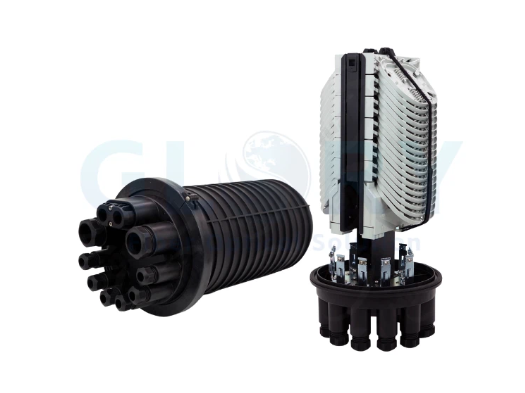
9 Cable Ports - 1 Oval Express + 8 Circular Branch Ports
The GL-M9 provides one oval express port for straight-through express cables and eight circular branch ports, accommodating cable diameters from Φ7mm to Φ26mm. This configuration supports both branching and straight-through cable installation methods from a single closure.
The oval port allows an uninterrupted express cable to pass through the closure without breaking the sheath - crucial for backbone routes where signal continuity matters more than branching at every node.
High-Strength PC Engineering Shell - Lightweight, Impact & UV Resistant
The GL-M9 shell is manufactured from high-strength engineering plastic - a material selected for its combination of impact resistance, UV stability, chemical corrosion resistance, and dimensional consistency across wide temperature cycling from −40°C to +60°C.
Two additional internal storage boxes and an inclined storage tray provide organized space for fiber slack management, preventing micro-bending signal loss from improper fiber coiling. Dimensions of Φ325mm × 530mm (B series) provide ample internal working space.

GL-M9 Full Technical Specifications
All parameters below are manufacturer-tested specifications from our production batches. Contact our technical team to verify suitability for your specific deployment environment or cable types.
| Parameter | GL-M9/JFT-BS (Compact) | GL-M9/JFT-B (Standard) | Notes |
|---|---|---|---|
| Dimensions (mm) | Φ325 × 390 | Φ325 × 530 | Height refers to sealed body including base |
| Cable Ports | 1 oval + 8 circular | Supports branching + straight-through | |
| Cable Diameter (mm) | Φ7 – Φ26 | Covers FTTH drop through 288F backbone | |
| Ingress Protection | IP68 | IEC 60529 · Full submersion rated | |
| Sealing Method | Mechanical compression | No gel tape, no heat gun. Re-enterable. | |
| Tray Type - BS1 / B1 | 8F/tray · 36 trays max = 288F | 8F/tray · 72 trays max = 576F | |
| Tray Type - BS2 / B2 | 16F/tray · 18 trays max = 288F | 16F/tray · 36 trays max = 576F | |
| Tray Type - BS3 / B3 | 24F/tray · 18 trays max = 432F | 24F/tray · 36 trays max = 864F | Maximum capacity variant |
| Shell Material | High-strength PC engineering plastic | UV resistant, corrosion resistant, lightweight | |
| Operating Temperature | −40°C to +60°C | Arctic and tropical deployment | |
| Grounding | Independent insulation grounding device | Integrated - no external hardware | |
| Installation Methods | Aerial, pole-mount, wall-mount, underground, direct burial | Single SKU for all outdoor environments | |
| Re-Entry | Yes - reusable seal design | Repeated open/reseal without parts replacement | |
| Industry Standard | YD/T 814.1-2013 · RoHS | Chinese telecom industry standard compliance | |
| Additional Storage | 2 × storage box + inclined storage tray | Fiber slack management, prevents micro-bending | |
| Compatible Networks | FTTH, FTTx, FTTB, PON, backbone, 5G fronthaul | ||
Dome vs. Inline Splice Closure - Which One Do You Need?
This is the most common selection question from engineers new to outside-plant fiber design. The short answer: dome for branch/distribution nodes; inline/horizontal for through-routes. Use the decision table below.
| Selection Criterion | Dome / Vertical (GL-M9) | Inline / Horizontal |
|---|---|---|
| Cable entry topology | All cables enter from one end (butt/branch) | Cables enter from both ends (pass-through) |
| Best use case | Distribution tap / branch node | Mid-span backbone route splicing |
| FTTH deployment point | Distribution node (feeder-to-drop) | Feeder backbone (CO-to-distribution) |
| High-capacity branching | ✓ Primary strength | ✗ Less suitable |
| Compact manhole footprint | ✓ Dome shape fits pedestals | ~ Longer form factor |
| Aerial (strand) installation | ✓ Pole / strand mount | ✓ Inline with span cable |
| PLC splitter integration | ✓ Available on request | ~ Optional |
| Re-entry for maintenance | ✓ Mechanical seal GL-M9 | ✓ Depends on model |
| When NOT to use | If cable runs continuously through the splice point | If you need to branch multiple drop cables at a node |
Where the GL-M9 Fiber Optic Enclosure Outdoor Performs Best
The dome configuration and 9-port layout make the GL-M9 the correct choice wherever multiple cables converge at a single protection point. Below are the deployment environments where this closure architecture is the industry standard.
FTTH / FTTB Distribution Nodes
Terminal points for residential connection in Fiber-to-the-Home networks. The 9 cable ports handle one feeder in plus multiple drop cables out - the defining topology of FTTH distribution nodes.
Access Network Branch Points
Mid-span or loop-through splicing in access networks enabling flexible expansion and maintenance without re-routing entire cable segments.
Underground Manhole & Direct Burial
IP68 mechanical seal withstands flooded manholes, direct-burial soil moisture, and seasonal water table variations - failure modes that disqualify gel-seal closures in these environments.
Pole-Mounted Aerial Distribution
Compact and lightweight PC shell suits elevated installations on aerial fiber distribution networks. Mounting brackets included for strand and pole deployment.
5G Fronthaul & Midhaul Nodes
Protection for fiber splice points on fronthaul routes connecting BBU pools to distributed radio units. The temperature range handles rooftop and exposed aerial deployments.
PON Splitter Nodes & Enterprise Campus
Houses PLC splitters alongside splice trays at PON distribution points. Also suited for building-to-building campus runs through outdoor manholes and conduit.
Frequently Asked Questions
Q: What is a dome fiber optic splice closure, and how does it differ from an inline closure? +
A: A dome fiber optic splice closure (also called a vertical closure or FOSC) is a sealed outdoor enclosure that protects fusion or mechanical splices in outside-plant fiber networks. Its defining structural characteristic is that all cable entries are at one end - the base - while the dome cap seals the top. This makes it inherently suited for branch and distribution nodes where multiple cables converge from a single direction. An inline (horizontal) closure, by contrast, has cable entries at both ends for pass-through routes. If your network topology has cables entering from multiple directions at a distribution point, use a dome closure. If a cable runs continuously through a splice point on a backbone route, use an inline closure.
Q: What does IP68 mean for a dome splice closure, and is it sufficient for direct burial? +
A: IP68 is the highest ingress protection grade defined by IEC 60529. It means the closure is completely dust-tight (6 = full dust protection) and rated for continuous submersion beyond 1 metre depth under manufacturer-specified pressure for manufacturer-specified duration (8 = submersion). For the GL-M9, this is tested per the YD/T 814.1-2013 Chinese telecom standard. For direct-burial applications: IP68 is the minimum you should specify - seasonal groundwater variation can bring water contact above any closure in a buried route. For flooded manholes: IP68 through mechanical seal (not gel tape) is the correct choice, because gel-tape closures can fail their IP68 rating when re-opened for maintenance. IP65 or IP67 are insufficient for sustained submersion or flooded-manhole environments.
Q: What is the maximum fiber capacity of the GL-M9 dome splice closure? +
A: The GL-M9/JFT-B3 achieves a maximum of 864 single fibers using 36 splice trays × 24 fibers per tray. The full capacity matrix is:
BS1 / B1 (8F trays): 288F (BS compact) or 576F (B standard)
BS2 / B2 (16F trays): 288F (compact) or 576F (standard)
BS3 / B3 (24F trays): 432F (compact) or 864F (standard)
The modular tray system allows you to start with fewer trays for current capacity and expand without replacing the closure housing - critical for networks that grow in phases.
Q: Can the GL-M9 dome closure be re-opened and re-sealed after initial installation? +
A: Yes. The GL-M9 uses a mechanical bolt-down sealing system rather than gel tape or heat-shrink, specifically because those methods fail their IP68 rating after the first maintenance visit. The mechanical compression seal on the GL-M9 can be opened and re-sealed without requiring replacement parts or a new sealing kit, making it suitable for networks with planned capacity expansions, fiber repairs, or route changes during their operational life. We recommend inspecting seal condition at each re-entry - seal replacement kits are available from our factory if wear is observed.
Q: What is the difference between mechanical sealing and heat-shrink sealing in dome closures? +
A: Heat-shrink sealing uses a heat-activatable adhesive sleeve that bonds to the cable jacket when heated - typically with a heat gun. It achieves a good initial IP68 seal but is single-use: cutting the heat-shrink for re-entry destroys the seal, requiring a new heat-shrink kit and heat gun for re-sealing. It also requires a controlled environment - hard to achieve in a flooded manhole or during rainfall. Mechanical sealing uses compression hardware (bolts, gaskets, glands) to physically compress against the cable jacket and closure body. No heat gun required. The GL-M9 uses mechanical sealing because it achieves equivalent IP68 protection with full re-entry capability, lower tooling requirements, and consistent seal performance independent of ambient temperature.
Q: What cable types and diameters are compatible with the GL-M9? +
A: The GL-M9 accepts cables with outer diameters from Φ7mm to Φ26mm across all 9 ports. This covers: 2-core FTTH drop cables (typically 8–12mm OD), standard distribution cables (14–22mm OD), and multi-tube backbone trunk cables up to 288F (commonly 20–26mm OD). The oval express port accommodates trunk cables where the cable jacket must remain uncut. Compatible cable types include loose-tube, tight-buffer, and ribbon optical cables. The closure is vendor-agnostic and compatible with G.652D and G.657A single-mode fiber from any manufacturer.
Q: What is the minimum order quantity, lead time, and sample policy? +
A: Standard MOQ for the GL-M9 is 50 units. Lead time for standard configurations is within 20 business days from order confirmation (we operate 25+ production lines across 2 production bases). Free samples are available for technical evaluation and qualification testing before bulk order commitment. OEM/ODM orders - custom branding, modified port configurations, co-branding, or alternative housing colours - are accepted. Contact our technical sales team with your requirements and network drawings.
Q: Can the GL-M9 be used with PLC splitters for PON FTTH networks? +
A: Yes. The GL-M9 can be configured to accommodate PLC splitter modules alongside splice trays, making it suitable for PON distribution points where optical power splitting and fiber splicing are co-located at the same node. This is a common architecture in FTTH deployments where the feeder-to-distribution connection and the 1:8 or 1:16 power split happen at the same pole or manhole location. Contact our technical team to specify the correct splitter tray configuration for your splitter ratio and fiber count

Our Quality Promise
Comprehensive 3-Year Warranty
We confidently back all our products with a 3-year warranty. Our specific service policy is: within one year for quality issues, we take full responsibility for returns; within two years, for replacements; and within three years, for repairs.
Clear & Competitive MOQ
We welcome both trial and bulk orders. Our standard Minimum Order Quantity (MOQ) is 50 units. We also offer free samples for testing to help you evaluate our quality with confidence.
Fast & Reliable Logistics
We guarantee delivery within 10 days for standard items. Our logistics advantage includes cost-effective door-to-door service to simplify shipping for you.
Our Foundation
Backed by 18 years of experience since 2008, we control quality from our own factory, accept OEM/ODM requests, and maintain ready stock for wholesale. We focus on delivering the optimal balance of price and quality directly to end customers worldwide.
Your trust is our priority. Partner with us for dependable fiber optic solutions supported by clear promises.
Hot Tags: fiber optic enclosure outdoor, China fiber optic enclosure outdoor manufacturers, suppliers, factory, fiber box, Splice Closure For Optical Fiber Cable, fiber in a box, fiber optic enclosure, fiber splice enclosure box, Joint Closure Dome


