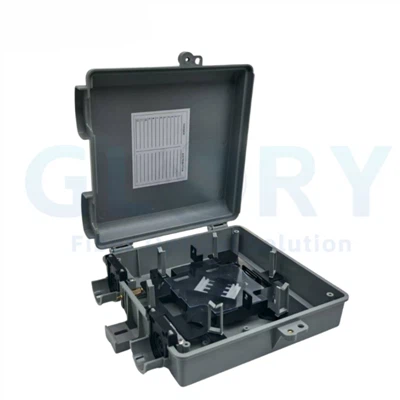

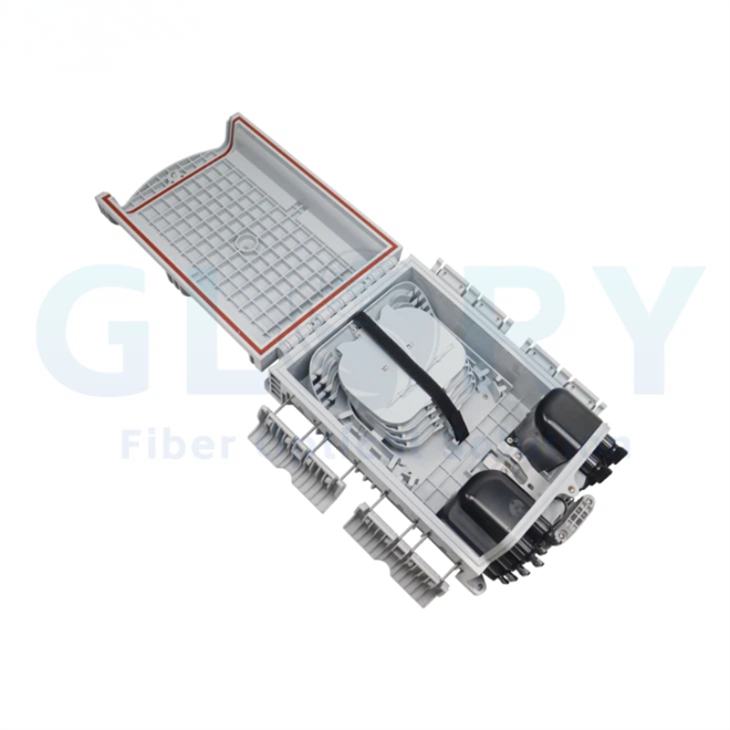
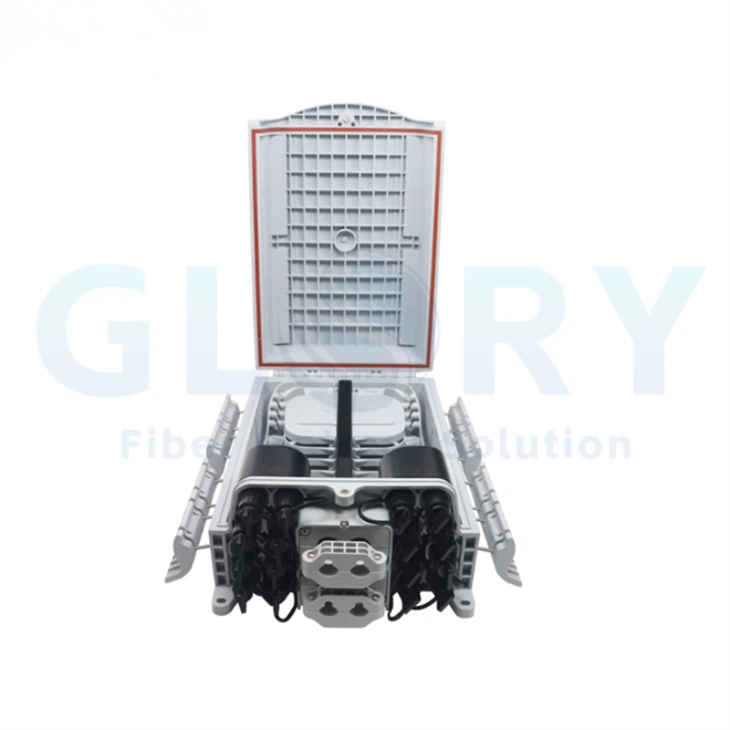
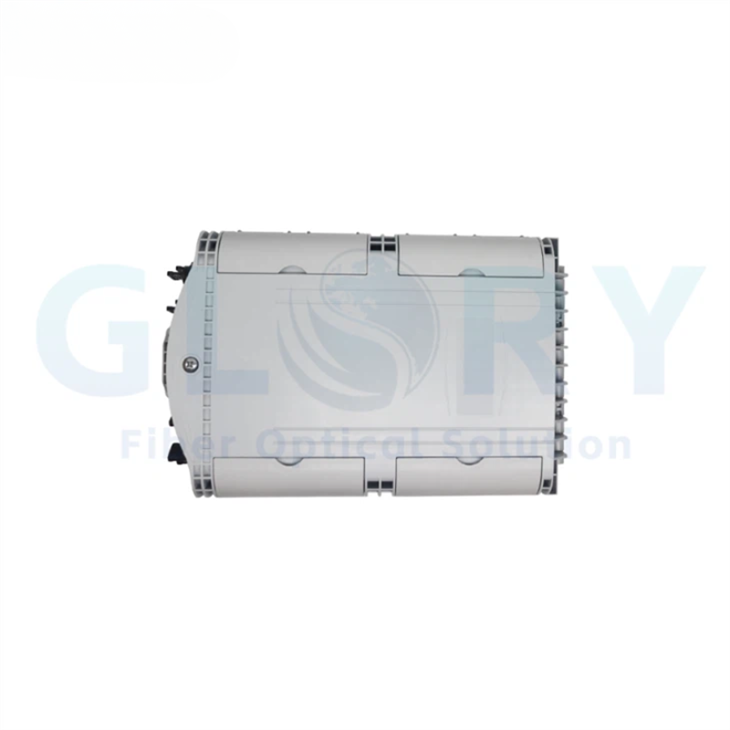
The GL-ODB-16S is a 16-core FTTH distribution enclosure built around FastConnect technology - meaning 16 pre-configured drop cable output ports that connect directly to pre-terminated drop cables without any on-site fiber splicing at the distribution level. One distribution cable in. Sixteen subscribers out. IP65 protection. Page-turning hasp structure sealed with vulcanized silicone tape for re-enterable mechanical sealing across the full outdoor service life.

16
Output ports
IP65
Protection
1:16
Max split ratio
−40°C
Low temp limit
The Four Field Failures the GL-ODB-16S Was Built Around
After reviewing FTTH distribution point outage patterns across Asia-Pacific, Latin America, and Eastern Europe, four failure modes cluster at the feeder-to-drop cable junction - the exact position the GL-ODB-16S occupies. Every engineering decision in this enclosure addresses at least one.
Seal failure under re-entry - IP rating lost at first maintenance visit
Distribution boxes with single-layer silicone gasket seals or bolt-only closures lose their IP65 rating after the first re-entry. Re-entry for splitter upgrades, fault isolation, or capacity additions requires re-sealing - and if that seal isn't designed for repeated closure, moisture infiltrates the box permanently. The GL-ODB-16S uses a page-turning hasp structure with vulcanized silicone tape sealing that maintains IP65 performance through repeated open-and-close cycles across the enclosure's outdoor service life.
Fiber bend radius violations - signal loss increasing over thermal cycles
Undersized distribution boxes force installers to coil excess fiber below the 30mm minimum bend radius for G.652D fiber (15mm for G.657A). Each thermal cycle - as the housing expands and contracts between −40°C and +85°C - subjects the tight-bent fiber to mechanical stress, accumulating micro-bending loss that gradually exceeds the GPON link budget. The GL-ODB-16S internal routing structure maintains minimum bend radius throughout, with dedicated fiber routing guides for both feeder and drop cable paths.
On-site splicing errors at distribution points driving rollout cost overruns
Traditional fiber distribution boxes requiring field splicing at each drop cable output introduce high-skill, time-consuming work that produces variable insertion loss in outdoor conditions. In high-volume FTTH rollouts, distribution-level splicing accounts for 20–35% of total deployment labor cost. The GL-ODB-16S FastConnect architecture provides 16 pre-configured SC adapter ports - subscriber drop cables plug in directly, with no on-site splicing required at the distribution level. Activation labor per port reduces from 20–30 minutes to under 3 minutes.
Splitter capacity undersizing forcing full box replacement within 3 years
Networks planned for 1:8 splits at installation regularly require upgrade to 1:16 as subscriber density grows. Distribution boxes designed for a single fixed splitter configuration force a complete box replacement - requiring re-splicing the feeder cable at the distribution point and interrupting service to all connected subscribers. The GL-ODB-16S supports either two 1:8 mini PLC splitters or one 1:16 mini PLC splitter in the same tray slot, providing upgrade-in-place capacity doubling without re-splicing the feeder.
What the GL-ODB-16S Delivers - Engineering Logic Behind Each Parameter
Each specification below maps to a real-world operational outcome. We explain the engineering reasoning - not just the numbers - so network planners and procurement teams can assess this against competitive alternatives with confidence.
16 FastConnect SC Adapter Output Ports - Simultaneous Drop Cable Management
The GL-ODB-16S provides 16 independent SC adapter output ports, each connected to a factory-routed pigtail from the internal PLC splitter. Each port accepts a pre-terminated SC/APC or SC/UPC FastConnect drop cable - the subscriber connection plugs in without opening the enclosure body. Port identity is labeled on the internal panel for fiber management documentation and fault isolation during maintenance.
The 16-port configuration matches the standard GPON PON split ratio of 1:16 - enabling a single GL-ODB-16S to serve all subscribers on one GPON port without requiring a second distribution box. For networks using 1:8 split at the distribution level, the two-splitter configuration (2 × 1:8) serves 16 subscribers while maintaining two independent feeder path connections for link redundancy applications.
Page-Turning Hasp + Vulcanized Silicone Tape Seal - Re-enterable IP65
The sealing mechanism of the GL-ODB-16S uses a page-turning (hinge-and-hasp) cover structure combined with vulcanized silicone tape along the mating surfaces of the upper and lower housing halves. Vulcanized silicone provides higher compression recovery than standard EPDM or foam gaskets - when the cover is closed and the hasp engaged, the seal re-establishes its original geometry even after multiple open-close cycles.
This design achieves two things simultaneously: IP65 protection grade (complete dust-tight, water-jet resistance from any direction) and re-enterable access without seal replacement. Unlike heat-shrink sealed boxes that lose IP rating at first opening, the GL-ODB-16S can be opened for splitter upgrades, fault isolation, and drop cable management without compromising the seal integrity on re-closure.
Dual PLC Splitter Tray - 2×1:8 or 1×1:16 Mini PLC Configuration
The GL-ODB-16S splitter tray accommodates either two 1:8 mini PLC splitter modules or one 1:16 mini PLC splitter module in the same physical slot. This field-swappable configuration means that a box initially deployed with 2×1:8 splitters (serving 16 subscribers from two separate feeder fibers) can be upgraded to 1×1:16 (serving 16 subscribers from a single feeder fiber) or vice versa, without re-splicing any output connections.
The mini PLC format is physically smaller than LGX cassette splitters and thermally more stable for outdoor temperature cycling environments. Mini PLCs maintain their split ratio accuracy across −40°C to +85°C operating range without the temperature-induced insertion loss variation that affects FBT (fused biconical taper) splitters in extreme temperature deployments.
3-Port Cable Entry - Uncut Through-Cable + Branch Architecture
The GL-ODB-16S provides three cable entry ports: two ports for uncut cable (supporting feeder cable pass-through to downstream distribution boxes in cascade topologies), and one branch cable port for direct feeder termination. Cable entry seals accommodate diameters up to 20mm - covering the full range from 4F micro-tube cables (approximately 8mm) through standard 48F loose-tube distribution cables (typically 15–18mm).
The modulated rubber sealing at each port maintains IP65 protection for all three port sizes without requiring port-specific gland sets - the rubber seal compresses to the cable diameter on installation. This eliminates the inventory management overhead of stocking multiple cable gland diameters for a single distribution box model.
ABS Housing - 332×268×111mm, 1.6–2kg, Wall/Aerial/Manhole Compatible
The GL-ODB-16S housing is manufactured from ABS engineering plastic - selected for its combination of impact resistance, UV stability for outdoor aerial deployment, and dimensional stability across the operating temperature range of −40°C to +85°C. The housing dimensions of 332×268×111mm provide sufficient internal volume for the splitter tray, fiber routing guides, and 16 pigtail management without requiring bend radius compromises on the internal fiber paths.
The 1.6–2kg total weight range (empty to loaded with splitter and all patch cables) makes single-technician aerial installation practical. Three installation configurations are supported from the same housing: wall-mounting (rear bracket with standard fixings), pole-mounting (hose clamp attachment points), and manhole/underground installation (orientation-agnostic sealed design). All mounting hardware is available as factory-supplied accessories.
Technical Specifications


| Parameter | Specification |
|---|---|
| Application Standard | FTTx Networks, GPON/EPON Systems |
| Ingress Protection | IP65 (Dust-tight and protected against water jets) |
| Material Composition | PC+ABS alloy with enhanced UV stabilization |
| External Color | Weather-resistant Gray (RAL 7035) |
| Fiber Capacity | 8 fibers maximum (with splice protection) |
| Operating Temperature | -40°C to +65°C (-40°F to 149°F) |
| Installation Methods | Wall mounting, pole mounting, strand mounting |
| Dimensions (H×W×D) | 280mm × 220mm × 110mm (11.0" × 8.7" × 4.3") |
| Integrated Splitter | 1x4 PLC splitter (optional 1:8 configuration) |
| Adapter Type | SC/APC or SC/UPC (customer specified) |
| Cable Entry/Exit | 4× Φ20mm ports with sealed gland options |
Application mapping
Where the GL-ODB-16S Performs Best
The FastConnect distribution architecture provides the greatest operational advantage in high-volume deployments where reducing per-subscriber labor cost is the primary objective. These are the deployment scenarios where the GL-ODB-16S consistently outperforms field-splice alternatives.
Residential FTTH Mass Rollout
Large-scale residential fiber deployments where subscriber activation speed determines project profitability. FastConnect ports enable non-splice-technician field crews to activate 16 subscribers per distribution box visit, compressing the rollout schedule by 40–60% versus field-splice alternatives.
MDU / FTTB Building Distribution
Multi-dwelling unit fiber distribution in apartment blocks and commercial buildings. Wall-mounted GL-ODB-16S serves 16 subscriber units per distribution box from a single feeder connection, with per-unit activation by FastConnect drop cable plug-in from the building distribution point to each ONT.
GPON / PON Access Network Nodes
Distribution node in GPON PON trees at the feeder-to-drop transition. 1:16 split serves all subscribers on one OLT port from a single GL-ODB-16S. SC/APC adapters (≥60dB return loss) comply with GPON upstream receiver requirements throughout the 1:16 split ratio.
5G Fronthaul Distribution Points
Fiber distribution at 5G base station clusters where multiple remote radio units or small cells are served from a single feeder cable. The −40°C lower limit and IP65 housing support outdoor pole-mounted deployment in all climate zones without supplemental weatherproofing.
Network Capacity Upgrade
Upgrading existing 1:8 split infrastructure to 1:16 without full box replacement. Install GL-ODB-16S at distribution points where subscriber demand has grown: the dual-splitter-tray design allows upgrading from 2×1:8 to 1×1:16 by swapping the splitter module only, without re-splicing any connected subscriber drop cables.
Rural & Remote FTTH Expansion
FTTH build-out in areas where fusion splicers and skilled splice technicians are not locally available. GL-ODB-16S FastConnect eliminates the requirement for splice technicians at each distribution point - a critical advantage in remote deployment economics where skilled labor mobilization costs often exceed the hardware cost.
Frequently Asked Questions
Q1: What is a 16 core optical fiber cable distribution box and what does it do in an FTTH network?
A1: A 16 core optical fiber cable distribution box (also called a fiber distribution box, FDB, or ODB) is an outdoor enclosure that serves as the junction point between the distribution (feeder) fiber cable and the individual drop cables running to subscriber premises. Inside the box, a PLC splitter divides one feeder fiber signal into up to 16 outputs. Each output connects to a drop cable running to one subscriber's ONT/ONU. The GL-ODB-16S uses FastConnect technology: 16 SC adapter ports are factory-pre-configured with the splitter pigtails, so subscriber drop cables connect by plugging in - no on-site fiber splicing is required at the subscriber port level. The enclosure provides IP65 environmental sealing to protect the splitter, splices, and adapters from outdoor exposure across the service life of the deployment.
Q2: What is the difference between a 1:16 and 2×1:8 splitter configuration in a 16-port distribution box?
A2: Both configurations serve 16 subscriber drop cable ports from the GL-ODB-16S. The difference is in feeder cable architecture: A 1:16 configuration uses one PLC splitter module that takes a single feeder fiber and splits it into 16 outputs. One OLT PON port serves all 16 subscribers. This is the standard configuration for most GPON FTTH deployments. A 2×1:8 configuration uses two separate 1:8 PLC splitter modules, each taking one feeder fiber and producing 8 outputs. Two OLT PON ports (or two feeder fibers) are required. Each feeder independently serves its own 8 subscribers. This configuration is used in networks requiring path diversity - for example, if two feeder cables run from different OLTs for redundancy, or where the feeder cable pair was allocated at network design. The GL-ODB-16S supports field-swapping between these configurations by replacing the splitter module in the tray slot, without re-splicing any of the 16 output connections.
Q3: Is IP65 sufficient for outdoor fiber distribution box deployment, or do I need IP68?
A3: IP65 provides complete dust-tight protection and water-jet resistance from any direction - the protection level required for above-ground outdoor installations including aerial pole, wall-mount, and messenger cable positions where the enclosure is exposed to rain, condensation, and driving wind-blown water. IP65 is the correct and sufficient specification for the majority of outdoor FTTH distribution point deployments. IP68 (continuous submersion rated) is required for direct-burial installations, flooded manhole applications, and deployments in coastal or riverside locations where periodic submersion occurs. The GL-ODB-16S standard model is IP65. If your deployment includes below-grade manholes, submersion-risk locations, or direct-burial requirements, contact our technical team for IP68 variant availability and specifications.
Q4: Can the GL-ODB-16S be re-opened after initial installation without losing its IP rating?
A4: Yes. The GL-ODB-16S sealing mechanism uses vulcanized silicone tape combined with the hasp locking structure. Vulcanized silicone has high compression recovery - when the cover is re-closed and the hasp re-engaged after maintenance, the seal re-establishes to IP65 standard without replacement parts. This is the key design advantage over heat-shrink sealed enclosures, which lose their IP rating permanently at first opening and require new sealant material to restore protection. The GL-ODB-16S can be re-entered for splitter module upgrades, fault isolation, drop cable port changes, and fiber routing adjustments across the full outdoor service life of the deployment without degrading environmental protection or stocking seal replacement kits.
Q5: What cable types and diameters are compatible with the GL-ODB-16S cable entry ports?
A5: The GL-ODB-16S accepts cables up to 20mm outer diameter at all three cable entry ports (two uncut cable ports and one branch cable port). This covers the full range of standard FTTH feeder cable types: 4F to 12F micro-tube cables (typically 8–12mm OD), 24F loose-tube distribution cables (typically 12–16mm OD), and standard 48F backbone cables (typically 16–20mm OD). Cable entry seals use modulated rubber compression - the seal compresses to the cable diameter on installation without requiring a specific gland insert for each diameter. Compatible cable structures include loose sleeve, skeleton, and ribbon optical cables. For the 16 drop cable output ports, compatible drop cable types include standard 2.0×3.0mm flat (butterfly) cable and 3.0mm round cable with SC/APC or SC/UPC FastConnect termination.
Q6: How does FastConnect technology reduce FTTH deployment labor costs?
A6: FastConnect technology eliminates on-site fiber splicing at subscriber drop cable connection points. In traditional fiber distribution boxes, activating each subscriber port requires field fusion splicing - stripping the drop cable, cleaving the fiber, running the fusion splicer, loading the splice into a tray, and routing excess fiber: approximately 20–30 minutes per subscriber port. With the GL-ODB-16S, subscriber activation requires only plugging a pre-terminated FastConnect drop cable into the SC adapter port: approximately 2 minutes per subscriber. For a fully-loaded 16-port GL-ODB-16S serving 16 subscribers, the comparison is approximately 320 minutes (5+ hours) of splicing versus 32 minutes of plug-in connection - an 80% reduction in distribution-level activation labor. Across a 1,000-subscriber FTTH rollout with approximately 63 distribution boxes, FastConnect labor savings total approximately 430 hours of skilled splice technician time.
Q7: What installation mounting methods does the GL-ODB-16S support?
A7: The GL-ODB-16S supports four standard outdoor distribution box installation methods: wall mounting (rear bracket with standard fixing points for exterior building walls, utility room walls, and equipment room walls), pole mounting (hose clamp attachment positions for 60–120mm diameter poles), aerial messenger cable mounting (lashing bracket for strand wire in aerial cable routes), and manhole/handhole installation (orientation-agnostic sealed design - the box can be positioned horizontally or at any angle in a handhole installation). Wall and pole mounting kits are available as factory-supplied optional accessories - please specify the required mounting kit when ordering. The 332×268×111mm footprint and 1.6–2kg loaded weight support single-technician installation in all four configurations.
Q8: Can the GL-ODB-16S support feeder cable pass-through for cascade topology FTTH networks?
A8: Yes. The two uncut cable ports allow the feeder cable to pass through the GL-ODB-16S without being cut, with selected fibers entered into the splice cassette for connection to the splitter at this distribution node. The remaining fibers in the feeder cable continue to downstream distribution boxes in the cascade. This is the standard topology for linear FTTH distribution routes along a pole line or building facade - a single multi-fiber feeder cable provides fiber to multiple distribution boxes, with different fiber subsets served at each box. The splice cassette in the GL-ODB-16S accommodates the splice between the feeder fiber and the splitter input, while the uncut cable's remaining fibers are secured and routed through the cassette to the second cable exit port without needing to be stripped or spliced at this node.
Q9: What are the MOQ, lead time, and OEM/ODM options for the GL-ODB-16S?
A9: Standard MOQ for the GL-ODB-16S is 10 units. Free samples (1–2 units) are available for technical evaluation, network qualification testing, and installer training before bulk order commitment - no minimum purchase required. Standard configurations ship within 15 business days. OEM/ODM orders - custom branding, housing colors, adapter type modifications, IP68 upgrade, non-standard splitter configurations - are accepted with 25–30 business days from specification confirmation. Volume pricing tiers available from 50 units. Full specification sheets, IP65 test reports, and RoHS declarations provided on request. Contact sales@gloryoptic.com with your project requirements, annual volume estimate, and delivery location for complete pricing and logistics information.
Q10: What is the difference between a fiber distribution box (FDB), ODB, and CTO in FTTH network terminology?
A10: These terms describe the same category of product with regional and vendor-specific naming differences: FDB (Fiber Distribution Box) - the general international term for an outdoor enclosure at the feeder-to-drop cable junction, typically integrating a PLC splitter. The GL-ODB-16S is an FDB. ODB (Optical Distribution Box) - same as FDB; ODB is used by some Asian manufacturers and ISPs. GL-ODB-16S uses this notation. CTO (Caixa Terminal Óptica) - the Brazilian/Latin American term for the same product type, particularly for pre-connectorized versions with hardened Mini-SC adapters. FAT (Fiber Access Terminal) - used in some markets to describe the same distribution box function, particularly in Quick ODN deployments. All four terms describe outdoor fiber enclosures at the feeder-to-drop transition with integrated splitters, serving essentially the same network function. The GL-ODB-16S qualifies under all four naming conventions and is fully compatible with international GPON/FTTH network architectures using any of these terminology conventions.

Our Quality Promise
Comprehensive 3-Year Warranty
We confidently back all our products with a 3-year warranty. Our specific service policy is: within one year for quality issues, we take full responsibility for returns; within two years, for replacements; and within three years, for repairs.
Clear & Competitive MOQ
We welcome both trial and bulk orders. Our standard Minimum Order Quantity (MOQ) is 50 units. We also offer free samples for testing to help you evaluate our quality with confidence.
Fast & Reliable Logistics
We guarantee delivery within 10 days for standard items. Our logistics advantage includes cost-effective door-to-door service to simplify shipping for you.
Our Foundation
Backed by 18 years of experience since 2008, we control quality from our own factory, accept OEM/ODM requests, and maintain ready stock for wholesale. We focus on delivering the optimal balance of price and quality directly to end customers worldwide.
Your trust is our priority. Partner with us for dependable fiber optic solutions supported by clear promises.
Hot Tags: 16 core optical fiber cable distribution box, China 16 core optical fiber cable distribution box manufacturers, suppliers, factory, 24 Port Fiber Termination Box, Fiber Access Terminal Box, fiber closure box, fiber optic termination box, fiber outlet box, Outdoor Fiber Optic Junction Box